
As an Amazon Associate I earn from qualifying purchases.
Badlands National Park breaks the pattern of most park hiking: the trail list is short, the distances look easy on paper, and the real challenge is not mileage — it is heat, exposure, water and footing on soft, crumbling rock. This guide works through all eight established trails in the order most visitors should meet them, with the distances and warnings the park itself publishes, plus the open-hiking rules, the fossil story under your boots, and the gear that decides whether a Badlands day feels epic or punishing.
Park Hiking, Planned Like a Local
Our Rocky Mountain guide is the site’s most-read park trail guide — read it next to see how a very different park answers the same distance, water and timing questions.
Key Takeaways
- Hike the Notch Trail first if you hike only one trail — a canyon, a ladder and a ledge in under two miles, and the park’s signature hour on foot.
- Carry water like a desert hiker, not a boardwalk tourist: two quarts per person for every two hours, and a full gallon a day in summer heat.
- Start at the Door and Window parking area — four of the eight official trails leave from one lot, so a first morning plans itself.
- Respect the open-hiking rule without abusing it: you may walk off-trail here, but formations climb easier than they descend and help is far away.
- Finish the walking before the heat peaks — Badlands trails offer almost no shade, and summer temperatures regularly pass 100 degrees.
Table of Contents
- The Eight Official Trails at a Glance
- Notch Trail: The One Everyone Remembers
- Door and Window Trails: Start Here
- Castle Trail: The Long Walk
- Medicine Root Loop: Prairie With the Formations in View
- Cliff Shelf Nature Trail: Shade, Junipers and Birds
- Saddle Pass Trail: Short, Steep and Connected
- Fossil Exhibit Trail: The Fossil Story on a Boardwalk
- Open Hiking and the Backcountry: The Badlands Off-Trail
- Heat, Water and Weather: The Rules That Decide the Day
- What to Carry: Sun, Water and Footing
- The Geology Under Your Boots
- Our view
- FAQ
- Sources
- Recommended
The Eight Official Trails at a Glance
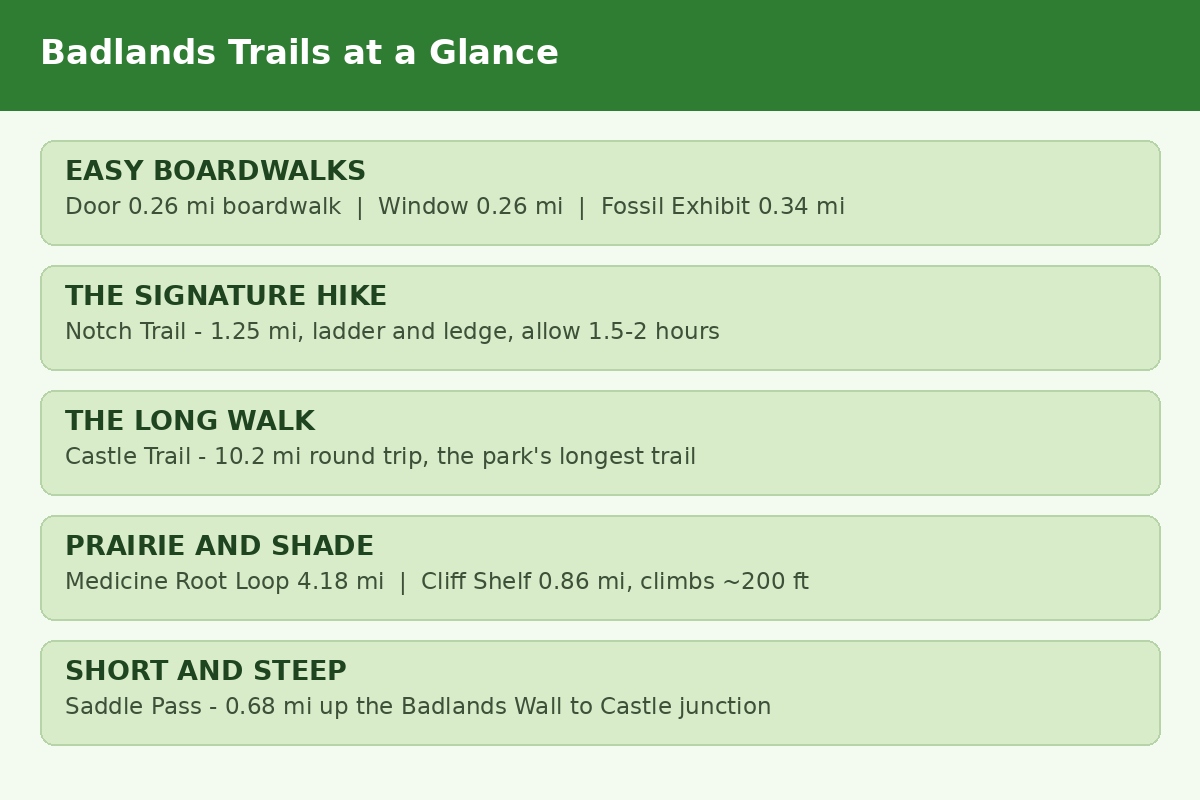
Eight established trails, all within a few miles of the visitor center. That is the park’s own framing on its Hiking in Badlands page, and it shapes the whole visit: a single base — the Ben Reifel Visitor Center area — serves short boardwalks, a ladder climb, a prairie loop and a ten-mile traverse. The park’s Hiking Trails listing adds the individual trail pages behind each name below. Before you rank them, read our explainer on trail difficulty ratings — Badlands ratings run on exposure and footing more than on distance.
| Trail | Distance (round trip, NPS) | Rating / time | Best for |
|---|---|---|---|
| Notch Trail | 1.25 mi / 2 km | Moderate to strenuous, 1.5–2 hrs | The signature hike: canyon, ladder, ledge view |
| Castle Trail | 10.2 mi / 16.45 km | Moderate, ~5 hrs | A full half-day among the formations |
| Medicine Root Loop | 4.18 mi / 6.73 km | Moderate, ~2 hrs | Mixed-grass prairie with formations in view |
| Cliff Shelf Nature Trail | 0.86 mi / 1.38 km | Moderate, ~30 min | Juniper shade, stairs and birdwatching |
| Saddle Pass Trail | 0.68 mi / 1.09 km | Strenuous, ~40 min | A steep climb up the Badlands Wall |
| Door Trail | 0.26 mi boardwalk (0.75 mi full trail) | Easy, ~20 min | Walking through the Wall into the formations |
| Window Trail | 0.26 mi / 0.41 km | Easy, ~20 min | A framed canyon view, fully accessible |
| Fossil Exhibit Trail | 0.34 mi / 0.55 km | Easy, ~20 min | Fossil replicas and the park’s ancient story |
One honest note on the numbers. The park publishes slightly different figures on different pages — its Hiking the Badlands summary lists the Notch at 1.5 miles, while the trail-by-trail page gives 1.25 miles. Treat the table as the planning version: a few minutes of walking either way, on trails where heat matters more than a quarter mile.
Notch Trail: The One Everyone Remembers
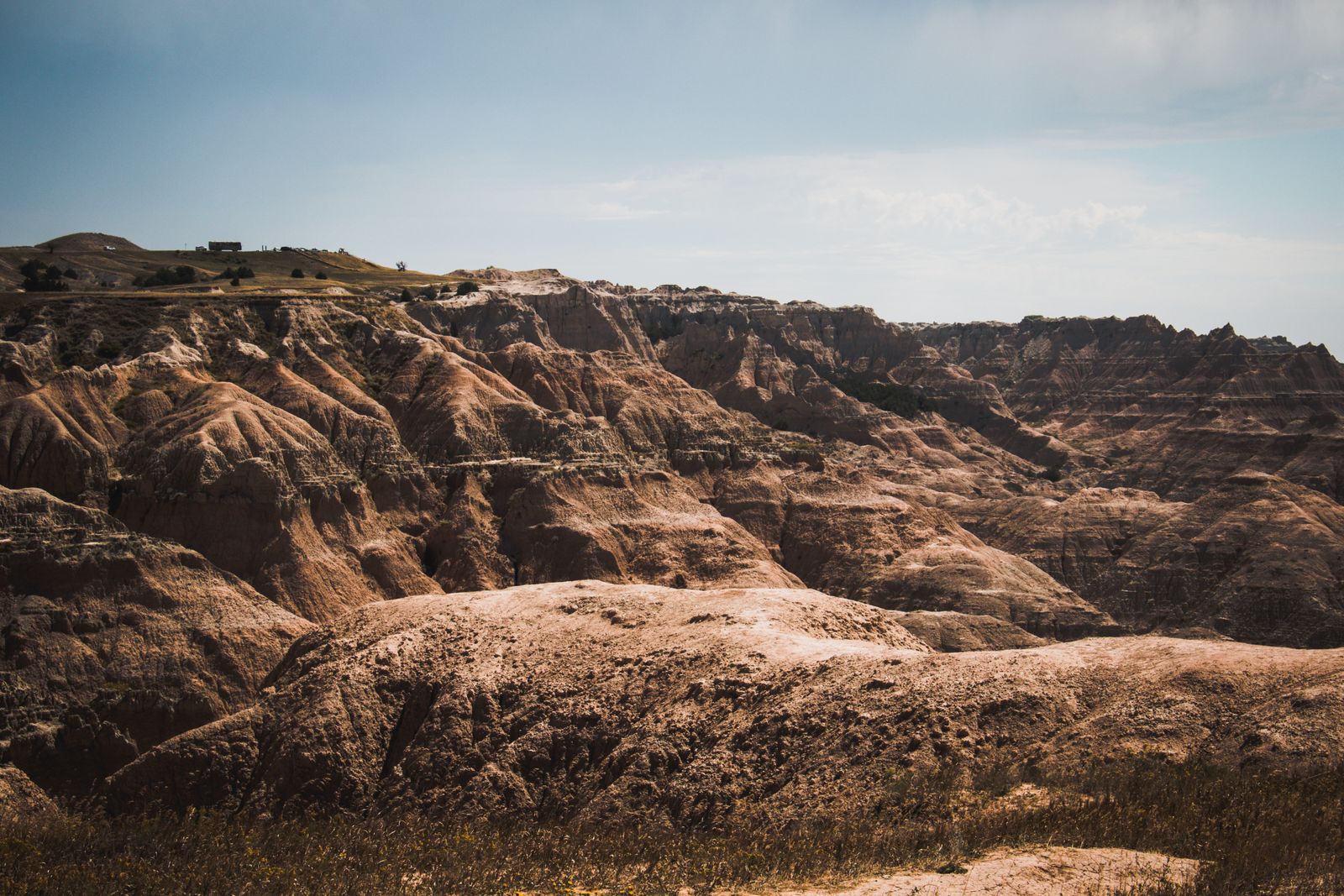
If you hike one Badlands trail, hike this one. The route threads a canyon, climbs a ladder, then follows a ledge to the Notch — a gap in the Badlands Wall with a dramatic view over the White River Valley. The park rates it moderate to strenuous at 1.25 miles round trip and one and a half to two hours: canyon shade, a hands-on climb and an exposed shelf walk, all inside a short distance.
The ladder is the decision point, and the park is blunt about it. The Notch is not recommended for anyone with a fear of heights, it can be treacherous during and after rains, and the park advises good hiking boots with ankle support. Watch for drop-offs and loose gravel on the ledge, and if the ladder or shelf feels wrong when you reach it, turn around there; the canyon walk back is a good hike in its own right.
When to Walk the Notch
Walk it early, and walk it dry. Morning puts the climb in the coolest hours and the ledge in softer light, and a dry day keeps the clay underfoot honest — the park’s safety page warns that badlands buttes, composed primarily of clay, are very slippery when wet. Pair the Notch with the Door and Window boardwalks from the same parking area and you have the park’s essential first morning; our guide to planning a national park hike shows how to sequence a morning like that around heat and crowds in any park.
Door and Window Trails: Start Here
Two short boardwalks, one parking lot, and the fastest way into the landscape. The Door Trail begins with an accessible boardwalk — 0.26 miles round trip — through a break in the Badlands Wall known as the Door to an overlook; beyond the boardwalk, posts mark the remainder of the route through the formations. The Window Trail is an accessible boardwalk of the same length to a natural window in the Wall, framing an intricately eroded canyon. Both are rated easy at about twenty minutes, with the same park advice: on the Window, stay on the trail.
Do not mistake easy for trivial. The Door teaches the park’s geology at walking pace: you pass through the Wall rather than looking at it, and the marked route beyond the boardwalk is your first taste of route-finding among the formations — posts, not a worn path.
Accessibility and the Honest Limits
The boardwalk sections are the accessible core of the park. The Door’s boardwalk, the Window Trail and the Fossil Exhibit Trail below are all described by the park as accessible — three genuine options. Past the Door’s boardwalk end, the surface becomes natural badlands ground: uneven and soft in places. Plan that split honestly for your group.
Castle Trail: The Long Walk
The longest established trail in the park, and the only one that feels like a full hike. Castle runs 10.2 miles round trip from the Door and Window parking lot to the Fossil Exhibit Trail, rated moderate at about five hours — relatively level, passing through formations the whole way. The park notes it can be divided into shorter hikes: walk an hour out, an hour back, and you have seen more formation country than the boardwalk crowds see in a weekend.
Length here is a water problem, not a fitness problem. Level miles in full sun, with no water on the route, are a serious undertaking in summer. The park’s trail note ends with the instruction that matters — bring plenty of water — and its backcountry guidance explains why: the little water found here is not drinkable or filterable because of its sediment content, so what you carry is what you have. Our roundup of the best hydration packs for long hikes covers the carry systems for a five-hour dry walk.
Shortening Castle Without Wasting It
Use the junctions; that is what they are for. Castle connects with the Medicine Root Loop and, via Saddle Pass, drops back to the road — combinations that turn one long out-and-back into loops of different lengths. Decide the combination before you start, and keep the turnaround rule simple: when half your water is gone, the hike is half over.
Medicine Root Loop: Prairie With the Formations in View
The prairie trail — and the park is half prairie. Medicine Root Loop runs 4.18 miles round trip, rated moderate at about two hours, through mixed-grass prairie with views of the formations in the distance. Access is flexible: park at the pull-off along Old Northeast Road, or reach it via Castle or Saddle Pass. After days of looking at eroded rock at arm’s length, this is the trail that shows you the grassland the rock sits in.
The prairie is not the empty part. The park protects one of the largest remaining expanses of mixed-grass prairie, and its wildlife lives here: the Bison Bellows account describes a herd of over a thousand bison, grown from fifty animals brought in decades ago. The state’s own South Dakota parks lesson names the same community — bison, bighorn sheep, prairie dogs and the endangered black-footed ferret. Walk it with binoculars, watch for cactus at ankle height, and give anything with hooves full distance.
Cliff Shelf Nature Trail: Shade, Junipers and Birds
The park’s shaded exception. Cliff Shelf is a 0.86-mile loop of boardwalks, stairs and natural paths climbing approximately 200 feet, weaving through juniper trees perched along the Badlands Wall — rated moderate at about thirty minutes, and a popular area for birdwatching. In a park where shade is a rumour, a juniper grove is a genuinely different microclimate.
Take it as the midday trail — with one caution. Thirty shaded minutes suits the hot part of a day, but the stairs still demand real footwear. If you are building a full day, our day hiking essentials checklist is the pack list to run the night before.
Saddle Pass Trail: Short, Steep and Connected
The shortest trail on the list, and the steepest effort per step. Saddle Pass climbs aggressively up the Badlands Wall in 0.68 miles round trip — rated strenuous at about forty minutes — to a summit overlooking the White River Valley, where it connects with the Castle and Medicine Root Loop trails. Read that connection as its real purpose: a ladder between the road and the long-trail network.
The park’s warnings here are specific, so repeat them exactly. Saddle Pass is treacherous during and after rains and can be dangerous during extreme heat; caution is advised. Clay slopes that are merely steep when dry become a slide when wet, and there is no shade on the wall. Hike it in the morning, in dry conditions, in boots with real tread — our guide to how to choose the right hiking boots covers the tread and ankle-support decisions this park keeps demanding.
Poles on the Wall
This is the trail where poles stop being optional for many hikers. A steep, loose climb and a steeper descent are exactly the ground where a pair of poles buys balance and saves knees — the same case made in our roundup of the best hiking poles and, for the descent specifically, the trekking poles for knee pain guide.
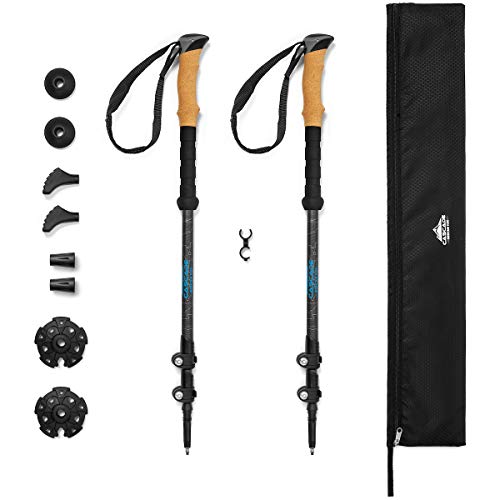
Cascade Mountain Tech Carbon Fiber Trekking Poles
- High Quality Strong Value – Poles are built with Carbon Fiber which is known for its light weight. These poles are user friendly for beginners and strong for thru hikers.
- Lightweight & Compact Poles – 8.1 oz. Or less than a pound – our carbon fiber trekking poles provide hikers, walkers, back packers, campers and more the best option for a lightweight strong pole when focusing speed and ultralight packing.
- Quick Lock & Extendable – Our quick lock will support you during all your adventures, it is easy to use and reliable for holding the pole at the desired height ranging from 26”- 54”.
List Price :
Offer: 64.98 $
Go to AmazonFossil Exhibit Trail: The Fossil Story on a Boardwalk
Twenty minutes that explain everything you have been looking at. The Fossil Exhibit Trail is a fully accessible boardwalk loop of 0.34 miles, lined with fossil replicas and exhibits of the now-extinct creatures that once roamed the Badlands area. It is also Castle Trail’s far trailhead, so the long walk and the short one literally meet here.
The fossils are the park’s second landscape. Badlands holds one of the best-preserved fossil records of its era, and the park’s Badlands in Your Classroom programme teaches the same sequence the boardwalk shows: fossils are clues to past environments, and the rocks record how they changed. Walk this trail before the Notch if you can. And hold the park’s rule absolutely: fossils, rocks and artifacts stay where you find them; collecting is illegal, and leaving what you find is the core of the Leave No Trace principles.
Open Hiking and the Backcountry: The Badlands Off-Trail
Badlands is an open-hike park — you are allowed to hike off-trail. The policy, stated on the park’s hiking summary page, frees you to explore social trails like Deer Haven, the Sage Creek Wilderness Area, or any other part of the park you can visit safely. It is the biggest difference between this park and the mountain parks most hikers know, and why experienced visitors treat the eight official trails as a starting framework rather than a fence.
Freedom here carries its own skill list, and the park names it. Formations are often easier to climb up than to climb down, and cell service is not readily available in the backcountry. For overnight trips, the Backcountry Camping page adds the rules: permits are not currently required, but check in with staff at the Ben Reifel Visitor Center or Pinnacles Entrance Station first, use the backcountry registers, camp at least half a mile from a road or trail and out of sight of roadways, carry at least a gallon of water per person per day, and expect no campfires under any circumstances. Pets are not permitted on trails or in the backcountry at all.
Navigation Without a Trail
Off-trail, the maze is the hazard. The formations repeat, the drainages look alike, and a skyline that seemed obvious from below turns anonymous from inside. Carry a topographic map and a compass you know how to use; our explainer on navigating without a GPS covers the discipline, and our guide to planning a multi-day backpacking trip covers the trip-plan habits an open-hike park demands even for a long day.
Heat, Water and Weather: The Rules That Decide the Day
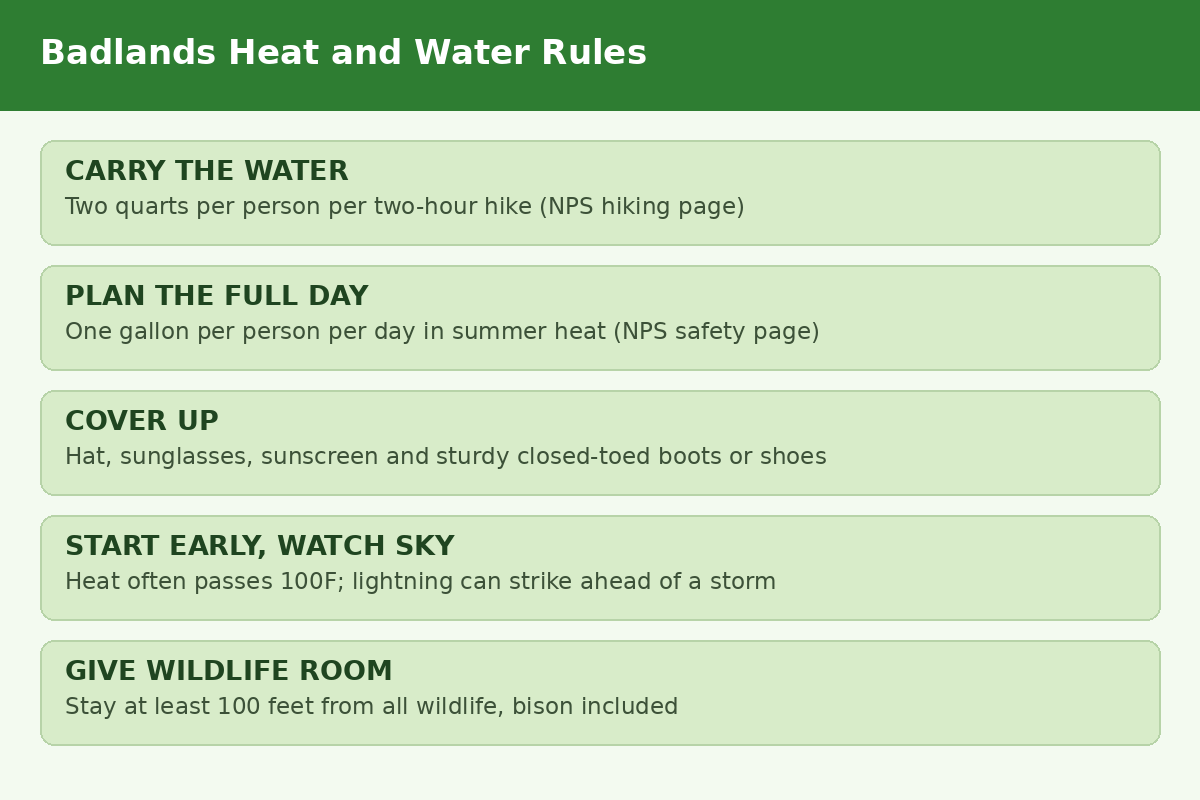
Every Badlands plan is a heat plan. Summer here is hot and dry with temperatures often exceeding 100°F, and the park’s Safety page prescribes the countermeasures plainly: drink a gallon of water per day, wear sunscreen of SPF 15 or higher, and cover up with long sleeves, pants and a wide-brimmed hat. The hiking page’s rate is two quarts per person per two-hour hike. There is no reliable water on any trail in this guide.
The weather turns fast, in both directions. The park’s Weather page records extremes from 116°F down to -40°F, occasional violent summer thunderstorms, and sudden, dramatic changes as the norm; it urges layers, hats, sunglasses, sunscreen and adequate water. Lightning can strike well ahead of a storm, so exposed ridges are places to leave early. Check the forecast before you set out, every day.
Wildlife Distance and the Small Hazards
Keep at least 100 feet from all wildlife — if an animal reacts to you, you are already too close. Bison can run faster than 30 miles per hour and can inflict fatal wounds; that is the safety page’s wording, not drama. Prairie rattlesnakes hide by day under boardwalks, stairs and tall grass, so never place hands or feet where you cannot see, and closed-toed boots are the park’s prescribed protection against snakes and cactus spines. Falls on unstable ground are the park’s most common injury pattern.
What to Carry: Sun, Water and Footing
Build the Badlands kit around three problems: sun, water volume and footing. The baseline is the 10 Essentials framework; the Badlands adjustments are a bigger water carry than the distance suggests, sun coverage you can hike in for hours, and boots chosen for loose clay and hidden cactus. An entrance pass is part of the kit too — the park’s Fees and Passes page sets the current charges, and the NPS entrance passes page explains how the interagency pass covers parks like this one.
Sun protection is a system, not a bottle. Hat, sunglasses and sunscreen are the park’s own trio, reapplied on a schedule the heat sets, not when you remember. A spray sunscreen is the version most hikers actually reapply at a trailhead without stopping the day.

Sun Bum SPF 70 Sunscreen Spray
- ORIGINAL SPF 70 SUNSCREEN SPRAY. Ultra sheer SPF that’s easy to apply anywhere. This is the stuff we use every day. The sunscreen that started it all and smells like summer. We wanted a sunscreen to protect those who live and love in the sun, so we made it
- MOISTURIZING SUN PROTECTION. Dermatologist and Sonny approved, this non-comedogenic sunscreen delivers UVA/UVB protection and is packed with Vitamin E. Our water-resistant and Hawaii 104 Act Compliant SPF 70 Spray is great for all skin types
- HOW TO USE. 15 minutes before sun exposure, apply liberally to all areas of the skin and avoid the eye area. For best results, reapply after 80 minutes of swimming or sweating. Sonny’s Tip: Apply every 2 hours for maximum sun protection
List Price :
Offer: 14.86 $
Go to AmazonCarrying a Gallon Without Hating It
A reservoir beats bottles for steady drinking on dry trails. Three litres in the pack, sipped continuously, covers most of a morning at the park’s two-quarts-per-two-hours rate. Our comparison of the best hydration bladders covers fit and cleaning, and the pack size guide settles how much daypack volume a water-heavy day needs.

CamelBak Crux 3L Reservoir
- High‑Flow Hydration Performance: Crux design delivers increased water flow per sip to support sustained output in demanding environments
- Rapid Fill with Secure Seal: Wide 80 mm opening and quarter‑turn cap allow fast refills while maintaining leak‑resistant reliability
- One‑Handed Flow Control: Integrated HydroLock shutoff lever enables positive on‑and‑off control, even while wearing gloves
List Price :
Offer: 45.71 $
Go to AmazonThe Geology Under Your Boots
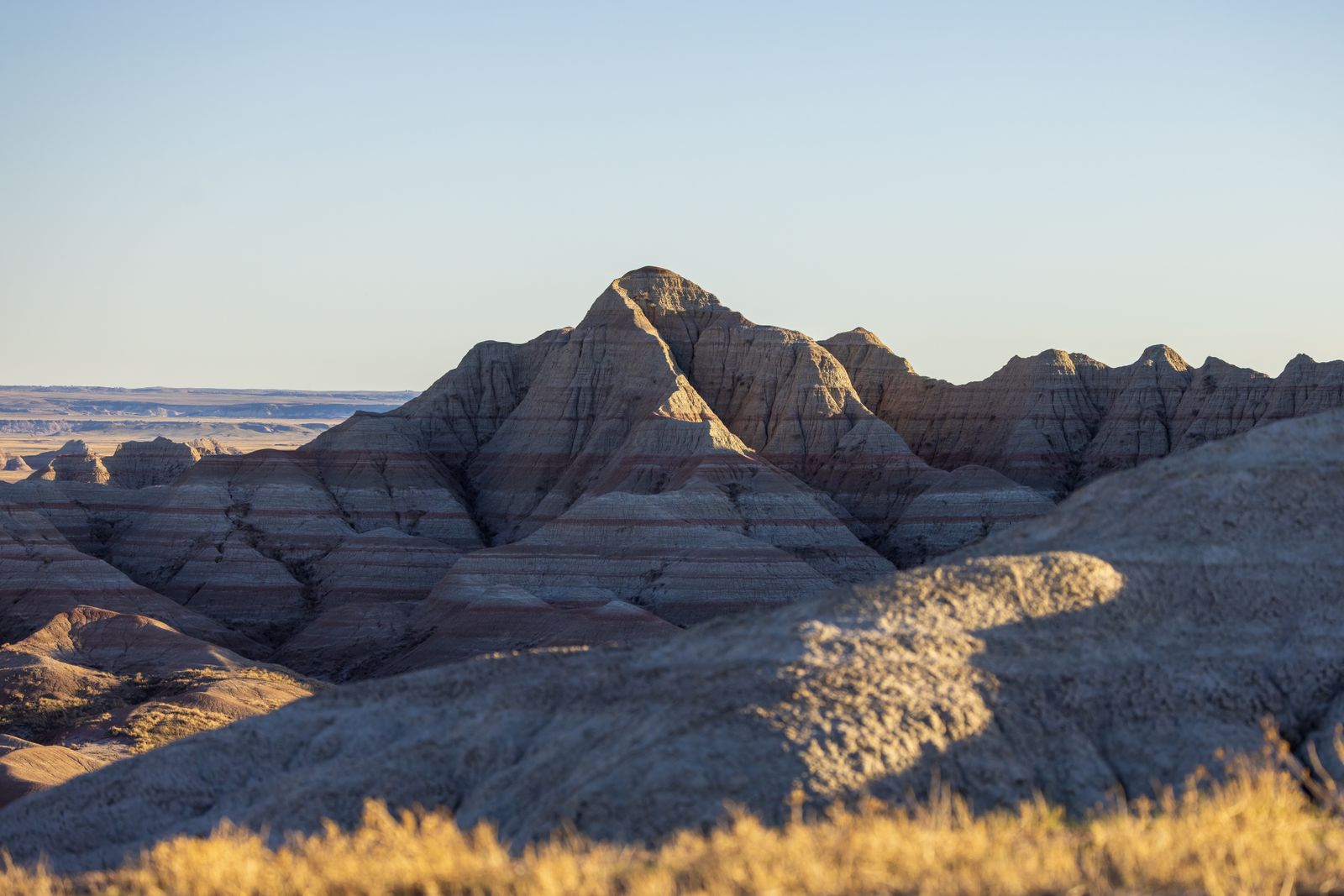
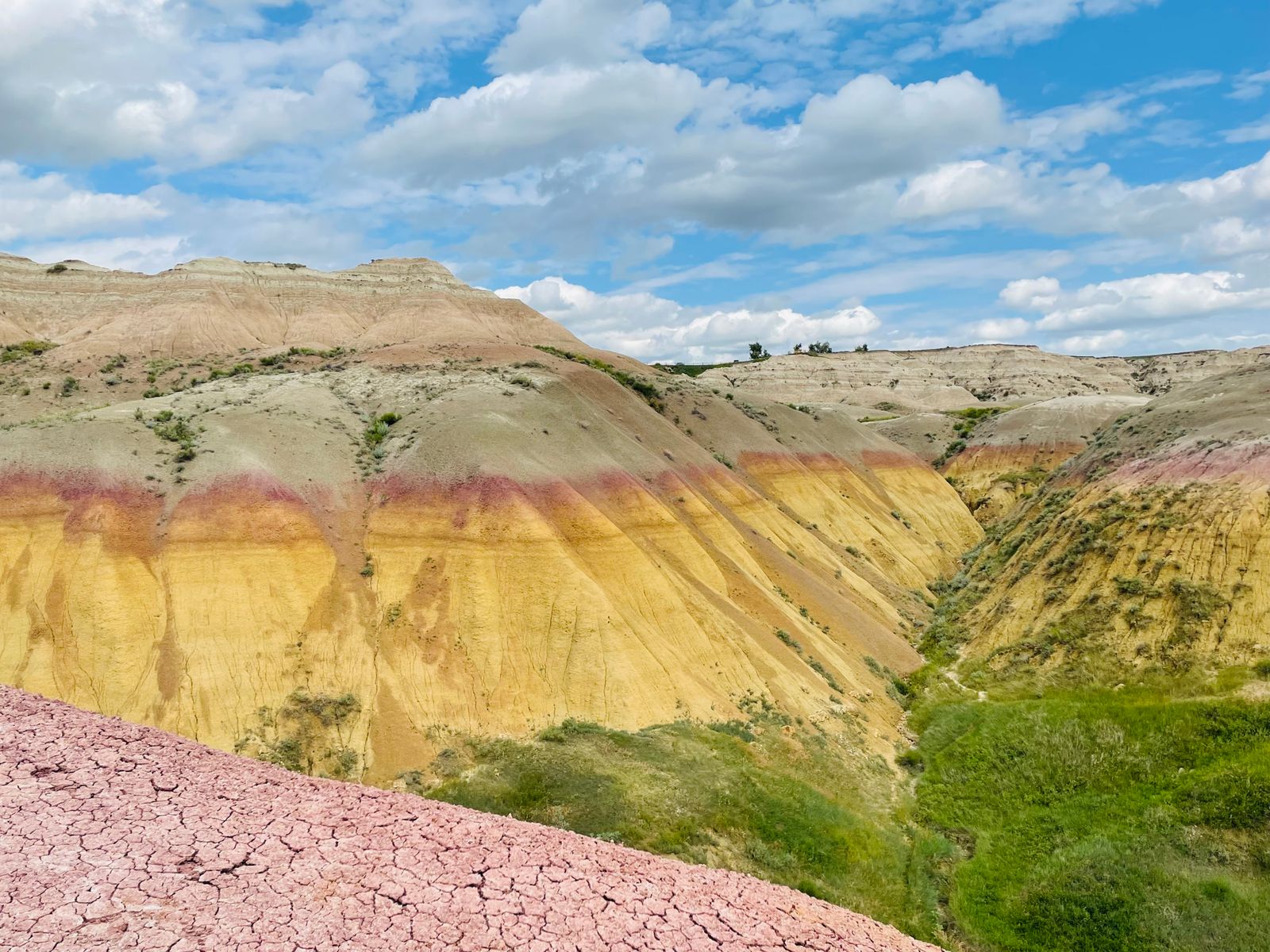
The colours are a timeline, and the park reads it for you. The Reading the Rocks wayside lays out the sequence: sediments spread by rivers and wind millions of years ago, erosion beginning roughly 500,000 years ago, and modern rain and wind still washing the soft rock away at about an inch a year. The highest peaks are the Sharps Formation, some 28 to 30 million years old; a grey ash line, the Rockyford Ash, marks the boundary with the older Brule Formation below it, whose layers and ancient soils — the banding on every wall — run 30 to 34 million years old.
The science behind the wayside is survey-grade. The USGS geology report works the same stratigraphy formation by formation — Chamberlain Pass, Chadron, Brule and Sharps — and explains how erosion exposes the fossil-bearing strata. Once you know the pale bands are ancient soils and the white cap is volcanic ash, no Badlands view looks flat again. Compare it with our desert-park guides to Arches and Death Valley — three parks, three different ways for rock to come apart.
Our view
Badlands teaches hikers to read a landscape instead of just walking it: eight short trails, one honest ladder, and a rulebook written by heat and water rather than distance. Do the Notch early, carry the gallon the park tells you to carry, and use the freedom this place offers — compare its open-hiking spirit with the permit discipline in our national park planning guide, walk the fossil boardwalk before the Bryce Canyon guide’s hoodoos, and keep the essentials checklist open while you pack. Small park on paper; nothing small about it on foot.
— Brian Ka
FAQ
How many official trails does Badlands National Park have?
Eight established trails, all within a few miles of the Ben Reifel Visitor Center, from the 0.26-mile Window boardwalk to the 10.2-mile Castle Trail. Beyond them, the open-hike policy allows off-trail hiking almost anywhere you can travel safely.
What is the best hike in Badlands National Park?
The Notch Trail, for most visitors. In 1.25 miles it packs a canyon walk, a ladder climb and a ledge traverse ending at a view over the White River Valley. It is not for anyone with a fear of heights, and it is treacherous during and after rain — in wet weather, the Door, Window and Cliff Shelf trails are the better day.
Do I need a permit to hike in Badlands National Park?
No permit is needed for day hiking, and none is currently required for backcountry camping either. Backcountry campers should still talk to staff at the Ben Reifel Visitor Center or Pinnacles Entrance Station first, sign the registers, and camp at least half a mile from roads and trails, out of sight of roadways. An entrance pass is required.
How much water should I carry on a Badlands hike?
Two quarts per person for every two hours of hiking, and about a gallon per person per day in summer. There is no reliable water on the trails, and backcountry water is too sediment-laden to drink or filter. When half your water is gone, turn around — that rule outranks any distance goal.
Can I hike off-trail in Badlands National Park?
Yes — Badlands has an open-hike policy. You may leave the trails and explore, including the Sage Creek Wilderness Area. Go prepared: formations are easier to climb up than down, cell service is unreliable, there is no water, and you must keep 100 feet from wildlife. Carry a topographic map and tell someone your route.
Are dogs allowed on Badlands trails?
No. Pets are not permitted on trails, in the backcountry or in wilderness areas. They are allowed, leashed, only in developed areas such as campgrounds, picnic areas and road corridors — so a Badlands hiking day needs a plan for the dog that does not involve the trailhead.
Questions About Hiking the Badlands?
Tell us how many days you have, who is hiking with you and how you handle heat, and we will help you sequence the Notch, Castle and the prairie loops into days that work.
Sources
- National Park Service — Hiking in Badlands
- National Park Service — Hiking the Badlands
- National Park Service — Hiking Trails, Badlands National Park
- National Park Service — Backcountry Camping, Badlands National Park
- National Park Service — Safety, Badlands National Park
- National Park Service — Weather, Badlands National Park
- National Park Service — Fees and Passes, Badlands National Park
- National Park Service — Reading the Rocks, Badlands Wayside
- U.S. Geological Survey — Geology of Badlands National Park
- National Park Service — Bison Bellows: Badlands National Park
- National Park Service — Badlands in Your Classroom
- National Park Service — Leave No Trace
- National Park Service — Entrance Passes
- Travel South Dakota — South Dakota’s National and State Parks
- American Hiking Society — The 10 Essentials