
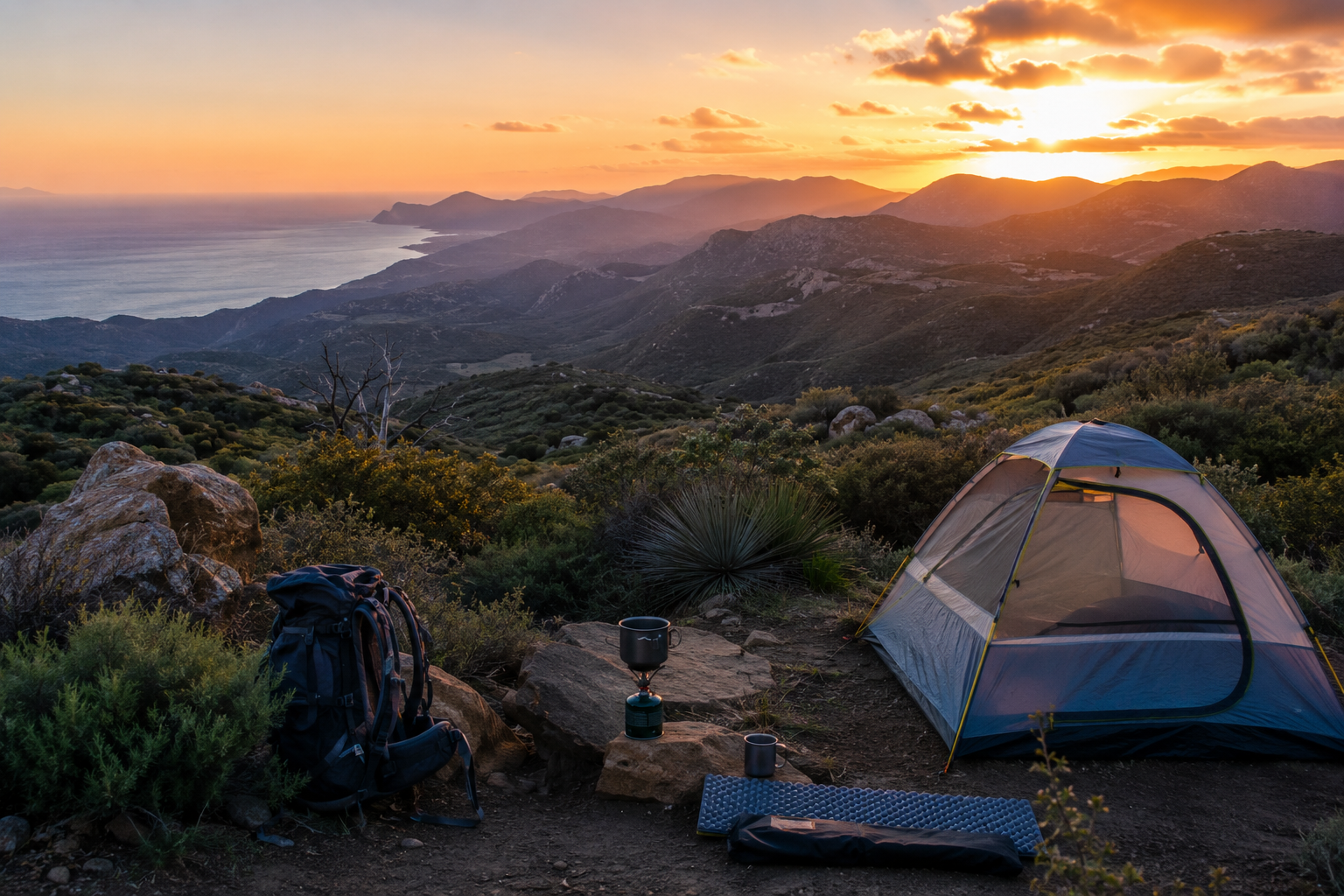
Most people looking for their first overnight backpacking trip default to searching for something dramatic and far away — a mountain summit, a multi-day wilderness epic, something that photographs well on social media. The better first trip is usually much closer and much simpler than that. Nineteen Oaks Camp in the Santa Barbara backcountry is close to the ideal introduction to overnight backpacking: a well-marked trail, a genuinely beautiful destination, water nearby, and just enough distance to feel like a real accomplishment without demanding experience you don’t have yet.
This guide covers everything you need to plan an overnight backpacking trip to Nineteen Oaks Camp — the route, water sources, campsite options, permits, and the practical details that make the difference between a smooth first overnight and a frustrating one.
For gear to prepare for this trip, our how to pack a backpack for hiking guide and best personal water filter for hiking guide cover the essentials worth having before you head out.
Trail Overview
Distance: Approximately 3.5 to 4 miles round trip
Elevation gain: Roughly 550 feet
Difficulty: Easy to moderate — genuinely appropriate for a first overnight backpacking trip
Location: Los Padres National Forest, Santa Barbara backcountry
Water: Available at Oso Creek near the camp turnoff, seasonally variable
Nineteen Oaks sits roughly two miles up the Santa Cruz Trail from the Upper Oso Campground trailhead — close enough that the hike in doesn’t consume your entire day, far enough to feel like you’ve genuinely left the front country behind. The trail is easy to follow throughout, with only a modest climb near the very end, which is exactly the kind of manageable technical difficulty that makes a good first overnight trip.
The camp itself sits on a small rise overlooking Oso Canyon, with sweeping views up toward Little Pine Mountain and down toward the Santa Ynez Mountains. Multiple mature oak trees provide shade across the grassy mesa, and the setting has the kind of open, breathable character that makes it comfortable to relax in rather than feeling closed in by forest on all sides.
Getting to the Trailhead
From Santa Barbara, take Highway 154 toward San Marcos Pass and continue to Paradise Road. Follow Paradise Road to the kiosk at the first river crossing — this is where you’ll need to display an Adventure Pass, available for purchase at the kiosk or at several other locations along Paradise Road. Continue on Paradise Road as it crosses the Santa Ynez River, then turn toward Upper Oso Campground. Parking for the trailhead is just past Upper Oso at the locked gate where the paved road ends.
The drive from Santa Barbara takes roughly 30 minutes — genuinely one of the most accessible true-backcountry trailheads in Southern California relative to a major city. Check current road status before heading out; sections of the access road have experienced closures due to flooding and washouts in wet years, and the Forest Service doesn’t always update signage in real time. A locked gate at Upper Oso doesn’t necessarily mean the trail itself is closed to foot traffic — it more commonly indicates a closure to motor vehicles. When in doubt, check with rangers at the trailhead or call the Mount Pinos Ranger District office before you go.
The Route
The hike begins by going around a locked gate and following a wide dirt road for roughly three-quarters of a mile. This section doubles as the Buckhorn Camuesa Road and is open to motorcycle and OHV traffic — stay alert for vehicles, though the road is low-angle, covered in soft dirt, and pleasant enough hiking parallel to Oso Creek in the shade of oak trees. Several unofficial side trails branch off toward swimming holes in the creek along this stretch, worth a look if you’re hiking in warm weather.
At the three-quarter mile mark, the trail leaves the dirt road and officially becomes the Santa Cruz Trail — a genuine single-track trail from this point forward, and immediately more peaceful without the OHV traffic sharing the route. The trail continues following Oso Creek, threading through chaparral vegetation dominated by manzanita, easily identified by its distinctive smooth red bark.
The trail crosses Oso Creek twice over the next mile or so. At approximately the 1.8 to 2 mile mark, you’ll reach the signed turnoff for Nineteen Oaks Camp. This junction is easy to identify — if you find yourself crossing the creek one final time and starting to climb steeply out of the canyon toward Little Pine Mountain, you’ve missed the turnoff and gone too far.
From the junction, it’s a quarter mile of steeper uphill hiking to reach the camp itself — a low-angle hillside climb that’s the only genuinely demanding section of the entire route, and it’s short enough not to be discouraging even for a first-time backpacker carrying a loaded pack.
Water
Water availability at Nineteen Oaks is seasonal and worth planning around carefully. A horse trough near the camp sometimes holds water, but it’s unreliable and not a source you should count on. The more dependable option is Oso Creek itself, accessible via a short side trail near the camp turnoff — cool, clear water when the creek is flowing, which is most reliable from late winter through late spring following a wet season, and increasingly unreliable by late summer or during drought years.
Bring a water filter regardless of what you find at the creek — untreated water from any natural source carries the same bacterial and parasitic risk here as anywhere else, however clear it looks. Our best personal water filter for hiking guide covers compact, reliable options appropriate for exactly this kind of short backpacking trip.
The practical approach for a first overnight trip: carry 2 to 3 liters from the trailhead as your baseline, and treat any water you collect at camp as a bonus rather than a guarantee. If you’re hiking in late summer or during a dry year, call ahead or check recent trip reports to confirm the creek is actually running before relying on it as part of your water plan.
Campsites
Nineteen Oaks has multiple designated campsites spread across the mesa, each with a picnic table and fire ring, tucked under mature oak trees that provide genuine afternoon shade — a meaningful comfort difference from exposed camping in the open chaparral sections of the broader trail system.
The sites vary in character. Some sit in a more enclosed, alcove-like setting surrounded by trees with a cozier, more private feel. Others are more open with better long-range views down the canyon and a more exposed, airy character. None of the sites are far from each other, so it’s entirely reasonable to walk the full camp area before committing to a spot for the night — arriving with enough daylight to survey your options is one of the small advantages of not pushing your mileage to the absolute maximum on a first overnight trip.
A rustic, primitive open-air toilet exists in the camp area, though it may not be consistently maintained or easy to locate depending on when you visit — plan to dig a proper cathole at least 200 feet from camp, water sources, and the trail as a backup regardless, following standard Leave No Trace waste disposal practice.
Permits and Regulations
No permit is required for camping at Nineteen Oaks. You do need a California Campfire Permit if you plan to have a fire — free and obtainable online through CAFirePermits.com — and an Adventure Pass to park at the Upper Oso trailhead, purchasable at kiosks along Paradise Road or at several outdoor retailers in the Santa Barbara area.
Signing the trailhead register is not mandatory but is genuinely worth doing. It costs nothing, takes thirty seconds, and gives rangers a record of who’s in the backcountry — useful in the event of an emergency and a small contribution to responsible backcountry practice, particularly during dry years when fire risk and search-and-rescue considerations are elevated.
The Los Padres National Forest also protects historical and archaeological resources throughout this area — items over 50 years old are protected by federal law and cannot be removed from the wilderness regardless of how insignificant they might seem. If you come across old equipment, structures, or artifacts at camp or along the trail, photograph them if you’re curious, but leave them exactly where you found them.
Wildlife
Deer are common and frequently visible near camp, particularly at dawn and dusk. Mountain lions are present in the broader Los Padres ecosystem though sightings are rare — if you notice scat containing significant hair or fur content along the trail, that’s a normal indication of predator activity in the area rather than cause for alarm, but it’s worth staying aware of your surroundings, especially around dusk.
Ticks are a genuine consideration in this terrain, particularly as temperatures warm from late winter into spring. Check yourself thoroughly at camp, particularly around the ankles, waistline, and hairline, and consider treating clothing with permethrin before the trip if you’re hiking during peak tick season. Our best hiking bug repellent gear guide covers the most effective prevention options.
Best Time to Visit
Spring is the strongest season for this trip — wildflowers cover the hillsides, including shooting stars, poppies, and lupine, and Oso Creek is most reliably flowing following winter rains. Temperatures are comfortable for hiking, and the exposed sections of trail beyond the immediate creek corridor aren’t yet punishingly hot.
Winter offers a genuinely pleasant option too, particularly hiking on a weekday — cooler temperatures, minimal crowds, and a good chance of having the camp entirely to yourself. Just monitor road conditions carefully, since the access road to Upper Oso is vulnerable to closure after significant rain.
Summer is the most challenging season. This is a three-season trail that gets dangerously hot and dry during peak summer months, and Oso Creek is far more likely to be dry by late summer, removing your most reliable water source. If you hike this trip in summer, start early, carry significantly more water than you think you’ll need, and don’t rely on the creek at all.
Fall is a reasonable middle option — generally dry, warm days, and quieter trail conditions, though water reliability depends heavily on how wet the preceding winter and spring were.
Why This Is a Genuinely Good First Overnight Trip
The specific combination of factors that make Nineteen Oaks work well as an introduction to overnight backpacking is worth naming directly, because it’s a useful template for evaluating any first overnight destination:
The distance is honest. Under four miles round trip with modest elevation gain means you’re not pushing your physical limits on the same trip where you’re also learning how your pack fits, how your sleep system performs, and how much food you actually need. Save the ambitious mileage for your second or third trip once those variables are worked out.
The trail is unambiguous. A single, well-marked route with a clearly signed camp turnoff removes navigation anxiety from the list of things a first-time overnight backpacker needs to manage. You can focus on the backpacking experience itself rather than route-finding.
Water is nearby, even if not perfectly reliable. Having a water source within a short walk of camp — even a seasonal one — means the consequences of a water-planning miscalculation are much less severe than on a genuinely remote route where a dry creek means real trouble.
The proximity to civilization is a genuine feature, not a compromise. A 30-minute drive from Santa Barbara and a short hike to camp means the barrier to trying this is low, and if something goes wrong or you decide overnight backpacking isn’t for you after all, you’re never more than a few hours from your car regardless of how the trip is going.
What to Bring
Beyond the standard backpacking kit, a few Nineteen Oaks-specific considerations:
Sun protection matters more than the shade at camp suggests. The trail beyond the immediate creek corridor is largely exposed chaparral with limited shade — sunscreen, sunglasses, and a hat are worth carrying even though camp itself sits under oak cover.
A lightweight, packable meal system covers dinner comfortably. A compact stove setup boils water quickly for a simple backpacking dinner — our best hiking cookware guide covers appropriately sized options for a solo or small-group overnight like this one.
A comfortable sleep system makes the difference between a good first trip and a rough one. Adjusting to sleeping in a tent for the first time is a real adaptation — a properly rated sleeping bag and a decent pad matter more on a first overnight than almost any other gear decision. Our best backpacking sleeping pads guide covers options appropriate for three-season Southern California conditions.
A backup fire-starting method and a headlamp are worth having even on a trip this short and this close to the trailhead — the basic redundancy that turns a minor inconvenience into a non-event.
Final Thoughts
Nineteen Oaks Camp earns its reputation as one of the best introductions to overnight backpacking in Southern California honestly — not because it’s dramatic or remote, but because every element of the trip is calibrated to let a first-time backpacker succeed. The distance is manageable, the trail is clear, the destination is genuinely beautiful, and the margin for error if something doesn’t go according to plan is comfortably wide.
For hikers who complete this trip and want to go further, the Santa Cruz Trail continues past Nineteen Oaks toward Little Pine Mountain and, eventually, deeper into the Los Padres backcountry toward Santa Cruz Station and the San Rafael Wilderness — a natural next step once you’ve built confidence with a shorter overnight under your belt.
For more Southern California backpacking guides, check our Alder Creek Cave and Chumash Pictographs guide for a more demanding multi-day route in the same broader Los Padres National Forest system once you’re ready for something bigger.