
As an Amazon Associate I earn from qualifying purchases.
Choosing a hiking backpack by litres alone leads to the wrong pack: a 50L bag that fits your torso and carries on your hips feels lighter than a smaller pack that hangs off your shoulders, while a 50L bag filled carelessly still punishes every climb. This guide solves that problem in order, showing who 50 litres genuinely suits, how fit, frame and hip belt decide comfort, what actually fits inside, and how to compare pack classes so the pack you buy matches the trips you really take.
Choosing the Right 50L Pack Starts With the Right Size
Work out the capacity your trips actually need before you compare models, frames or features.
Key Takeaways
- Measure your torso length before comparing any 50L models, because frame size decides comfort far more than brand, colour or extra pockets ever will.
- Choose 50 litres for one to three nights with standard gear, then size up or down only when your shelter, food or layers demand it.
- Prioritise a padded hip belt that sits on your hip bones, since that belt should carry most of the load instead of your shoulders.
- Pack heavy items close to your back and centred, because load placement changes balance and fatigue more than small differences in pack weight alone.
- Test every shortlisted pack loaded with real gear, walk and climb stairs in it, and reject any pack that creates hot spots immediately.
Table of Contents
- Why 50L Is the Middle Size That Fits Most Overnight Trips
- Who a 50L Pack Suits — and Who It Does Not
- The 50L Pack Classes Worth Comparing
- Torso Fit Comes Before Capacity
- Hip Belt and Load Transfer
- Frame, Back Panel and Ventilation
- Compartments, Access and Organisation
- Weight Tradeoffs: Pack Weight Versus Carried Weight
- What Actually Fits Inside a 50L Pack
- Choosing by Trip Length
- How to Test a 50L Pack Before You Commit
- Our view
- FAQ
- Sources
- Recommended
Why 50L Is the Middle Size That Fits Most Overnight Trips
The middle size earns its popularity honestly. Fifty litres sits between a large daypack and an expedition pack, and that position matters because most overnight hikers carry the same core kit: shelter, sleep system, food, water, layers and safety gear. Guidance in REI notes that backpacking packs span a wide litre range, so the useful question is never which size sounds impressive, but which size swallows your actual kit without forcing you to strap loose gear all over the outside.
| Pack size | Typical use | Strength | Limitation |
|---|---|---|---|
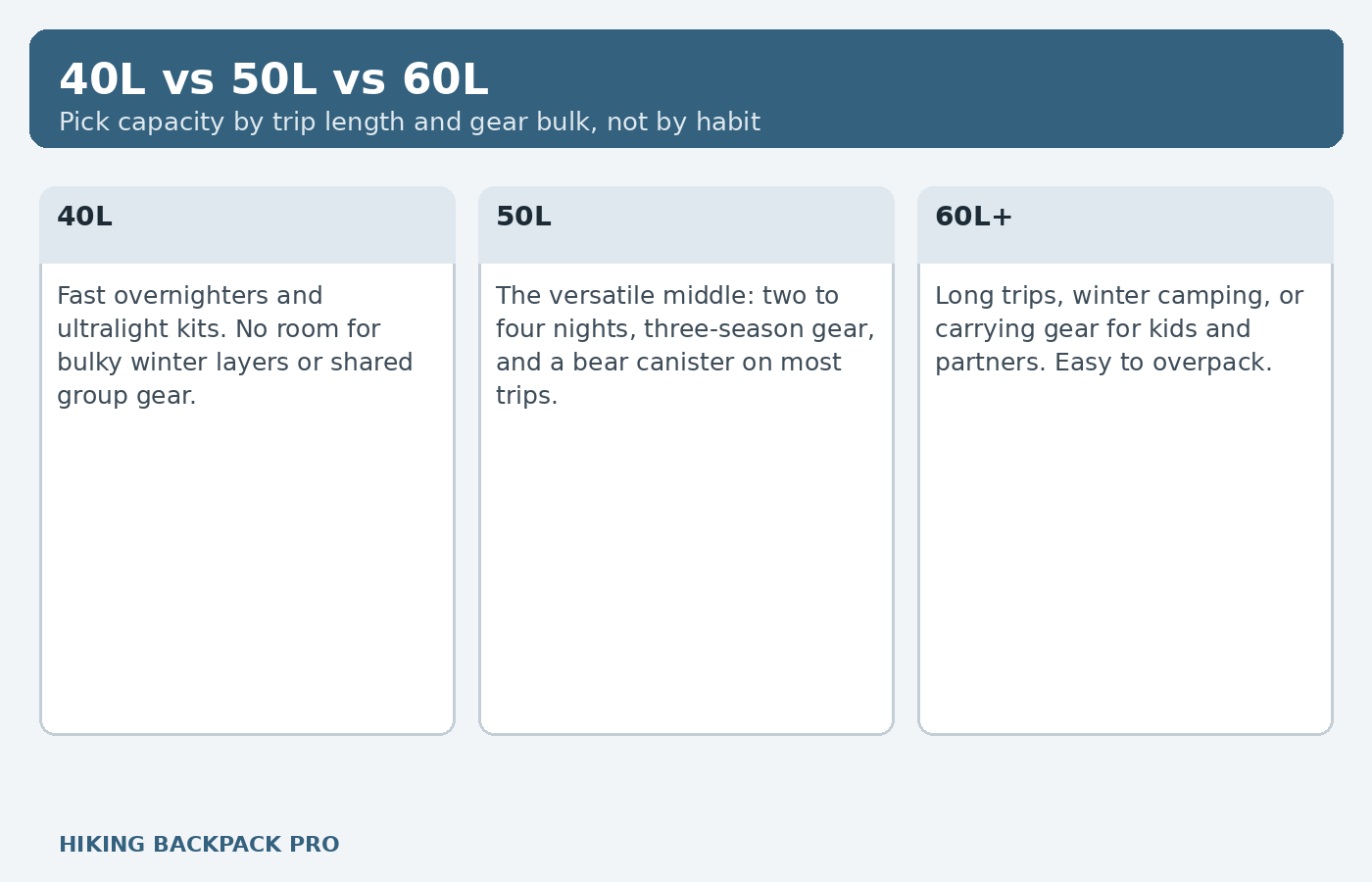
| Around 35L | Fast overnight trips with compact gear, hut-to-hut trips, warm-weather weekends | Forces a disciplined, light kit | Little margin for bulky layers, extra food or a bear canister |
| Around 50L | One to three nights with a tent, sleep system and cooked meals | Balances room, weight and carry comfort for most hikers | Can be tight for bulky gear or long food carries |
| Around 60L | Longer trips, bulkier sleep systems, trips needing a canister or extra layers | Swallows volume without complex packing | Tempts you to fill the extra space and carry more weight |
| Daypack sizes | Day hikes only | Light and simple | No honest room for shelter and sleep kit together |
When 50L Is the Honest Answer
For most first and second overnight packs, it is. A 50L pack holds a standard tent, sleeping bag and pad, a stove and cook kit, food for a weekend, rain layers and the safety essentials without requiring ultralight versions of everything. The American Hiking Society essentials list is a useful reality check here: navigation, water and a way to treat it, extra food, rain gear, fire starting, first aid, a knife or multi-tool, light and sun protection all need a home in the pack, and 50 litres gives those systems room without turning packing into a puzzle.
Who a 50L Pack Suits — and Who It Does Not
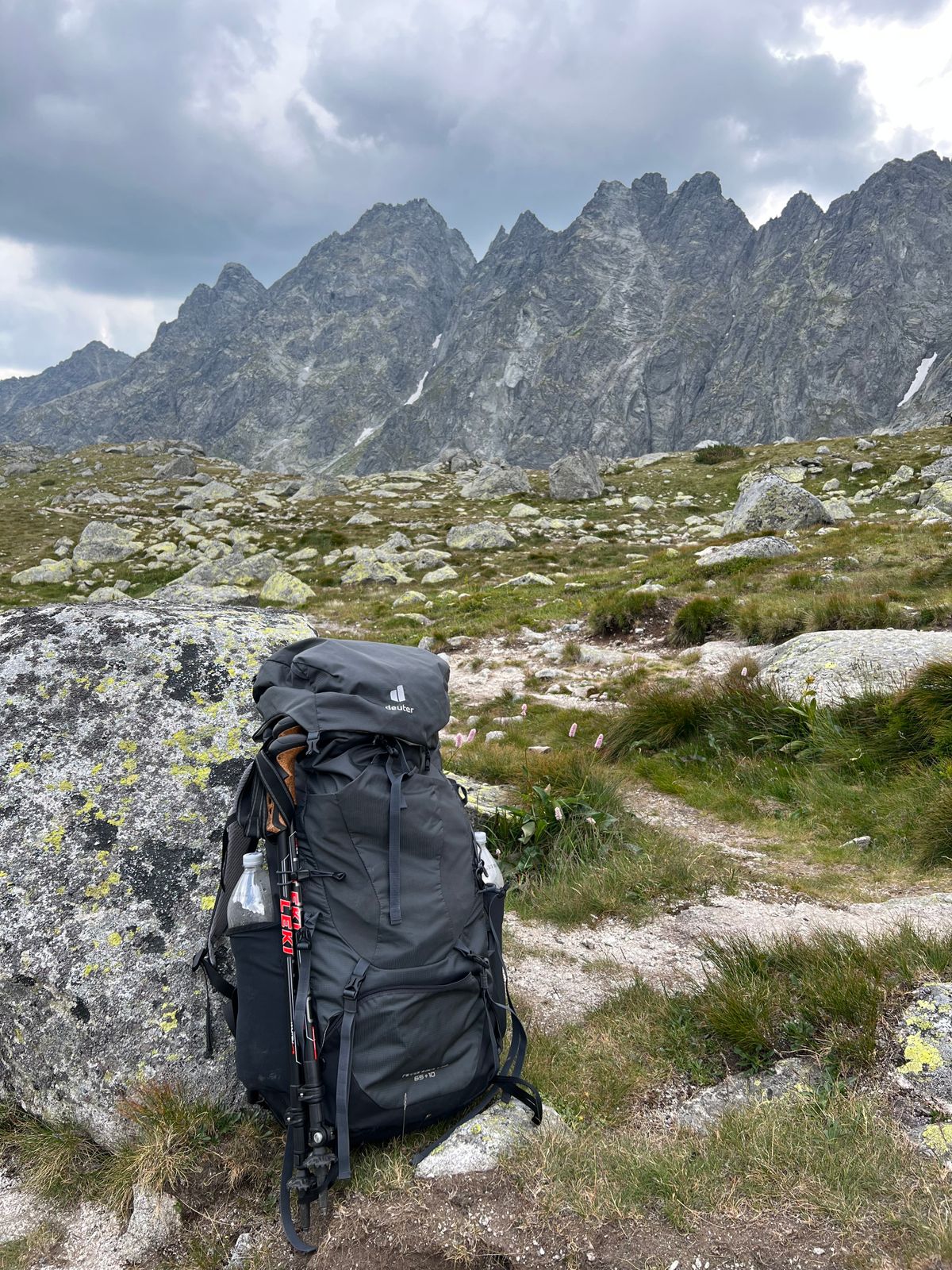
Weekend backpackers are the centre of the target. If your normal trip is one to three nights, you carry your own shelter and food, and your gear is standard rather than ultralight or expedition-grade, a 50L pack is built for you. It also suits hikers stepping up from day hiking who want one pack that covers overnight trips without committing to a large expedition bag they will rarely fill. The Forest Service essentials checklist — extra clothing, emergency items and a pack that fits them all — is a practical test of whether that prepared load still fits comfortably.
Who Should Size Down or Up
Size up if volume, not weight, is your problem. A bear canister, a bulky sleep system, extra layers for cold conditions or food for more nights all consume litres fast. In bear country the storage rules alone can decide the question, as Yosemite National Park explains: food, trash and scented items must go inside an allowed bear-resistant container or locker, and that rigid container has to fit inside your pack alongside everything else. If a canister is part of your normal kit, test-fit it before falling for any 50L model.
The 50L Pack Classes Worth Comparing
Traditional internal-frame packs are the default choice. A shaped frame sheet or internal stays transfer load to the hip belt, keep the load close to your back and handle a full weekend weight in a stable, predictable way. This is the class most hikers should start with, because it tolerates imperfect packing, carries comfortably across the widest range of loads and works on maintained trails and rougher ground alike.

Osprey Atmos AG 50 Internal-Frame Pack
- Included raincover made with PFAS-free DWR and bluesign approved materials
- Curved zip access on one side of panel
- Floating top lid with lash points
List Price :
Offer: 261.95 $
Go to AmazonVentilated suspended-mesh packs trade closeness for airflow. A curved frame holds the bag away from your back and stretches mesh across the gap, so air moves behind you and sweat builds more slowly. The tradeoff is that the load sits slightly farther from your body, which some hikers notice on uneven ground. Hikers who run hot, hike in humid conditions or simply hate a soaked back panel often accept that tradeoff gladly, and our guide to ventilated mesh packs covers that family in depth.
Lightweight and Women-Specific Classes

Osprey Aura AG 50 Women's Lightweight Pack
- Fine-Tuned Fit – Fit-on-the-Fly harness and hipbelt make for improved comfort and a fine-tuned fit
- Integrated Raincover – Keeps your pack and gear dry in inclement weather
- Enhanced Organization – Large, curved side zip access into main compartment on both sides
New starting from: 343.65 $
Go to AmazonWomen-specific and shorter-torso models are fit tools, not marketing. These packs typically offer shorter torso ranges, narrower shoulder spacing and hip belts shaped for a different pelvic angle. The principle, set out clearly by Gregory, is that adjusting straps on the move lets you shift load between hips and shoulders to manage fatigue — and that only works when the underlying frame geometry matches your body in the first place. Hikers with petite frames should also read our petite frames guide, and women comparing dedicated models should start with the women’s roundup.
Torso Fit Comes Before Capacity
Measure your torso, not your height. Pack size is based on the length from the C7 vertebra at the base of your neck to the iliac crest at the top of your hip bones, and two hikers of identical height can need different frame sizes. The Osprey sizing guide is explicit that pack size is based on torso length and that hip-belt fit affects how the load transfers to your hips, so measure first and shop second, in that order.
Use the manufacturer’s chart for the exact model. Torso ranges, size splits and adjustment ranges differ between brands and even between models from the same brand. Guidance from Deuter stresses that back length is key and that larger packs need a well-fitting, adjustable back system, because the bigger the load, the less forgiving a wrong back length becomes. Our step-by-step torso fitting guide walks through the measurement itself.
Hip Belt and Load Transfer
The hip belt is the engine of the whole pack. Your legs and pelvis carry weight far more efficiently than your shoulders, so a well-designed belt — wide, padded and stiff enough to hold its shape under load — should take most of the weight while the shoulder straps mainly stabilise. When REI explains that most of a backpack’s weight should be supported by your hips, it is describing the single most important comfort fact in this entire guide.
Belt fit is about position and wrap. The padding should straddle your hip bones, roughly centred over the iliac crest, and wrap far enough around that the buckle does not pull the padded sections together into your stomach. Osprey’s fit guidance makes the same point in sizing terms: measure around the hips at the iliac crest, not the waist, and expect the padded portion to wrap well around the hips. A belt that tops out — fully tightened and still loose — means the size is wrong, full stop.
Load Lifters, Sternum Strap and Stabilisers
Set the load lifters so they angle back at roughly 45 degrees from your shoulder straps, pulling the top of the load in toward your back without lifting the straps off your shoulders. Clip the sternum strap at collarbone height and snug it just enough to keep the shoulder straps from sliding outward, then snug the hip-belt stabiliser straps last so the bottom of the pack sits still against your pelvis when you walk.

Osprey Rook 50 Padded Hip Belt Pack
- Highly ventilated and comfortable AirSpeed backpanel with adjustable shoulder harness to fit a wide range of torso lengths
- Integrated removable raincover keeps your gear dry and protected
- Zippered sleeping bag compartment with floating divider and removable sleeping pad straps provide organization for multi-day trips
Frame, Back Panel and Ventilation
The frame decides how honestly the pack carries. Internal frames use aluminium stays, a frame sheet or a perimeter frame to give the bag structure and move load to the belt. A stiffer frame carries heavier loads with less sag and less barrel distortion; a softer frame feels friendlier at light loads but lets a full pack bulge and shift. For a 50L pack used at typical weekend weights, a proven internal frame is the safe, versatile choice, and hikers curious about the alternative should read our explainer context in the external frame roundup before romanticising it.
Compartments, Access and Organisation
One big compartment plus smart pockets beats a maze. Most 50L packs use a main compartment with top access, a lid, a front stretch or zip pocket, side water-bottle pockets and hip-belt pockets. That layout works because it matches how you actually use gear: camp items buried deep, day items near the top, small essentials on your hips. The packing system in REI divides a pack into bottom, core and top zones plus peripheral storage, which is the clearest mental model for organising any 50L bag.
Weight Tradeoffs: Pack Weight Versus Carried Weight
Judge total carried weight, not pack weight alone. A very light pack that forces you to carry a separate stuff-sack system, lacks the suspension for your load and leaves you sore is not a light outcome. Conversely, a sturdier pack that carries the same load comfortably can feel easier across a full day even though the scale number is higher. The REI essentials framework helps here too: the safety systems you must carry have a real weight, and the pack’s job is to carry that weight well, not to win a specification contest.
What Actually Fits Inside a 50L Pack
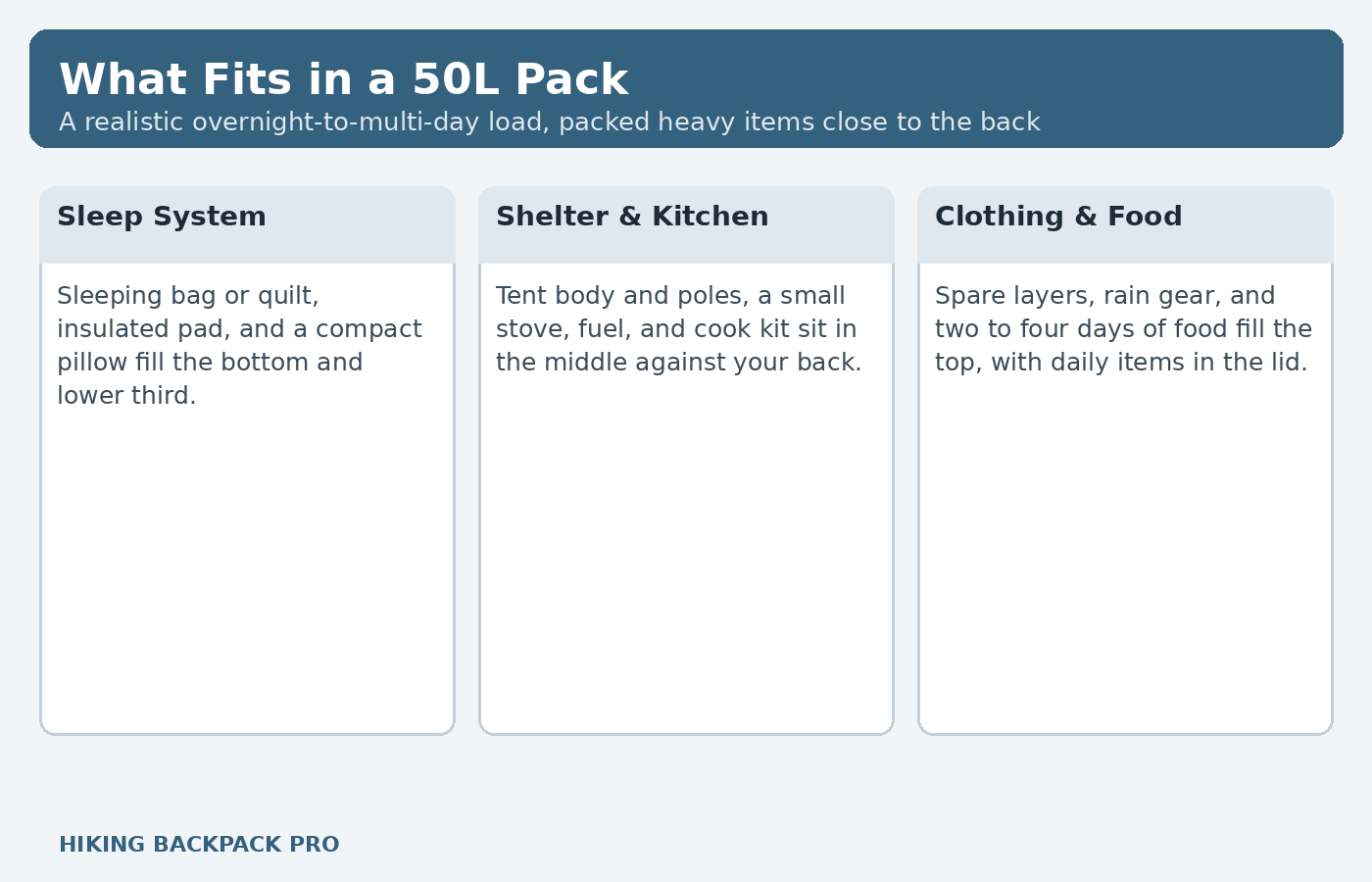
Start with the sleep system and shelter. A compressible sleeping bag goes at the bottom, where bulky items you do not need until camp belong, with the pad either inside or strapped securely, and the tent split sensibly — poles along the frame, fabric compressed in the main body. REI’s zone system puts exactly those bulky, camp-only items in the bottom zone, which keeps the load stable and the packing repeatable. For pad choices that compress well, see our sleeping pad roundup.
Food, water and cooking fill the core. Heavy, dense items belong in the middle of the pack, close to your back, so the centre of gravity stays high and tight rather than low and dragging. Water treatment deserves a planned home too, not a loose bottle in the lid: the CDC explains that boiling is the best way to kill germs in backcountry water and that filtering followed by disinfection is the next best option, so carry the stove fuel or the filter your plan actually depends on.
A Realistic 50L Load, Item by Item
The weekend load that fits comfortably looks like this. Sleeping bag and pad, a compact tent, two to three days of food in a bag or canister, a stove and small cook kit, two litres of water capacity, a full layer system including rain gear, and the essentials. That load fills a 50L pack properly without heroics. Our packing guide shows the loading order in detail, and the multi-day checklist is the pre-trip check that stops forgotten items becoming trail problems.
What does not fit tells you the truth about your trip. If the load above plus a canister, bulky cold-weather layers and extra group gear all have to travel together, you do not have a packing problem, you have a capacity problem, and the honest fix is the larger size. Forcing it produces a top-heavy, strap-draped pack that is unpleasant and hard on the bag itself. Equally, if your load rattles around in half of a 50L bag, the smaller size will carry better.

BearVault BV500 Bear Canister
- Every ounce matters! The BV500 excels as a high volume, lightweight bear barrel for backpacking. The most spacious choice of bear canister for backpacking ultralight style, pack food for 7 plus days.
- Clear and easy to use: Easily find your breakfast. Transparent sides and a wide opening make it easy to find. Tool-free, with rounded corners and pack straps, it packs easily. Doubles as a camp stool!
- Tested and Approved: Grizzly (IGBC) and Black Bear (SIBBG) certified bear resistant container. Keep your food and scented items protected from raids by bears and other wildlife.
New starting from: 99.95 $
Go to AmazonChoosing by Trip Length
One night: 50L is generous, and that is fine. A single overnight with a proper sleep system and cooked food uses most of the bag if your gear is standard, and far less if it is compact. The margin is useful for beginners, whose packing is rarely efficient yet, and for anyone carrying a little extra comfort. Use the space for a better layer system rather than novelty extras, following the prepared approach in Zion National Park, which stresses planning, self-reliance and being ready to spend an unexpected night out if an emergency demands it.
How to Test a 50L Pack Before You Commit
Do the loaded walk test at home or in the shop. Load the pack with your real gear or equivalent weight, adjust it in the proper order — hip belt first, then shoulder straps, load lifters and sternum strap — and walk for at least fifteen minutes, including stairs or a slope if you can find one. The adjustment sequence in the Deuter guide, which sets back length first and then works through the straps, is the order to follow, because fitting an unloaded or badly adjusted pack tells you nothing true.
Our view
A 50L pack is the size I point most overnight hikers to first, because it rewards honest packing and punishes nothing. Get the fit right with our torso fitting guide, sanity-check the capacity against the pack size guide, and load it using the packing guide, and a good 50L bag quietly disappears into the trip — which is exactly what a pack is for.
— Brian Ka
FAQ
Is 50L big enough for a three-day backpacking trip?
For most hikers with standard gear, yes. Three days adds food volume but not shelter or clothing volume, so a well-packed 50L bag handles it comfortably. Bulky sleep systems, a bear canister and cold-weather layers together can push you to the next size up, which is why a full home pack-up with all food included is the reliable test.
Is a 50L backpack too big for a single overnight trip?
No, though it will not be full. A one-night load with a tent, sleep system and cooked food uses a good share of the bag, and compression straps tidy the rest. If all your trips are single overnights with compact gear, a smaller pack will feel neater, but a 50L pack remains perfectly usable and far more versatile.
How should a 50L pack fit on my hips and shoulders?
The hip belt should carry most of the weight. Centre the belt padding over your hip bones, tighten it first, then set the shoulder straps to stabilise rather than lift, and angle the load lifters to pull the top of the load in toward your back. If your shoulders ache early on a hike, check belt position and torso size before blaming the load weight.
Can a 50L pack hold a bear canister?
Most can, but test the exact combination. A rigid canister consumes a large block of volume and shapes the whole load around it. Fit it vertically or horizontally in the core of the pack, close to your back, and confirm the lid still closes and the pack still carries in balance with your full food load inside it.
What is the difference between a 50L and a 60L backpack in practice?
About one bulky item or two extra days of food. In practice the larger bag suits longer food carries, bulkier sleep systems and hikers who carry group gear, while the 50L suits the standard weekend load with less temptation to overfill. Choose by packing your real kit, not by imagining future trips you have not planned.
Questions About 50L Hiking Backpacks?
Not sure whether 50 litres covers your trip, your torso size or your gear list? Send your pack-size question and tell us the trip you are planning.
Sources
- REI — How to Choose a Backpack: Sizing and Fit Guide
- Osprey — Backpack Size Chart and Sizing Guide
- Gregory — Fit and Sizing
- Deuter — All About Trekking Backpacks
- Deuter — How to Adjust a Backpack
- American Hiking Society — The 10 Essentials of Hiking
- USDA Forest Service — Brave the Elements, Black Hills National Forest
- REI — How to Pack a Backpack
- REI — The Ten Essentials
- CDC — Water Treatment Options When Hiking, Camping, or Traveling
- National Park Service — Backpacking Safety and Regulations, Zion National Park
- National Park Service — Food Storage While Backpacking, Yosemite National Park