As an Amazon Associate, HikingBackpackPro.com earns from qualifying purchases at no extra cost to you.
There’s a lesson that almost every backpacker learns the hard way at least once: the sleeping pad matters as much as the sleeping bag. You can spend $400 on a premium down bag and still shiver through the night if your pad isn’t doing its job. The ground conducts heat away from your body up to 160 times faster than air — and a pad with the wrong R-value for your conditions turns a good sleep system into an expensive disappointment.
The other side of that lesson is that the right sleeping pad transforms a backcountry night from something you endure into something you actually enjoy. Waking up rested after a night on the ground, ready for another day on trail — that’s what a well-chosen pad makes possible.
This guide covers the 10 best backpacking sleeping pads available, organized by use case — from the lightest ultralight options to the warmest cold-weather pads to the best budget picks for hikers who don’t want to spend $200 on a place to sleep. Every pad on this list is available on Amazon.
For more on building your overnight kit, check out our guides to the best hiking backpacks for tall men and best 60L hiking backpacks for packs that carry your sleep system properly.
Understanding R-Value Before You Buy
R-value measures a sleeping pad’s resistance to heat flow — essentially how well it insulates you from the cold ground. The higher the R-value, the warmer the pad.
Here’s a practical guide to matching R-value to conditions:
R-value 1–2: Summer camping only, in warm conditions above 40°F. Not suitable for shoulder season or elevation camping.
R-value 3–4: Three-season use in most conditions. Handles temperatures down to around 20°F for average sleepers.
R-value 4–5: True all-season capability for most backpackers. Handles most three-season conditions and light shoulder-season use.
R-value 5+: Cold-weather and four-season camping. Handles sub-freezing conditions and high-altitude camping.
One critical note: always use ASTM-certified R-values when comparing pads. Manufacturer-estimated R-values without ASTM certification are not standardized and cannot be compared across brands.
1. NEMO Tensor All-Season — Best Overall Backpacking Sleeping Pad

Nemo Equipment Tensor All-Season Ultralight Insulated Sleeping Pad – Regular Mummy (72" x 20) – Blade/Spicy Orange
- Two layers of floating Thermal Mirror metallized film provide quiet insulation with an unprecedented weight-to-warmth ratio.
- Impressively quiet for uninterrupted sleep (and happy neighbors).
- Spaceframe baffles offer unparalleled stability and weight distribution, using low-stretch, die-cut trusses that eliminate springiness.
New starting from: 199.95 $
Go to AmazonThe NEMO Tensor All-Season is the most consistently recommended backpacking sleeping pad by experienced testers — and after extensive field testing by multiple publications logging thousands of backcountry nights, it’s earned that reputation. It sits at a near-perfect balance of warmth, weight, comfort, and packability that no other pad matches across all four metrics simultaneously.
The hexagonal baffle pattern is the design detail that sets it apart from most competitors. Rather than vertical tubes running the length of the pad, the hex cells create lateral stability that prevents the side-rolling that plagues many inflatable pads — meaning side sleepers can actually stay on the pad throughout the night without waking up on the ground. At 3.5 inches thick, it provides genuine cushioning on rough ground without bottoming out under a 185-lb sleeper.
The aluminized film insulation reflects body heat effectively without the noise of traditional mylar pads — a meaningful quality-of-life improvement for light sleepers and tent partners who’ve suffered through the infamous “potato chip” noise of older insulated pads. The included pump sack inflates it quickly without exhausting yourself after a long trail day, and the deflation valve empties it completely in under a minute.
At R-5.4, it handles three-season conditions and most shoulder-season use without requiring a separate cold-weather pad. For most backpackers doing most trips, this is the one pad that covers all the bases.
Best for: Three-season backpackers who want the best all-around balance of warmth, comfort, weight, and packability in a single pad.
2. Therm-a-Rest NeoAir XLite NXT — Best Warmth-to-Weight Ratio

Therm-a-Rest NeoAir Xlite NXT Ultralight Camping and Backpacking Sleeping Pad, Solar Flare, Regular
- The standard for ultralight backpacking. The XLite NXT mattress delivers unrivaled comfort and warmth for minimal weight
- Foam-free NeoAir design weighs just 13 oz (370 g) in size Regular and rolls up as small as a conventional 1-liter bottle
- 3-inch (7.6 cm) thick profile and baffled internal structure provide unrivaled stability and support
List Price :
Offer: 198.95 $
Go to AmazonThe Therm-a-Rest NeoAir XLite NXT is the benchmark for warmth-to-weight performance — and the NXT update addresses the one complaint that held the previous version back. The original XLite was famously loud, earning the nickname “potato chip” in backpacking circles. The NXT version reduced noise by 83%, making it a legitimate option for light sleepers and tent partners who complained about the original.
At 13.1 oz for a regular size with an R-value of 4.5, the warmth-to-weight ratio is unmatched by any comparable pad at this price. Thru-hikers have logged thousands of miles on the XLite across the AT, PCT, and CDT — real-world durability testing that no lab can replicate. The 70D nylon bottom resists punctures better than most ultralight pads, holding up against sharp rocks and rough tent floors over extended use.
The WingLock valve is a genuine improvement over older twist valves — a larger opening inflates the pad about three times faster than breath alone, and a one-way flap lets you pause between breaths without losing air. Deflation is equally fast with a simple valve twist.
The main limitation is noise — still present at lower levels than the original — and a 3-inch thickness that can cause side sleepers with wider hips to occasionally bottom out. For back sleepers and stomach sleepers, it’s as close to perfect as a backpacking pad gets.
Best for: Weight-conscious backpackers and thru-hikers who want maximum warmth per ounce from a proven, trail-tested design.
3. Therm-a-Rest NeoAir XTherm NXT — Best Cold-Weather Sleeping Pad

Therm-a-Rest NeoAir XTherm NXT Ultralight Camping and Backpacking Sleeping Pad, Neptune, Large
- 3-inch-thick ultralight air mattress trusted by alpinists and mountaineers looking for extra warmth and durability in the backcountry
- Reflective ThermaCapture technology traps radiant heat while the Triangular Core Matrix construction minimizes convective heat loss providing a 7.3 R-value, ideal for extreme conditions
- Foam-free NeoAir design weighs just 20 oz (570 g) in size Large and is super-packable, rolling up as small as a conventional 1-liter bottle
List Price :
Offer: 229.95 $
Go to AmazonWhen conditions get genuinely cold — high elevation camping, shoulder-season snow, or winter backpacking — the Therm-a-Rest NeoAir XTherm NXT is the answer. At R-7.3, it delivers more insulation per ounce than any other pad on the market, in a package that still weighs under a pound and packs to the size of a large water bottle.
The 70D nylon construction handles the rough ground conditions that come with cold-weather camping — frozen dirt, ice patches, sharp rocks — without the puncture anxiety of thinner ultralight alternatives. One tester used it regularly in desert terrain with rocks and sticks present and never needed a patch — a durability record that lighter pads can’t match.
At this R-value, the XTherm handles temperatures down to -40°F when paired with an appropriate sleeping bag. For most cold-weather backpackers, that’s well beyond what they’ll ever need — which means the XTherm provides a generous margin of safety for unexpected temperature drops that can happen at elevation in any season.
The WingLock valve from the XLite carries over here, making inflation and deflation fast and straightforward. The same mylar-related noise applies — slightly less than the XLite but still present. For winter camping where warmth is the only metric that matters, the XTherm is the unambiguous choice.
Best for: Cold-weather backpackers, winter campers, and anyone who runs cold and wants a generous warmth margin for all-season use.
4. NEMO Eclipse All-Season — Best for Side Sleepers

Nemo Equipment Eclipse All-Season Lightweight Insulated Sleeping Pad – Birch Bud/Stormy Night – Regular Wide (72"x25")
- With 4 inches of air-supported cushioning, this is the thickest NEMO air pad available.
- The sleep surface is subtly contoured to create a cradling experience and keep the body centered throughout the night.
- Spaceframe Nova baffles use less material and offer unparalleled stability and weight distribution, using low-stretch, die-cut trusses that eliminate springiness.
New starting from: 189.95 $
Go to AmazonThe NEMO Eclipse All-Season is the most comfort-focused pad on this list — and for side sleepers who’ve been bottoming out on every other pad they’ve tried, it changes the overnight experience significantly. At 4 inches of loft with contoured longitudinal baffles that cradle the body and raised sides that prevent rolling off, it’s the most body-conforming pad available at this weight.
The baffle design creates a cradling effect that keeps you centered on the pad throughout the night — meaning fewer 3am corrections when you’ve rolled to the edge. The R-6.2 rating gives it the warmest all-season profile of any pad in the under-1-lb category, covering four-season conditions for most backpackers without stepping up to dedicated winter gear.
The trade-off is that it only comes in rectangular versions — no mummy cut option for weight savings — and the 40D top fabric is less durable than the 70D construction on the XTherm. For most three-season backpackers on established trails, the durability is more than adequate. For technical terrain or winter camping with sharp crampons nearby, treat it more carefully than the XTherm.
Best for: Side sleepers who’ve struggled with bottoming out on thinner pads and want a comfort-first all-season option with genuine four-season warmth.
5. Sea to Summit Ether Light XR Insulated — Best for Side Sleepers on a Budget

Sea to Summit Ether Light XR Insulated Sleeping Pad, Rectangular – Regular (72 x 25 x 4 inches)
- ThermalCore insulation consists of multiple TRM layers that are quiet and reflect back infrared energy to the sleeper for increased insulation
- Extended 3 season capable, ASTM-tested R-Value of 4.1
- Lighter weight and significantly reduced packed size compared to prior models
New starting from: 239.00 $
Go to AmazonThe Sea to Summit Ether Light XR is a legitimate alternative to the NEMO Eclipse for side sleepers who want 4-inch loft without paying Eclipse prices. The mattress-style tufting creates pressure relief across the pad surface that handles hip and shoulder pressure points better than standard baffle designs — consistently earning high comfort scores from side sleepers who bottom out on narrower pads.
The XR version packs down 40% smaller than the original Ether Light — a meaningful improvement for backpackers who were already fans of the comfort but struggled with the bulk. The integrated pump sack handles inflation quickly without exhausting your lungs after a long trail day, and the dual deflation valve empties the pad completely in seconds.
At R-4.1 it covers three-season conditions comfortably for average-temperature sleepers. Cold sleepers or those pushing into shoulder season should consider stepping up to the XTherm or Eclipse for more insulation margin. The 4-inch thickness provides comfort on rough ground that R-4.1 pads with standard 2.5-inch profiles simply can’t match.
Best for: Side sleepers who want generous loft and pressure relief at a lower price than premium competitors, for three-season use.
6. Klymit Static V2 — Best Budget Backpacking Sleeping Pad

KLYMIT Static V2 Inflatable Sleeping Pad | Portable, Ultralight, Easy to Inflate, Foldable Air Bed for Camping, Backpacking & Hiking — Green
- CAMPING SIMPLIFIED. The Insulated Static V Lite mattress packs light and small in a backpack, while still offering body-mapping chambers for ultimate comfort. The result: side, back, and stomach sleepers can all rest comfortably on a generous bed of air.
- ALL THE COMFORT OF HOME. Sleep better all night with our exclusive V-Chamber design that conforms to the shape of your adult body, limiting air movement while maintaining lofted air pockets. Dynamic side rails lightly cradle you for a more restful sleep.
- 4 SEASON INSULATION. This mat’s V-Chambers are filled with light and lofty Klymalite synthetic insulation. With an exceptional warmth-to-weight ratio, enjoy a compressible, warming layer between you and the cold ground.
List Price :
Offer: 49.98 $
Go to AmazonThe Klymit Static V2 is the most recommended budget backpacking sleeping pad on the market — and at around $50 with a lifetime warranty included, it’s hard to argue with the value proposition for warm-weather backpackers who don’t need high R-value performance.
The V-shaped air chambers provide more comfort than a flat pad at this price, and the wider-than-standard construction gives bigger sleepers more room to move without falling off the edge. At 25 oz it’s heavier than premium options, but for backpackers who aren’t counting grams and just want a reliable, comfortable surface to sleep on in summer conditions, the weight trade-off is inconsequential.
The R-1.3 rating limits it to warm-weather use — above 45°F for most sleepers. Below that threshold, you’ll feel the cold coming up from the ground regardless of your sleeping bag. The Static V2 is a summer pad through and through, and within those conditions it performs well above its price point.
Best for: Budget-conscious backpackers doing warm-weather summer camping who want a reliable, comfortable pad without spending $150+.
7. Therm-a-Rest Z Lite Sol — Best Foam Pad for Backpacking

Therm-a-Rest Z Lite Sol Camping and Backpacking Sleeping Pad, Limon/Silver, Regular – 20 x 72 Inches
- Lightweight and compact closed-cell foam camping mattress is a durable, dependable, and economical option for sleeping on the ground
- Trusted by mountaineers and backpackers for generations, the classic pad features folding accordion-style construction that is compact and easily packable
- Reflective ThermaCapture coating and heat-trapping dimples capture radiant heat, increasing overall warmth by 20 percent for an extra cozy night’s sleep (R-Value 2.6)
List Price :
Offer: 49.95 $
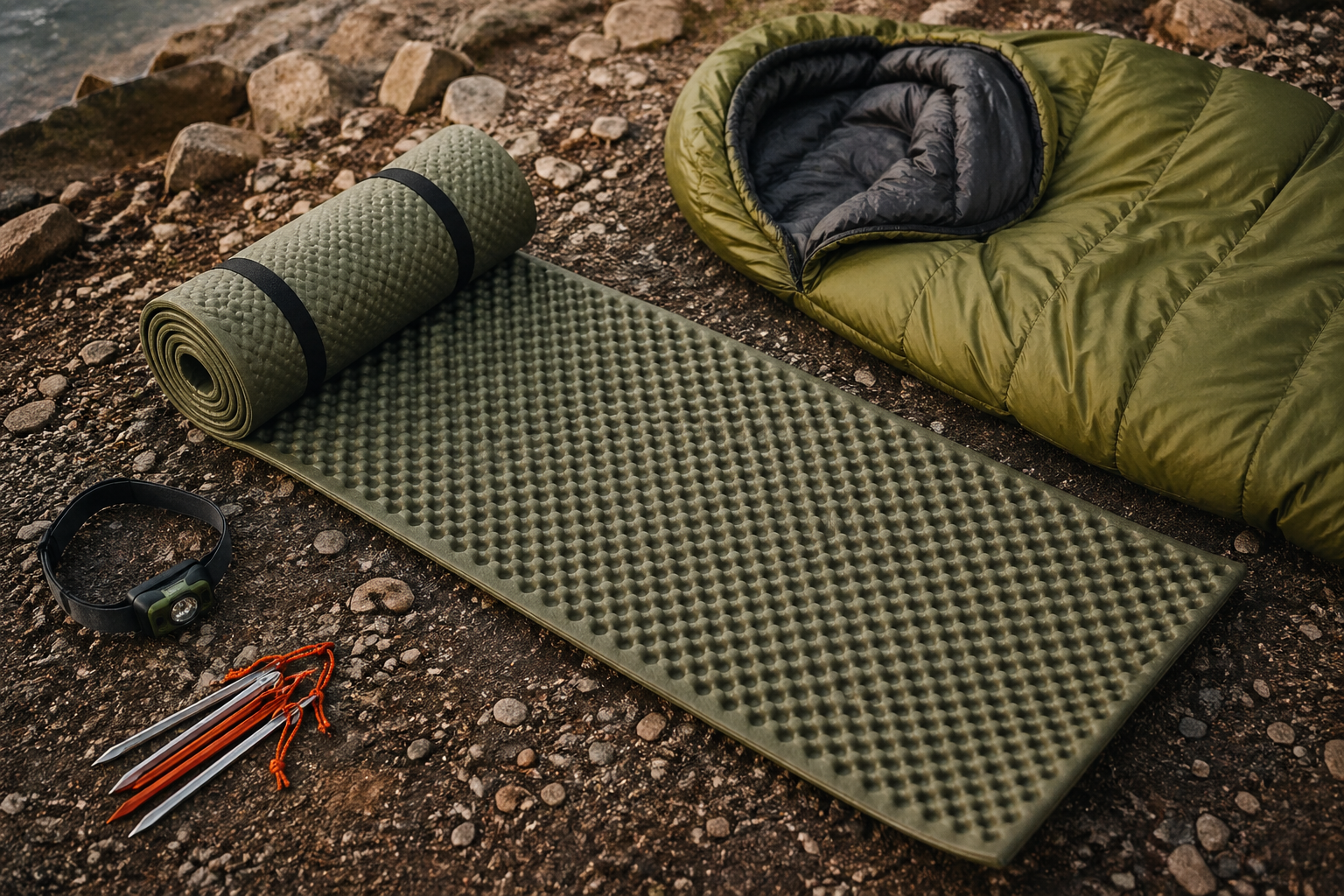
Go to AmazonFoam pads are a dying breed in backpacking — but they have genuine advantages that inflatable pads don’t. They can’t puncture, they don’t need inflation, they double as a sit pad at rest stops, and they work as a base layer under an air pad for extra cold-weather insulation. The Therm-a-Rest Z Lite Sol is the best foam pad available, consistently recommended alongside inflatable options for good reason.
The accordion fold design compresses reasonably well for a foam pad and can be lashed to the outside of a pack without taking up internal volume. The metalized ThermaCapture coating on the top surface reflects body heat back to add warmth beyond what plain EVA foam provides. At R-2.0, it covers summer camping and works as the base layer in a two-pad winter system.
For ultralight backpackers who want the simplest, most reliable sleep surface possible — no inflation, no deflation, no puncture anxiety — the Z Lite Sol delivers that without compromise. For winter camping, pair it under an XLite or XTherm for an R-value stack that handles serious cold.
Best for: Ultralight backpackers who want zero-maintenance sleep gear, and winter campers who want a base layer under their primary air pad.
8. NEMO Switchback — Best Ultralight Foam Pad

NEMO Equipment Switchback Foam Sleeping Pad – Regular – Sunset Orange
- Highly-efficient, hexagonal nesting pattern allocates more space for taller, wider nodes, providing significantly greater plushness.
- More precise tooling eliminates wasted space between folded layers, enabling taller nodes to nest tighter for a smaller packed size.
- Taller nodes create more space for uncompressed sleeping bag insulation, trapping more warmth around your body.
New starting from: 59.95 $
Go to AmazonThe NEMO Switchback is the foam pad alternative to the Z Lite Sol — offering a slightly different accordion fold geometry and a more structured surface that some backpackers find more comfortable than the Z Lite’s smoother surface. Both weigh around 14 oz and deliver similar R-2.0 performance, so the choice between them is largely personal preference.
What sets the Switchback apart is the structural rigidity of its folds — it maintains its shape more consistently when lashed outside a pack, and the raised surface pattern provides slightly better pressure distribution than a flat foam surface. For backpackers who’ve tried foam pads and found them too rigid and uncomfortable, the Switchback is the version most worth trying before giving up on foam entirely.
Like the Z Lite Sol, its primary value for many serious backpackers is as a supplemental layer under an air pad in cold conditions rather than as a standalone primary pad. A Z Lite or Switchback under a Tensor or XLite adds meaningful insulation without significant weight penalty — a combination that serious cold-weather backpackers use regularly.
Best for: Ultralight backpackers who prefer foam pads, and cold-weather backpackers who want a lightweight supplemental insulation layer under their primary air pad.
9. Sea to Summit Ultralight Insulated — Best Lightweight Three-Season Pad Under $150

Sea to Summit Ultralight Insulated Backpacking Sleeping Pad, Large (78 x 25 x 2 inches)
- Ultralight insulated air mattress provides a warm and comfortable sleeping surface for late spring to early fall (3.1 R-Value) backpacking, adventure racing, and bike touring
- Air Sprung Cell construction mimics a spring mattress, maintaining more body contact area and even dispersion of pressure for restful backcountry slumber
- Multi-function valve for fast inflation in just a few breaths (using integrated Airstream Pumpsack), one-way deflation for quick packup, and fine-tuning of air pressure
New starting from: 139.3 $
Go to AmazonThe Sea to Summit Ultralight Insulated sits in a practical middle ground — more affordable than NEMO and Therm-a-Rest premium options while delivering genuine three-season performance in a packable, lightweight design. For backpackers who want a step up from the Klymit Static V2 without spending $200+, the Sea to Summit Ultralight is the right landing spot.
The valve system is one of the best on any pad at this price — quick and easy to use with reliable sealing that prevents air loss during sleep. The R-3.3 rating handles three-season conditions comfortably for warm sleepers and adequately for average sleepers in all but the coldest shoulder-season conditions.
Durability testing from CleverHiker — which logged hundreds of backcountry nights on this pad — found it more resistant to delamination and flattening than many competitors at similar price points, which is an important consideration for a pad you’re going to use regularly over multiple seasons. At 16 oz it’s not the lightest option, but for the price it delivers reliable, comfortable performance.
Best for: Backpackers who want genuine three-season performance at a mid-range price without paying for features they don’t need.
10. Klymit Insulated Static V2 — Best Budget Insulated Pad

KLYMIT Insulated Static V2 Inflatable Sleeping Pad | Upgraded Comfort | Portable, Ultralight, Easy to Inflate, Foldable Air Bed for Camping, Backpacking & Hiking — Saffron
- Body Mapping Technology – Next-Level Comfort is here with the Insulated Static V2 to help you flip, roll, or sprawl without losing your comfort sweet spot.
- All the Comfort of Home – Sleep better all night with our exclusive V-Chamber design that conforms to the shape of your adult body, limiting air movement while maintaining lofted air pockets. Dynamic side rails lightly cradle you for a more restful sleep.
- 4 Season Insulation – This mat’s V-Chambers are filled with light and lofty Klymalite synthetic insulation. With an exceptional warmth-to-weight ratio, enjoy a compressible, warming layer between you and the ground.
List Price :
Offer: 76.59 $
Go to AmazonThe Klymit Insulated Static V2 bridges the gap between the budget Static V2 and premium insulated options — delivering R-4.4 performance at a price that’s roughly half of NEMO and Therm-a-Rest competitors. For cold-weather backpackers on a tight budget who can’t justify $200 for a sleeping pad, the Insulated Static V2 is the most capable affordable option available.
The insulation upgrade from the base Static V2 is significant — jumping from R-1.3 to R-4.4 makes it a genuine three-season pad rather than a summer-only option. The wider-than-standard construction and V-shaped chambers provide comfort that’s above average for the price, and the lifetime warranty backs up Klymit’s confidence in the durability.
The trade-off is weight. At 29 oz it’s the heaviest pad on this list — a meaningful penalty for ounce-conscious backpackers. But for car campers stepping into backpacking, casual hikers doing occasional overnights, or budget-focused backpackers who don’t mind a heavier pack, the warmth-to-price ratio is genuinely impressive.
Best for: Budget-conscious backpackers who need a three-season insulated pad without spending $200 on a premium option.
How to Choose the Right Backpacking Sleeping Pad
Start with R-value, not price or weight. A pad with the wrong R-value for your conditions is useless regardless of how light or comfortable it is. Match R-value to your coldest expected conditions first, then optimize for weight and comfort within that constraint.
Know your sleep position. Back and stomach sleepers do fine on most pads — even 2.5-inch thickness handles their pressure distribution well. Side sleepers need 3.5–4 inches of loft and baffles designed for lateral pressure relief. The NEMO Eclipse and Ether Light XR are the best options for dedicated side sleepers.
Consider your pack volume. Foam pads don’t compress and need to be lashed outside your pack. Air pads compress to roughly the size of a water bottle and fit inside. If pack volume is limited, an air pad is the practical choice. For packs with external attachment points, foam pads free up internal volume for other gear — check our best extra-large hiking backpacks guide for packs with external lash points.
Carry a repair kit. Every air pad can puncture. A small patch kit weighs almost nothing and can save an overnight trip when it happens. Most quality pads include one in the box — keep it with the pad, not at home.
Inflate less than fully. Most backpackers over-inflate their pads on the first night. A fully rigid pad doesn’t contour to your body — letting out 10–15% of air after initial inflation creates a more comfortable, body-conforming surface. Experiment on your first few nights to find the right pressure for your weight and sleep position.
Final Thoughts
The right sleeping pad is the most underappreciated piece of kit in a backpacker’s gear list. It determines how warm you sleep, how rested you are, and ultimately how much you enjoy the next day on trail.
For most three-season backpackers, the NEMO Tensor All-Season is the best all-around choice. For weight-obsessed hikers and thru-hikers, the Therm-a-Rest NeoAir XLite NXT delivers the best warmth-to-weight ratio available. For cold-weather camping, the NeoAir XTherm NXT is the unambiguous answer. And for budget backpackers doing warm-weather trips, the Klymit Static V2 gets the job done at a fraction of the price.
Check current pricing and availability using the links above. And for more on building a complete overnight kit, our best hiking headlamps and best water purification options for backpacking guides cover the other essentials worth having on overnight trips.