
As an Amazon Associate I earn from qualifying purchases.
Most men’s packs are built around a medium torso, so a shorter man ends up wearing a frame that is too long: the hip belt slides off his hips, the shoulder straps gap, and the load hangs from his shoulders for miles. The fix is not a smaller litre count — it is a shorter frame. This guide shows you how to measure your torso, which frame sizes and hip belts actually fit a 15 to 18 inch back, and the packs that come in those sizes.
Fit Your Pack to Your Torso, Not Your Height
Measure once, match your number to the right frame size, and carry the load on your hips with our step-by-step torso fitting guide.
Read the Torso Fitting GuideKey Takeaways
- Measure your torso before you shop, because frame length — not your height and not the litre count — decides whether a pack fits you.
- Shop the short end of every size chart: XS/S, S/M and Short frames built for roughly 15 to 18 inch torsos.
- Reject any hip belt you cannot cinch snugly on your hip bones, because a belt that bottoms out puts the whole load on your shoulders.
- Try women’s and unisex small frames without hesitation, since several of the shortest, best-fitting frames are sold in those lines.
- Load the pack and walk before you commit, because an empty pack hides every fit fault that a full one exposes in minutes.
Table of Contents
- Why Standard Men’s Packs Fit Short Men Badly
- Measure Your Torso Before You Look at a Single Pack
- The Frame Sizes and Hip Belts That Fit a Short Torso
- The Best Hiking Backpacks for Short Men
- Adjustable Torso vs Fixed Short Frames
- How to Fit the Pack Once It Arrives
- Capacity: How Many Litres a Short Frame Should Carry
- Mistakes Short Men Make When Buying a Pack
- Our view
- FAQ
- Sources
- Recommended
Why Standard Men’s Packs Fit Short Men Badly
A pack fits your back, not your height. Two men of the same height can carry noticeably different torso lengths, and frame size follows the torso alone. The fit guidance in REI states the rule plainly: torso length, not overall height, is what a pack must be sized to, and the ranges vary by maker and model. Our own tall men’s backpack guide makes the same point from the long end — this guide is its mirror for the short end.
A too-long frame fails in a predictable order. First the hip belt, pushed down by the long back panel, rides below your hip bones where it cannot carry weight. Then the shoulder straps, anchored too high, lift off your shoulders or dig at the neck. Finally the load lifters sit at the wrong angle and pull the load backwards instead of in toward your back. The result is the classic short-hiker complaint — sore shoulders, a swinging load, and a belt that needs re-tightening every mile — on a pack that was never the wrong quality, only the wrong length.
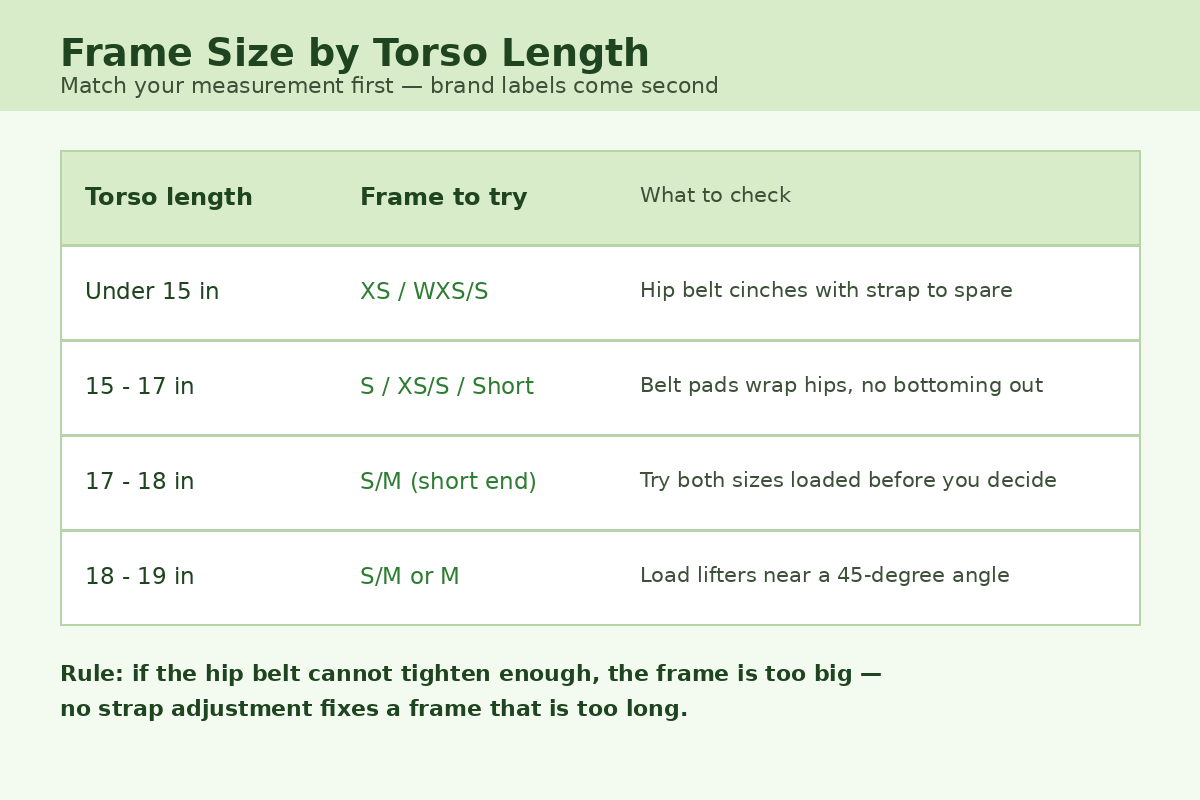
| Your torso length | Frame labels to try first | Typical chart examples | Hip belt check |
|---|---|---|---|
| Under 15 inches | XS, WXS/S, Extra Small | Shortest women’s and unisex frames | Must cinch with strap tail to spare |
| 15 to 17 inches | S, XS/S, Short | The core short-men range in most lines | Pads wrap the hips, buckle centred |
| 17 to 18 inches | S/M at its short setting, Short | Overlap zone — try both sizes loaded | Check lifter angle at both settings |
| 18 to 19 inches | S/M or M | Standard men’s sizing starts to work | Standard belts usually cinch fine |
The Hip Belt Problem Is Half the Fit Problem
Short men often have narrower hips as well as shorter backs. A standard men’s belt sized for a medium frame may run out of adjustment before it gets snug, leaving the pads floating instead of gripping. The sizing overview from Osprey treats hip belt sizing as its own measurement — taken around the hips at the iliac crest, not the waist — precisely because frame size and belt size do not always travel together. If your waist is slim, belt range matters as much as torso range, and our backpack size guide walks through both numbers together.
Measure Your Torso Before You Look at a Single Pack
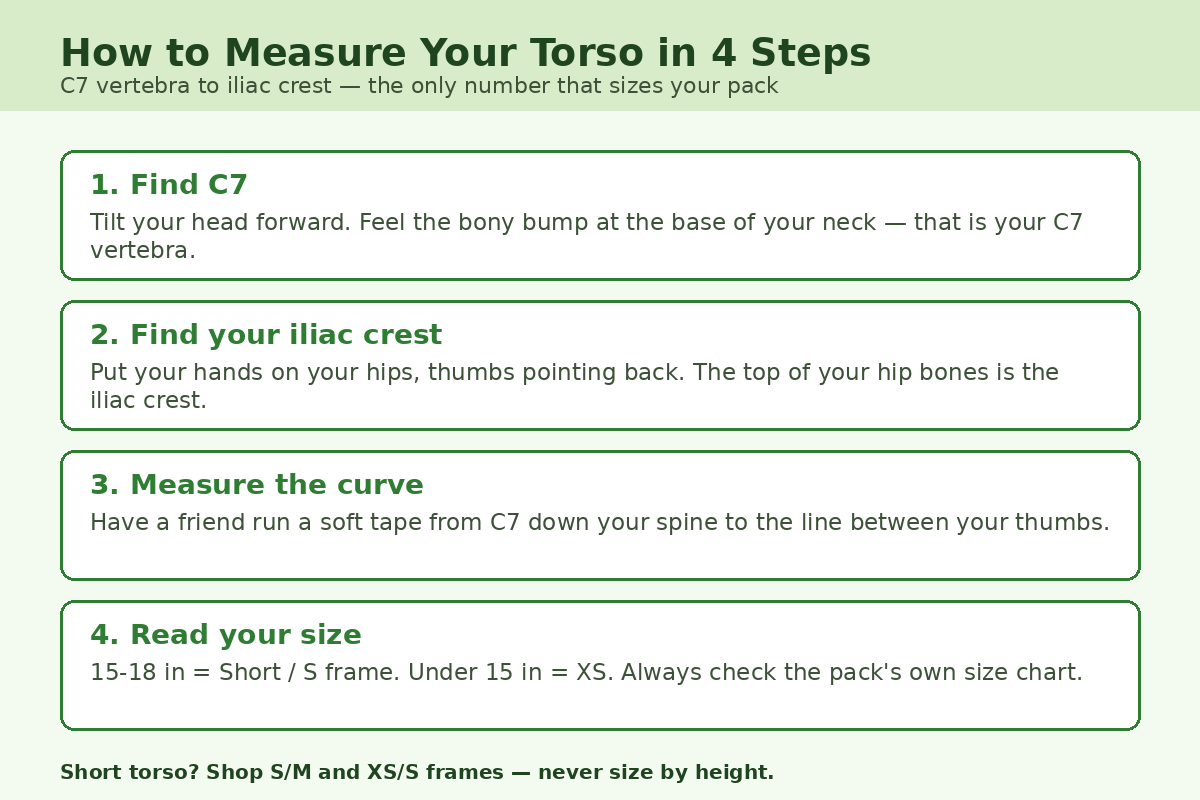
The measurement takes one helper and one soft tape. Tilt your head forward and find the bony bump at the base of your neck — the C7 vertebra. Then place your hands on your hips with your thumbs pointing back; the line between your thumbs, across the top of your hip bones, is the iliac crest line. Your helper runs the tape from C7 down the curve of your spine to that line. That distance is your torso length, and the measuring method in Deuter uses exactly these two landmarks, with a belt worn at hip-bone height to mark the lower point.
Write the number down and shop by it, not by size labels. Labels are not standardised: one brand’s small starts where another’s extra small ends. The fit guide from Thule makes the same warning — torso length is the most important consideration because a pack that is too tall or too short cannot distribute weight correctly. Our torso fitting guide shows the measurement with the adjustment sequence that follows it, so do the tape work there before you open a single product page.

Read Every Brand’s Own Chart
Never carry a size label from one brand to another. Gregory states that its sizes run consistently across its own men’s, women’s and unisex lines, as summarised in the Gregory size guide drawn from the maker’s own fit pages — but that consistency stops at the brand border. A short torso that takes a Gregory SM can sit in a different band entirely on an Osprey or Deuter chart. Check the exact model’s chart every time, including when you reorder a brand you already own, because ranges shift between product families.
The Frame Sizes and Hip Belts That Fit a Short Torso
Start at the short end of three product families. Men’s S/M frames with adjustable harnesses reach down furthest among men’s lines; women’s XS/S frames go shorter still; and dedicated Short sizes in unisex lines split the difference. The range of overnight packs at Gregory shows how one maker spreads those options across capacities, with adjustable torso systems doing much of the work for shorter backs. For day hikes, our daypack roundup covers the smaller end where one-size frames run shorter by design.
Women’s frames are a legitimate short-men’s option. REI’s fit guidance notes that women-specific packs, with their smaller frame sizes, often work well for shorter backpackers, since the torso dimensions run shorter and narrower. The concrete proof sits in the specs: the Gregory Jade 28 comes in an XS/S fitting 14 to 17 inch torsos with an adjustable harness, a range most men’s lines never reach. Our petite frame backpack guide mines the same short-frame territory and is worth reading alongside this one.
What a Good Short-Frame Hip Belt Looks Like
The belt must grip bone, not squeeze soft tissue. Centred on your iliac crest, the padded sections should wrap well around your hips with the buckle fastened and some strap still available to tighten as the day goes on. The day-pack end of the market shows the target clearly: the REI Co-op Trail 40 in XS–S fits 15.5 to 17.5 inch torsos and 28 to 38 inch hips, a belt range that actually closes on a slim waist. If a belt is fully cinched and still loose, walk away from that frame no matter how good the back length feels — and check the fixes in our hip belt padding guide before you give up on a pack that is otherwise right.
The Best Hiking Backpacks for Short Men
Every pick below is sold in a genuinely short frame. I have listed the size that fits a short torso for each pack, because the same model in its larger size is a different fit entirely. Judge each one by the same three tests: does its smallest frame match your measured torso, does its belt cinch on your hips, and does its capacity match your trip length from our 3-day hike pack guide?
Gregory Paragon 58 in S/M — Best Adjustable Fit for Short Men
The Paragon’s adjustable harness is built for the overlap zone. Its S/M size fits torso lengths from 15 to 19 inches with continuous adjustment, so a 16 or 17 inch torso sits comfortably inside the range instead of at its ragged edge. That adjustability is why it leads this list for short men who fall between fixed sizes: set the harness short, load the pack, and fine-tune until the belt lands exactly on your hip bones. Gregory positions the Paragon family as its lightweight multi-day option, and the S/M is the size to order.

Gregory Paragon 58
- FreeFloat Hybrid Suspension – Hybrid suspension featuring Gregory’s FreeFloat dynamic comfort cradle lower back system and breathable 3D foam upper backpanel support
- Full length Side Zipper – Full length side-loading access zipper for easy unloading and gear organization
- Sunglasses Quickstow System – Quickstow system on shoulder harness for a secure, scratch-free way to store your sunglasses
Osprey Aura AG 65 in XS/S — The Shortest Mainstream Frame
When men’s frames stop at 17 inches, this frame keeps going. The women’s twin of the Atmos line fits torsos down to the shortest band Osprey publishes, and its specs at Osprey Ariel 55 show the pattern: an XS/S fitting 13.5 to 17 inch torsos with hips from 26 inches. A short man with a 15 or 16 inch torso and a slim waist gets a suspended-mesh carry that no men’s S/M can match at that length. The harness shape differs from a men’s pack, so try it loaded — but on pure frame length, nothing mainstream goes shorter. Our women’s backpack guide covers its fit details in full.

Osprey Aura AG 65
- Curved zip access on one side of panel
- Floating top lid with lash points
- Tall dual-access side water bottle pockets
New starting from: 369.95 $
Go to Amazon
Granite Gear Crown3 60 in Short — Best Lightweight Short Frame
A dedicated Short size, not a shrunken regular. The Crown3’s Short fits 15 to 18 inch torsos as a fixed frame, and the review at SectionHiker confirms the split: Short at 15 to 18 inches, Regular at 18 to 21, with an adjustable Re-Fit hip belt running 26 to 42 inches on the unisex model. That belt range is the quiet headline for slim-waisted men — it closes properly where standard belts run out of webbing. The independent test at Switchback Travel adds the caution that the fixed torso is unforgiving, so your measurement has to be right before you order. It earns a place in our lightweight backpack roundup for exactly this combination of low weight and honest short sizing.

Hyperlite Mountain Gear Southwest 55 in Small — Best Ultralight Short Frame
Five torso sizes is how ultralight sizing should look. The Southwest runs from Extra Small at under 15 inches through Small at 15 to 17 inches, as set out in the Hyperlite buyers guide — a ladder that gives short men two rungs instead of one compromise. The test notes at OutdoorGearLab confirm the sizes fit torsos from 15 inches upward and that correct sizing is what makes the minimalist suspension work. Choose Small for a 15 to 17 inch torso, and size up only if you sit exactly on a boundary, per the maker’s own advice.

Hyperlite Mountain Gear Southwest 55
- Robust exterior pockets safeguard gear, concealing contents during adventures
- Side and top compression straps secure external gear, preventing load shift on varied terrain
- Hydroport and internal mesh sleeve offer easy water access, keeping you hydrated on the go
Adjustable Torso vs Fixed Short Frames
Adjustable harnesses forgive a borderline measurement. A sliding yoke or ladder adjustment lets one frame cover several inches, which helps if you sit between sizes or share a pack. The trade-off is a little extra weight and hardware. The measuring guidance from Topo Designs adds a useful tie-breaker for fixed frames: if you cannot find an exact match, pick the size down, because a smaller pack is less likely to sit too low and cause pain from friction and imbalance.
Fixed short frames carry cleaner when the size is exactly right. No sliding parts means no creep under load, and the lightest short packs are usually fixed for that reason. The risk is precision: a fixed Short that misses your torso by an inch cannot be adjusted into fitting. Whichever route you take, compare the candidates against the broader field in our best hiking backpacks roundup and let your measured number — not the marketing size name — make the final call.
When to Try Both Sizes
Boundary measurements demand a loaded comparison. If your torso falls where two sizes overlap, load both with your real kit weight and walk each for several minutes. The right size keeps the belt on your hip bones as you move; the wrong one migrates. Our Osprey Rook 65 review shows this loaded-check process on a budget frame, and it applies to every pack on this page.
How to Fit the Pack Once It Arrives
Fit in a fixed order, with weight in the pack. Loosen every strap, put roughly your real trail weight inside, and set the hip belt first: centred on your iliac crest and cinched snugly, since the hips should carry the large majority of the load. Standard fitting practice puts the same 80-percent-on-the-hips principle at the centre of the sequence. Only then tighten the shoulder straps until they wrap without gaps, set the load lifters near a 45-degree angle, and finish with the sternum strap.
Check the three short-torso failure points. First, the shoulder strap anchor should sit below the top of your shoulders, not above them — an anchor riding high means the frame is still too long. Second, the belt pads should not meet at the buckle; pads touching means the belt has run out of adjustment. Third, the load lifters should pull the top of the pack toward you, not lie flat. The full adjustment walkthrough lives in our torso fitting guide, and the packing method in our backpack packing guide keeps heavy items close to your back so a correct fit is not undone by a bad load.
The Ten-Minute Loaded Walk Test
Walk, climb stairs, and bend before you decide. A correctly sized short frame stays put through all three; a too-long frame announces itself by sliding, gaping, or pulling within minutes. Do this test at home while returns are still easy, with your shelter, food and water aboard — the same load discipline our multi-day checklist is built around.
Capacity: How Many Litres a Short Frame Should Carry
Capacity follows the trip, frame size follows your back — independently. A short frame in a given model usually holds slightly fewer litres than its long sibling, because the bag is shorter. Do not size up the frame to gain volume; gain volume by choosing a higher-capacity model in your frame size instead. The capacity bands in our 60L pack guide and 35L pack guide map litres to trip lengths without reference to frame size, which is exactly how the two decisions should stay separated.
Short men often do better one capacity step leaner. A shorter back carries a tall, top-heavy load less comfortably, so compact packing pays double. Keep the load low and close, use the compression straps, and let our pack size guide sanity-check your litre choice against your longest planned trip rather than your average one.
Mistakes Short Men Make When Buying a Pack
Buying by height is the first and worst mistake. Height charts smuggle in an average torso that shorter men, by definition, may not have. The second mistake is accepting a belt that almost cinches — almost becomes fully loose an hour into a climb. The third is refusing to look at women’s and unisex frames, which cuts off the shortest sizes in the market; the shortest women’s frames exist precisely because those lines are built shorter.
The fourth mistake is testing empty and returning never. An unloaded pack feels fine in almost any size. Load it, walk it, and use the return window while it exists. Budget does not excuse any of this: our backpacks under $100 guide includes short-frame options, so a correct fit is available at every price point.
Our view
Short men do not need a special category of pack — they need the short end of the charts they are already reading, chosen by a measured torso instead of a height guess. Start with the torso fitting guide, cross-check your litres in the pack size guide, and if your partner hikes with the long version of this problem, send them the tall men’s backpack guide — fit is a measurement, and once you have yours, the right frame is simply the one built to that number.
— Brian Ka
FAQ
Should short men buy women’s backpacks?
Yes, when the frame length is right. Women’s lines carry the shortest frames in the mainstream market — XS/S sizes fitting torsos down to about 13.5 inches — and REI’s fit guidance explicitly notes they often work well for shorter backpackers. Check the harness and hip belt shape loaded, because those contours differ, but never rule a pack out on its line label alone.
What torso length counts as short for a backpack?
Roughly 18 inches and under, with 15 to 18 the core short range. Brand charts differ, but Short, S and XS/S sizes cluster around those numbers: Granite Gear’s Short covers 15 to 18 inches, Hyperlite’s Small covers 15 to 17, and the shortest women’s frames start near 13.5. Your measured number, read against the specific model’s chart, is the only definition that matters.
Can I just tighten the straps on a medium pack?
No — straps cannot shorten a frame. Adjustment straps fine-tune a frame that already matches your back; they cannot move the hip belt up a too-long back panel or lower a shoulder anchor that sits too high. If the frame length is wrong, the load path is wrong, and no amount of cinching repairs it.
How tight should the hip belt be on a small waist?
Snug on the hip bones, with strap tail still available. The belt should not slide down when you walk, and the padded sections should wrap your hips without meeting at the front. If you reach the end of the adjustment and the belt still moves, the belt — and usually the frame size — is too big for you.
Is an adjustable torso pack better for short men?
It is the safer buy when you sit between sizes. An adjustable S/M that covers 15 to 19 inches lets you set the harness at the short end and fine-tune from there. A fixed Short frame is lighter and cleaner when your measurement lands squarely inside its range. Decide by where your number falls on the chart, not by the feature list.
Questions About Hiking Backpacks for Short Men?
Measured your torso and still torn between two frame sizes? Send us your torso length, your hip measurement and your trip length and we will help you pick the frame that fits.
Contact UsSources
- REI — How to Choose a Backpack: Sizing & Fit Guide
- Osprey — Backpack Size Chart & Sizing Guide
- Deuter — All About Trekking Backpacks
- Gregory — Backpacking Packs
- Gregory Size Guide (from Gregory fit guide and size chart)
- REI — Gregory Jade 28 Pack, Women’s (XS/S specs)
- REI — Osprey Ariel 55 Pack, Women’s (XS/S specs)
- REI — REI Co-op Trail 40 Pack, Women’s (XS–S specs)
- SectionHiker — Granite Gear Crown3 60L Backpack Review
- Switchback Travel — Granite Gear Crown3 60 Backpack Review
- SectionHiker — Hyperlite Mountain Gear Backpack Buyers Guide
- OutdoorGearLab — Hyperlite Mountain Gear Southwest 55 Review
- Thule — How to Choose a Backpack
- Topo Designs — How to Choose a Hiking Backpack: Measuring for Backpack Sizes