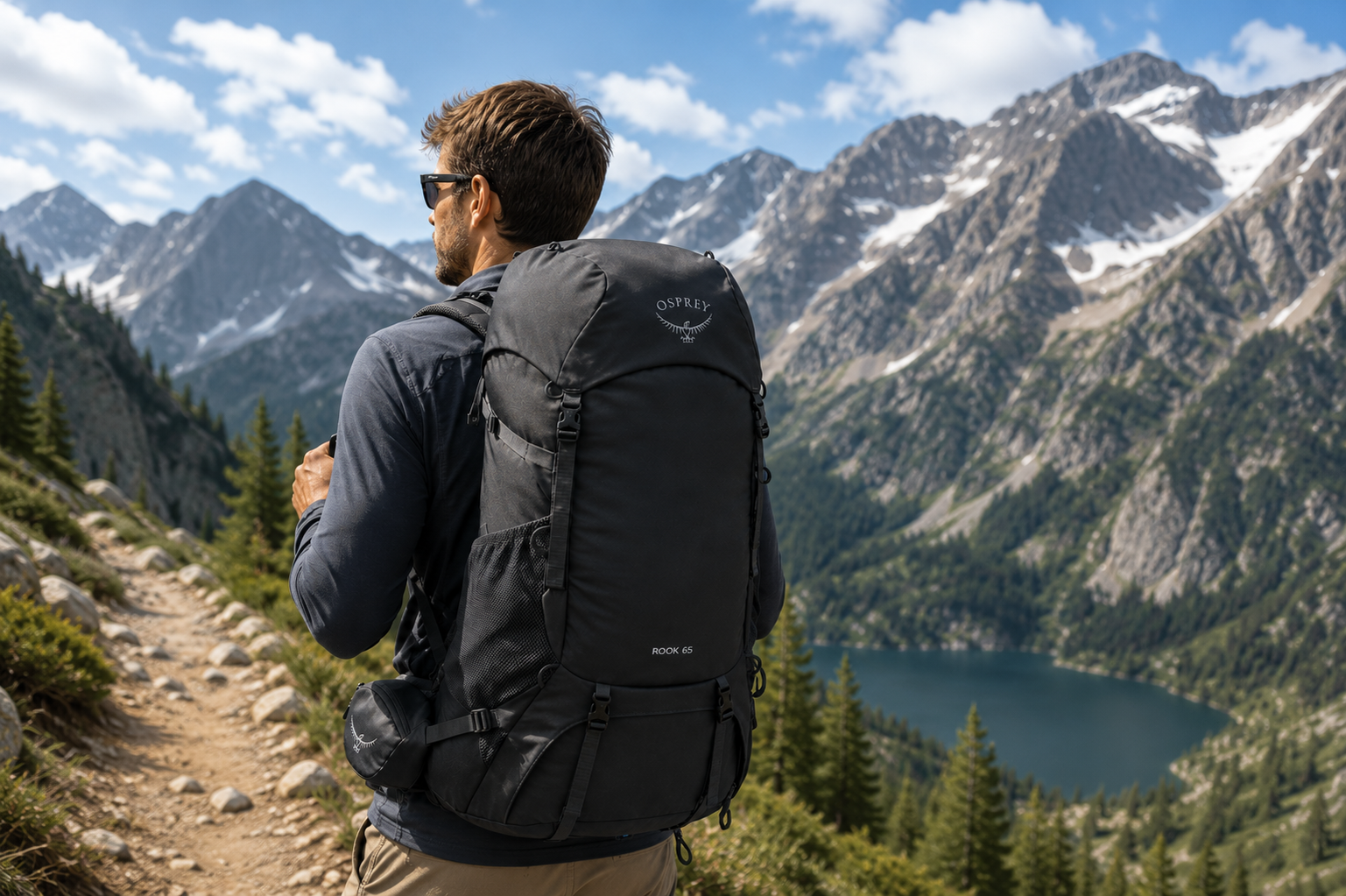
The Osprey Atmos AG 65 is one of the most consistently recommended backpacking packs on the market. It’s also $270 — which is a real barrier for hikers who want Osprey quality without the premium price tag. The Osprey Rook 65 exists to answer that exact question: how much of the Atmos AG experience can you get for significantly less money?
After months of real-world testing across varied terrain and load weights, the answer is more nuanced than a simple yes or no. The Rook 65 is genuinely impressive for its price — but it makes specific trade-offs to get there, and whether those trade-offs affect you depends almost entirely on how much weight you carry and how long you spend on trail.
This review covers everything — build quality, suspension, ventilation, organization, weight, and the direct comparison against the Atmos AG — so you can make the right call before spending money on either pack.
Both packs are available on Amazon. For more on Osprey’s full lineup at different volume ranges, check out our best 60L hiking backpacks guide and our best hiking backpacks for heavy loads guide.
Osprey Rook 65 at a Glance
Available on Amazon | ~$165 | 65L | 3 lbs 8.5 oz
- Back system: AirSpeed suspended mesh
- Torso adjustment: 4+ inches of adjustability via ladder system
- Hip belt: Fixed (not adjustable)
- Material: 600D polyester body, 1000D polyester bottom
- Rain cover: Included
- Warranty: Osprey All Mighty Guarantee (lifetime)
- Women’s version: Osprey Renn 65
Osprey Atmos AG 65 at a Glance
Available on Amazon | ~$270 | 65L | 4 lbs 6 oz
- Back system: Anti-Gravity suspended mesh
- Torso adjustment: Multiple sizes (S/M/L)
- Hip belt: Fit-on-the-Fly adjustable, part of AG suspension
- Material: 100D High Tenacity Nylon
- Rain cover: Not included (sold separately ~$25)
- Warranty: Osprey All Mighty Guarantee (lifetime)
- Women’s version: Osprey Aura AG 65
Build Quality and Materials
The first thing experienced hikers notice when handling both packs side by side is the material difference. The Rook uses a 600D polyester body — dense, heavy-duty fabric that actually feels more rugged than the Atmos at first touch. The 1000D polyester bottom is among the thickest base panels on any pack tested at any price point, handling the repeated ground contact of trail use without visible wear.
The Atmos AG uses 100D High Tenacity Nylon — a lighter, more refined fabric that sacrifices some of the industrial durability feel of the Rook in favor of better flexibility and a more premium hand feel. In practical trail testing, both materials hold up well for regular hiking use. Where the difference shows is in heavy-use scenarios — the Rook’s thicker polyester shrugs off abrasion from rocky ground and rough trail use more confidently than the Atmos’s lighter nylon.
Stitching quality on both packs is excellent — Osprey’s manufacturing standards show at every price point, and the Rook doesn’t reveal itself as a budget pack through construction quality. Zippers operate smoothly throughout, and stress points at strap attachment zones are reinforced appropriately.
One quality note from field testing: an isolated report of a zipper pull failing on the Rook after limited use, addressed by Osprey’s warranty. The All Mighty Guarantee covers both packs equally — Osprey repairs or replaces malfunctioning gear for the life of the pack regardless of which model you own.
Verdict: The Rook is surprisingly durable for its price — arguably more abrasion-resistant than the Atmos in day-to-day rough use. Build quality is competitive across both packs.
Suspension System — The Most Important Difference
This is where the two packs diverge most significantly, and understanding the difference determines which pack is right for your specific hiking style.
Osprey Rook — AirSpeed System
The Rook uses Osprey’s AirSpeed suspended mesh back panel — a tensioned mesh frame that holds the pack body away from your back, creating genuine airflow between your back and the pack. The 4+ inch torso adjustment ladder makes dialing in fit straightforward. The shoulder straps and hip belt are padded adequately but firmly — noticeably less plush than the Atmos, with padding that feels stiff rather than soft against your body.
The critical performance specification: the Rook’s suspension system is optimized for loads up to approximately 35 lbs. Within that range it performs impressively — stable on the back, good load transfer, the suspended mesh keeps everything locked in place without swaying. Beyond 35 lbs the firmer padding becomes a limiting factor. The hip belt and shoulder straps begin to create pressure points that the Atmos handles with significantly more comfort at the same load weight.
Osprey Atmos AG — Anti-Gravity System
The Atmos AG uses Osprey’s Anti-Gravity suspension — a more sophisticated version of the suspended mesh concept that extends around the inside of the hip belt and creates a wrap-around connection between the back panel and hip system. The result is a more immersive, body-conforming feel that experienced Osprey users describe as the pack becoming part of your body rather than sitting on top of it.
The Fit-on-the-Fly hip belt adjusts while wearing the pack — a meaningful practical advantage for getting precise fit during a hike as load weight shifts. The Anti-Gravity system handles heavier loads more comfortably than the AirSpeed — loads up to 50 lbs carry noticeably better on the Atmos than on the Rook at equivalent weights.
The trade-off is weight: the Atmos AG 65 weighs 4 lbs 6 oz compared to the Rook’s 3 lbs 8.5 oz — nearly a pound difference that’s meaningful on long trips where pack weight matters.
Verdict: For loads under 35 lbs, the AirSpeed system is 90-95% as comfortable as Anti-Gravity and performs well across the majority of day hiking and moderate backpacking scenarios. For loads over 35 lbs or for hikers who spend multiple consecutive days on trail with heavy gear, the Anti-Gravity system’s comfort advantage becomes meaningful enough to justify the price premium.
Ventilation
Both packs use suspended mesh back panels that create airflow between your back and the pack — and both deliver on the core promise of keeping your back significantly cooler than foam-padded alternative designs.
The Atmos AG’s Anti-Gravity panel provides slightly more surface area contact and a more refined airflow pattern than the Rook’s AirSpeed system. In practical terms, the ventilation difference between the two packs is measurable in controlled testing but unlikely to be the deciding factor for most hikers. Both packs significantly outperform non-suspended alternatives in warm conditions.
One shared quirk: both packs produce noticeable noise from the harness-frame interaction as you walk — a consequence of the suspended mesh design. It’s consistent, rhythmic, and inoffensive after initial adjustment, but worth knowing before your first hike if you’re sensitive to pack noise.
Verdict: Both packs ventilate well. The Atmos AG performs slightly better in sustained hot conditions, but the Rook is more than adequate for most hikers and significantly outperforms foam-panel packs at any price.
Organization and Pockets
This is the clearest area where the Rook makes its budget-conscious design choices most visible.
Rook 65 organization:
- Large main compartment with sleeping bag divider
- Top lid pocket
- Two side mesh water bottle pockets (fit 4L combined, slanted for easy access)
- Hip belt pockets (small)
- Compression straps with external attachment capability
Atmos AG 65 organization:
- Large main compartment with sleeping bag divider
- Top lid pocket with multiple internal pockets
- Stretch front shove-it pocket
- Two side mesh water bottle pockets
- Hip belt pockets (larger, more accessible)
- Compression straps
The most significant organizational omission on the Rook is the stretch front shove-it pocket — a quick-access external storage area that modern Osprey packs use for rain jackets, snacks, and frequently accessed items without opening the main compartment. Its absence means everything goes into the main compartment, which requires more unpacking to access buried items.
The lid pocket on the Rook is fixed — it doesn’t float or extend as the pack fills. This limits how much you can overstuff the pack before the lid stops fitting correctly. The Atmos AG’s lid system accommodates more loading flexibility.
For hikers who use kit bags and organizational pouches inside the main compartment — separating food, sleep gear, and clothing into dedicated bags — the Rook’s minimal pocket layout is a non-issue. For hikers who rely on external pockets for quick-access trail organization, the lack of a front shove-it pocket is a genuine daily inconvenience.
Verdict: The Atmos AG wins on organization — more pockets, better hip belt pockets, and a front shove-it pocket that the Rook omits. For hikers who use internal organization systems, the Rook’s layout is adequate.
Weight
The Rook’s weight advantage over the Atmos is one of its most surprising specs.
Osprey Rook 65: 3 lbs 8.5 oz Osprey Atmos AG 65: 4 lbs 6 oz
Nearly a pound lighter despite using denser fabric throughout — the weight savings come from the simpler suspension system, less padding, fewer pockets, and the fixed rather than floating lid. For ultralight-conscious hikers who are managing total pack weight carefully, the Rook’s lighter base weight is a genuine advantage.
Verdict: Rook wins on weight — a meaningful advantage for ounce-conscious hikers and those covering big daily mileage where pack weight compounds over long days.
Rain Cover
The Rook includes an integrated rain cover stored in a dedicated bottom pocket — ready to deploy in seconds when weather moves in. This is a genuine value add that Osprey omits from the Atmos AG, where a rain cover costs an additional $25 to purchase separately.
At the Rook’s price point, the included rain cover represents meaningful value — you’re getting a complete, trail-ready system without additional accessories required. For the Atmos AG, budget an additional $25 to $30 for rain cover coverage that the Rook provides out of the box.
Verdict: Rook wins — the included rain cover is a practical advantage that offsets some of the price difference between the two packs.
Fit Options
The Rook comes in a single size with 4+ inches of torso adjustment via the ladder system — meaning most hikers can dial in a workable fit, but those at the extremes of torso length may find it less precise than a size-specific pack.
The Atmos AG is available in Small, Medium, and Large torso sizes — each with additional adjustability within the size range. For tall hikers with longer torsos, the Atmos AG’s sizing system delivers a more precisely fitted suspension than the Rook’s single-size approach. For more on fitting packs to longer torsos, our best hiking backpacks for tall men guide covers what to look for in suspension systems for longer backs.
Verdict: Atmos AG wins on fit precision — the multiple torso size options deliver better suspension performance for hikers at the edges of standard sizing ranges.
Head-to-Head Comparison Table
| Feature | Osprey Rook 65 | Osprey Atmos AG 65 |
|---|---|---|
| Price | ~$165 | ~$270 |
| Weight | 3 lbs 8.5 oz | 4 lbs 6 oz |
| Back System | AirSpeed | Anti-Gravity |
| Ideal Load Range | Up to 35 lbs | Up to 50+ lbs |
| Hip Belt | Fixed | Fit-on-the-Fly |
| Front Pocket | No | Yes |
| Rain Cover | Included | Not included |
| Torso Sizing | Single size | S/M/L |
| Material | 600D polyester | 100D HT Nylon |
| Warranty | All Mighty Guarantee | All Mighty Guarantee |
Who Should Buy the Osprey Rook 65
The Rook 65 is the right choice if:
You’re newer to backpacking and want a quality pack without committing $270 to a first backpacking purchase. The Rook delivers genuine Osprey quality and performance in a package that handles the majority of hiking scenarios a beginner or intermediate hiker encounters.
You consistently carry loads under 35 lbs. The suspension performs well within this range, and the comfort gap with the Atmos AG is minimal for most hikers at lighter loads.
You hike in hot conditions and prioritize ventilation — the AirSpeed system delivers excellent back ventilation at a price that significantly undercuts alternatives with comparable breathability.
You want an Osprey-quality pack with the best durability for the money — the 600D/1000D polyester construction is among the most abrasion-resistant in the 65L category regardless of price.
You use internal organization systems — kit bags, stuff sacks — rather than relying on external pockets for trail organization.
Who Should Buy the Osprey Atmos AG 65
The Atmos AG 65 is the right choice if:
You regularly carry loads over 35 lbs on multi-day trips. The Anti-Gravity suspension and Fit-on-the-Fly hip belt handle heavier loads with meaningfully more comfort than the Rook over sustained hiking days.
You’ve been backpacking long enough to know that the difference between a great suspension and a good one compounds over consecutive days on trail. What feels fine on a day hike becomes significant on day three of a week-long trip.
You want maximum organizational flexibility — the front shove-it pocket, more capable hip belt pockets, and floating lid provide daily convenience that the Rook’s minimal layout doesn’t match.
You need precise torso length fit — the Small/Medium/Large sizing options accommodate longer and shorter torsos more accurately than the Rook’s single-size system.
You’re investing in a pack you’ll use for many years across ambitious multi-day and week-long trips where the suspension difference matters across cumulative miles and days.
The Verdict
The Osprey Rook 65 is 90-95% of the Atmos AG at roughly 60% of the price — and for hikers who stay under 35 lbs, that remaining 5-10% gap is academic rather than practical. It’s the best entry-level backpacking pack available from a quality brand, and the 600D/1000D construction gives it durability credentials that budget alternatives from lesser brands simply can’t match.
The Atmos AG 65 earns its price premium for a specific type of hiker — someone carrying heavier loads, covering consecutive days on trail, and experienced enough to notice and care about the suspension difference under load. For that hiker, the Anti-Gravity system is genuinely worth the additional $100.
The honest summary: buy the Rook if you’re building your first serious backpacking kit or consistently hiking light. Buy the Atmos if you carry heavy, hike often, and want the best Osprey has to offer in this volume range.
Both packs are available on Amazon — check current pricing using the links above, as prices shift seasonally. For more on Osprey’s full backpacking lineup at different price points, our best lightweight hiking backpacks guide covers the full spectrum from budget to premium.