
A sleeping bag rated for 20 degrees doesn’t actually keep you warm at 20 degrees if you’re lying directly against cold ground with an inadequate pad underneath — a genuinely common mistake that leaves backpackers shivering despite owning perfectly good insulation. Ground contact pulls heat away from your body far faster than air does, which is exactly why a sleeping pad’s insulation value matters as much as your bag’s temperature rating, and often gets overlooked entirely when buyers focus purely on the bag itself.
This guide covers how to actually choose a backpacking sleeping pad — what R-value means and how to match it to your real conditions, the genuine tradeoffs between pad types, and how weight and packed size should factor into the decision alongside comfort. For the sleeping bag half of this system, hikingbackpackpro.com’s guide on choosing a sleeping bag temperature rating covers the companion decision this pad works alongside.
What R-Value Actually Means
R-value measures a pad’s resistance to heat flow — specifically, how effectively it insulates you from the cold ground beneath you. The core relationship is straightforward: higher R-value equals more insulation, and the number you need scales directly with how cold your actual sleeping conditions will be.
Under 2 covers genuinely warm-weather use only, appropriate for summer trips where overnight lows stay comfortably mild and ground heat loss is a minor concern rather than a real threat to comfort or safety.
2 to 4 handles three-season conditions — the range most backpackers spend the majority of their nights in, covering spring, summer, and fall trips with moderately cool overnight temperatures.
4 to 6 is built for genuinely cold conditions, appropriate for late fall, early spring, or higher-elevation trips where overnight temperatures drop meaningfully below what a standard three-season pad can handle.
Above 6 moves into true winter and expedition territory, designed for sustained sub-freezing conditions where ground insulation becomes a genuine safety consideration rather than just a comfort one.
R-values from different pads are also additive if you genuinely need more insulation than a single pad provides — stacking a foam pad underneath an inflatable pad combines their R-values, a real technique worth knowing for cold-weather trips where a single pad’s rating falls short of what conditions demand.
Matching R-Value to Your Actual Trip
The practical mistake to avoid is buying for the coldest hypothetical trip you might someday take rather than the conditions you actually hike in most often. A pad rated for winter expedition use adds real weight and cost that goes unused on the three-season trips that make up most backpackers’ actual mileage — match your primary pad to your genuine typical conditions, and treat a second, warmer pad as a specialized purchase for the specific cold-weather trips that actually demand it, rather than defaulting to maximum insulation on every purchase.
Elevation matters here in a way that’s easy to underestimate when planning around a valley-floor forecast. Overnight temperatures drop meaningfully as elevation increases, and a trip that starts in a warm trailhead parking lot can end at a genuinely cold high-elevation campsite the same night — plan your pad’s R-value around the coldest point on your actual route, not the trailhead conditions.
The Three Main Pad Types
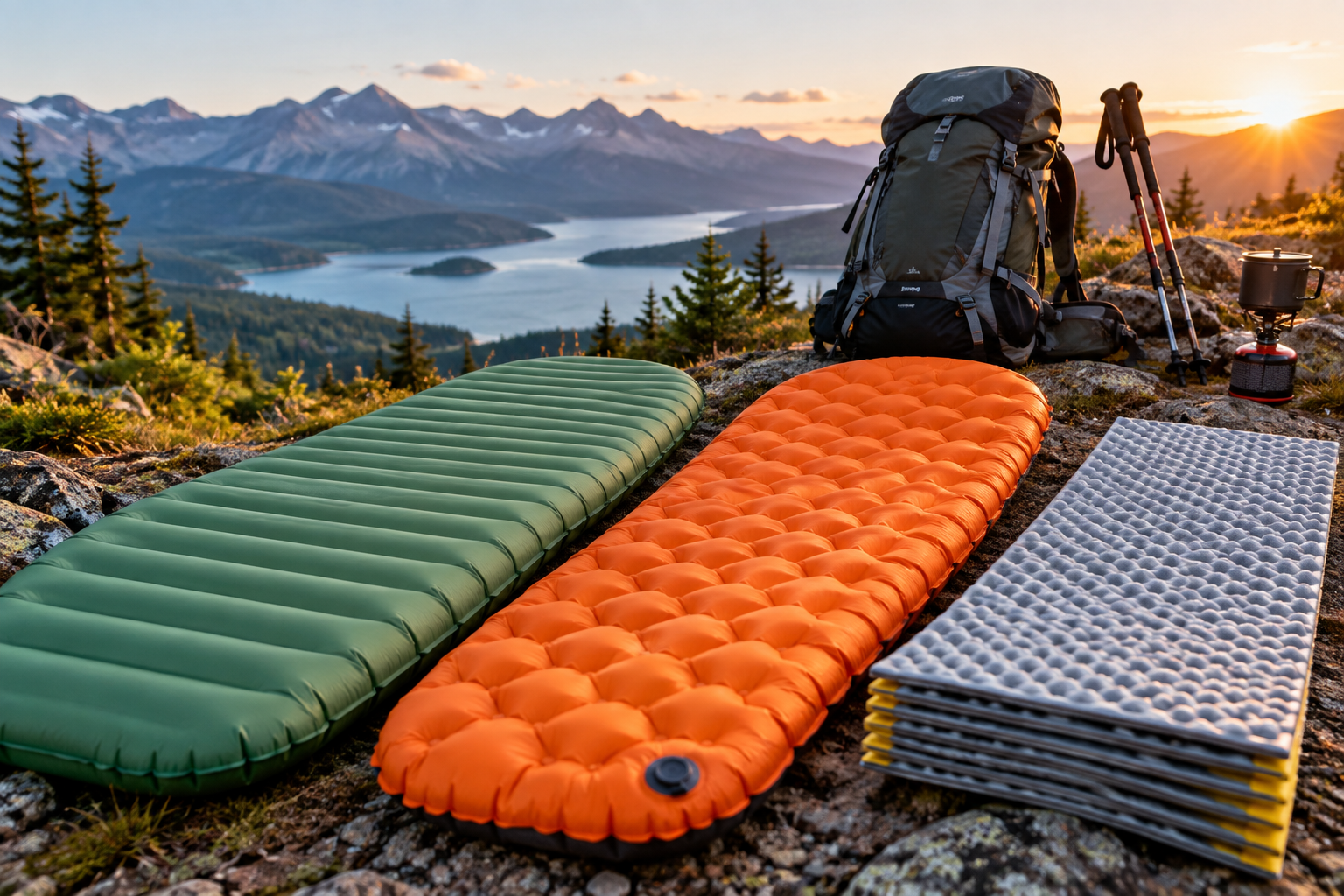
Air pads (inflatable pads) offer the best warmth-to-weight and packed-size ratio of the three types, making them the standard choice for weight-conscious backpackers who want genuine comfort without carrying excessive bulk. The tradeoff is a real puncture risk that the other two types simply don’t share — a rock or a stray branch can compromise an air pad’s function entirely, whereas foam and self-inflating pads are considerably more forgiving of rough ground contact.
Self-inflating pads combine open-cell foam with an air valve, delivering a genuine middle ground between an air pad’s packability and a foam pad’s puncture resistance. These generally weigh more than pure air pads for equivalent insulation and comfort, but the foam core provides some functional insulation even if the pad does develop a slow leak — a real safety margin an air pad alone doesn’t offer.
Closed-cell foam pads are the most affordable and virtually puncture-proof option in this category, genuinely bombproof for extended backcountry use where you can’t easily patch a failure mid-trip. The tradeoff is bulk — foam pads pack down considerably larger than air or self-inflating options, typically strapped to the outside of a pack rather than fitting inside it, and comfort is generally the most basic of the three types given the thinner, uncompressible foam layer.
Weight and Packed Size Tradeoffs
Weight and packability genuinely matter more the further and longer you’re hiking, and matter proportionally less on short trips where the marginal ounces don’t compound across serious mileage. A pad that’s slightly heavier but meaningfully more comfortable is often the right tradeoff for a casual weekend trip; that same weight penalty becomes a genuinely different calculation for someone covering 20-plus miles a day on a thru-hike, where cumulative weight across the entire pack matters enormously.
Thickness affects comfort directly, particularly for side sleepers. A thicker pad provides genuinely more cushioning between your hip or shoulder and the ground when sleeping on your side, a real comfort factor that’s easy to underestimate until you’ve spent an uncomfortable night on a pad that’s too thin for your actual sleep position.
Packed size determines how much pack volume the pad actually consumes. Air pads generally compress to the smallest packed size for a given R-value and comfort level, which matters directly if pack space is genuinely tight relative to everything else you’re carrying — closed-cell foam’s bulk, by contrast, is precisely why it usually rides external to the pack rather than inside it.
Length and Width Sizing
Standard pad lengths run roughly 72 inches, with shorter options available for hikers who specifically want to save weight by not insulating the lower legs — a genuine weight-saving strategy for minimalist backpackers, though one that trades away some warmth and comfort at the feet in exchange. Taller hikers should confirm a pad’s specific length accommodates their actual height rather than assuming “standard” length covers everyone, since a pad that’s genuinely too short leaves feet or lower legs directly on cold, uninsulated ground.
Width matters similarly — a narrower pad saves weight but provides less margin before you roll off the edge during the night, a real consideration for restless sleepers or anyone sharing a smaller tent footprint where pad width interacts with available floor space.
Sound and Sleep Disruption
Some inflatable pads, particularly certain synthetic-insulation-filled designs, produce a genuinely noticeable crinkling sound with every movement — a real consideration for restless sleepers or anyone sharing a tent, where a noisy pad can disrupt sleep for both the user and any tent-mate. This is rarely mentioned in spec sheets, and it’s worth checking user reviews specifically for noise complaints before committing to a pad, particularly for hikers who already know they move around a lot during sleep.
Putting It Together
Three-season backpackers doing the bulk of typical spring, summer, and fall trips should target an R-value in the 2-to-4 range, prioritizing an air pad for the best combination of packed size and weight unless puncture risk in genuinely rocky or thorny terrain pushes you toward a self-inflating alternative instead.
Cold-weather or shoulder-season hikers need to step up into the 4-to-6 R-value range, and should factor elevation into that decision specifically — a trip that gains significant elevation over the course of a day needs a pad rated for the coldest point on the route, not the trailhead’s starting conditions.
Budget-conscious or durability-focused backpackers headed into genuinely rough terrain are often better served by closed-cell foam despite the bulk, since the puncture-proof reliability removes a real failure mode that air pads carry — a foam pad that never fails is often a better practical choice than a lighter air pad that could leave you with inadequate insulation mid-trip if it’s compromised.
Weight-conscious thru-hikers and long-distance backpackers should prioritize air pads specifically for their superior warmth-to-weight ratio, accepting the puncture risk as a real tradeoff worth managing through careful campsite selection and a genuine repair kit carried specifically for that possibility.
Conclusion
Choosing a backpacking sleeping pad comes down to three decisions working together rather than any single spec in isolation: match R-value honestly to the coldest conditions your actual route will encounter rather than your most extreme hypothetical trip, choose a pad type based on the real tradeoff between weight, packed size, and puncture risk that matters most for your specific terrain, and confirm length and width genuinely fit your body rather than assuming a standard size works for everyone.
Get those three decisions right, and the pad becomes exactly what it should be on trail — the layer between you and the ground that quietly does its job all night, rather than the reason you wake up cold or sore despite an otherwise well-chosen sleep system.