

As an Amazon Associate I earn from qualifying purchases.
A warm sleeping bag over a cold pad still sleeps cold, because the ground underneath you pulls heat away all night and the pad is the only thing standing in its way. R-value is the number that tells you how hard a pad fights that pull. This explainer decodes the number itself — what it physically measures, how it is lab-tested, how much you need for the ground you will actually sleep on, and how to read it without being misled.
See the Pads Behind the Numbers
Once you know the R-value your trips demand, compare the pads that deliver it in our full sleeping pad roundup.
Browse the Best Backpacking Sleeping PadsKey Takeaways
- Read R-value as resistance: the higher the number, the slower heat escapes into the ground.
- Trust only standardized values — an untested number from one brand cannot be compared with another.
- Match the pad to ground temperature, because cold soil and snow steal more heat than cold air.
- Add R-values when you stack pads; a foam pad under an air pad is simple, proven arithmetic.
- Pair the pad with your bag rating, because every bag rating quietly assumes a pad underneath.
Table of Contents
- What R-Value Actually Measures
- How the ASTM F3340 Test Works
- Ground Temperature, Not Air Temperature
- How Air Pads Build Insulation
- How Much R-Value You Need
- Stacking Pads: R-Values Add
- R-Value and Your Sleeping Bag Rating
- Common Misreadings of the Number
- Our view
- FAQ
- Sources
- Recommended
What R-Value Actually Measures
R-value is thermal resistance — a measure of how hard it is for heat to flow through the pad. It is the same idea used to rate home insulation, and the U.S. Department of Energy describes insulation in exactly those terms: materials are rated by their resistance to heat flow, and the higher the R-value, the more effective the insulation. On a pad the heat is yours, the flow is downward, and the destination is the ground. A pad generates no warmth and holds no temperature; it slows the rate at which your body heat leaks away beneath you.
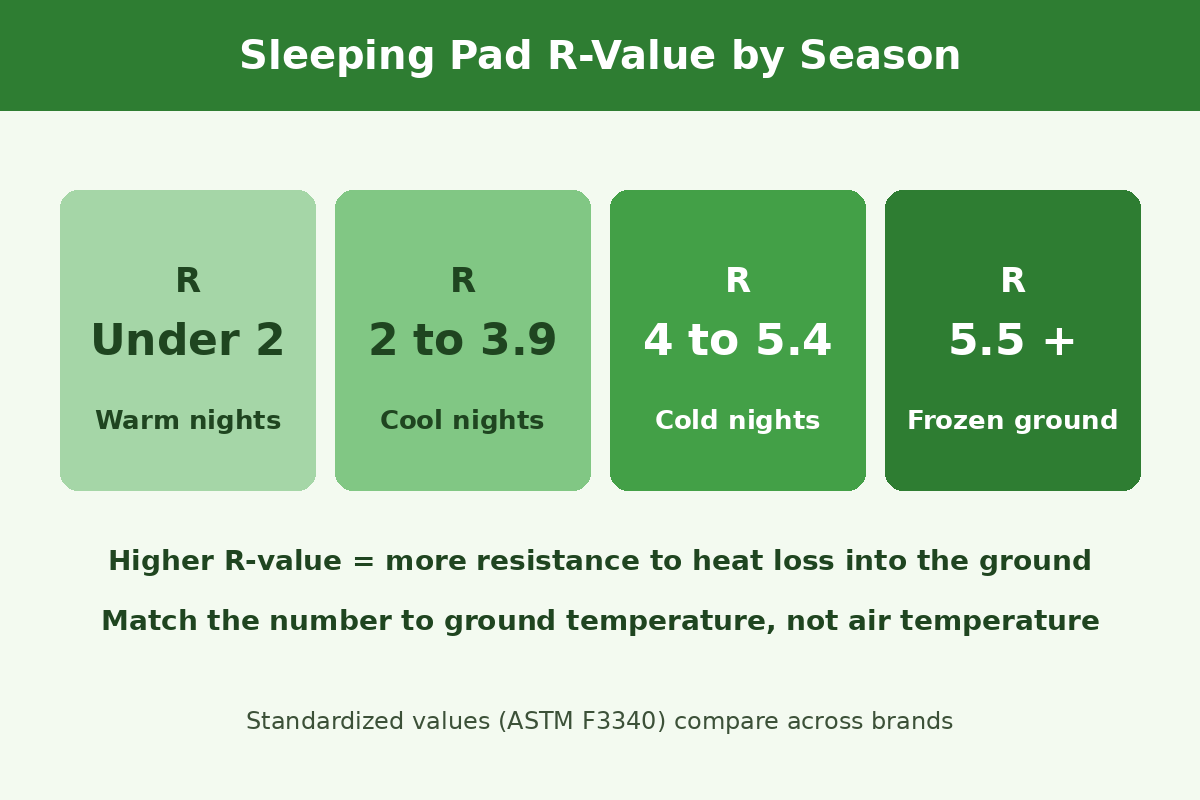
The scale is linear, which makes the arithmetic honest. The sleeping pad guide from REI puts it plainly: a pad with an R-value of 2.0 is twice as warm as a pad with an R-value of 1.0, because it resists the same heat flow twice as well. That linearity is what makes the seasonal bands below meaningful, and what makes stacking work later in this guide. The bands are the widely used rule-of-thumb ranges for an average sleeper with a matched bag.
| R-value band | Ground conditions | Typical use | Watch out |
|---|---|---|---|
| Under 2 | Warm, dry ground | Warm nights, lowland summer camping | High ground stays cold after dark even on warm days |
| 2 to 3.9 | Cool ground, occasional damp soil | Most three-season backpacking | Early-season ground that has not warmed yet asks for more |
| 4 to 5.4 | Cold ground, frost likely | Cold nights, shoulder-season mountains, first snow trips | A single cold night on frozen ground can still defeat it |
| 5.5 and above | Frozen ground, sleeping on snow | Winter camping and mountaineering | Often reached by stacking two pads rather than one |
Resistance, Not a Temperature Rating
R-value is not a temperature, and it does not promise comfort at a stated low. Older pad marketing often attached a temperature range to a pad, as if the pad alone could be rated the way a sleeping bag is. The explainer from Mountain Equipment describes that history directly: a mat’s warmth — its thermal resistance — is defined by its R-value, while in the past those values were determined in numerous different ways. A resistance number travels between trips; a temperature claim does not, because the same pad feels warm under one sleeper and cold under another. Treat any pad sold with only a temperature claim and no R-value as a pad whose warmth you cannot verify.
How the ASTM F3340 Test Works
ASTM F3340 is the shared lab method that turned R-value from marketing into measurement. Its full title is the Standard Test Method for Thermal Resistance of Camping Mattresses Using a Guarded Hot Plate Apparatus, and the scope published by ASTM International describes the setup exactly: the mattress is held under constant compressive force between a guarded hot plate and a cold plate, heat transfer is measured one-dimensionally through the pad’s thickness under steady-state conditions, and the method applies to every pad construction — inflatable air pads with or without insulation or reflective layers, self-inflating open-cell foam pads, and closed-cell foam mats. Sleeping bags and covers are deliberately excluded, so the number belongs to the pad alone.
The measurement itself is an energy measurement. The support documentation from Cascade Designs explains the principle: the pad sits between plates, one held at a steady temperature with a measured electrical current, and a pad that insulates well needs less energy to keep that plate warm — less energy required means a higher R-value. Because every brand following the standard runs the same arrangement, the same number now means the same resistance on any label.
Why Older Numbers Cannot Be Compared
Before the shared method, each maker measured warmth its own way, and the numbers were not interchangeable. The standard FAQ from SectionHiker describes how the standardized test tightened the process: the pad is sandwiched between a hot plate and a cold plate, the R-value is measured in three different locations on the pad, and the test is run on three identical pads with the results averaged. A single-brand test had none of those safeguards, so an older pad’s printed number can read higher or lower than the same pad would score under F3340. Compare only numbers that carry the standard; treat an unstandardized figure as unknown.
The standard is also honest about its own limits. ASTM’s scope notes that the measured value is a repeatable comparative measurement that may not always correlate to field performance, because real nights add edge heat loss, heat loss from uncovered surfaces, and changes in compression and posture. That caveat defines what the number is for: R-value ranks pads against each other reliably, while your warmth still depends on the whole sleep system — which is why our multi-day backpacking checklist treats pad, bag and clothing as one kit decision.
Ground Temperature, Not Air Temperature
The forecast low is the wrong number to size a pad by, because you do not sleep on air — you sleep on ground. Air cools and warms quickly; the ground stores temperature and gives it back slowly, and the surface you lie on can be far colder than the night air, especially on clear nights, at altitude, and on ground cold for weeks. Two nights with the same forecast low can demand very different pads.
Soil holds its season. The soil-temperature explainer from Purdue Extension, written with Indiana’s associate state climatologist, makes the mechanics plain: soil type and water content drive soil temperature cycles, sandy dry soils heat and cool fast, wet soils warm slowly because part of the heat goes into drying them, and early in the season soil averages below air temperature. Translated to camp: spring ground is colder than the air suggests, autumn ground is warmer, and damp ground is a colder bed than dry ground at the same thermometer reading.
Soil, Rock and Snow Pull Heat Differently
What is under the tent changes how fast heat leaves you. Loose, dry forest duff traps air and is the kindest surface; bare rock conducts steadily and feels cold long after sunset; wet soil adds water’s efficient heat transfer; and snow presents a surface held at freezing that melts slightly under your warmth and refreezes — a bed that never warms up under you. The same pad can feel generous on a forest floor and thin on an alpine rock slab, which is why site choice in our how to choose a backpacking tent guide matters to warmth as well as shelter.
The stakes of getting it wrong are physiological, not just comfort. The CDC guidance on preventing hypothermia starts from the basic mechanism: in cold temperatures the body begins to lose heat faster than it can produce it, and hypothermia can occur even above 40 degrees Fahrenheit when a person is wet and chilled. A sleeper is a worst case for that equation — motionless for hours, producing little heat, in full contact with a cold surface. The pad is your control over the largest contact area in it.
How Air Pads Build Insulation
An air pad’s warmth comes from what is inside the air space, never from the air alone. Still air insulates, but a tall air chamber lets air circulate in convection loops carrying heat from the warm top surface to the cold bottom one. Insulated air pads interrupt those loops: baffles divide the chamber, synthetic fill stills the air, and reflective film bounces radiant heat back toward the sleeper. The R-value explainer from Therm-a-Rest describes how its testers quantify the result — two plates with the pad between them, one held at a steady temperature, and the energy needed to hold it becoming the pad’s R-value — which is why two pads of identical thickness can carry very different numbers.
That internal construction is the whole story of an air pad’s rating. A pad with layered reflective baffles can reach deep-winter resistance at a modest thickness, while a thick pad with an empty chamber can test near the bottom of the scale. When a trip genuinely calls for an insulated inflatable — cold ground, long miles, a bag already chosen — this is the slot where that pad earns its place. Our how to choose a sleeping pad for backpacking guide covers pad type and fit in one brief pass, because this post’s subject is the number, not the shopping.

KLYMIT Insulated Static V2 Sleeping Pad
- Body Mapping Technology – Next-Level Comfort is here with the Insulated Static V2 to help you flip, roll, or sprawl without losing your comfort sweet spot.
- All the Comfort of Home – Sleep better all night with our exclusive V-Chamber design that conforms to the shape of your adult body, limiting air movement while maintaining lofted air pockets. Dynamic side rails lightly cradle you for a more restful sleep.
- 4 Season Insulation – This mat’s V-Chambers are filled with light and lofty Klymalite synthetic insulation. With an exceptional warmth-to-weight ratio, enjoy a compressible, warming layer between you and the ground.
List Price :
Offer: 76.59 $
Go to AmazonWhy an Uninsulated Air Pad Feels Cold
A plain air mattress is a comfort item, not an insulation item. With nothing inside to stop convection, your body warms the top of the chamber, that air sinks as it cools against the ground side, and the loop runs all night — the pad pumps your heat into the ground. The R-value explainer published by Snowys, built around Sea to Summit’s range, adds the labelling caution: some brands may not test their products to the ASTM standard at all, so the product details are where you confirm whether a stated figure is a standardized one. A thick, uninsulated pad with no standardized number should be assumed to sit at the bottom of the warmth scale. Packing it well is covered in our best way to pack a backpack for hiking guide; warming it up is not something packing can fix.
How Much R-Value You Need
Start from the coldest ground you will actually sleep on, then read the band table in the first section as a floor, not a target. Warm nights on dry lowland ground are honestly served below R 2. Most three-season backpacking — cool ground, the odd damp pitch, altitude in the shoulder months — lives in the 2 to 3.9 band, with the top of the band the safer default. Cold nights with frost and early snow belong at 4 to 5.4. Sleeping on snow or frozen ground starts at 5.5, and that top band is where a dedicated high-resistance pad stops being a luxury.

NEMO Tensor All-Season Sleeping Pad
- Two layers of floating Thermal Mirror metallized film provide quiet insulation with an unprecedented weight-to-warmth ratio.
- Impressively quiet for uninterrupted sleep (and happy neighbors).
- Spaceframe baffles offer unparalleled stability and weight distribution, using low-stretch, die-cut trusses that eliminate springiness.
New starting from: 199.95 $
Go to AmazonPractitioner guidance for winter agrees on where the floor sits. The winter pad systems guide from the Appalachian Mountain Club states the winter rule directly: for winter camping you generally want an R-value of at least 5, while three-season campers need 2 or more for most conditions. Note the framing — the number is tied to the season’s ground, not to the coldest air temperature in the forecast.
Cold Sleepers and Cold Ground Both Move the Target
The bands assume an average sleeper; adjust honestly for the sleeper you are. Someone who sleeps cold, or camps hungry and tired, should take the band above the table’s suggestion. The same applies to the trip: a first winter trip, a static camp you cannot hike out of at midnight, or a route in the terrain covered by our best snowshoes for winter hiking roundup all argue for margin. Margin is cheap insurance: an over-insulated sleeper can vent a bag, while an under-insulated one has no move left. Clothing is the other half of that margin, and our how to layer clothing for cold weather hiking guide covers sleep layers as part of the same system.
Stacking Pads: R-Values Add
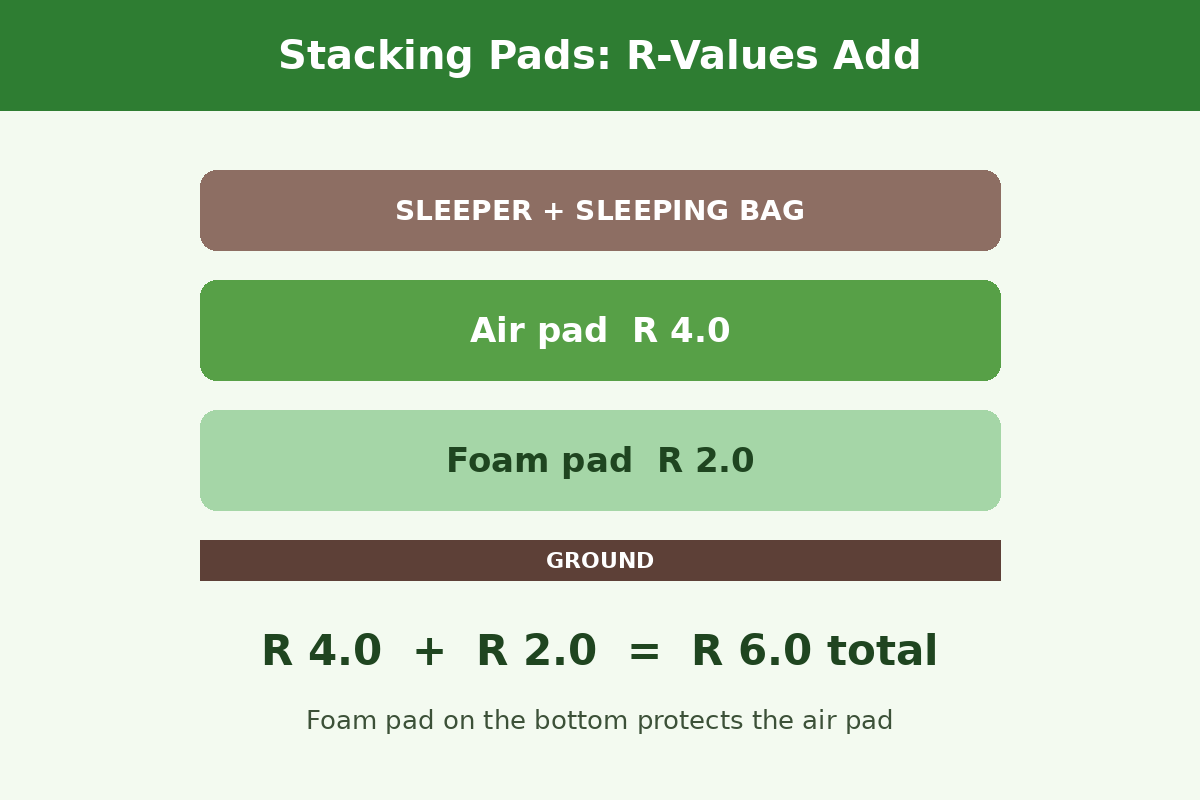
Because R-value is resistance, resistances in series simply sum — and that makes two ordinary pads a legitimate winter system. The standardized R-value explainer from NEMO lists this as one of the standard’s practical gifts: alongside confident cross-brand comparison, standardized values let you calculate the precise, additive R-value of multiple pads stacked in use, such as an air pad on a closed-cell foam pad. No temperature-rating system could be combined that cleanly.
The standard stack has a fixed order: foam on the bottom, air pad on top. The foam pad takes the ground’s abuse — sharp ice crystals, grit, frozen clumps — and shields the inflatable above it. It also guarantees a floor of insulation if the air pad leaks at the worst hour: deflated, an air pad contributes almost no resistance, but the foam pad still stands between you and the snow. And the foam pad works around camp all day as a sit pad, which no inflatable should be asked to do.

NEMO Switchback Foam Sleeping Pad
- Highly-efficient, hexagonal nesting pattern allocates more space for taller, wider nodes, providing significantly greater plushness.
- More precise tooling eliminates wasted space between folded layers, enabling taller nodes to nest tighter for a smaller packed size.
- Taller nodes create more space for uncompressed sleeping bag insulation, trapping more warmth around your body.
New starting from: 59.95 $
Go to AmazonWorked Examples for Common Trips
Run the arithmetic before you run the trip. A three-season air pad at R 3.2 over a foam pad at R 2.0 gives a combined R 5.2 — inside the cold band, from gear many backpackers already own. A warmer air pad at R 4.0 over the same foam pad reaches R 6.0, a genuine winter figure for sleeping on snow. Even a light summer air pad at R 1.8 over foam at R 2.0 reaches R 3.8, the top of the three-season band. The pattern: the foam pad is the constant, and one inexpensive, puncture-proof layer upgrades every other pad you own.
Stacking has two honest limits. First, the sum assumes full contact between the layers; a foam pad much narrower than the air pad above it leaves the top pad’s edges — and your arms and hips at those edges — over uninsulated ground. Second, stacking adds bulk, and the foam pad usually rides outside the pack, as the carry notes in our day hiking essentials checklist describe. Neither limit changes the arithmetic; both change how carefully you lay the stack out.
R-Value and Your Sleeping Bag Rating
A sleeping bag rating is not a property of the bag alone — it is a property of a bag tested on a pad. The bag guidance from REI is explicit that a bag’s temperature rating comes from standardized lab tests, and that real-world comfort will not match the lab figure because of variables the lab cannot simulate — including whether a person sleeps warm or cold, their metabolism, and the pad underneath. Change the pad and you have changed a fixed condition of the test, so the rating no longer describes your night.
The mechanism is compression. The insulation under your back is crushed flat by your body weight, and crushed insulation traps almost no air — which is why the pad, not the bag’s underside, does nearly all the insulating work below you. A bag with generous loft on top over a thin pad is a system with a hole in it, exactly where the coldest surface touches you. Our how to choose a sleeping bag temperature rating guide works through the comfort and limit figures on the label; read it alongside this one, because the two numbers only make sense as a pair.
The Pad Assumption Inside Every Bag Rating
Standardized bag tests are run on a standardized pad, and it is a warm one. A bag’s comfort figure quietly presumes real insulation underneath — in the same range as the cold band of this post’s table. Sleep on a summer pad instead and the bag underperforms its label by a margin no label will state, because the label was never earned on that pad. The rule follows directly: when a night is forecast near your bag’s comfort rating, you need the resistance the rating assumed. Warm trips invert the logic, which is why the sleep kit in our what to wear hiking in summer guide pairs a light bag with a light pad.
Common Misreadings of the Number
The commonest misreading is that thickness equals warmth. Thickness is comfort and ground-conformity; warmth is internal construction. A thick pad full of circulating air tests low, and a thinner pad packed with baffles, fill or reflective film tests high — the lab number, not the inflated height, is the warmth claim. The second misreading is treating R-value as a temperature: the number promises a rate of heat loss, and whether that rate keeps you warm depends on your bag, clothing, food and you.
The third misreading is the one-pad-for-all-seasons assumption. A pad chosen for summer ground is not a winter pad used carefully; the bands exist because ground temperature ranges wider than any single modest pad covers. The honest all-season answers are a genuinely high-R single pad or the stacking system above. The fourth misreading is subtler: assuming a high R-value makes you too hot in summer. A pad insulates you from the ground, not the night air; on warm ground it has little work to do, and overheating is managed with the bag and clothing.
One Brief Word on Choosing a Pad
Everything above is the number; choosing the physical pad around it is a separate, shorter job. Pad type, packed size and fit are covered once, properly, in our how to choose a sleeping pad for backpacking guide, and current models are compared in our best backpacking sleeping pads roundup — including the options for a four-legged sleeper in our best dog sleeping bags for backpacking guide, since a dog on cold ground runs the same heat-loss equation. Bring this post’s target number to those pages, and the choosing takes minutes.
Our view
R-value is the rare gear number that rewards being understood: learn what it measures, size it to the ground instead of the forecast, and stack it when the ground turns frozen. Set your target here, then match it against the pads in our best backpacking sleeping pads roundup, pair it with the right label using our sleeping bag temperature rating guide, and run the pad-type decision once in our how to choose a sleeping pad for backpacking guide — and cold ground stops deciding how you sleep.
— Brian Ka
FAQ
What R-value do I need for three-season backpacking?
Aim for the 2 to 3.9 band, and default to its top half. That range covers cool ground and most shoulder-season nights for an average sleeper with a matched bag. If your trips run early, late, high or damp, treat 3.9 as the floor and stack or step up from there.
Can I just add two pads together for winter?
Yes — the R-values add, and that is the standard winter approach. Put a closed-cell foam pad on the ground and your air pad on top: an R 2.0 foam pad under an R 4.0 air pad gives about R 6.0 of total resistance. The foam layer also protects the inflatable and remains as insulation if the air pad leaks.
Is a thicker sleeping pad always warmer?
No. Thickness is comfort; construction is warmth. A thick pad with an empty air chamber lets convection loops carry your heat to the ground, while a thinner pad with baffles, fill or reflective film can test several times higher. Judge warmth by the standardized R-value, never by inflated height.
Why do I sleep cold in a warm-rated bag?
Usually because the pad underneath is spending the bag’s rating. Bag figures are earned in lab tests on a properly insulated pad, and the insulation compressed under your body contributes almost nothing. If your pad sits in a lower band than your trips demand, the bag underperforms its label however much loft it has on top.
Does a higher R-value make me too hot in summer?
No. A pad insulates you from the ground; it does not heat you. On warm ground a high-R pad simply has little temperature difference to resist. Summer comfort is managed by venting or changing the bag and sleep clothing, not by choosing a colder pad.
Questions About Sleeping Pad R-Value?
Tell us the ground, the season and the bag you pair your pad with, and we will help you land on the R-value your trips actually need.
Contact UsSources
- ASTM International — F3340 Standard Test Method for Thermal Resistance of Camping Mattresses
- U.S. Department of Energy — Types of Insulation
- REI — Sleeping Pads: How to Choose
- REI — Sleeping Bags for Camping: How to Choose
- Cascade Designs Support — How Warm Is My Sleeping Pad and What Is R-Value?
- Therm-a-Rest — R-Value vs. Degree Ratings: Sleeping Pad Warmth
- NEMO — New Standardized R-Value and ASTM F3340
- Mountain Equipment — What Is an R Value? The New Standard Test for Sleeping Mats
- SectionHiker — Sleeping Pad R-Value Standard FAQ: ASTM F3340
- Appalachian Mountain Club — Gearing Up for the Cold: Winter Sleeping Pad Systems
- CDC — Preventing Hypothermia
- Purdue Extension via FarmProgress — 7 Facts You Didn’t Know About Soil Temperature
- Snowys — R-Value and Sleeping Mats Explained