

As an Amazon Associate I earn from qualifying purchases.
Two packs can hold the same gear, weigh the same on the scale and feel completely different after five miles, and the reason is usually the frame you cannot see — or the one you can. This explainer settles the internal frame vs external frame backpacks question in order: how each frame is built, how each one moves load onto your hips, where each design wins and loses on real trails, and how to choose between them for the trips you actually take.
Start With the Right Size, Then Choose Your Frame
Frame type only matters once the capacity fits your trip, so check the size guide first and come back to this explainer with your litre range settled.
Read the Pack Size GuideKey Takeaways
- Judge a frame by where it sends the load, because a good frame of either type puts most of the weight on your hips, not your shoulders.
- Choose internal for rough, narrow or off-trail ground, where a close, narrow load that moves with your body keeps you balanced.
- Choose external for heavy, bulky or awkward loads on maintained trails, where a rigid frame and open lashing points earn their keep.
- Expect a hotter back from most internal frames and a cooler, airier carry from an external frame that holds the load away from you.
- Fit the pack loaded before you judge it, because frame differences only show up honestly once real weight is riding on the hip belt.
Table of Contents
- The Two Frames at a Glance
- How an Internal Frame Carries Load
- How an External Frame Carries Load
- Stability, Balance and Terrain
- Ventilation and Back Comfort
- Packing, Organisation and Lashing Gear On
- Fit: Torso, Hip Belt and Adjustment
- Weight, Bulk and Travel
- Which Frame Suits Which Hiker
- How to Decide in the Shop and on the Trail
- Our view
- FAQ
- Sources
- Recommended
The Two Frames at a Glance
The difference is where the skeleton lives. An internal frame pack hides its structure inside the back panel: aluminium stays, a framesheet, a perimeter wire, or a combination of those parts, all sewn into the pack itself. An external frame pack puts its structure on display: a rigid ladder of aluminium tubing outside the bag, with the packbag, hip belt and shoulder harness all attached to that visible frame. The overview in REI puts it plainly: internal frames are body-hugging packs designed to keep a hiker stable on uneven terrain, while external frames expose the hardware that supports the load.
Neither design is a ranking, and this explainer does not rank them. If you want the product-level view, our external frame roundup covers the external designs as products and our frameless roundup covers the opposite extreme, where there is no frame at all. This post sits behind both of them: it explains the mechanics those roundups assume, so you can read any pack’s specification sheet and know what its frame will actually do under load.
| Feature | Internal frame | External frame |
|---|---|---|
| Where the frame sits | Hidden inside the back panel | Visible tubing outside the packbag |
| How load reaches the hips | Stays or framesheet channel load down into the hip belt | Rigid frame carries load down to a hip belt hung from the frame |
| Load position | Close against the back, narrow profile | Held off the back, wider and taller profile |
| Best ground | Rough, steep, narrow or off-trail terrain | Maintained trails and open country |
| Ventilation | Limited, unless a suspended mesh panel is fitted | Strong, because air flows between pack and back |
| Carrying odd loads | Limited to what fits inside or straps neatly on | Excellent, gear lashes directly to the exposed frame |
One Job, Two Structures
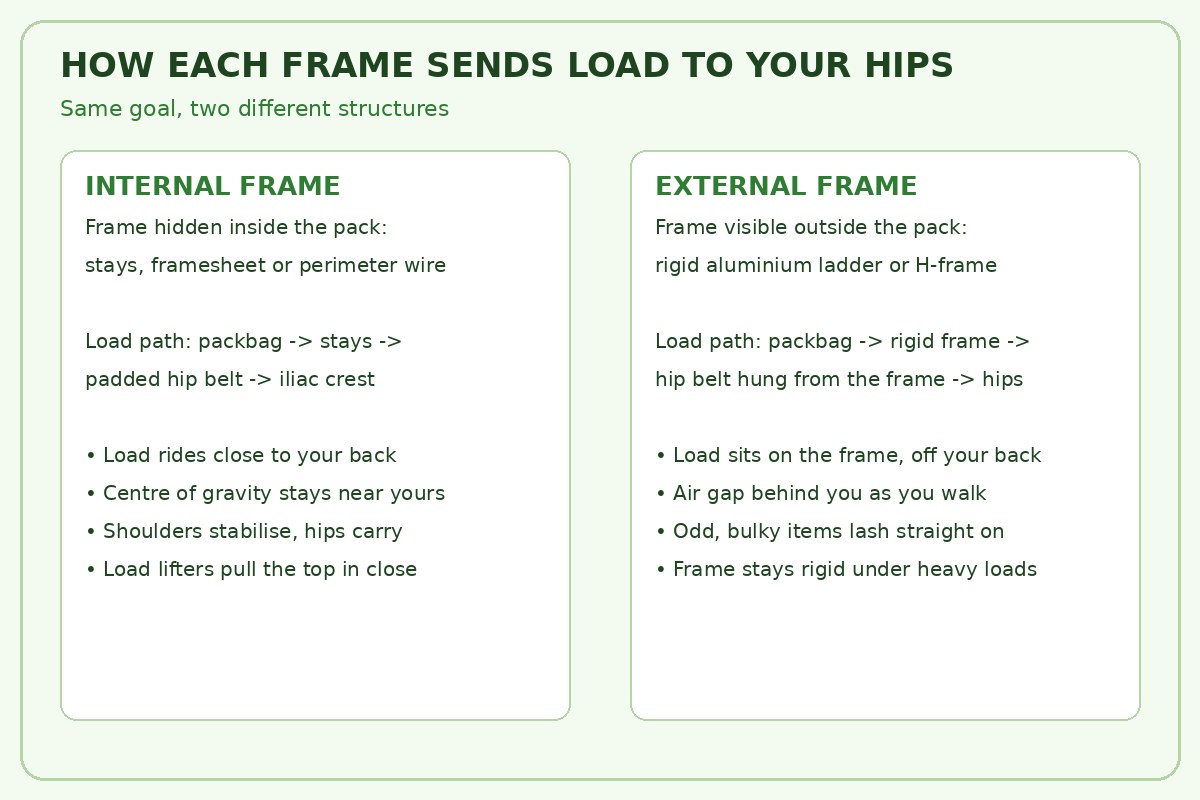
Both frames exist to solve the same problem. Legs and hips carry weight far better than shoulders and spine, so every frame design is really a load-transfer device: it collects the weight of everything in the bag and delivers as much of it as possible to the padded hip belt resting on your hip bones. The internal frame does that job with hidden, flexible parts that bend a little as you move. The external frame does it with a stiff, visible structure that barely bends at all. Everything else in this explainer — stability, ventilation, packing, fit — follows from that single structural choice.
How an Internal Frame Carries Load
The stays are the spine of the system. Most internal frames combine vertical aluminium stays with a plastic framesheet, and some use a tensioned perimeter wire instead. The stays resist the bag collapsing or barreling under a heavy, soft load, and they channel weight downward into the lumbar area and the hip belt. Osprey’s own Osprey documentation for its AntiGravity suspension describes a tensioned peripheral frame that transfers pack load while a continuous suspended mesh panel wraps the back and hips, which is the modern internal frame in one sentence: structure inside, comfort surface against your body.
Because the frame is inside, the load rides close. The packbag sits directly against your back, the weight stays near your own centre of gravity, and the whole system moves as one unit when you twist, step up or lean. That closeness is why internal frames dominate modern backpacking, and it starts with getting the basics right: capacity from our pack size guide and torso fit from our torso fitting guide, because an internal frame only transfers load well when its hip belt lands exactly where the frame expects it to.

Osprey Atmos AG 65
- Fine-Tuned Fit – Fit-on-the-Fly harness and hipbelt make for improved comfort and a fine-tuned fit
- Integrated Raincover – Keeps your pack and gear dry in inclement weather
- Enhanced Organization – Large, curved side zip access into main compartment on both sides
List Price :
Offer: 320.39 $
Go to AmazonHip Belts, Load Lifters and the Finishing Adjustments
The hip belt is where the transfer finishes. On a well-designed internal frame, the stays connect — directly or through the framesheet — into the structure behind the hip belt, so tightening the belt does more than hold the pack on: it completes the load path. Gregory’s Gregory Baltoro documentation describes a suspension whose hip belt and shoulder harness rotate independently to follow body movement, an attempt to keep that load path working while your hips roll with each stride. Load lifter straps then pull the top of the pack toward your shoulders, stopping the load from dragging backwards away from your back.
Back systems vary more than frame labels suggest. Deuter’s Deuter Aircontact documentation describes an aluminium Y-frame working with a close-contact back panel and pivoting hip fins, while other internal packs hold the bag off your back on tensioned mesh. Both are internal frames; they simply trade closeness for airflow in different proportions. When you compare models in our backpack roundup, read the back-system description as carefully as the frame description, because the two together decide how the pack feels at mile ten.
How an External Frame Carries Load
The frame is the pack’s chassis, and the bag is cargo. On an external frame, the packbag hangs on a rigid aluminium frame rather than containing one. The frame extends above the shoulders and below the bag, the hip belt attaches to the frame’s lower section, and the shoulder harness attaches higher up. Kelty’s Kelty external suspension instructions describe an H-frame design that moves the waist belt down the frame, preventing towering loads and improving load transfer to the hips — the external version of the same job the internal stays do invisibly.
Rigidity is the point, not a flaw. A stiff frame does not flex with your stride the way stays do, but it also does not sag, twist or collapse when the load is heavy, dense or awkwardly shaped. The companion Kelty suspension manual for its larger external models covers the same adjustable frame, back band and harness arrangement scaled for bigger loads, which is why external frames remain the default tool in our heavy load backpacks coverage whenever the weight itself is the trip’s defining problem.

Why the Load Sits Away From Your Back
The bag hangs on the frame, so your back touches mesh, not luggage. A taut back band stretches across the frame where your back rests, and the packbag sits behind it. That gap is the external frame’s signature comfort feature: air moves freely, sweat dries, and no hard or lumpy item presses into your spine. The cost is geometry. The load’s centre of gravity sits further behind you than it does in an internal frame, so the shoulder harness and load lifters work harder to keep you upright, and the whole rig stands taller and wider than an equivalent internal pack.
Stability, Balance and Terrain
Close loads are stable loads. Because an internal frame holds weight tight against your back, it shifts less when you step over a log, edge along a narrow ledge or pick through boulders. The pack and your torso turn together, which is why climbers, scramblers and skiers settled on internal frames early and never went back. The fitting sequence in REI — hip belt first, then shoulder straps, then load lifters, then the sternum strap — exists to lock that close load in place, in that order, so the frame can do its stabilising work.
External frames ask for tidier ground. On a maintained trail with a predictable surface, an external frame’s higher, more distant load is barely a handicap, and its rigidity can even feel reassuring under a genuinely heavy pack. Put that same rig on a steep side slope or a brushy, overgrown path and the trade reverses: the frame catches on branches, the load sways above and behind you, and every correction costs energy. The general preparation guidance from the National Park Service — know your limits, plan for the terrain you will actually cross — applies to frame choice exactly as it applies to route choice.
Tall, Petite and Broad Frames Feel This Differently
Body shape changes the balance equation. A tall hiker carrying a tall external load has a lot of weight stacked a long way from the ground, while the narrower internal options in our tall men backpacks guide keep that same volume lower and closer. Broader hikers often find an external frame’s adjustable harness width genuinely useful, and the fit-first thinking in our plus size backpacks guide applies here too: the frame that balances best is the one whose hip belt and harness actually match your body, whatever its type.

Ventilation and Back Comfort
This is the external frame’s home turf. With the bag held off your back, air circulates on every step, and on a hot climb that airflow is worth real comfort. Internal frames historically lost this comparison outright, because a foam back panel pressed against a sweating back is a heat trap. The modern answer is the suspended mesh back panel, where tensioned mesh holds the bag away from you on an internal frame’s perimeter wire — the designs collected in our ventilated mesh back backpacks guide exist precisely to close this gap.
Ventilation still costs closeness. A suspended mesh panel pushes the load a little further from your spine than a contact panel does, so the coolest internal frames give back a small slice of the stability that made internal frames popular. Plan for conditions as well as comfort: the Forest Service know-before-you-go guidance to research your area and its weather before a trip is also a pack decision, because a frame that feels perfect in a cool shop can feel very different on a shadeless afternoon climb.
Pressure Points and Lumpy Loads
External frames forgive bad packing; internal frames report it. A rigid item packed badly in an internal frame presses through the back panel into your spine all day. The same item in an external frame presses into the frame’s back band instead, and you may never feel it. That forgiveness is a genuine advantage for group trips and family loads, where packing is hurried and loads are uneven — and a genuine trap for beginners, because it hides packing mistakes that better technique would fix permanently.
Packing, Organisation and Lashing Gear On
Internal frames organise from the inside out. You get one main compartment shaped by the frame, plus lids, front pockets and sleeping bag dividers built into the bag. Packing follows a fixed logic — heavy items high and close to your back, soft items filling the edges — and our backpack packing guide walks through that logic step by step. The beginner guidance in REI, which advises erring on the side of easy on early trips, pairs naturally with an internal frame’s simpler, more forgiving organisation for a first multi-day load.
External frames organise from the outside in. Multiple separate pockets hang on the frame, and anything that will not fit inside can be lashed directly to the tubing: a tent across the top, a sleeping pad underneath, an oversize item no internal bag would swallow. For a trip planned from our multi-day backpacking checklist, that lashing capacity turns awkward group gear — a shared tent, a bear canister, extra water — from a packing puzzle into a strapping exercise.
The Trade You Are Really Making
Convenience against tidiness. External organisation is faster to live out of at camp, because every pocket opens without unpacking the bag, but a fully lashed external rig is wide, tall and eager to snag. Internal organisation is slower at camp and cleaner on the move. Neither is better in the abstract; each matches a different trip rhythm, and honest hikers know which rhythm is theirs within one weekend of trying both.
Fit: Torso, Hip Belt and Adjustment
Frame type never rescues a wrong size. Both designs transfer load through a hip belt that must sit on your hip bones, attached to a frame whose length must match your torso. An external frame adjusts by moving the harness up or down the frame’s uprights, often across a wide range, which is why youth and rental fleets loved them: one frame fits a growing hiker for years. An internal frame adjusts through torso size options and, on many models, a sliding harness — the range covered in our women’s hiking backpacks guide shows how closely modern internal sizing now follows different bodies.
Capacity interacts with fit more than frame type does. A frame carrying far more volume than the trip needs invites overpacking, and an overloaded frame of either type fits badly by the second day. Match the volume first using the sizes in our 60L backpacks range as a reference point for longer trips, then choose the frame that will carry that volume on your terrain.
Adjustment on the Trail
External frames adjust with pins, straps and patience. Moving a harness position is a camp job, not a mid-trail tweak, but once set, the rigid frame holds its geometry for years. Internal frames adjust in seconds — hip belt, load lifters, sternum strap — which suits hikers whose load changes through the day as water and food come and go. Either way, recheck the fit whenever the load changes materially, because a frame set for a full pack carries an empty one differently.

Weight, Bulk and Travel
Frames themselves weigh surprisingly similar amounts. A modern internal frame’s stays and framesheet are light, but the padded back systems built around them are not; a simple external aluminium frame is honest metal, but its bag can be simpler and lighter. The meaningful difference is bulk. Internal packs compress flat, travel well and store easily. External frames keep their shape in a car boot, a gear closet and an airport hold, and that fixed shape is either protection for the bag or wasted space, depending on your storage.
Durability follows simplicity. An external frame’s parts are exposed, inspectable and often replaceable with basic tools, and a bent tube announces itself. An internal frame’s stays can fatigue or a framesheet can crack inside the panel where you cannot see it, which argues for checking an internal pack’s back panel flex before any long trip and treating a sudden change in how it carries as a frame warning, not a fitness problem.
Which Frame Suits Which Hiker
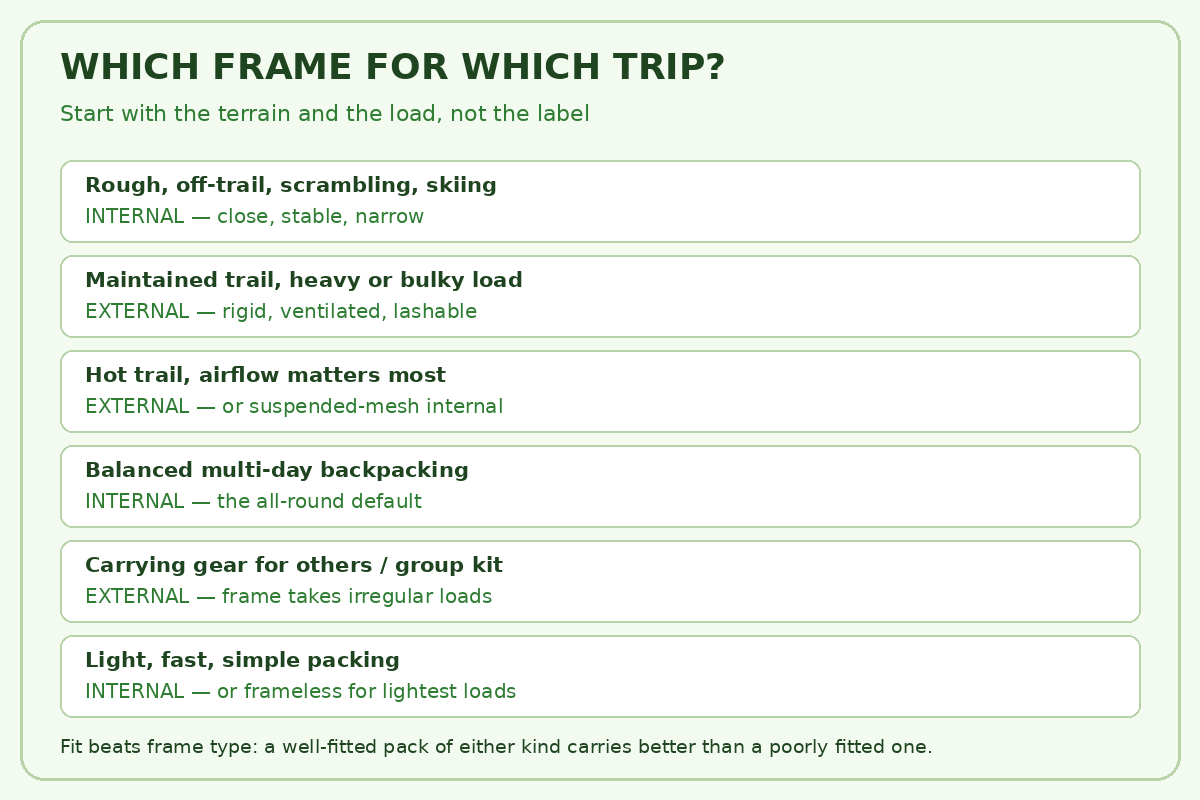
Choose internal if your trails are the story. Rough terrain, narrow paths, scrambling, winter travel, skiing and any trip where you move off maintained tread all reward the close, narrow, body-hugging load. That is also why the modern lightweight end of the market, surveyed in our lightweight hiking backpacks guide, is almost entirely internal: when every gram and every wobble matters, closeness wins.
Choose external if the load is the story. Heavy basecamp hauls, group gear, hunting and trail-work loads, bulky items that will never fit a sleek bag, and hot lowland trails where airflow matters all reward the rigid, lashable, ventilated frame. Remember that heavy loads also mean heavy water carries, and the CDC guidance that boiling is the most effective treatment, with filtering plus disinfection next best, decides how much of that external frame’s capacity ends up as water weight on dry routes.
The Middle Ground Most Hikers Actually Live In
Most ordinary backpacking sits between the extremes. A maintained-trail, multi-day trip with a sensible load suits either frame, and in that wide middle the decision comes down to fit, ventilation preference and the pack you already own. This is also where frameless and hybrid designs borrow from both sides, which is why understanding the two pure frame types first makes every modern variation easier to judge.
How to Decide in the Shop and on the Trail
Test with real weight, in a fixed order. Load each candidate with the weight you actually carry, walk, climb the shop stairs if there are any, and twist at the waist. An internal frame should feel like the load disappears into your hips and moves when you move. An external frame should feel upright, airy and utterly unmoved by the load’s shape. The essentials discipline in the American Hiking Society list keeps that test honest, because the weight you test with should be the weight of a real, safe load, not an optimistic one.
Then check the small systems. Work every strap in the order you would on the trail, confirm the hip belt centres on your bones with room to tighten further, and pack one awkward item — a canister, a bulky layer — to see where it honestly goes. Our day hiking checklist scales the same test down for shorter trips, and the planning habit behind Leave No Trace — prepare for the place and conditions in front of you — is the right final filter: choose the frame that suits the trips on your calendar, and carry the REI ten essentials framing with you whichever frame wins.
Our view
I reach for an internal frame on almost every trip I take, and I still keep respect for the external design that taught this whole sport how to carry weight on its hips. Start with the pack size guide so the volume is right, read the external frame roundup if your loads are heavy and your trails are kind, and glance at the frameless roundup before you decide a frame must weigh anything at all, and the internal frame vs external frame backpacks choice stops being a debate and becomes a description of your next trip.
— Brian Ka
FAQ
Is an internal frame backpack better than an external frame?
Neither is better in general; each is better at a different job. Internal frames carry closer and steadier on rough ground, which is why they dominate modern backpacking. External frames carry heavier, bulkier loads with better airflow on maintained trails. The better frame is the one matched to your terrain, your load and your body.
Why did internal frame backpacks take over?
Because most backpacking moved toward their strengths. As trails, travel and off-trail travel rewarded narrower, closer, more stable loads, internal designs fitted the trips most people actually take. Manufacturing followed: stays, framesheets and suspended mesh panels became cheap to build well, while external frames settled into the heavy-load and traditional niches they still serve.
Can an external frame backpack carry more weight?
Generally yes, comfortably and repeatedly. A rigid frame does not sag or twist as load rises, and gear can be lashed outside the bag, so total carried weight can exceed what the bag alone holds. That advantage only counts on ground where the taller, wider load stays manageable — weight capacity is not the same as terrain capability.
Are external frame backpacks cooler to wear?
Yes, in most conditions. The packbag hangs behind a back band rather than against your spine, so air flows across your back as you walk. Suspended mesh internal frames narrow the gap considerably, but a contact-panel internal frame on a hot climb remains the warmest way to carry a load.
What about frameless backpacks?
They are the light, simple end of the same spectrum. With no stays or frame, a frameless pack relies on its packed contents and a foam pad for structure, which works only at light loads. They suit experienced hikers with compact, light kits, and they punish heavy or badly packed loads immediately through the shoulders.
Questions About Backpack Frames?
Tell us your typical load, your trails and your torso length, and we will help you work out whether an internal or external frame will carry it better.
Contact UsSources
- REI — How to Choose a Backpack: Sizing & Fit Guide
- Osprey — Atmos AG 65
- Gregory — Baltoro 65
- Deuter — Aircontact Core 45+10 SL
- Kelty — Yukon External Suspension Instructions
- Kelty — Tioga and Trekker External Suspension Instructions
- REI — How to Fit a Backpack
- National Park Service — Hiking Safety
- USDA Forest Service — Know Before You Go
- REI — Backpacking Tips for Beginners
- National Park Service — Leave No Trace Seven Principles
- REI — The Ten Essentials
- CDC — Water Treatment Options When Hiking, Camping, or Traveling
- American Hiking Society — The 10 Essentials of Hiking