

As an Amazon Associate I earn from qualifying purchases.
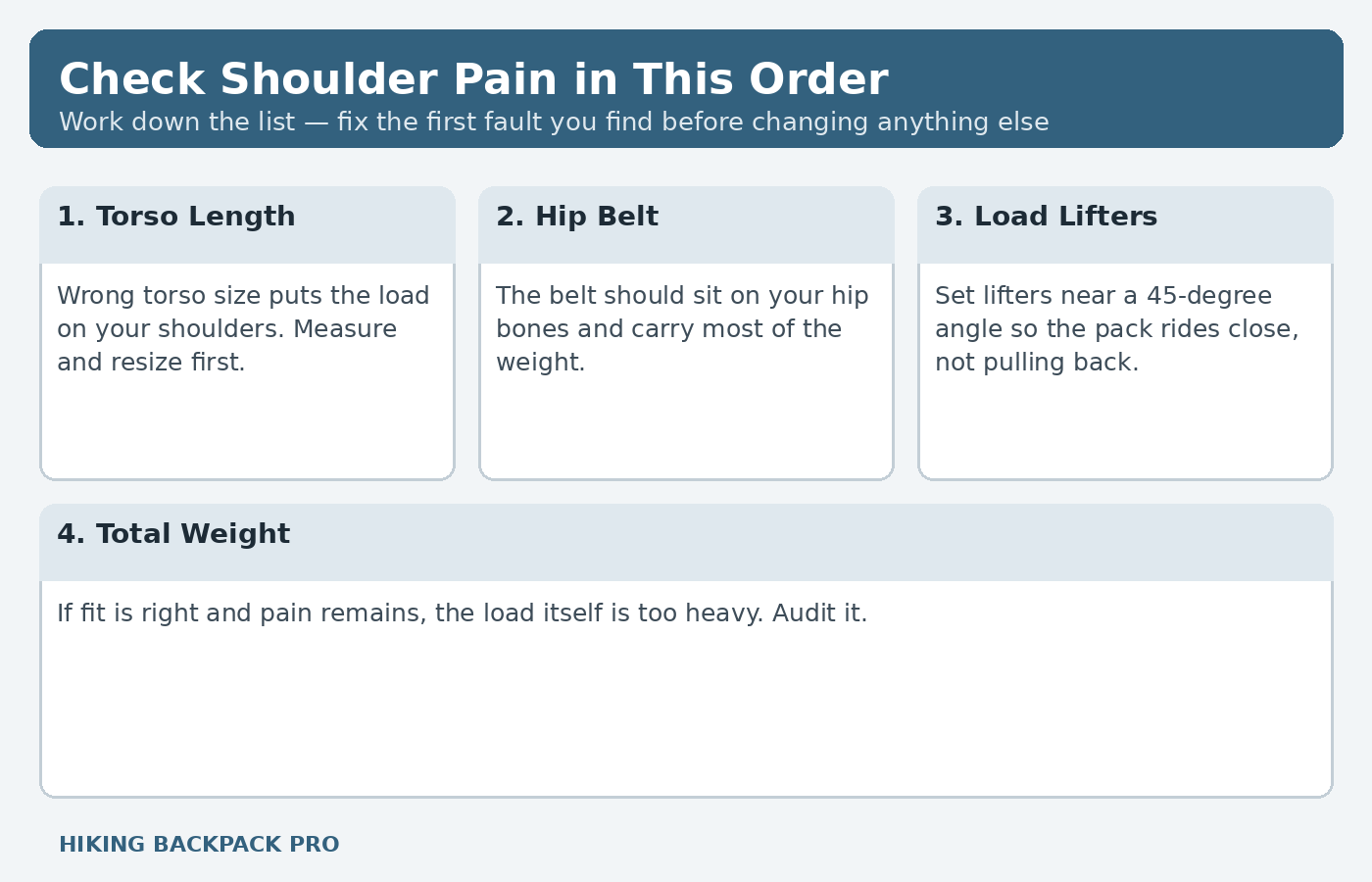
Shoulder pain from a backpack almost never means you need softer shoulder straps. It usually means the load that should be riding on your hips is hanging from your shoulders instead, because one fit step upstream has failed. Work through the causes in the order below — torso length first, hip belt second, straps third — fixing each one before you judge the next, and most shoulder pain disappears without buying anything at all.
Fit the Pack to Your Torso First — Everything Else Follows
Our step-by-step torso fitting guide shows you how to measure correctly and set the harness so the hip belt can actually do its job.
Key Takeaways
- Measure your torso length before adjusting anything else, because a pack built for a different back length can never transfer load to your hips properly.
- Tighten the hip belt first, centered on your hip bones, and let it carry the load — shoulder straps should stabilize the pack, not hold it up.
- Set load lifters to a moderate angle and snug them gently; cranking them hard pulls the pack into your neck and makes shoulder pain worse, not better.
- Weigh your loaded pack honestly, then remove or redistribute weight before blaming the suspension — excess weight defeats even a correctly fitted, well-made pack.
- Stop and seek medical advice promptly if shoulder pain comes with numbness, pins and needles that persist, weakness, or loss of feeling in your arm.
Table of Contents
- Start With the Symptom: A Quick Diagnosis Table
- Cause 1: Torso Length Mismatch
- Cause 2: The Hip Belt Is Not Carrying the Load
- Cause 3: Shoulder Straps and Load Lifters
- Cause 4: Sternum Strap Position and Tension
- Cause 5: Total Pack Weight Is Too High
- Cause 6: Packing and Weight Distribution
- Cause 7: The Pack Is the Wrong Size for the Load
- The Full Reset: Refit in the Correct Order
- When Shoulder Pain Is Not a Fit Problem
- Our View
- Frequently Asked Questions
- Sources
- Recommended
Start With the Symptom: A Quick Diagnosis Table
Read your symptom before touching a strap. Where pain sits, when it starts, and what else you feel point to different causes. Match your pattern to the table, then work that cause first — but still check the earlier causes, because torso and hip belt problems hide behind almost every row.
| Symptom | Likely cause | First fix |
|---|---|---|
| Both shoulders ache early, pack feels like it hangs backward | Torso length mismatch or loose hip belt | Measure torso, recenter and tighten the hip belt |
| Deep ache on top of the shoulders, straps leave marks | Hip belt not carrying the load | Refit the belt on the hip bones, loosen shoulder straps slightly |
| Pain at the front of the shoulder or collarbone | Load lifters cranked too tight or sternum strap too high | Ease the lifters, lower and loosen the sternum strap |
| One shoulder hurts more than the other | Uneven packing or uneven strap tension | Repack balanced left to right, equalize strap lengths |
| Shoulders fine at first, painful after hours | Total weight too high or weight packed too far back | Weigh the load, move heavy items close to your back |
| Numbness, tingling, or weakness in an arm or hand | Possible nerve compression — not a simple fit issue | Stop, remove the pack, and read the medical section below |
Use the table as a starting point, not a verdict. A well-fitted pack should feel balanced on your hips and not shift or sway. If yours sways or pulls backward, the problem is load placement or fit, not toughness.
Cause 1: Torso Length Mismatch
Check torso length first because nothing downstream can compensate for it. A pack is sized by back length, not height or liters. If the frame is longer or shorter than your torso, the hip belt and harness anchors land in the wrong places and the load lifters cannot reach a working angle — every later adjustment becomes an attempt to disguise a sizing error.
How to measure correctly
Measure from C7 to the iliac crest. The Osprey sizing guide defines torso length exactly this way: find the C7 vertebra, the bump at the base of your neck when you tip your head forward, then measure down your spine’s curve to the iliac crest, the top of your hip bones. Have someone else hold the tape if you can.
Compare the number to the maker’s chart for your exact model. Size ranges differ between brands and models, so a medium in one pack is not a medium in another.
Signs your torso length is wrong
Too long looks like this: the hip belt slips toward your thighs, the shoulder straps ride close to your neck, and the load tilts backward. Too short looks like the opposite: the belt rides onto your soft waist where it cannot grip bone, the padding finishes short, and the straps cut in and slide off your shoulders.
The fix decision is simple. If your pack has an adjustable torso, set it to your measured length and retest loaded. If it is a fixed size and your measurement falls outside its range, no strap sequence will fix it — you need a different size. Our walkthrough in how to fit a hiking backpack to your torso length covers the loaded test, and what size hiking backpack do I need separates torso sizing from volume.
Cause 2: The Hip Belt Is Not Carrying the Load
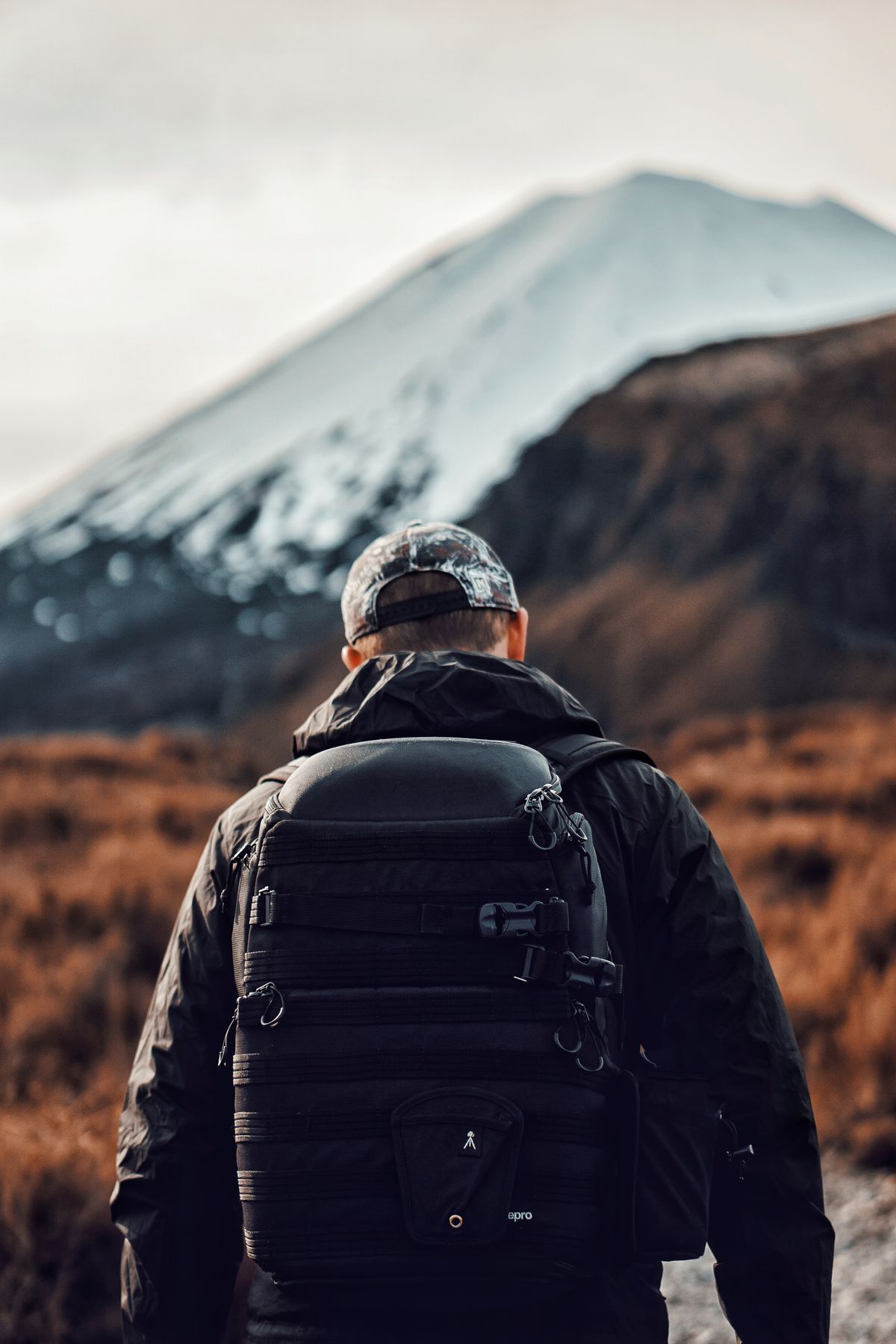
This is the most common cause of shoulder pain, by a wide margin. A framed pack is designed so the pelvis carries most of the weight; your hips and legs are built for load, your shoulders are not. When the belt is loose, sits on your waist instead of your hip bones, or is too large to tighten, the missing share transfers straight to the shoulder straps.
Position and tightness, in that order
Center the padded belt on your hip bones, then tighten it firmly. Deuter’s sequence in its adjustment guide puts the center of the hip fins over the top of the hip bone: too high restricts the waist, too low rubs the thighs and cannot lock on. Pads meeting in the middle mean the belt is too big to tension; pads barely reaching around mean it is too small.
Do the slack-strap test. With the belt centered, tight, and loaded, briefly loosen the shoulder straps. If the pack stays seated, the belt is working; if it slides down, belt position, belt size, or torso length is wrong — revisit Cause 1. Belts that bottom out are often a fit-category issue, hence the separate guides for backpacks for petite frames, backpacks for plus-size hikers, and hiking backpacks for tall men.
Worn or thin belt padding is real but secondary. If position and size are right and pressure still concentrates on one point, padding upgrades are a legitimate next step.

Aymzbd Padded Hip Belt for Hiking
- 【Design】Thickened elastic black foam padding makes your waist comfrotable during heavy backpacking.
- 【Fit】Widened and reinforced structure ensures a snug wrap your waist, prevent slipping or shifting during movement.
- 【Ergonomic Support】Designed to fit the curve of your waist, this pad provides stable support and enhances comfort for extended wear.
New starting from: 30.49 $
Go to AmazonCause 3: Shoulder Straps and Load Lifters
Shoulder straps should wrap, stabilize, and share — not hoist. Once the belt is set, snug them until they lie smoothly with no large gap and no digging at the neck or armpit. If you must pull them very tight to stop sagging, go back to the hip belt: the load never transferred.
Load lifters: the most over-tightened strap on the pack
Snug the load lifters gently; do not crank them. These small straps draw the top of the load closer to your back and fine-tune how much weight the shoulders feel. Gregory explains in its fit and sizing guidance that tightening lifters while loosening the shoulder adjustment shifts weight toward the hip belt, while the reverse shifts weight toward the shoulders for short steep sections — lifters are a dial, not a winch.
Watch the angle as a diagnostic. On a correctly sized pack, moderately tensioned lifters sit at a clear upward angle from shoulder to pack. If yours lie flat or stand nearly vertical, recheck Cause 1. The REI fitting guide walks through the same order step by step.
Change one thing at a time. Adjust a little, walk several minutes, then judge.
Cause 4: Sternum Strap Position and Tension
The sternum strap is a stabilizer, not a load-bearing strap. It links the shoulder straps so they stay at a comfortable width and do not slide outward. It should sit across the upper chest, below the collarbones, snug enough to hold position without restricting breathing.
Too high or too tight creates its own pain. A strap cranked tight at throat or collarbone height can produce front-of-shoulder and chest discomfort that hikers misread as a shoulder-strap problem, and any strap that restricts breathing is too tight.
The quick sternum check
Slide it, loosen it, retest. Drop the strap an inch, ease tension until you can breathe and swing your arms fully, then walk. If the ache fades, the fix costs nothing. If the straps immediately slide off without it, that points to harness width or torso fit — a reason some hikers do better in models for narrower shoulders, covered in hiking backpacks for women.
Cause 5: Total Pack Weight Is Too High
Even a perfect fit has a weight limit — yours. Past a certain load, discomfort stops being a fit failure and becomes overload: the suspension compresses, the belt creeps, and your shoulders take a growing share. Weigh the pack fully loaded, with water and food. The number you hope it is does not count.
Use body weight as a rough reference, not a guarantee. The AAOS backpack guidance notes that heavy backpacks can cause back, neck, and shoulder pain and that recommended limits vary — for children it cites the commonly suggested ten to twenty percent of body weight. Adult hiking loads differ, but the principle transfers: relative load and conditioning matter, and pain is information, not a challenge.
Research points the same direction. A peer-reviewed review of backpack ergonomics in PMC found that a pack’s effects depend on weight carried, pack design, and their interaction with the wearer, and recommends a hip belt and a higher, tighter load placement.
The fix is subtraction before substitution. Remove what did not earn its place before buying lighter replacements. If your load is genuinely heavy, use a pack framed for it, such as those in best hiking backpacks for heavy loads, and compare best lightweight hiking backpacks when cutting weight.
Cause 6: Packing and Weight Distribution
A correctly fitted pack can still hurt if it is packed badly. Heavy items placed low, far from your back, or on one side create leverage that pulls the pack backward or twists it sideways. Your shoulders then work continuously to correct that pull — which is why some hikers feel fine for a mile, then increasingly sore as the load shifts.
Pack in zones, with the dense core against your back. REI’s zone system in how to pack a backpack puts bulky camp items at the bottom, dense items in the core close to your back, and bulkier trail essentials at the top. Heavy gear too low sags; too high feels tippy. Balance left to right, fill gaps, and tighten compression straps.
Three packing mistakes that load the shoulders
Water and food far from the back panel — your densest items, and even a few inches outward increases the backward pull. A heavy lid, which raises the center of gravity and feels unstable on uneven ground. External lashing as overflow — loose gear swings and adds shoulder work with every step. Our step-by-step in the best way to pack a backpack for hiking applies the same logic in full, and repacking is the fastest change to test after the hip belt.
Cause 7: The Pack Is the Wrong Size for the Load
Volume mismatch is the last mechanical cause to check. A pack far too large lets gear slump low and far from your back, beyond what compression can stabilize. A pack too small forces the opposite error: gear strapped outside, a lid riding high, and a frame carrying more than its suspension was built for.
Match volume to the trip, not the biggest trip you can imagine. Start from the sizing logic in what size hiking backpack do I need, then confirm torso size separately — liters describe capacity, never fit.
The fix decision: if your pack fits your torso and carries your typical load well, keep it and fix the earlier causes. If you routinely overfill or underfill it, a correctly sized pack solves what adjustment cannot.

Keenso Padded Replacement Shoulder Straps
- [Versatile Replacement]Adjustable shoulder straps fit various backpacks, enhancing comfort during travel and outdoor activities.
- [Padded Comfort]Soft padded design minimizes shoulder fatigue, ensuring a pleasant experience for long-term wear.
- [Durable Materials]Constructed with Oxford cloth and mesh, designed to withstand outdoor conditions.
New starting from: 13.22 $
Go to AmazonThe Full Reset: Refit in the Correct Order
When several small errors stack up, start over instead of patching. Load the pack with real trail weight, loosen every strap, and follow the makers’ agreed order, because each step depends on the one before it. Choosing a pack follows the same logic, which is why REI’s backpack guide treats sizing and fit as the starting point.
First, set the torso adjustment to your measured length. Second, center and tighten the hip belt on your hip bones. Third, snug the shoulder straps until they wrap smoothly. Fourth, tension the load lifters moderately. Fifth, position and lightly snug the sternum strap. Finally, tighten stabilizers and compression straps, walk, climb stairs if you can, and make one small correction at a time.
When Shoulder Pain Is Not a Fit Problem
Some symptoms should end the fitting process and start a medical conversation. This section is general information, not a diagnosis. It covers the patterns medical authorities say deserve prompt professional assessment rather than another strap adjustment.
Numbness, tingling, and weakness deserve particular attention. The Mayo Clinic describes brachial plexus symptoms including burning or electric-shock sensations down the arm, numbness and weakness in less severe injuries, and, in serious cases, inability to use certain muscles, loss of feeling, and intense pain. Heavy straps can compress the nerves crossing the shoulder: backpack palsy is documented in a case series in PMC and a military review in PMC, attributing it to compression or stretching of the brachial plexus. That is a reason to take nerve symptoms seriously, not to diagnose yourself.
Use the NHS thresholds as a practical guide. The NHS shoulder pain page advises seeing a clinician if pain worsens or does not improve after two weeks, or if moving the arm is very difficult. It advises urgent assessment for sudden or very bad pain, inability to move the arm, persistent pins and needles, no feeling in the arm, a change in shape or bad swelling, or pain after an injury.
On the trail: stop, take the pack off, and do not push through numbness or weakness. If symptoms persist, recur with even a light load, or interfere with using your hand or arm, get assessed before your next loaded hike. Fit fixes are not treatment for nerve or joint injury.
Our View
In our view, shoulder pain almost always names its own cause if you check in order. Start with how to fit a hiking backpack to your torso length, make the hip belt prove it can carry the load, and repack using the best way to pack a backpack for hiking before spending anything. If a new pack is genuinely the answer, size it with what size hiking backpack do I need and let your torso measurement, not the liter number, make the call.
— Brian Ka
Frequently Asked Questions
Should a backpack rest on your shoulders or your hips?
On a framed pack, most of the load should rest on your hips through a correctly positioned hip belt, with the shoulder straps stabilizing and sharing a smaller portion. If your shoulders feel like the primary support, check torso length and hip belt fit first.
How tight should shoulder straps be?
Snug enough to wrap smoothly with no large gap or sliding, but not so tight they lift the pack off your hip belt or dig into your neck. You should always be able to breathe, swing your arms, and move your head comfortably.
Can a backpack cause numbness in my arms or hands?
A heavy or badly fitted pack can compress nerves around the shoulder, and numbness, tingling, and weakness are documented symptoms in the medical literature on backpack palsy. Treat persistent numbness or any weakness as a reason to stop and seek medical assessment.
Is a padded shoulder strap the solution to shoulder pain?
Rarely on its own. Padding spreads pressure but cannot transfer weight to your hips. Fix torso length, hip belt position, weight, and packing first; consider padding only when fit is already correct and a specific pressure point remains.
How do I know if my pack is simply too heavy?
Weigh it fully loaded and watch your posture: leaning forward, repeated shrugging, or the belt creeping as miles build all suggest overload. Remove items first, redistribute what remains close to your back, and reassess before replacing the pack.
Questions About Backpack Shoulder Pain?
Tell us your pack model, your torso measurement, and where the pain shows up, and we will point you to the fit check most likely to help.
Sources
- Osprey — Backpack Size Chart & Sizing Guide
- Deuter — How to Adjust a Backpack
- Gregory — Fit and Sizing
- REI — How to Pack a Backpack for Backpacking & Hiking
- REI — Backpacks: Adjusting Fit
- REI — How to Choose a Backpack: Sizing & Fit Guide
- Mayo Clinic — Brachial Plexus Injury: Symptoms and Causes
- NHS — Shoulder Pain
- PMC — Recovery of Brachial Plexus Lesions Resulting From Heavy Backpack Use
- PMC — Backpack Palsy and Other Brachial Plexus Neuropathies in the Military Population
- AAOS — Backpack Injury Prevention
- PMC — Impact of Backpacks on Ergonomics: Biomechanical and Physiological Effects