
As an Amazon Associate I earn from qualifying purchases.
A puppy that will one day trot happily up a mountain trail starts as a small, unfinished animal whose bones, joints, immune system and confidence are all still under construction, and the owners who get this stage right resist treating enthusiasm as readiness. This how-to gives you the safe order of operations: the veterinary checks that set your start date, the home skills to build first, how to choose and run a first short hike, when to carry instead of walk, and how to build distance by age.
See the Dogs Built for a Lifetime of Trails
Your puppy’s adult range starts with the right breed expectations, so see which dogs are made for hiking before you plan the miles ahead.
See the Best Hiking DogsKey Takeaways
- Get your veterinarian’s clearance first, because vaccinations and growth plates, not enthusiasm, set your puppy’s start date.
- Keep early outings measured in minutes, not miles, and let the puppy set the pace on soft, flat ground.
- Carry your puppy before it is tired, not after, because a carried break protects joints and keeps the day fun.
- Build one thing at a time — a little more time, then a little more terrain — and never both in the same week.
- Stop at the first tired sign and head home happy, because a puppy that ends every outing fresh asks to go again.
Table of Contents
- Step 1: Start With Your Veterinarian, Not the Trailhead
- Step 2: Build the Trail Skills at Home First
- Step 3: Choose the First Trail Like a Puppy Would
- Step 4: Run the First Hike, Minute by Minute
- Step 5: Carry the Puppy Before the Puppy Is Tired
- Step 6: Fit the Gear a Puppy Actually Wears
- Step 7: Feed, Water and Rest on a Puppy Schedule
- Step 8: Build Distance by Age, Not by Ambition
- Step 9: Follow Trail Rules With a Puppy
- Warning Signs: When to Stop, Carry or Turn Back
- Our view
- FAQ
- Sources
- Recommended
Step 1: Start With Your Veterinarian, Not the Trailhead
Step one happens in a clinic, not at a trailhead. Book a puppy visit and ask three direct questions: is my puppy’s vaccination course far enough along for public ground, does anything in this puppy’s breed, weight or structure change the exercise plan, and when would you clear us for gradually longer walks? The exercise guidance in the AKC overview of how much exercise a puppy needs is built on exactly that order — tailor activity to the individual puppy’s age, breed and development, with veterinary input, rather than copying another dog’s routine. The AVMA companion animal care guidelines make the same point: regular veterinary involvement sits at the centre of a young animal’s plan, because the plan changes as the animal grows.
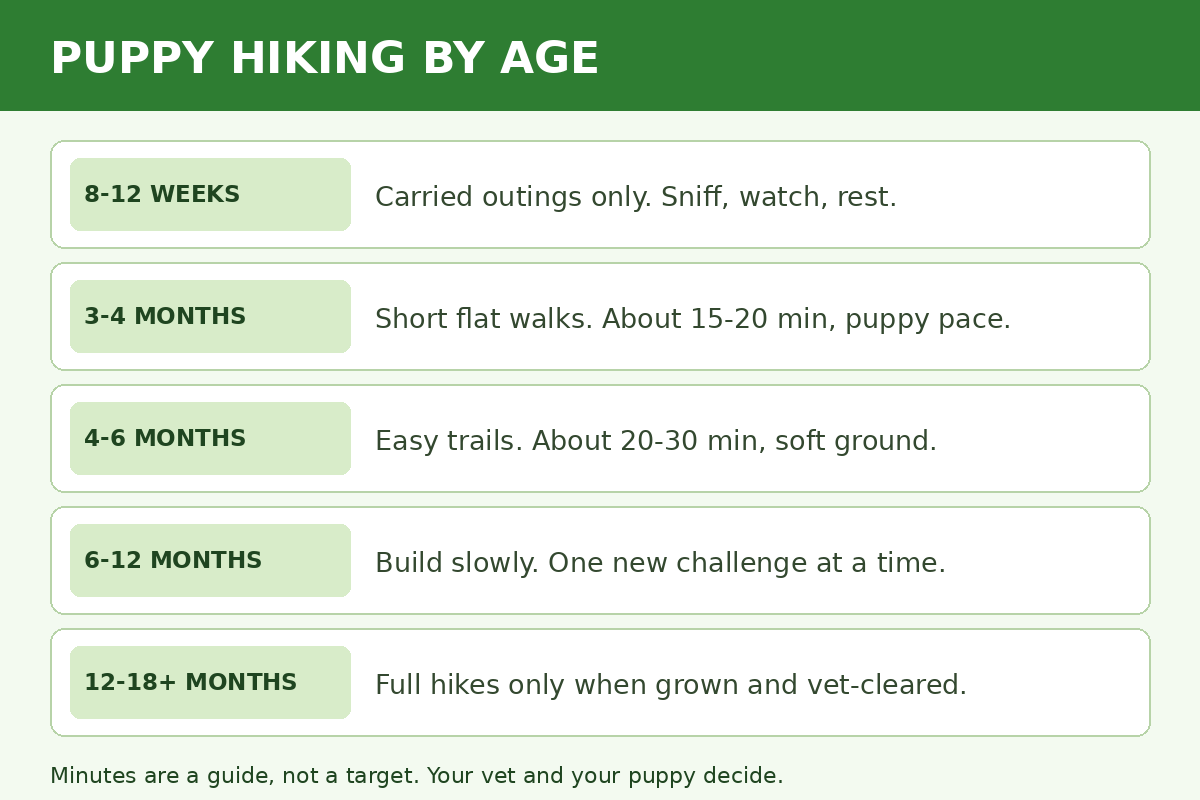
Use the age-stage table below as your map for the whole first phase. It is a planning guide, not a prescription — published guidance varies on exact minutes, and your veterinarian’s reading of your own puppy outranks any table. What the stages agree on everywhere is the shape: carried and self-paced first, short and flat next, and real trail distance only once growth is complete.
| Age stage | What is safe | What waits |
|---|---|---|
| Around 8–12 weeks | Carried outings for sights and sounds; short self-paced play and sniffing on clean ground at home | Walking on public trails and busy dog areas until vaccinations are cleared |
| Around 3–4 months | Short, flat, gentle walks of roughly 15–20 minutes at the puppy’s pace, with rest whenever it wants it | Hills, rough ground, jogging, and any walk the puppy cannot stop during |
| Around 4–6 months | Easy trails of roughly 20–30 minutes on soft surfaces, carrying breaks built into the plan | Sustained climbing, repetitive jumping, stairs as exercise, and long descents |
| Around 6–12 months | Gradually longer easy hikes, one new challenge at a time, judged by next-day recovery | Full adult distance, running on leash, and loaded or technical routes |
| Around 12–18 months and beyond | A steady build toward adult hiking once growth is complete and your vet agrees — later for large and giant breeds | Nothing is owed at this stage; the adult programme takes over from here |
Vaccinations Set the Start Date
A young puppy’s immune system is a work in progress, and public trails are shared with every dog that walked them before you. That is why the start date for walking where other dogs walk is a vaccination question before it is a fitness question. The global recommendations in the WSAVA vaccination guidelines describe a puppy series given across the early months, with timing adjusted by your own veterinarian to your region and your puppy. Until your vet clears public ground, carry the puppy to see traffic, water, bikes and trailheads from your arms, where socialisation happens without paws on shared ground. The early-care basics in the Merck Veterinary Manual puppy care guidance — veterinary visits, parasite control and gradual, supervised introduction to new experiences — describe the same foundation: health first, exposure second, adventure third.
Growth Plates Set the Ceiling
The hard limit on puppy hiking is not stamina; it is construction. A puppy’s long bones grow from growth plates, areas of cartilage near the ends of the bones that stay soft and vulnerable until they close and harden as the dog matures. The explanation in the VCA Hospitals guidance on exercise and puppy growth plates is direct: strenuous, repetitive exercise can injure those plates, so long hikes, sustained jogging and repeated jumping wait until maturity — sooner in small dogs, much later, well past a year, in giant breeds. The walking advice from the Royal Kennel Club adds the risks to avoid while joints develop: high-impact exercise, sharp sudden turns, and stairs for very young puppies. Treat every figure in this post as a cautious guide that varies by source and by puppy, never as a target.
Step 2: Build the Trail Skills at Home First
Step two happens on your street and in your garden, in sessions of a few minutes. A puppy that walks calmly on a harness, checks in with you, comes when called and settles on a mat can be managed on a trail; a puppy without those skills turns a short walk into a wrestling match. The preparation sequence in the AKC guide to training a dog to hike starts with the same home foundations — veterinary clearance, breed research and basic control — before any trail distance. Keep sessions short and successful: a few steps of loose-leash walking rewarded well beat a long march practised badly, and ending while the puppy still enjoys the game is what makes it ask for the game tomorrow.
Practise the trail situations before they are real. Pass other people and dogs at a comfortable distance and reward calm looking rather than lunging introductions. Walk over the surfaces a trail will offer — grass, gravel, a wooden board, a damp patch — so textures are old news by the first hike. Teach a settle on a blanket, because a puppy that can rest at a water stop recovers during the outing instead of winding itself tighter. Owners starting with the breeds in our first-time owners guide will recognise the pattern: easy trail dogs are made by this groundwork, not born with it. Our long-distance training guide is the programme this puppy graduates into later, not the one it starts on now.
Step 3: Choose the First Trail Like a Puppy Would
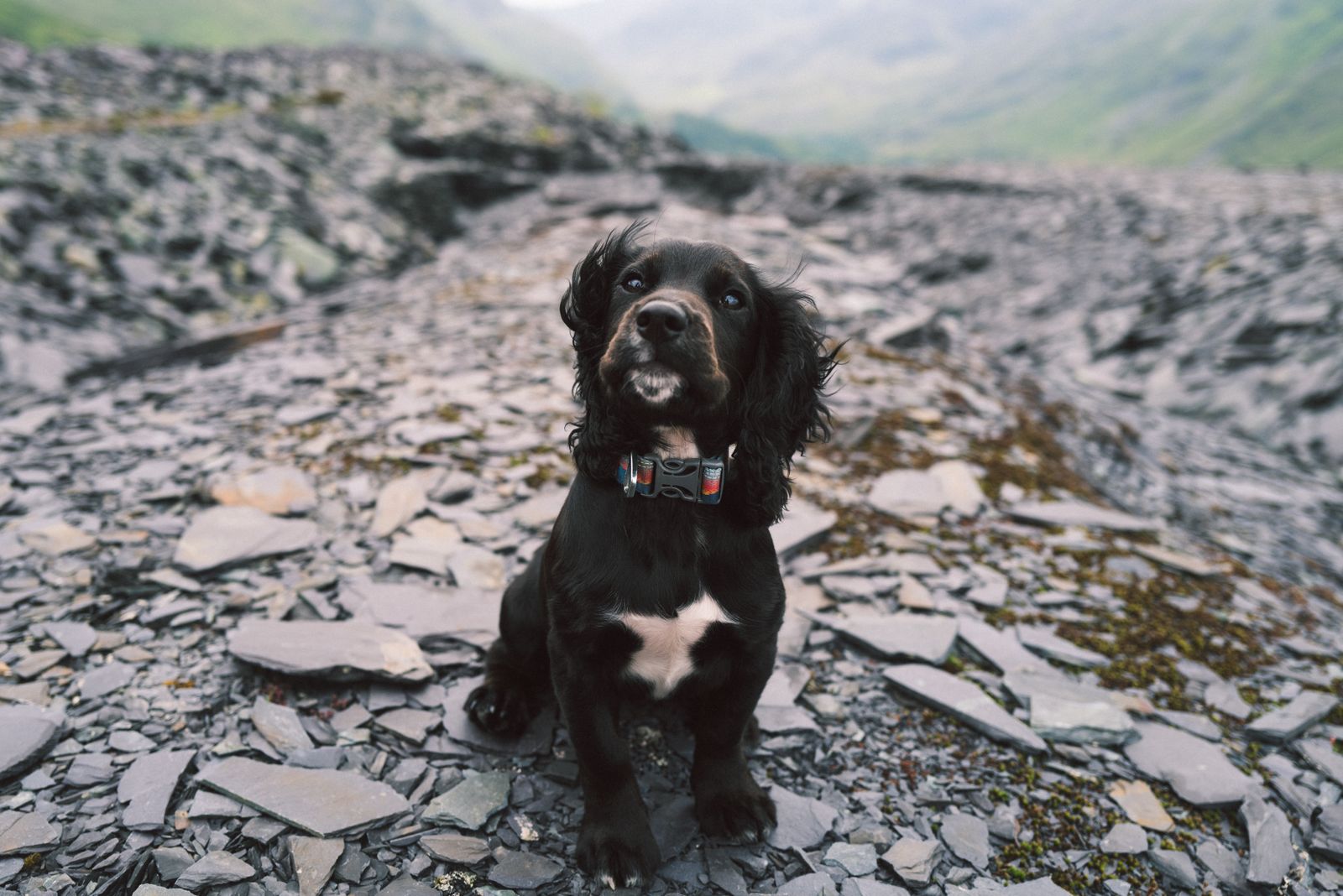
Step three is route selection, and the right first trail looks boring on paper. Choose a short, flat, shaded loop or an out-and-back you can cut at any point, on soft ground — packed earth, grass or forest tread — close to home, at a quiet time, in mild weather. Short matters more than scenic: you are testing how the puppy travels, rests and recovers, not collecting a summit. The general exercise guidance from VCA Hospitals frames the fit correctly — the right amount of exercise depends on the individual dog’s age, breed and health, and is built up progressively — which for a puppy means the easiest version of every variable at once: least distance, least climb, softest surface, coolest hour.
Read the route for puppy hazards an adult dog would shrug off. Steep descents ask growing joints to brake with every step, so save them. Rocky stretches are hard on soft young pads; the options in our dog boots guide suit grown trail dogs, but the simpler puppy answer is gentler ground. Fast water, unfenced drops, livestock and heavy bike traffic all raise the management load past what a first outing should carry. Set the turn-around by the clock: when half your planned minutes are gone, you turn, however fresh the puppy looks — the walk home still has to happen on the same small legs.
Step 4: Run the First Hike, Minute by Minute
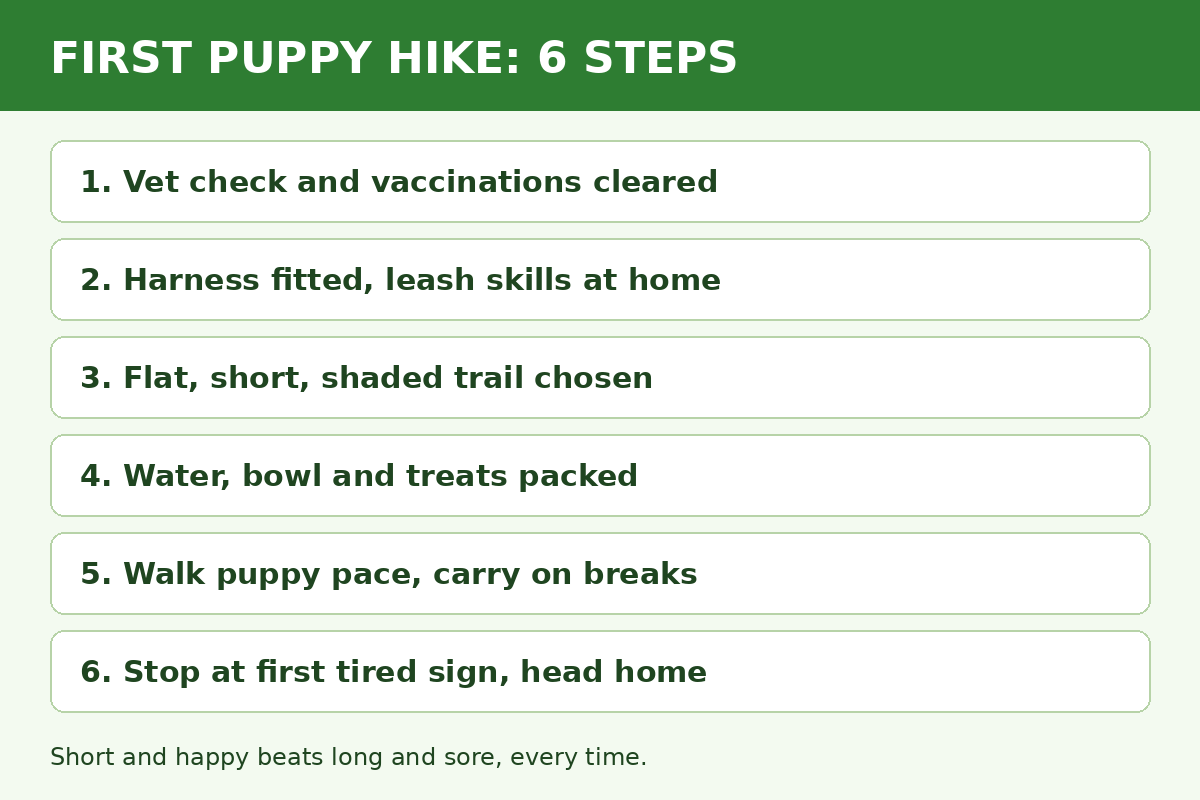
Step four is the outing itself, run as a procedure rather than a wander:
- Before you leave: feed nothing heavy in the hour before, offer water, fit the harness, and pack water, a bowl, treats, waste bags and your carrier.
- At the trailhead: let the puppy sniff and look around for a few minutes first; a puppy that has processed the place walks out calmer.
- First ten minutes: walk at the puppy’s pace — stopping whenever it stops — and reward check-ins and loose-leash steps as you trained them at home.
- Middle of the outing: take a proper rest — water offered, a settle on the blanket — before the puppy asks for one.
- Turn on time: head back at the planned halfway mark, and use the carrier for stretches of the return if the puppy flags or the ground roughens.
- At the car: water again, and a note of how far, how long and how the puppy seemed — that note plans the next outing.
The trail-craft in the American Hiking Society hiking-with-dogs guidance supports the same shape: preparation, control and consideration for other users make a dog welcome and safe on shared trails, and with a puppy the preparation simply starts smaller. Pack for the puppy on the same list as yourself — our day hiking checklist covers the human kit; the puppy additions are the carrier, the bowl, extra water and the blanket it knows from home.
Step 5: Carry the Puppy Before the Puppy Is Tired
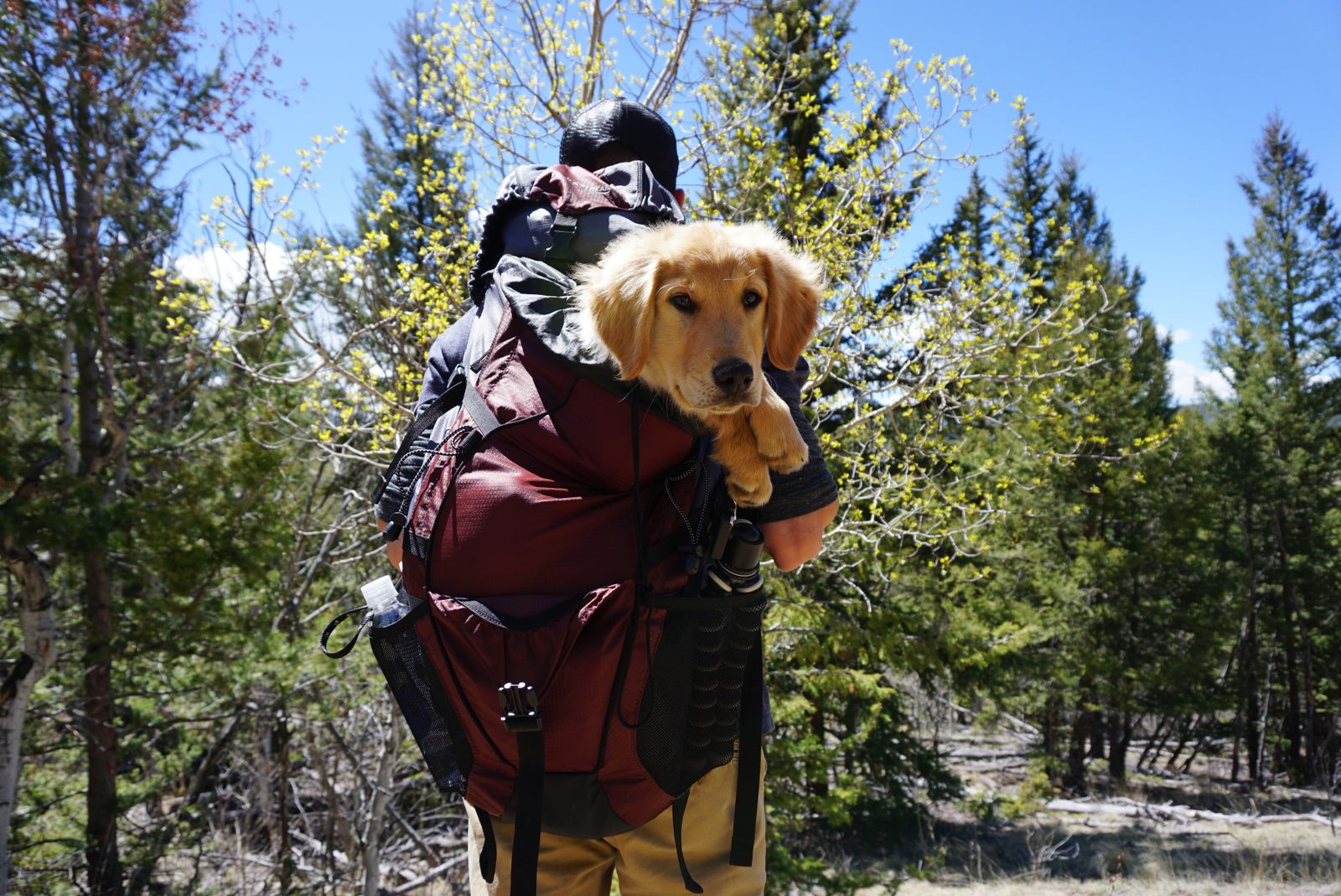
Step five is the rule new hikers resist and experienced ones swear by: the carrier is part of the hike, not an admission of defeat. A puppy’s outing can be longer than its walking budget when the difference is spent riding — watching, smelling and resting while you cover the ground between the places worth a puppy’s paws. Carrying breaks protect growing joints from repetitive loading, and they protect the day itself: a puppy carried at the first slow-down arrives home fresh, while a puppy marched to exhaustion learns that trails end in misery. Plan the carry in advance — ride the climb, walk the flat top, ride the descent is a perfectly good first-hike design.

Petskd Dog Front Carrier Backpack for Small Pet with Adjustable Cross Shoulder Straps, Hands Free Puppy Legs Out Chest Carriers for Hiking, Cycling, Vet (Black, M)
- HOW TO MEASURE YOUR PET–To get a Dog front carrier that will fit your pet properly, measure your pet’s back length (from the base of the neck to the tail) and chest girth (at the widest point behind the front legs), as well as the distance between the tail and back legs before ordering. Compare these figures to the size chart. If your pet is in between sizes, or you don’t know how to choose, please reach us first.
- ANTI-SLIP SHOULDER STRAP DESIGN–Dog hiking backpack shoulder straps feature a crossed, widened, and adjustable design that not only prevents the straps from slipping off during walks or when bending over, but also helps alleviate your back and shoulder stress by evenly distributing your pet’s weight across your upper body, minimizing pain in certain pressure points of the body such as the waist, shoulders and back. Legs out front dog carrier is a great helper for walking your pet or bending over to clean your room.
- CREATIVE FOR PET HEALTH CARRIER–Different from other pet carrier, petskd puppy carrier wearable are filled with soft sponge fleece material around the neck part, so your pet won’t get choked by gravity and throw up or suffocate. Sponge pad on the bottom of the dog holder for chest gives your pet extra support, which helps protect their spine and reduces anxiety or struggling. Front facing dog carrier makes your hands free when cycling or hiking with your pet.
List Price :
Offer: 28.48
Go to AmazonChoose the carrier for support, not cuteness. A structured base, ventilation, a safety tether clipped to its harness, and a fit that keeps the load close to your centre of gravity are the features that matter; the tested options are compared in our dog carrier backpacks guide. Introduce the carrier at home first, with treats, in minutes, so the trail version is a familiar den. Watch heat while carrying: a puppy riding against your back on a warm day can overheat quietly, and the warning picture in the AKC heatstroke overview — heavy panting, thick drool, fast-escalating distress — is why shaded rests and water apply to a riding puppy exactly as to a walking one. A puppy carries nothing on its own back; you are the pack animal here. The packs in our small dog backpacks roundup are for the grown dog.
Step 6: Fit the Gear a Puppy Actually Wears
Step six is a short kit list, fitted properly. The centrepiece is a harness, not a collar: a harness spreads pressure across the chest instead of the throat, gives you steering on uneven ground, and provides the clip point for the carrier tether. Fit it so you can slide two fingers under every strap, and check it again as the puppy grows — puppies outgrow harness settings in weeks, not seasons. A standard short leash gives you control near other trail users; the waist-belt systems in our hands-free leashes roundup suit many owners once a puppy walks predictably, but a young puppy’s lunges are easier to manage with a leash in hand.

Dog Hiking Harness
- DUAL LEASH ATTACHMENT POINTS. Features an aluminum V-ring on the back and reinforced webbing at the chest. Gives you options for everyday walks or redirecting dogs that tend to pull, so you can enjoy more controlled and pleasant outings.
- FIND THE RIGHT FIT WITH EASE. Not sure which size to choose? Check out our sizing chart image and how-to-fit video to help you measure your dog correctly. A proper fit means more comfort, control, and confidence on every adventure.
- FOAM-PADDED CONSTRUCTION. Built with closed-cell foam padding in the chest and belly panels. This provides cushioned support that helps prevent chafing during extended wear, making it ideal for long walks, hikes, or all-day adventures.
New starting from: 59.99 $
Go to AmazonBuy for the puppy in front of you, and expect to buy again. The fits in our dog hiking harnesses guide show the adjustment ranges that let one harness span a growth stage — the honest way to shop for a dog whose chest will soon be a different size. Beyond the harness, the puppy kit is deliberately small: an ID tag, waste bags, a familiar blanket for rests, and treats cut small. Boots, jackets and its own backpack are adult equipment solving adult problems; adding them now only gives a young dog more strangeness to process.
Step 7: Feed, Water and Rest on a Puppy Schedule
Step seven runs the outing’s logistics on puppy timing, which is faster and smaller than adult timing. Offer water little and often — at the trailhead, at every rest, and at the car — rather than waiting for obvious thirst, and carry the puppy’s water yourself; a young dog should drink from what you bring, never from stagnant pools. Time the outing around meals: a puppy exercised hard on a full stomach is uncomfortable at best, so walk before feeding or leave a settled gap after it, and use small treats as training rewards, not a meal substitute. The hot-weather guidance from the ASPCA underlines the discipline for all dogs in warm conditions — limit exercise in heat, provide ample shade and water — and a puppy needs it applied earlier and more strictly than an adult.

Portable Dog Water Bottle
- Easy To Use: Exclusive patented design, U2mug design dog water bottle and water bowl two in one. The fold cap acts as a water bowl, and you don’t need any external bowl to give your hairy buddy water to drink anymore.The built-in travel water bowl for dogs and water key ensure no water is wasted, making it an ideal dog travel accessories
- Large Capacity: lesotc dog water bottle with a volume of 18oz/520ml. Dog travel water bottle can provide safe, fresh, and healthy water for puppy during long walking, travel, hiking, camping and other outdoor activities. It’s addition to your dog accessories, perfect for dog beach essentials and dog camping essentials
- Leak-Proof Design: dog water bottle dispenser designed with upgraded push-button lock keeps water clean and prevents spills. This dog water dispenser is designed with silica gel seal ring which can prevent water leakage efficiently. This makes it a reliable dog portable water bottle and a safe choice for your pet
List Price :
Offer: 15.19 $
Go to AmazonMake the stop effortless or it will not happen. A bowl you can reach without unpacking turns hydration into a habit; the designs in our portable water bowls roundup are built for that trailside moment. Rest works the same way: build stops in at set intervals — every ten to fifteen minutes of walking in the early stages — instead of negotiating them with a tired puppy. During a rest, let the puppy sniff, watch and settle on its blanket with water and a chew. Finish every outing with the same quiet routine — water, a calm ride home, food once settled — because puppies learn the shape of hiking from its repetitions.
Step 8: Build Distance by Age, Not by Ambition
Step eight is the long game: converting minutes into miles across the first year and beyond, one variable at a time. When an outing ends with the puppy fresh and the next morning shows it moving freely, eating well and keen to go, you may add a little: a few more minutes, or a gentle hill, or a slightly rougher surface. Never two additions together, and hold each new level for a couple of outings. If next-day stiffness, reluctance or unusual sleepiness appears, the last step was too big; drop back to the level that produced a clean recovery. This is the same recovery logic that governs adult distance, and our dog distance explainer lays it out in full for the adult dog your puppy is becoming.
Expect the build to look uneven, because growth is uneven. Adolescent puppies go through phases of clumsiness and distraction that are developmental, not defiant; shorten the training ask during those weeks. Breed changes the timetable as much as age does — the profiles in our hiking dog breeds guide and the stamina of the small dogs that hike all day show small dogs maturing into full trail range sooner than large and giant breeds, whose growth plates close latest. When growth is complete and your veterinarian agrees, the programme in our long-distance training guide takes over.
Step 9: Follow Trail Rules With a Puppy
Step nine keeps you welcome on the trails you are training for. Check before every new route that dogs are allowed at all, and on which trails: the National Park Service guidance on visiting parks with pets is explicit that pets must be restrained, kept to permitted areas, and are excluded from many trails entirely. Add a stricter layer for a puppy — one still building its vaccination course and manners has no business in crowded trailhead scenes or off-leash areas. Keep greetings with strange dogs brief or declined, and step off the trail with the puppy held close when others pass.
Practise the etiquette as part of the training, because it is part of the training. The National Park Service B.A.R.K. Ranger framework — bag your pet’s waste, always use a leash, respect wildlife, know where you can go — reads like a puppy curriculum written by a park: every element can be practised on short outings, from packing out waste to watching wildlife at a distance without a chase. A puppy raised inside those habits becomes the adult dog other hikers are glad to meet. None of it requires a long hike to teach — just the same short hikes, run with the rules switched on from the first one.
Warning Signs: When to Stop, Carry or Turn Back
Read your puppy the way you would read weather — early signs first, while changing the plan is still cheap. The earliest fatigue signs are behavioural: a puppy that sits down, lags behind, stops to sniff everything, or tries to turn for home is not being stubborn; it is reporting its limit in the only language it has. Respond immediately — stop, rest in shade, offer water, and carry the puppy out or shorten the day. Physical signs raise the stakes: heavy panting that does not settle during a rest, thick drool, wobbliness, limping, or licking at a paw end the outing on the spot. The VCA Hospitals heat stroke guidance describes how quickly overheating can become life-threatening, which is why a puppy showing heat signs is cooled gradually, offered water without forcing it, and taken for veterinary care.
Carry the safety kit that matches the risks you can actually meet. A puppy emergency on a short trail is usually simple — a thorn, a cut pad, a bee sting — and the response steps in our injured dog guide cover what to do when a dog cannot comfortably continue, while the kits in our dog first aid kits guide make that knowledge usable with cold hands. Know the line that sends you to a veterinarian the same day: any limp persisting after rest, any swelling, any puppy quiet or off its food the morning after an outing. That morning-after check keeps small problems from becoming a serious injury.
Our view
The puppy hikers I admire are the patient ones, because the first year is not lost time — it is the foundation every long trail day stands on. Start with the breed picture in our best hiking dogs roundup, measure progress against the honest ranges in our dog distance explainer, and save the serious conditioning in our long-distance training guide for the adult dog at the end of this process, and you will get there with a partner built to last.
— Brian Ka
FAQ
When can a puppy start hiking?
On carried outings, almost as soon as it comes home; on its own paws on public trails, when your veterinarian clears it. The gates are the vaccination course, which governs where a puppy may safely walk, and your vet’s reading of the individual puppy. Before clearance, carry the puppy to see the world; after it, begin with short, flat walks measured in minutes.
How far can a puppy hike?
Far less than it wants to, and far less than an adult dog — which is the point of this guide. Published guidance varies by source, but the common shape is short sessions scaled to age: roughly fifteen to twenty minutes at three to four months, building gradually through the first year, with full distance waiting until growth is complete. Let recovery, not a mileage figure, set your number.
What is the five-minutes-per-month rule?
A widely used rule of thumb, not a law of physiology. It suggests about five minutes of structured walking for each month of a puppy’s age, once or twice a day, as a cautious cap on leash walking while it grows. Sources present it as a guide that varies by breed and individual; free play at the puppy’s own pace is a different category from marched walking, and your veterinarian’s advice outranks the rule.
Can I carry my puppy on a hike instead of walking it?
Yes — carrying is the correct way to give a young puppy a longer day out. Ride the sections that exceed its walking budget, set it down for the easy stretches, and rest it before it is tired. Use a supportive, ventilated carrier with a safety tether, introduce it at home first, and watch for overheating on warm days.
When can my puppy hike like an adult dog?
When growth is complete and your veterinarian agrees — and that date depends on size. Small breeds mature earliest, while large and giant breeds may not finish growing until well into their second year. Then switch from puppy rules to a gradual adult conditioning programme rather than jumping straight to long routes.
Questions About Hiking With a Puppy?
Tell us your puppy’s breed, age and vaccination stage, plus the trails you are dreaming about, and we will help you set a safe start and a build-up plan.
Contact UsSources
- AKC — How Much Exercise Does a Puppy Need?
- AKC — How to Train Your Dog to Hike With You
- AKC — Heatstroke in Dogs
- AVMA — Companion Animal Care Guidelines
- VCA Hospitals — How Exercise Can Damage Puppy Growth Plates
- VCA Hospitals — Exercise for Dogs
- VCA Hospitals — Heat Stroke in Dogs
- Royal Kennel Club — Puppy and Dog Walking Tips
- Merck Veterinary Manual — Puppy Care
- WSAVA — Vaccination Guidelines
- ASPCA — Hot Weather Safety Tips
- National Park Service — Pets
- National Park Service — B.A.R.K. Ranger, Shenandoah National Park
- American Hiking Society — Hiking With Dogs