
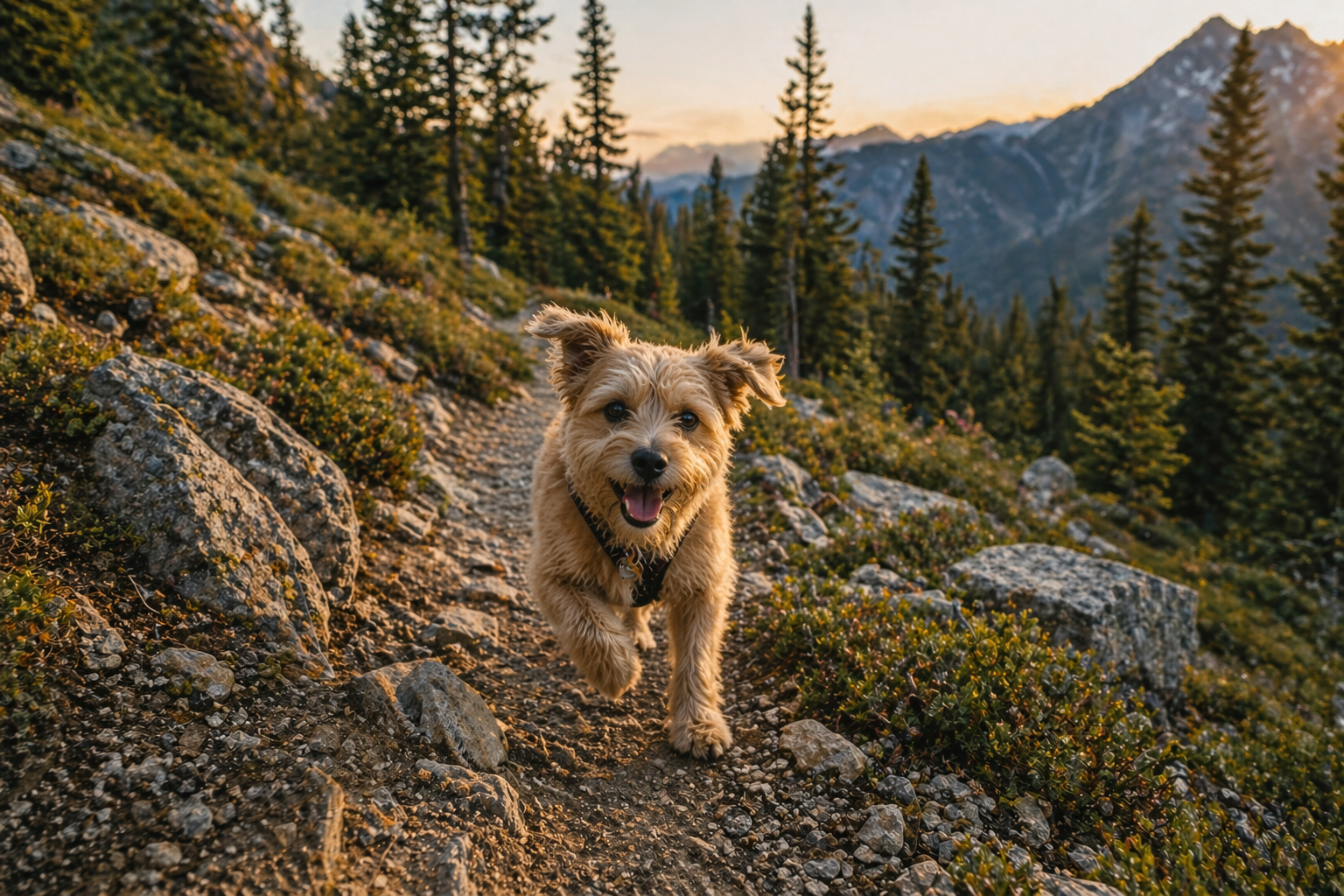
Small dogs get underestimated on the trail constantly. The assumption is that a 15-pound dog can’t possibly keep up on a serious hike — that they’ll tire out by mile two, need to be carried, or slow everything down. For the wrong breeds, that’s true. For the right ones, it couldn’t be further from reality.
The best small hiking dogs share a common thread: they were bred for physical work. Terriers were bred to hunt vermin across rough terrain for hours. Herding breeds were bred to move livestock across miles of open land. These dogs weren’t designed for the couch — they were designed for the kind of sustained activity that a long trail day demands.
This guide covers the 10 best small dog breeds that can genuinely hike all day — not just tolerate a walk, but thrive on a full-day trail adventure. We’ve also included what makes each breed suited to the trail and what to watch out for so you can match the right dog to your hiking style.
If you already have a small hiking dog, check out our guides to the best small dog backpacks for hiking and best hiking snacks for dogs to keep them geared up and fueled on the trail.
What Makes a Small Dog Good at Hiking?
Before the breed breakdown, here’s what separates a capable trail dog from one that’s going to struggle:
Leg length relative to body size. Dogs with short legs relative to their body length — like Dachshunds and Basset Hounds — work significantly harder to cover ground than dogs with proportionate legs. On a flat trail this matters less; on steep terrain it compounds quickly.
Brachycephalic (flat-faced) breeds are a no. Pugs, French Bulldogs, Boston Terriers, and Shih Tzus have compressed airways that make sustained exertion difficult and dangerous in heat. These are great companion dogs but not serious trail dogs.
Working breed history. Dogs bred for hunting, herding, or other sustained physical work have the cardiovascular capacity and mental drive to stay active for hours. Most terriers, herding breeds, and hunting hounds fall into this category.
Temperament on trail. A dog that’s easily distracted, has a high prey drive that overrides training, or gets anxious around other hikers creates trail problems. The best small hiking dogs are focused, trainable, and adaptable to new environments.
Paw durability. Smaller paws on rough terrain can become a limiting factor on long days. Building up calluses gradually and bringing dog booties for harsh conditions protects your dog’s paws on demanding routes.
1. Jack Russell Terrier — Best Small Dog for All-Day Hiking
Jack Russells are the gold standard for small trail dogs. Originally bred in England for fox hunting — which required hours of sustained effort across fields and through brush — these dogs have an almost inexhaustible engine. A well-conditioned Jack Russell will still be looking for more trail at the end of a 10-mile day.
Their compact, muscular build and proportionate legs make them efficient hikers across varied terrain. They’re light enough to carry if conditions require it but rarely need it. The AKC notes that Jack Russells need around 90 minutes of exercise per day just to stay balanced — which tells you everything about their capacity for longer efforts.
The trade-off is the prey drive. Jack Russells are terriers to their core — if they spot a squirrel, rabbit, or any moving wildlife, recall can fail even in well-trained dogs. Keep them leashed on trails where wildlife is a factor, and invest seriously in recall training before relying on off-leash freedom.
Trail verdict: The most capable all-day hiking small dog available. High prey drive requires management but doesn’t diminish the breed’s trail credentials.
2. Miniature Australian Shepherd — Best for Technical Terrain
The Mini Aussie carries all the athleticism, intelligence, and drive of the standard Australian Shepherd in a more trail-portable package — typically 20–40 lbs depending on the individual. They were bred to herd livestock across demanding terrain all day, and that stamina translates directly to serious hiking.
What makes Mini Aussies exceptional on technical terrain is their agility and body awareness. They navigate rocks, roots, and steep grades with natural confidence, reading the ground underfoot in a way that many small dogs don’t. Their intelligence also makes them highly trainable — reliable recall, good trail manners, and adaptability to new environments are all strengths of the breed.
The double coat requires more grooming after trail days, particularly in areas with burrs and brush. They also have significant exercise needs even off the trail — this is not a low-maintenance dog.
Trail verdict: One of the most capable and versatile small hiking dogs available, especially on demanding or technical routes.
3. Cairn Terrier — Best for Rocky and Rugged Trails
The Cairn Terrier was bred in the Scottish Highlands specifically to work across rocky, uneven terrain — hunting prey through cairns (rock piles) in some of the most challenging landscape in the British Isles. That origin story is essentially a resume for trail hiking.
Their wiry double coat provides natural protection from brush, thorns, and weather without requiring the maintenance of longer-coated breeds. They’re sturdy, low-slung dogs with excellent paw durability — built for the kind of rough ground that wears out softer-pawed breeds quickly.
Cairn Terriers are also known for staying active well into their senior years. If you’re looking for a decade-plus hiking companion, this breed has the longevity to stay on the trail with you long after many other dogs have slowed down.
The independence streak common to terriers means training requires consistency. They’re not naturally biddable dogs — recalls need work, and they’ll investigate every interesting scent given the opportunity.
Trail verdict: One of the most purpose-built small dogs for rugged, rocky terrain. Excellent durability and trail longevity.
4. Beagle — Best for Scent-Driven Trail Exploration
Beagles are scent hounds bred for sustained hunting over long distances, and that background gives them a natural capacity for all-day hiking that surprises people who think of them as just a friendly family dog. They’re sturdy, even-tempered, and have the cardiovascular endurance to cover serious miles.
On the trail, Beagles are particularly good at engaging with the environment around them — following scent lines, investigating the natural world, staying curious and motivated over long distances. For hikers who want a dog that seems genuinely excited about every mile rather than just tolerating the effort, Beagles deliver that energy consistently.
The caveat is the nose. Beagles follow scent with singular focus, and a compelling smell can temporarily override training. Like Jack Russells, reliable recall requires serious work before off-leash trail use. Keep water and trail snacks readily available — Beagles are motivated by food and known for big appetites, which makes them easy to reinforce but also means they’ll let you know when they need refueling.
Trail verdict: Excellent endurance and trail enthusiasm. Scent drive requires management but doesn’t limit trail capability on leash.
5. West Highland White Terrier — Best Low-Maintenance Trail Dog
The Westie was bred for fox and badger hunting in the Scottish Highlands — demanding, sustained work across rough terrain that required both endurance and toughness. Despite their compact size and bright white coat, these are working dogs underneath the fluffy exterior.
What makes Westies particularly practical as trail dogs is the combination of capability and low health maintenance. The breed is generally robust, with fewer of the joint and respiratory issues that limit other small breeds, and their wiry coat is surprisingly resilient against brush and light rain.
They’re friendly with other hikers and dogs on the trail — a meaningful practical advantage on popular routes where encounters are frequent. Training responsiveness is better than most terriers, though the independent streak still requires consistent work.
Trail verdict: A capable, durable small trail dog with good social temperament and fewer health complications than many comparably-sized breeds.
6. Miniature Pinscher — Best Athlete in a Small Package
Min Pins punch dramatically above their weight class on the trail. Despite standing just 10–12 inches tall, they’re among the most athletic small dog breeds available — muscular, agile, and built with proportionate legs that make them efficient movers across varied ground.
Their energy level is high and sustained rather than explosive and brief. A Min Pin that’s been conditioned for trail use can maintain effort over long distances in a way that surprises hikers unfamiliar with the breed. They love fast-paced, demanding exercise — a long trail day is exactly what they’re designed for.
The challenge is the independent temperament. Min Pins are confident, sometimes stubborn dogs that respond best to early, consistent obedience training. A Min Pin with solid trail manners is a capable hiking companion; one without that foundation can be challenging to manage off-leash.
Trail verdict: Exceptional athleticism for the size. Temperament management is the work required to unlock the breed’s trail potential.
7. Dachshund — Best Small Dog for Moderate Trails
Dachshunds are more capable on trail than their body shape suggests. The long, muscular build and deep chest give them real cardiovascular capacity, and their history as scent hounds bred to track prey underground means they have both the drive and the stamina for sustained effort.
On moderate, non-technical terrain, a well-conditioned Dachshund can cover impressive mileage. Their low center of gravity gives them surprising stability on uneven ground, and the determination bred into the line means they rarely give up willingly.
Where they hit their limit is steep terrain. The lever mechanics of a long spine and short legs on serious elevation gain creates significantly more physical effort than a proportionally-built dog faces. On trails with major elevation changes, a Dachshund will work harder than its companions, which shortens the realistic day. On flat to rolling terrain, they’re far more capable than most people expect. For dogs that occasionally need a break, a quality carrier takes the pressure off — our best dog carrier backpacks for hiking guide has solid options.
Trail verdict: Capable and determined on moderate terrain. Steep elevation is the limiting factor to plan around.
8. Miniature Schnauzer — Best Small Dog for Cold Weather Hiking
The Miniature Schnauzer is a sturdy, intelligent small breed with a double coat that provides genuine weather protection — making them one of the better small options for hikers who push into cold, wet, or variable conditions.
Their endurance is solid without being exceptional — they’re not going to run circles around a Jack Russell, but a well-conditioned Mini Schnauzer can handle a full day of moderate to challenging hiking without difficulty. Their alert, focused temperament translates well to trail behavior: attentive to their handler, not excessively reactive to wildlife or other dogs.
The double coat that helps in cold weather requires maintenance in warmer months — burrs and debris accumulate in the wiry fur more than in smooth-coated breeds. Regular grooming after trail days is part of the deal.
Trail verdict: A reliable, weather-resistant small trail dog particularly well-suited to cold and wet conditions.
9. Alaskan Klee Kai — Best for High-Energy Mountain Hiking
The Alaskan Klee Kai is a rare breed that most hikers haven’t heard of — essentially a small Husky analog with Husky-level energy and endurance packed into a 10–25 lb frame. They were developed specifically to have the working capacity of a Siberian Husky in a more compact size.
On the trail, a Klee Kai is genuinely impressive. The high-energy, athletic build and Husky heritage mean they’re built for sustained effort in cold, mountainous terrain — exactly the kind of conditions that challenge many small breeds. They’re agile, sure-footed, and seem to find difficult terrain motivating rather than discouraging.
The breed is less common and can be harder to find from responsible breeders. They also inherit some of the Husky’s independent streak and vocality — training and socialization are important. But for mountain hikers looking for a small dog with serious alpine capacity, the Klee Kai is worth seeking out.
Trail verdict: Exceptional capacity for cold-weather and mountain hiking. Less common but worth the effort for serious alpine hikers.
10. Chihuahua — Most Surprising Small Hiking Dog
This one surprises most people. Chihuahuas have a reputation as pampered lap dogs — but the right Chihuahua, with proportionate legs and a confident temperament, can be a genuinely capable trail companion on appropriate terrain.
The key qualifier is individual variation. Chihuahuas vary significantly in body structure — deer-type Chihuahuas with longer legs are far better suited to serious hiking than apple-head Chihuahuas with shorter, stockier builds. A fit, long-legged Chihuahua can cover 5–7 miles on a moderate trail without difficulty, and their light weight makes them easy to carry when conditions get beyond their limit.
Their heat tolerance is better than many small breeds, making them practical options for warm-weather hikers in desert or lower-elevation environments. In cold conditions they struggle — a dog jacket and careful weather monitoring are essential.
Trail verdict: More capable than the reputation suggests on appropriate terrain, with significant individual variation. Best for moderate trails in mild to warm conditions.
How to Prepare Your Small Dog for All-Day Hiking
Build up gradually. Start with short hikes of 2–3 miles and increase distance over several weeks. Small dogs build trail fitness just like humans do — rushing into long days before their body is ready leads to sore muscles, joint stress, and setbacks.
Watch the paws. Small dog paws on rough terrain wear down faster than large breeds. Check paws after every hike for cuts, cracks, and abrasions. Dog booties help on particularly rough or hot terrain.
Carry water for them. Dogs don’t sweat — they cool themselves by panting, which requires water. A collapsible dog bowl weighs almost nothing and keeps your dog properly hydrated on long days. Never rely on trail water sources alone, especially in summer.
Know the signs of fatigue. Excessive panting, slowing down, reluctance to move forward, and seeking shade are all signals that your dog needs a break. Small dogs won’t always tell you when they’ve hit their limit — watch their body language.
Train recall before off-leash use. For any of the terrier or hound breeds on this list, reliable recall is non-negotiable before going off-leash. Even well-trained dogs can be overridden by a strong prey drive. Invest in recall training seriously before trusting it on trail.
Gear up appropriately. A well-fitted harness distributes trail stress better than a collar. For dogs that carry their own gear, our best dog backpacks for hiking guide covers options for dogs that are big enough to carry a small pack. And to keep them properly fueled, our best hiking snacks for dogs guide has the best trail-ready options.
Final Thoughts
Small dogs and big trails aren’t the contradiction most people assume. The breeds on this list were built for physical work — and with the right preparation, conditioning, and gear, they’ll match you mile for mile on the trail.
The Jack Russell Terrier and Miniature Australian Shepherd lead the list for raw all-day capability. The Cairn Terrier and West Highland White Terrier bring rugged durability and low maintenance. And if you want the most surprising trail dog in a genuinely small package, a fit Chihuahua will earn the respect of everyone you pass on the trail.
For everything you need to hit the trail with your small dog, also check out our how to train your dog to hike long distances guide before your first big adventure.