
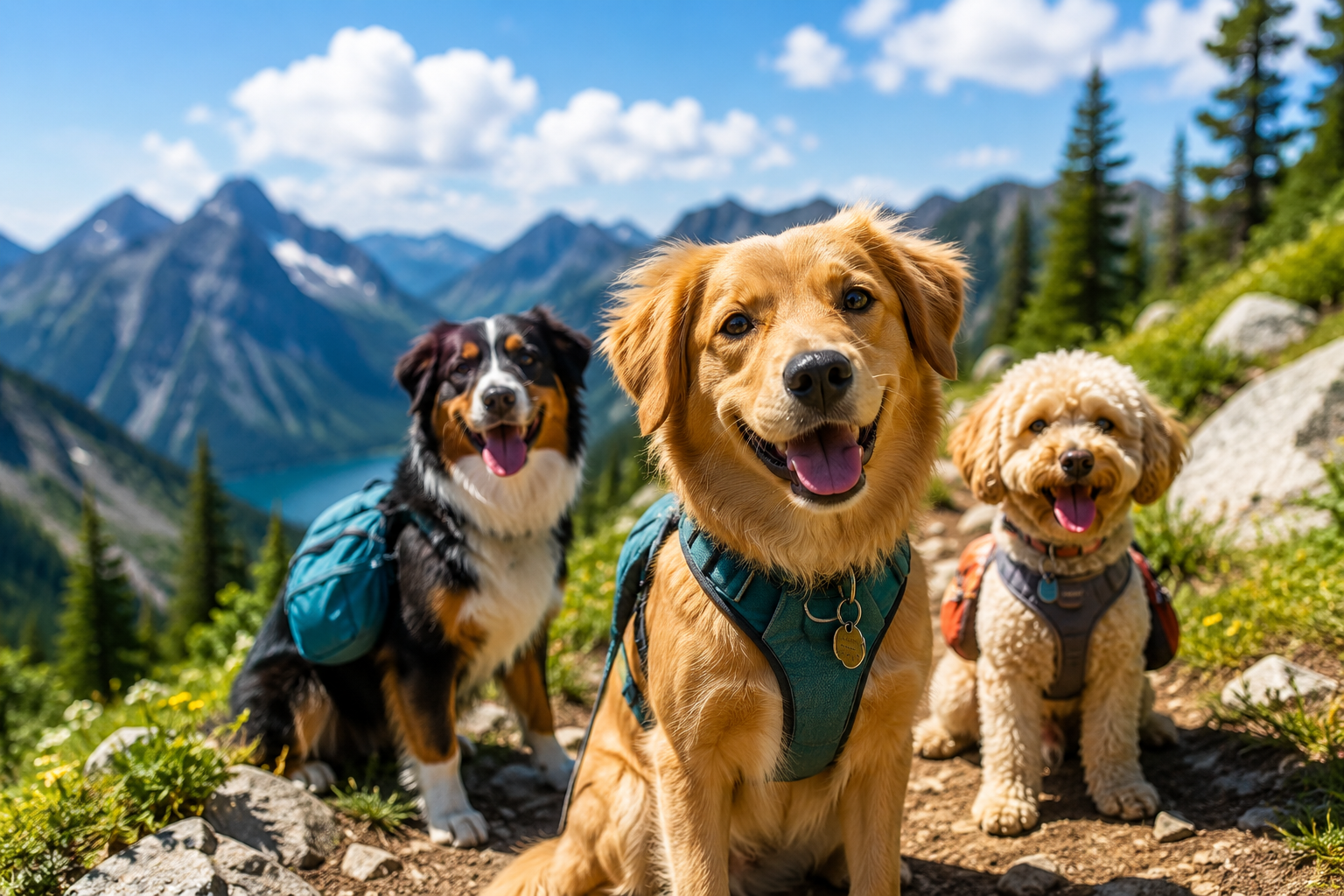
Getting a dog specifically to hike with is a genuinely different decision than getting a dog for companionship alone, and it’s one that trips up more first-time owners than you’d expect. The instinct is to research the most athletic, most trail-capable breeds available — the ones that can cover 15 miles at elevation without breaking stride — and while that instinct isn’t wrong exactly, it skips a more important question for someone who’s never owned a working or sporting breed before: which of these dogs can a first-time owner actually train, manage, and live with successfully?
A breed that’s physically built for the trail but temperamentally demanding — high prey drive, intense exercise requirements even on rest days, a stubborn streak that fights novice training attempts — can turn hiking ownership into a genuinely frustrating experience for someone without prior dog-handling background. The breeds that actually work best for first-time hiking dog owners sit at a specific intersection: real trail capability, genuine trainability for a novice handler, and a temperament that’s forgiving of the mistakes every new owner inevitably makes.
This guide covers the best beginner-friendly hiking dog breeds — organized by what makes each one specifically approachable for someone building their first relationship with a working or sporting dog. For the full range of hiking dog breeds across all experience levels, our best hiking dog breeds guide covers more advanced and specialized options. For gear once you’ve chosen your dog, our best hiking snacks for dogs and best small dog backpacks for hiking guides cover trail essentials.
What Makes a Hiking Dog Genuinely Beginner-Friendly
Before the breed list, it’s worth being specific about what “beginner-friendly” actually means in this context, because it’s not the same thing as “easy” in general terms.
Trainability that responds to consistent, positive methods without requiring advanced technique. Some working breeds are highly intelligent but also highly independent, developing their own opinions about tasks in a way that outsmarts novice training approaches. The best beginner hiking breeds are intelligent enough to learn quickly but biddable enough that consistent, reward-based training actually sticks without needing a professional trainer’s intervention.
A forgiving temperament around the inevitable mistakes of a first-time owner. Every new dog owner makes early handling errors — inconsistent commands, accidental reinforcement of bad behavior, uncertain body language on trail. Beginner-friendly breeds tend to be resilient to this kind of early inconsistency rather than breeds that require precise, expert handling from day one to avoid developing problem behaviors.
Genuine trail capability without extreme athletic demands. A dog that needs serious daily mileage to stay mentally and physically balanced is a significant commitment for a first-time owner still learning what regular exercise their own schedule can actually sustain. The breeds on this list are capable, enthusiastic hiking partners without requiring the borderline-obsessive exercise regimen that some working breeds genuinely need to avoid behavioral problems.
Manageable prey drive and reactivity around other trail users, dogs, and wildlife. A first-time owner without established handling skills benefits enormously from a breed that’s naturally more even-tempered around distractions on a busy or wildlife-rich trail, rather than one that requires advanced impulse-control training to manage safely.
Best Beginner-Friendly Hiking Dog Breeds
Labrador Retriever — Best Overall First Hiking Dog
The Labrador Retriever tops nearly every list of beginner-friendly dogs generally, and that reputation holds up specifically for hiking. Labs are genuinely athletic — built with a sturdy, muscular frame and natural endurance that handles moderate to demanding day hikes comfortably once properly conditioned — while being among the most food-motivated, trainable breeds available, which makes basic obedience and recall training genuinely approachable for a first-time owner using standard positive reinforcement methods.
Their temperament is famously stable and friendly, which matters enormously on busy trails with other hikers, dogs, and occasional wildlife encounters. A well-socialized Lab tends to default to curious and friendly rather than reactive, reducing the management burden on a handler still building their skills. The breed’s short, water-resistant coat also handles varied weather and terrain with minimal grooming complexity compared to longer-coated alternatives.
The main consideration: Labs have a genuine appetite for food and can gain weight quickly without adequate exercise, so hiking regularly is actually a good match for the breed’s needs rather than an imposition on a naturally low-energy dog.
Best for: first-time owners who want the most broadly trainable, temperamentally stable hiking companion available, with genuine athletic capability for regular moderate-to-demanding trail use.
Golden Retriever — Best for Families New to Hiking Together
Golden Retrievers share much of the Labrador’s beginner-friendly profile — highly trainable, food-motivated, and temperamentally stable — with a slightly gentler, more people-oriented disposition that many first-time owners find easier to read and respond to. Goldens are consistently ranked among the most patient breeds with children, making them a strong choice for families introducing both a new dog and hiking as a shared family activity simultaneously.
Their trainability extends naturally to recall work, which is one of the most important skills for any hiking dog and one of the more challenging behaviors for a first-time owner to build from scratch. Goldens tend to check in with their handler frequently and respond well to consistent recall practice, reducing the anxiety many new owners feel about off-leash or long-line hiking.
The trade-off relative to Labs is coat maintenance — Goldens carry a longer, feathered coat that picks up burrs, mud, and debris more readily on trail and requires more consistent brushing and post-hike grooming to manage properly.
Best for: first-time owners, particularly families with children, who want a gentle, highly trainable hiking companion and are willing to manage the additional coat care that comes with it.
Border Collie — Best for Owners Willing to Commit to Mental Engagement
Border Collies are widely regarded as the most intelligent dog breed, and that intelligence is a double-edged consideration for a first-time owner — genuinely trainable in a way that produces impressive results quickly, but also demanding of consistent mental engagement in a way that under-stimulated Border Collies can channel into problem behaviors.
For a first-time owner who’s specifically drawn to hiking as a primary activity and genuinely committed to regular exercise and mental stimulation, a Border Collie rewards that commitment with an extraordinarily responsive, capable hiking partner. Their herding heritage gives them remarkable stamina and agility on technical terrain, and their trainability makes advanced trail skills — precise recall, off-leash reliability, response to subtle cues — achievable for a dedicated novice handler in a way that’s harder with less biddable breeds.
The honest caveat: this is the breed on this list that requires the most consistent commitment from a first-time owner. A Border Collie who only hikes occasionally and otherwise gets minimal mental engagement is a genuinely more challenging dog to live with than the other breeds here. This is the right choice specifically for a first-time owner whose lifestyle genuinely supports frequent, engaged activity — not for someone hoping hiking alone, done occasionally, will be sufficient.
Best for: first-time owners with a genuinely active lifestyle who want to build advanced trail skills and are prepared to provide consistent daily mental engagement beyond just hiking days.
Australian Shepherd — Best for Active Terrain and Family Settings
Australian Shepherds combine much of the Border Collie’s herding-breed intelligence and athleticism with a temperament that many owners find slightly more adaptable to a mixed lifestyle that isn’t built entirely around constant activity. They’re highly trainable, genuinely capable on technical and varied terrain, and tend to form strong, watchful bonds with their family that make them attentive, responsive hiking partners.
Their double coat handles a wide temperature range effectively, from cool mountain mornings to moderate summer heat, though genuinely hot conditions require the same heat management every double-coated breed needs. Aussies are also commonly praised for their natural watchfulness — a trait that gives first-time owners a mild sense of security on trail without the more assertive protective instincts of dedicated guardian breeds, which can be harder for a novice handler to manage appropriately.
Like Border Collies, Aussies benefit from consistent mental engagement, but most owners find their exercise and stimulation needs slightly more forgiving of an occasionally lighter week than a true Border Collie requires.
Best for: first-time owners who want herding-breed intelligence and technical-terrain capability with a slightly more adaptable temperament than a Border Collie, particularly in family settings.
Beagle — Best Small-to-Medium Hiking Dog for Beginners
For first-time owners drawn to a smaller, more manageable dog rather than a large sporting or herding breed, the Beagle offers genuine trail enthusiasm in a compact, historically hardy package. Bred originally for scent-driven fieldwork requiring sustained stamina, Beagles handle moderate day hikes comfortably and bring an infectious, curious energy to trail time that many first-time owners find genuinely delightful.
Beagles are food-motivated in a way that makes basic training approachable, though their strong scent drive means recall training requires more patience and consistency than with a Labrador or Golden — a Beagle who catches an interesting scent trail can become genuinely absorbed in following it, which is worth understanding and planning around before choosing this breed specifically for off-leash hiking use. On leash or a long line, this concern becomes far less significant.
Their friendly, non-aggressive temperament makes them easy around other hikers and dogs, and their compact size makes them a more manageable physical presence for a first-time owner still building handling confidence and strength.
Best for: first-time owners who want a smaller, food-motivated, genuinely enthusiastic trail companion and are prepared to manage a strong scent drive through leash use or dedicated recall training.
Standard Poodle — Best Low-Shedding Option for Beginners
Standard Poodles carry an outdated reputation as a purely decorative breed that doesn’t reflect their actual working heritage as capable water retrievers with genuine athleticism and — relevantly for this guide — some of the highest trainability rankings of any breed. For a first-time owner who specifically wants a low-shedding dog for allergy or household cleanliness reasons without sacrificing trail capability, the Standard Poodle is a genuinely strong, underappreciated option.
Their intelligence rivals working and herding breeds, and their eagerness to please translates into fast, reliable training progress for a first-time owner using consistent positive methods. Standard Poodles handle moderate to demanding hiking comfortably once conditioned, and their curly, low-shedding coat — while requiring regular grooming maintenance — doesn’t scatter fur throughout a home or vehicle the way many hiking-suitable breeds do.
The main consideration for prospective owners is coat maintenance frequency — Standard Poodle coats mat if not brushed regularly, and trail debris (burrs, twigs, mud) tends to work into the curl more than it would with a shorter coat, requiring more consistent post-hike grooming attention.
Best for: first-time owners who want genuine working-breed trainability and trail capability in a low-shedding package, and are willing to maintain a more grooming-intensive coat.
Boxer — Best for Owners Who Want an Energetic, Playful Companion
Boxers bring a genuinely playful, high-energy temperament to hiking that many first-time owners find engaging rather than overwhelming, provided they’re prepared for a breed that stays notably puppyish in demeanor well into adulthood. They’re athletic, muscular dogs built for sustained activity, and their trainability — while requiring a somewhat firmer, more consistent hand than a Labrador or Golden — is genuinely accessible to a committed novice owner using structured, positive methods.
Their short coat requires minimal grooming maintenance, and their loyal, affectionate temperament toward their family makes them a genuinely rewarding companion breed beyond just hiking use. Boxers do best with owners who provide consistent structure during training, since their playful energy can otherwise translate into boisterous, hard-to-manage behavior — a first-time owner who commits to early, consistent training generally finds Boxers a genuinely manageable and enjoyable hiking breed.
One practical note: Boxers are a brachycephalic-adjacent breed with a somewhat shortened muzzle relative to fully long-nosed breeds, which means heat management on warm hiking days deserves more attention than with a Labrador or Border Collie — plan hikes around cooler parts of the day in hot weather and watch for early overheating signs.
Best for: first-time owners who want a playful, athletic, affectionate companion breed and are committed to consistent early training structure, with attention to heat management on warm trail days.
Vizsla — Best for Owners Wanting a Highly Affectionate, Velcro-Style Companion
The Vizsla is a genuinely athletic Hungarian sporting breed known for both serious trail stamina and an unusually intense attachment to their owner — frequently described as a “velcro dog” for their tendency to stay physically close to their person rather than ranging independently. For a first-time owner who specifically wants a dog that naturally checks in and stays oriented toward their handler on trail, this trait is a genuine practical advantage for recall and off-leash management.
Vizslas are highly trainable and food-motivated, and their close-bonding temperament tends to make them attentive, responsive students for a first-time owner building foundational obedience and trail skills. Their short, low-maintenance coat requires minimal grooming, and their build handles sustained, demanding hiking mileage comfortably once properly conditioned.
The genuine consideration for prospective owners: Vizslas have real energy requirements and don’t do well left alone or under-exercised for extended periods — their attachment to their owner combined with high energy can produce separation anxiety in households where the dog spends significant time alone. This is the right breed for a first-time owner whose lifestyle genuinely includes frequent companionship and activity, not one built around long stretches of the dog being home alone.
Best for: first-time owners who want an intensely bonded, highly trainable hiking companion and have a lifestyle that includes frequent companionship rather than extended periods alone.
Cardigan or Pembroke Welsh Corgi — Best Small Breed With Genuine Trail Stamina
Corgis surprise many first-time owners with their genuine trail capability relative to their small stature — bred originally for herding cattle across demanding terrain, they carry real stamina and a sturdy, low-to-the-ground build that handles moderate hiking distances more comfortably than their size might suggest. For owners who specifically want a smaller dog without sacrificing meaningful trail enthusiasm, Corgis are a genuinely strong option.
Their herding-breed intelligence makes them highly trainable, and their food motivation supports straightforward positive-reinforcement training for a first-time owner. Corgis tend to be alert and vocal, which some owners appreciate as an early-warning trait on trail and others find requires management around excessive barking at trail encounters.
The practical limitation worth understanding clearly: Corgis’ short legs and long backs mean they’re genuinely less suited to extremely technical, steep, or extended high-mileage terrain than the larger breeds on this list, and their build carries some elevated risk of back injury on very demanding scrambles. For moderate day hiking on established trails, they’re an excellent, manageable choice; for serious backcountry mileage, they’re not the right breed regardless of enthusiasm.
Best for: first-time owners who want a smaller, genuinely trail-enthusiastic breed for moderate day hiking, understanding the physical limitations around extremely technical or high-mileage terrain.
Building the Right Foundation With Your First Hiking Dog
Beyond breed selection, a few practices genuinely improve the experience of raising your first hiking dog regardless of which breed you choose.
Start training and socialization well before the first real hike. Basic obedience, loose-leash walking, and recall work in low-distraction environments before ever attempting a trail sets your dog — and you — up for a genuinely smoother first hiking experience than trying to build these skills on trail itself.
Condition gradually rather than starting with an ambitious first hike. Even the most athletically capable breed on this list needs a building period of shorter, easier hikes before tackling serious mileage or elevation. Our how to train your dog to hike long distances guide covers the specific conditioning process in depth.
Invest time in recall training specifically, regardless of breed. This is consistently the skill that matters most for safe, enjoyable off-leash or long-line hiking, and it’s worth prioritizing above almost any other training goal in your first months with a new hiking dog.
Don’t underestimate the value of a knowledgeable trainer for your first dog, even with a naturally trainable breed. A handful of sessions with a positive-reinforcement trainer early on can meaningfully accelerate a first-time owner’s confidence and skill in ways that compound across the dog’s entire life.
Final Thoughts
The best hiking dog for a first-time owner isn’t necessarily the most athletically extreme option available — it’s the breed that matches genuine trail capability with a temperament and trainability profile that a novice handler can actually work with successfully. Labradors and Golden Retrievers remain the most broadly reliable starting point for exactly this reason, while breeds like Border Collies and Vizslas reward owners with a genuinely active, engaged lifestyle who are ready for the higher commitment those breeds require.
Whichever breed you choose, the foundation that matters most is consistent, patient training built before serious trail use begins — the breed sets your starting point, but the relationship you build in those early months determines what kind of hiking partner your dog actually becomes.
For more on preparing any dog for the trail, check our best hiking dog breeds guide for the full range of options across experience levels, and our best hiking snacks for dogs guide for fueling your new hiking partner properly on the trail.