
As an Amazon Associate I earn from qualifying purchases.
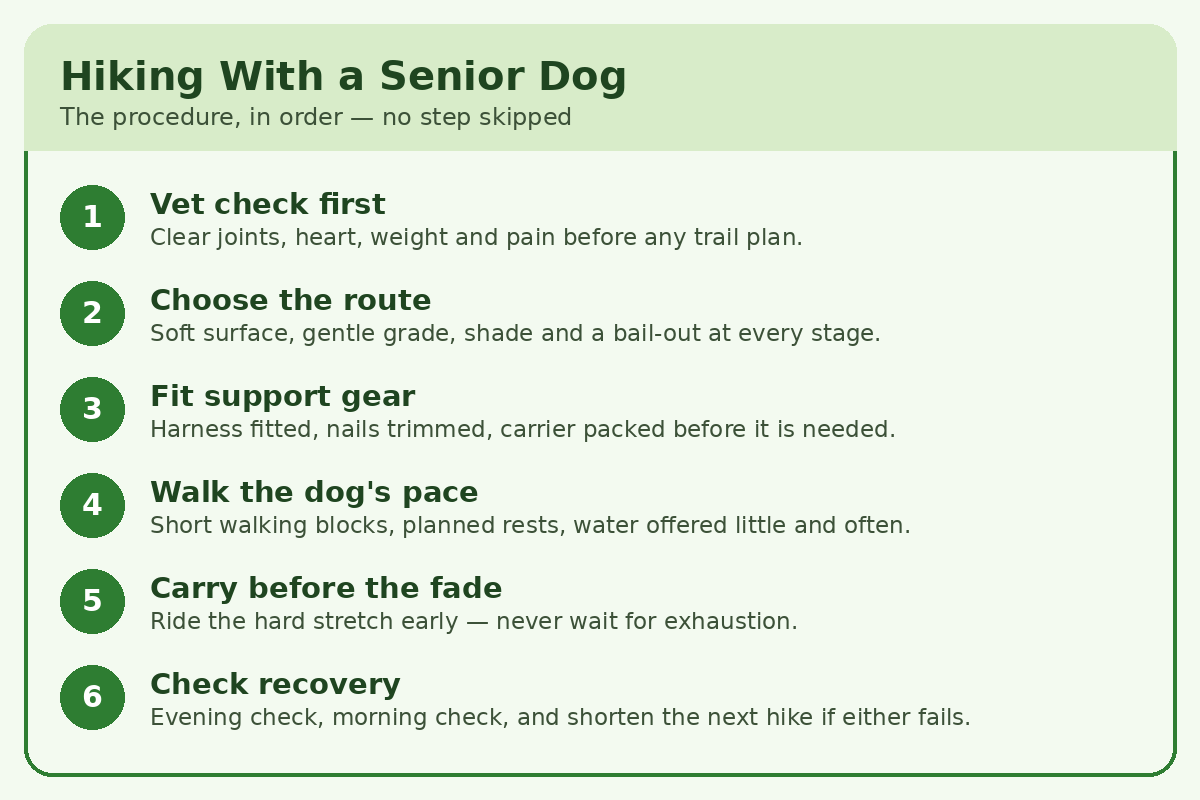
An older dog still lights up at the sight of a leash, but the body attached to that enthusiasm has changed: joints stiffen sooner, heat bites harder, and a route that was easy two summers ago can cost two days of soreness now. Hiking with a senior dog stays safe and joyful when you run it as a procedure instead of a habit. This how-to gives you that order: a senior-specific vet check first, route choice by surface, grade and bail-out points, a pace and rest schedule, a carrying plan, and an honest recovery check after every hike.
See the Dogs Built for a Lifetime of Trails
Your senior’s trail years are not over, so see which dogs are made for hiking and how the best of them keep going into old age.
See the Best Hiking DogsKey Takeaways
- Book the senior vet check before the trailhead, because joints, heart and pain set the plan, not your dog’s enthusiasm.
- Choose routes by surface, grade and bail-out points, and let the easiest version of each win every time.
- Walk in short blocks at your dog’s pace, rest on a schedule, and offer water before thirst shows.
- Pack the carrier before you need it, and carry your dog at the first fade, not after it.
- Run the evening and morning recovery checks, and shorten the next hike the moment one of them fails.
Table of Contents
- Step 1: Start With a Senior-Specific Vet Check
- Step 2: Choose the Route by Surface, Grade and Bail-Out Points
- Step 3: Fit the Gear an Older Dog Actually Needs
- Step 4: Set the Pace, the Rest Schedule and the Water Plan
- Step 5: Build the Carrying Plan Before You Need It
- Step 6: Run the Hike as a Procedure, Start to Finish
- Step 7: Monitor Joints and Recovery After the Hike
- Step 8: Follow Trail Rules With an Older Dog
- Warning Signs: When to Shorten, Carry or Stop
- Our view
- FAQ
- Sources
- Recommended
Step 1: Start With a Senior-Specific Vet Check
Step one happens in a clinic, and it is a different appointment from the annual check of a younger dog. Tell the clinic you are planning trail walks and want a senior assessment with hiking in mind. The AVMA companion animal care guidelines put regular veterinary involvement at the centre of an animal’s care plan, and for a senior that involvement tightens: the VCA Hospitals senior dog care guidance recommends examinations at least twice a year, because health changes in older dogs are often subtle and several conditions commonly arrive together. A dog can look willing at the door and still be carrying early heart, kidney or joint disease that a trail day would expose the hard way.
Ask four direct questions and write the answers down. Is there any joint pain today, and is it managed? Is the heart and breathing picture safe for sustained gentle exercise? Is the current weight helping or hurting the joints? And what is the exercise ceiling you want us to stay under until the next visit? The ASPCA senior pet guidance frames the same visit around early detection: senior pets should see a veterinarian at least twice a year, with attention to weight changes, mobility, dental health and lab work that can flag kidney or liver changes. Bring your own observations to that conversation, because you see the daily evidence: slower rising, hesitation at steps, a shorter walk chosen by the dog.
Translate the Vet Check Into Route Limits
The output of step one is not permission; it is a set of limits you translate into route choices. A dog cleared as sound and comfortable earns the standard senior route in the table below. A dog with managed joint pain earns the gentler column, and a dog whose vet wants more work-up earns neighbourhood walks until the picture is clear. The Cornell osteoarthritis guidance explains why the distinction matters: osteoarthritis is a chronic, progressive joint disease in which cartilage loss leads to pain, inflammation and difficulty using the limb, and its management rests on exactly the levers a hiker controls, including weight control and low-impact activity such as leash walks. Published senior guidance varies on details by dog and by source, so treat the table as a planning frame your veterinarian’s reading of your dog can tighten, never loosen on your own.
| Your senior’s condition | Surface | Grade | Route shape and bail-out |
|---|---|---|---|
| Sound and comfortable, vet-cleared | Packed earth, grass or forest tread; short rocky stretches only | Gentle, rolling at most; no sustained steep climbing or descending | Loop or out-and-back you can shorten at several points; car never far from a cut-off |
| Stiff or sore after rest, joint pain managed with your vet | Soft and even only; avoid loose rock, deep sand and slippery roots | Nearly flat; treat any descent as the hardest part and keep it short | Short out-and-back on one tread; turn at the first planned point, not the furthest one |
| Overweight or rebuilding condition | Soft, shaded and even, close to home | Flat while condition rebuilds; add grade only after clean recoveries | Familiar loop with a bail-out every few minutes; frequency beats distance |
| Heat-sensitive, heavy-coated or flat-faced | Shaded forest tread; avoid exposed rock and hot pavement entirely | Flat to gentle, in the coolest hours only | Short shaded loop near water and the car; cancel rather than push a warm day |
Know Your Dog’s Baseline Before the Trail
A recovery check only works if you know what normal looks like, so record the baseline at home first. Note how your dog rises after a nap, how it takes the household steps, how far the ordinary morning walk runs before the pace fades, and how it eats and settles in the evening. Weigh the dog, and keep weighing on the same scale: the nutrition guidance from Cornell on choosing food for a senior dog stresses regular weighing and body-condition checks because slow weight change is hard to see on a dog you live with, and both weight gain and muscle loss change what a trail day costs. The comfort advice in the AKC guide to caring for an old dog adds the home side of the same picture: comfortable resting places, help with steps and jumping, and attention to stiffness all tell you how the joints are doing before a trail ever tests them. Owners of the breeds in our hiking dogs for seniors roundup will recognise the pattern: the dogs still hiking in old age are the ones whose owners measured the change early.
Step 2: Choose the Route by Surface, Grade and Bail-Out Points
Step two is route selection, and for a senior dog the route is the treatment. Work the three variables in order. Surface first: soft, even tread (packed earth, grass, forest floor) cushions every step, while loose rock, scree, deep sand and wet roots multiply joint load and slip risk. Grade second: gentle and rolling at most, with descents treated as the expensive part, because an older dog brakes downhill with its front end on every step. Bail-out third: choose a loop with cut-offs or an out-and-back you can abandon at any point, so shortening the day never means pushing a tired dog further to reach the car. The trail-craft in the American Hiking Society hiking-with-dogs guidance supports the preparation habit behind all three: research the route, its rules and its conditions before you go, rather than discovering them at your dog’s expense.
Read the route description the way a senior dog will walk it. Our trail difficulty explainer helps translate a published rating into the surface and grade your dog will actually feel, and it is worth rereading before any new route. Shade and water along the way count as route features, not scenery. A route with no shade and no bail-out is a young dog’s route whatever its length, and the honest move is to save it. Keep a short list of proven senior routes near home and rotate them; familiarity lets the dog relax and lets you spot a slower day immediately, because you know exactly how this route usually goes.
Distance: Borrow the Framework, Not the Number
This post deliberately does not hand you a senior mileage figure, because the honest figure is built from your dog’s vet limits and recovery, not from a chart. The general framework (how size, age, breed type, conditioning, terrain and temperature move any dog’s range) is laid out in full in our dog distance explainer, and it is the right background reading. What changes for a senior is the method: start from the easiest route in your table row, walk it at the schedule in step four, and let the recovery checks in step seven, not ambition, decide whether the next outing grows at all. Where veterinary sources give exercise figures for older dogs, they vary, and every one of them ties the number to the individual dog’s health and your veterinarian’s judgement.
Step 3: Fit the Gear an Older Dog Actually Needs
Step three is a short kit list, fitted for support rather than speed. The centrepiece is a harness, not a collar: a harness spreads pressure across the chest instead of the throat, gives you gentle steering on uneven ground, and on many designs offers a handle you can use to steady the dog over a step or into the car. Fit it so you can slide two fingers under every strap, and check the fit against today’s body, not last season’s, because senior bodies change shape as muscle and weight shift. The fits compared in our dog hiking harnesses guide show the adjustment ranges and handle designs that suit an older dog, and the waist-belt systems in our hands-free leashes roundup suit owners whose senior walks calmly at heel.

Ruffwear Front Range Dog Harness
- DUAL LEASH ATTACHMENT POINTS. Features an aluminum V-ring on the back and reinforced webbing at the chest. Gives you options for everyday walks or redirecting dogs that tend to pull, so you can enjoy more controlled and pleasant outings.
- FIND THE RIGHT FIT WITH EASE. Not sure which size to choose? Check out our sizing chart image and how-to-fit video to help you measure your dog correctly. A proper fit means more comfort, control, and confidence on every adventure.
- FOAM-PADDED CONSTRUCTION. Built with closed-cell foam padding in the chest and belly panels. This provides cushioned support that helps prevent chafing during extended wear, making it ideal for long walks, hikes, or all-day adventures.
New starting from: 59.99 $
Go to AmazonFinish the fit with feet and weather. Trim nails before the hike, not after: overgrown nails change how a dog stands and walks, reduce traction, and can worsen arthritic discomfort, which is why nail care sits in the senior routine rather than the grooming extras. Check pads for cracks and tenderness, and on hot or sharp ground consider the protection in our dog boots guide or the barrier help in our paw protection wax roundup, introduced at home first so trail day is not also new-gear day. An older dog also feels temperature sooner at both ends, so a light layer for a cold, still rest stop and a shade-first plan for a warm day belong in the pack beside your own kit from our day hiking checklist.
Step 4: Set the Pace, the Rest Schedule and the Water Plan
Step four runs the outing on senior timing: the dog sets the pace, and the schedule, not the dog’s pride, sets the rests. Walk in short blocks and stop on a plan, roughly every fifteen to twenty minutes at first, before fatigue asks for the stop. Let sniffing count as activity, because it is: an older dog working a scent line is exercising its mind at no cost to its joints. The exercise guidance in the AKC overview of how much exercise a dog needs makes the senior case directly: talk with your vet about exercising your senior dog, watch the dog’s own behaviour as the guide to what it can comfortably handle, and value the mental stimulation exercise provides alongside the movement. Shorter, more frequent outings usually serve a senior better than one long weekly effort, and consistency is what keeps muscle and confidence from slipping between hikes.
Offer water little and often, at the trailhead, at every planned rest and at the car, from water you carry. Older dogs may feel less thirst even as their need stays real, and a dog that will not drink on the move is a dog whose day should shorten. Carry the dog’s water yourself and make the stop effortless: a bottle or bowl you can reach without unpacking turns hydration into a habit, and the designs in our portable water bowls roundup and our dog water bottles guide are built for that trailside moment.

Portable Dog Water Bottle
- Easy To Use: Exclusive patented design, U2mug design dog water bottle and water bowl two in one. The fold cap acts as a water bowl, and you don’t need any external bowl to give your hairy buddy water to drink anymore.The built-in travel water bowl for dogs and water key ensure no water is wasted, making it an ideal dog travel accessories
- Large Capacity: lesotc dog water bottle with a volume of 18oz/520ml. Dog travel water bottle can provide safe, fresh, and healthy water for puppy during long walking, travel, hiking, camping and other outdoor activities. It’s addition to your dog accessories, perfect for dog beach essentials and dog camping essentials
- Leak-Proof Design: dog water bottle dispenser designed with upgraded push-button lock keeps water clean and prevents spills. This dog water dispenser is designed with silica gel seal ring which can prevent water leakage efficiently. This makes it a reliable dog portable water bottle and a safe choice for your pet
List Price :
Offer: 15.19 $
Go to AmazonLet the Weather Shrink the Plan First
Heat is the factor most likely to turn a gentle senior hike into an emergency, because older dogs regulate temperature less well than they once did. The hot-weather guidance from the ASPCA advises limiting exercise on hot days and providing ample shade and water for all dogs, and a senior needs that discipline applied earlier and more strictly: start at the coolest hour, choose the shaded route, and cancel without regret when the day runs hot and humid. The vests in our cooling vests guide can widen the margin on a mild day, and our dog overheating guide covers the warning picture in full, but no gear extends a senior past its signs. Cold asks for the mirror discipline: shorter outings, a layer for rest stops, and dry paws at the car.
Step 5: Build the Carrying Plan Before You Need It
Step five is the plan most owners skip and the one that saves the day when a senior fades further from the car than expected. Decide before you leave how the dog gets out if it cannot walk out: a carrier for a dog small enough to carry, a support harness and a shorter bail-out for a dog too large to lift, and a route in step two that never puts you beyond the distance you can actually manage. Carrying early is the rule, not carrying eventually: ride or support the hardest stretch while the dog is still comfortable, and the walk home stays inside the budget. A dog carried at the first fade arrives home ready for dinner; a dog marched to exhaustion pays for it for days.

Petskd Dog Front Carrier Backpack
- HOW TO MEASURE YOUR PET–To get a Dog front carrier that will fit your pet properly, measure your pet’s back length (from the base of the neck to the tail) and chest girth (at the widest point behind the front legs), as well as the distance between the tail and back legs before ordering. Compare these figures to the size chart. If your pet is in between sizes, or you don’t know how to choose, please reach us first.
- ANTI-SLIP SHOULDER STRAP DESIGN–Dog hiking backpack shoulder straps feature a crossed, widened, and adjustable design that not only prevents the straps from slipping off during walks or when bending over, but also helps alleviate your back and shoulder stress by evenly distributing your pet’s weight across your upper body, minimizing pain in certain pressure points of the body such as the waist, shoulders and back. Legs out front dog carrier is a great helper for walking your pet or bending over to clean your room.
- CREATIVE FOR PET HEALTH CARRIER–Different from other pet carrier, petskd puppy carrier wearable are filled with soft sponge fleece material around the neck part, so your pet won’t get choked by gravity and throw up or suffocate. Sponge pad on the bottom of the dog holder for chest gives your pet extra support, which helps protect their spine and reduces anxiety or struggling. Front facing dog carrier makes your hands free when cycling or hiking with your pet.
List Price :
Offer: 28.48
Go to AmazonChoose and practise the carry at home, on a calm afternoon, not on a tired trail. A structured base, ventilation, a safety tether clipped to the harness and a fit that keeps the load close to your own centre of gravity are the features that matter; the tested options are compared in our dog carrier backpacks guide. Introduce the carrier in minutes, with treats, until the dog settles in it as a resting place. The preparation sequence in the AKC guide to training a dog to hike starts from the same principle for any dog: build the skills and the equipment familiarity before the trail asks for them. Watch heat while carrying, because a dog riding against your back on a warm day can overheat quietly, and shaded rests and water apply to a riding dog exactly as to a walking one. For a large senior, be honest about the limit: if you cannot carry the dog, your routes must stay inside the bail-out discipline of step two, and that honesty is part of the plan, not a failure of it.
Step 6: Run the Hike as a Procedure, Start to Finish
Step six is the outing itself, run in the same order every time, because routine is what lets you spot the day something is different:
- Before you leave: check the dog against its baseline (rising, steps, appetite), offer water, fit the harness, and pack water, bowl, carrier, waste bags and a familiar blanket for rests.
- At the trailhead: let the dog sniff and look around for a few minutes first; an older dog that has processed the place walks out calmer and steadier.
- First block: walk at the dog’s pace on the easiest ground of the route, and take the first planned rest before the dog asks for it.
- Middle of the outing: water at every rest, a settle on the blanket, and a gait check as the dog rises from each stop; rising is where stiffness announces itself.
- Turn on the plan: head back at the planned point or the first fade, whichever comes first, and use the carrier or support on the return stretch you identified in step five.
- At the car: water again, dry paws, help with the step up or the ramp rather than a jump, and a short note of distance, surface, pace and how the dog seemed; that note runs step seven and plans the next outing.
Keep the procedure boring on purpose. The same order, the same rests and the same checks turn each hike into a measurement as well as an outing, and measurements are how a senior’s programme stays honest across a whole season. Vary the route for interest, never the procedure for novelty.
Step 7: Monitor Joints and Recovery After the Hike
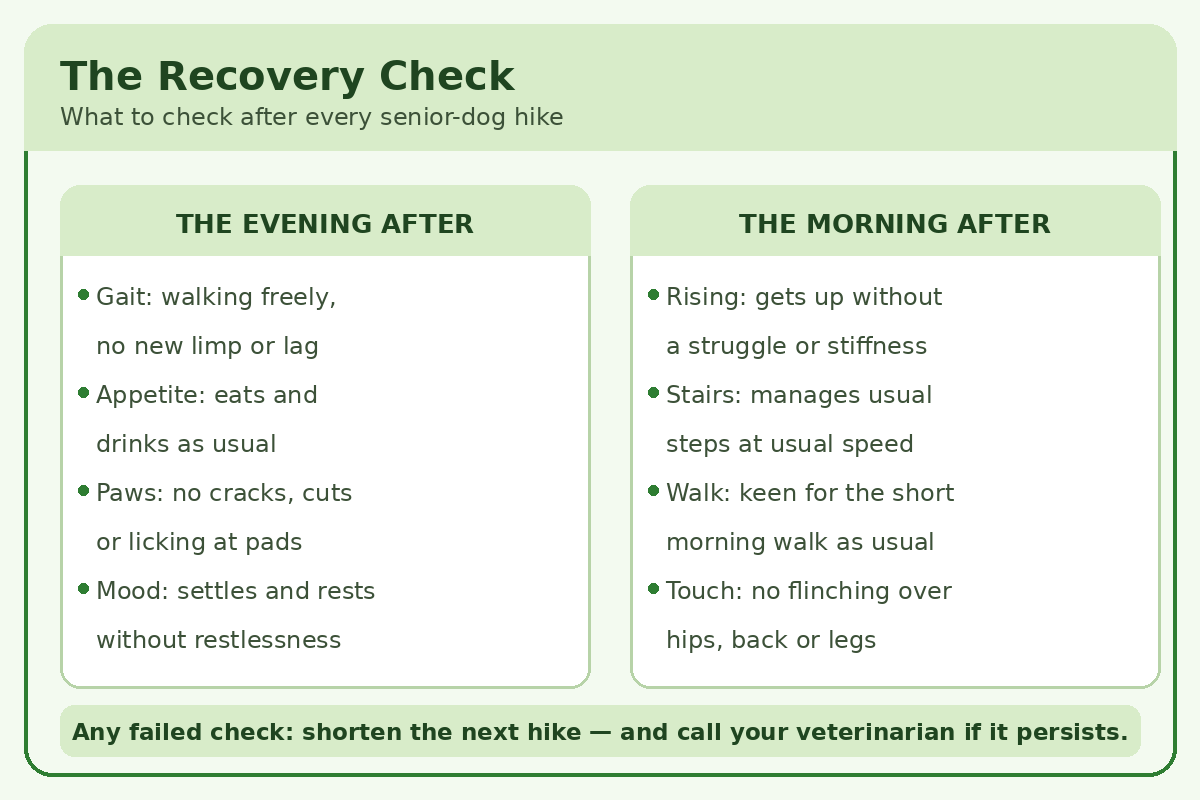
Step seven starts when the hike ends, because recovery is where a senior dog files its honest report. Run two checks. The evening check: gait on the walk to the garden, appetite and drinking at the usual level, paws inspected for cracks, cuts or licking, and a settle into rest without restlessness. The morning-after check: rising without a struggle, the usual steps taken at the usual speed, keenness for the short morning walk, and no flinching when you run a hand over hips, back and legs. The general exercise guidance from VCA Hospitals frames exercise around the individual dog’s age, breed and health, built up progressively, and the recovery check is how that principle works in practice for an older dog: the next outing is sized by the last outing’s recovery, never by the calendar.
What a Failed Check Changes
A failed check is information, not a disaster, and it changes exactly one thing: the next hike gets shorter or easier. Stiffness that clears within a day after a slightly longer route means the route was the ceiling; hold below it. Stiffness, limping or reluctance that persists, a dog off its food, or a dog quieter than its baseline for more than a day means a call to your veterinarian before the next trail day, not after it. The senior guidance in the AVMA senior pets brochure is direct that changes in activity level can be a warning sign of underlying disease, with arthritis a common cause, and that a veterinarian should examine a pet showing those changes to find out what is going on. Keep the recovery notes with the outing notes from step six; across a season they draw your dog’s real range more accurately than any general figure could. At home, recovery is furniture as much as rest: a supportive bed the dog can reach without jumping, like the options in our orthopedic dog beds roundup, turns the hours after a hike into part of the programme.
Step 8: Follow Trail Rules With an Older Dog
Step eight keeps you welcome on the trails your senior can still use. Check before every new route that dogs are allowed at all, and on which trails: the National Park Service guidance on visiting parks with pets is explicit that pets must be restrained, kept to permitted areas, and are excluded from many trails entirely. Add a senior layer to the standard rules: an older dog with slower reactions and fading sight or hearing has no business in crowded trailhead scenes or busy off-leash areas, so choose quiet times and step well off the trail, with the dog held close and given time, when others pass.
Practise the etiquette as part of the outing, because it protects your dog as much as other walkers. The National Park Service B.A.R.K. Ranger framework (bag your pet’s waste, always use a leash, respect wildlife, know where you can go) suits a senior programme well: every element is manageable at a senior’s pace, and the leash discipline matters more, not less, when a dog’s recall has slowed with its hearing. Keep greetings with strange dogs brief or declined; an older dog knocked off balance by a boisterous youngster can be sore for days from an incident that looks like nothing.
Warning Signs: When to Shorten, Carry or Stop
Read your dog the way you would read weather: early signs first, while changing the plan is still cheap. The earliest signs are behavioural: a dog that lags where it usually ranges, sits down unprompted, seeks shade at every stop or turns toward the car is reporting its limit in the only language it has. Respond at once: stop, rest in shade, offer water, and carry the dog out or take the nearest bail-out. Physical signs raise the stakes: panting that does not settle during a rest, thick drool, wobbliness, a new limp or licking at a paw end the outing on the spot. The VCA Hospitals heat stroke guidance describes how quickly overheating can become life-threatening, which is why a dog showing heat signs is moved to shade, offered water without forcing it, cooled gradually and taken for veterinary care. The response steps in our injured dog guide cover what to do when a dog cannot comfortably continue, and the kits in our dog first aid kits guide make that knowledge usable on the trail.
Know the honest signs that the programme itself needs to shrink, because this is the part of senior hiking nobody wants to write. When the recovery checks start failing on routes that used to pass, when the dog is keen at the door but fades earlier each month, or when your veterinarian’s picture changes, the answer is a shorter, flatter, more frequent programme, not a braver one. The heat guidance in the AKC heatstroke overview underlines the wider point for older dogs: a dog that cannot cool or recover as it once did can move from uncomfortable to emergency faster than owners expect, in conditions it handled easily when younger. Shortening is not the end of hiking; for most seniors it is how hiking continues, as garden trails, shaded park loops and short familiar routes with the same procedure and the same company. The day the dog no longer brightens at the leash is a veterinary conversation about comfort and quality of life, and having run the checks all along means you will have that conversation with evidence, early, while it can still help.
Our view
The senior dogs still on trails are not there because their owners pushed; they are there because their owners adapted early and kept adapting. Start from the breed picture in our best hiking dogs roundup, borrow the framework rather than the figures from our dog distance explainer, and take the conditioning principles in our long-distance training guide at senior speed, and you will give your old friend more good trail days than any single heroic hike ever could.
— Brian Ka
FAQ
How do I know if my dog is a senior for hiking purposes?
By condition and your veterinarian’s reading, not by a birthday alone. Size changes the timing (giant breeds age fastest, small breeds slowest), but the practical signs are the ones in this procedure: slower rising, earlier fading on familiar walks, longer recovery after ordinary outings. When those appear, switch to the senior procedure and book the senior vet check, whatever the calendar says.
Can a dog with arthritis still hike?
Often yes, on the gentler programme, with your veterinarian managing the joint picture. Low-impact leash walking on soft, flat ground is a standard part of managing arthritic joints, while steep, rocky or long routes are not. The decision, the pain plan and the ceiling belong to your vet; the route, pace and recovery discipline in this post are how you work inside them.
How often should a senior dog hike?
Little and often usually beats long and rare. Several short, easy outings across the week keep muscle, joints and confidence working without a big recovery debt, and the recovery checks tell you if the frequency is right. A dog failing checks needs fewer or shorter outings and a veterinary conversation, not a longer rest followed by the same hike.
What if my senior dog is too big to carry?
Then the carrying plan becomes a route plan. Choose routes with bail-outs inside the distance your dog can always walk, use a support harness for steps and stumbles, hike with a second person when you can, and never let a scenic loop talk you past the point your dog could not walk back from. The discipline is the plan.
When should a senior dog stop hiking altogether?
When the recovery checks fail on the easiest programme, or when your veterinarian advises it. Most dogs step down in stages (shorter, flatter, closer to home) long before they stop, and many keep enjoying short shaded walks when summits are long past. Let the dog’s recovery and your vet, not nostalgia, make the final call.
Questions About Hiking With a Senior Dog?
Tell us your dog’s age, breed and current walks, plus any joint or health picture your vet has given you, and we will help you set a route, pace and recovery plan that fits the dog you have now.
Contact UsSources
- AVMA — Companion Animal Care Guidelines
- AVMA — Senior Pets Brochure
- VCA Hospitals — Senior Dog Care: Special Considerations
- VCA Hospitals — Exercise for Dogs
- VCA Hospitals — Heat Stroke in Dogs
- Cornell Riney Canine Health Center — Osteoarthritis
- Cornell Riney Canine Health Center — Choosing Food for Your Senior Dog
- AKC — 6 Ways to Care for Your Old Dog
- AKC — How Much Exercise Does a Dog Need?
- AKC — How to Train Your Dog to Hike With You
- AKC — Heatstroke in Dogs
- ASPCA — 5 Expert Tips for Caring for Senior Pets
- ASPCA — Hot Weather Safety Tips
- National Park Service — Pets
- National Park Service — B.A.R.K. Ranger, Shenandoah National Park
- American Hiking Society — Hiking With Dogs