
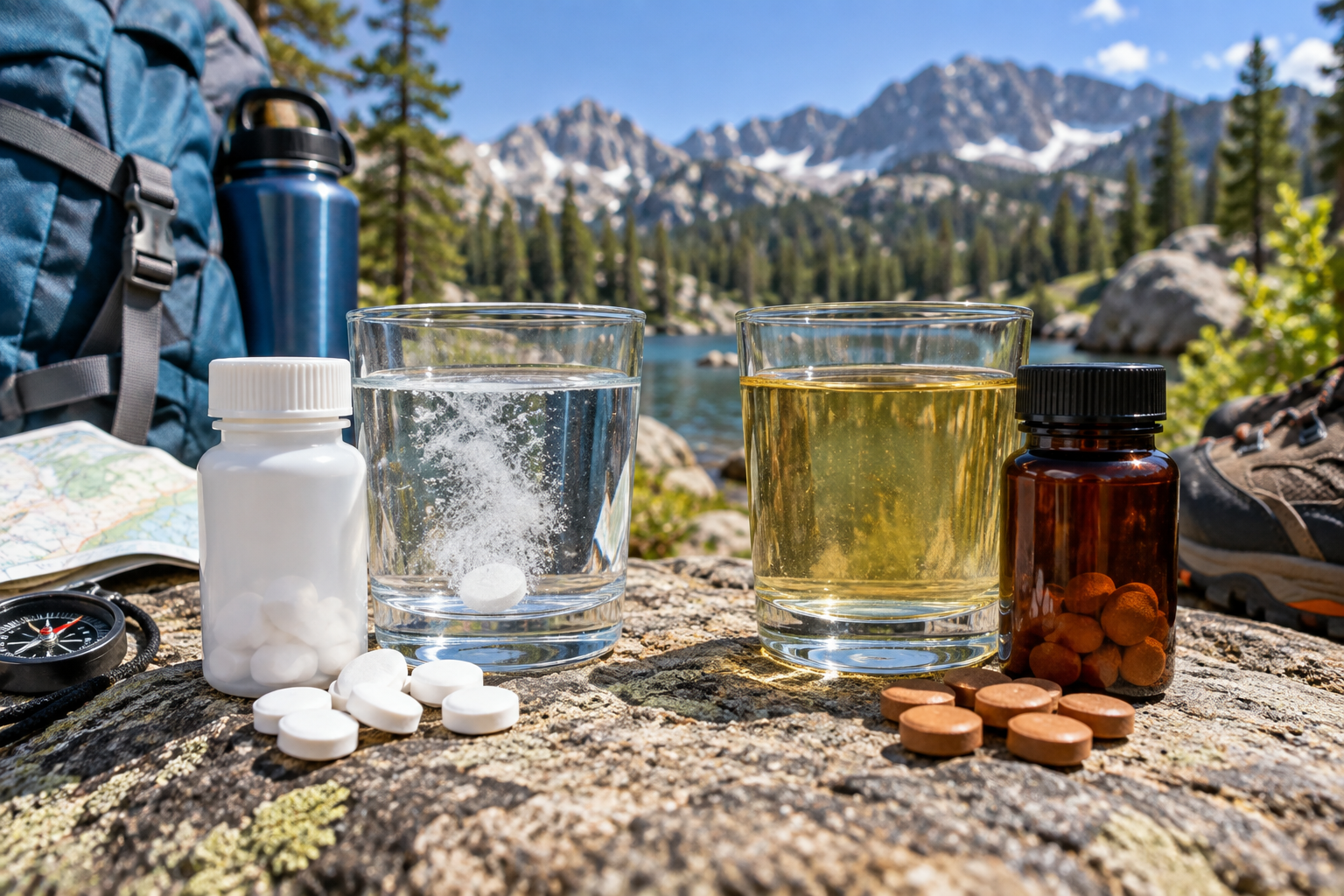
Chemical water purification tablets remain one of the most reliable backups a hiker can carry, precisely because they have no moving parts to fail, no membrane to freeze or clog, and no battery to die at the wrong moment. But the two dominant chemistries — chlorine dioxide and iodine — genuinely differ in ways that matter directly for real trail use: what pathogens they actually kill, how long you have to wait before drinking, what the water tastes like afterward, and whether a specific hiker can safely use them at all. Understanding those differences matters more than simply grabbing whichever tablet is available at the outdoor store.
This guide covers exactly how chlorine dioxide and iodine tablets compare on the specs that actually matter for backpacking, and which one makes more sense for your specific trip and body. For the broader filter and purifier landscape these tablets fit into, hikingbackpackpro.com’s how to choose a water filter for backpacking guide covers mechanical filtration options as well.
What Both Chemistries Actually Do
Before comparing the two directly, it’s worth understanding what chemical water treatment accomplishes that mechanical filtration doesn’t always cover. Both chlorine dioxide and iodine work by chemically disrupting pathogens rather than physically straining them out of water the way a hollow-fiber filter does. This matters specifically for virus protection — most mechanical filters can’t catch viruses by pore size alone, since viruses are dramatically smaller than bacteria or protozoa, but a properly dosed chemical treatment neutralizes them regardless of size. This is exactly why chemical tablets remain the standard backup carried alongside a mechanical filter, and why international travelers specifically favor them over filtration alone.
Pathogen Coverage: The Single Biggest Difference
Chlorine dioxide is effective against bacteria, viruses, and protozoa, including Cryptosporidium — a specific and genuinely important distinction, since Cryptosporidium is notoriously resistant to standard chemical disinfection. This broader coverage is the main reason chlorine dioxide has become the more commonly recommended tablet for backcountry use specifically in North America, where Cryptosporidium contamination is a real, documented risk in some water sources.
Iodine is effective against bacteria and viruses but is considerably less reliable against Cryptosporidium and Giardia cysts specifically. This is a genuine limitation worth taking seriously rather than a minor technicality — if your water source has any real risk of Cryptosporidium contamination, iodine alone may not provide adequate protection regardless of how long you wait or how much you use.
This pathogen-coverage gap is the single most consequential practical difference between the two chemistries, and it’s worth treating as the deciding factor for most hikers before considering taste, wait time, or cost at all.
Wait Time Before Drinking
Chlorine dioxide tablets typically require roughly 30 minutes for general bacteria and viruses, but up to 4 hours for full protection against Cryptosporidium specifically. This extended wait time is a real practical consideration for trip planning — if you’re treating water at a break and want to drink soon after, you’re covered against most pathogens within half an hour, but genuinely comprehensive protection against the most resistant protozoa requires planning treatment well ahead of when you actually need to drink.
Iodine tablets generally require a similar or sometimes shorter wait time for general effectiveness, often in the 30-minute range, but this shorter wait doesn’t compensate for the underlying Cryptosporidium coverage gap — a faster-acting treatment that doesn’t reliably address a specific pathogen isn’t actually a practical advantage if that pathogen is present in your water source.
Cold water genuinely slows the reaction time for both chemistries. In cold streams or high-altitude water near or below the temperature where ice forms, both treatments take meaningfully longer to reach full effectiveness, and doubling the standard wait time is a reasonable practice specifically in cold conditions rather than assuming the standard label timing applies universally regardless of water temperature.
Taste
Iodine produces a genuinely more noticeable, often described as harsher taste than chlorine dioxide. This isn’t a minor cosmetic difference — some hikers find iodine-treated water genuinely difficult to drink in the quantities needed to stay properly hydrated on a demanding trail day, which creates a real secondary problem beyond the treatment itself if the taste actively discourages adequate water intake.
Chlorine dioxide leaves a comparatively milder taste, and while it’s not flavorless, most hikers find it considerably easier to tolerate across a full day of repeated water treatment and consumption. Some products include a neutralizer tablet specifically to address chlorine dioxide’s taste, though many hikers find the base taste acceptable without needing that additional step.
A taste-neutralizing additive, where available, can improve either chemistry’s palatability, but iodine’s more pronounced flavor profile means a neutralizer often matters more for iodine specifically, while chlorine dioxide is more commonly used without one.
Who Should Avoid Iodine Specifically
Iodine tablets are not safe for individuals with thyroid conditions, iodine allergies, or pregnant women. This is a genuine, real medical restriction rather than a minor caution — iodine affects thyroid function directly, and someone with an existing thyroid condition using iodine-based water treatment regularly on a multi-day trip is taking on a real, avoidable health risk. Anyone in these categories should default to chlorine dioxide or an entirely different treatment method rather than iodine.
Chlorine dioxide has a broader safety profile and doesn’t carry the same specific medical contraindications that iodine does, which is a genuine practical advantage for hikers who don’t want to think carefully about their own or a hiking partner’s specific health history before choosing a water treatment method.
Shelf Life and Storage
Both chemistries have genuinely long shelf lives when stored properly, making either a reasonable choice for a backup kit you don’t expect to use on every single trip but want available reliably when needed. Check the specific expiration date on your particular product rather than assuming indefinite shelf life, since both chemistries do eventually degrade, and a genuinely expired tablet may not deliver full potency even if it looks unchanged.
Keep tablets in their original packaging until use, since both chemistries are sensitive to moisture and air exposure in ways that can degrade effectiveness before the stated expiration date if the packaging is compromised.
Cost and Availability
Both chemistries are widely available through outdoor retailers, and neither commands a dramatically different price point from the other at the consumer level — cost is rarely the deciding factor between the two, and it’s genuinely more productive to base your choice on pathogen coverage and personal health considerations first.
Which One Should You Actually Choose
For most hikers in North America, chlorine dioxide is the more broadly recommended choice, specifically because of its reliable effectiveness against Cryptosporidium — a real, documented risk in many backcountry water sources that iodine doesn’t reliably address. This single factor is why chlorine dioxide has become the more common recommendation across hiking and outdoor safety guidance generally.
Iodine remains a reasonable choice specifically when chlorine dioxide isn’t available, or in situations where its particular chemistry offers some specific advantage for your trip, but the thyroid and pregnancy contraindications mean it’s genuinely not a universal substitute — always check whether iodine is medically appropriate for everyone in your hiking group before relying on it as your primary or backup treatment.
If you’re treating water specifically from a source with known or suspected Cryptosporidium risk — agricultural runoff areas, water with visible livestock access, or regions with documented outbreaks — chlorine dioxide is genuinely the safer default rather than a preference-based choice, given iodine’s real limitation against this specific pathogen.
For hikers with no specific medical contraindication and no particular Cryptosporidium concern, either chemistry provides genuinely adequate general protection, and the choice comes down more to taste tolerance and whether the extended 4-hour wait for full Cryptosporidium protection with chlorine dioxide fits your actual trip planning and water-treatment rhythm.
Practical Trip Planning With Chemical Tablets
Treat water well ahead of when you actually plan to drink it, rather than treating and drinking immediately. Building treatment into your rest-stop or camp-arrival routine, rather than treating water reactively right when you’re thirsty, means you’re not stuck waiting around specifically because you didn’t plan the timing in advance.
Carry tablets as a genuine backup even if your primary treatment method is a mechanical filter. Filters clog, break, or get lost, and a lightweight backup that requires no moving parts is exactly the kind of redundancy that turns a filter failure from a genuine crisis into a manageable inconvenience.
Double the standard wait time in cold water conditions, since both chemistries react more slowly at lower temperatures, and treating water from a genuinely cold mountain stream without accounting for this can leave you drinking before treatment has actually completed.
Confirm dosing against the specific product’s instructions rather than assuming a standard dose applies universally. Tablet concentration and recommended water volume per tablet vary between specific products and manufacturers, and using the wrong ratio genuinely undermines the treatment’s effectiveness regardless of which chemistry you’ve chosen.
Discuss any thyroid conditions, iodine allergies, or pregnancy within your hiking group before the trip, not after someone’s already used iodine tablets. This is a genuine health and safety conversation worth having explicitly during trip planning rather than assuming it’s not relevant to anyone in your specific group.
Conclusion
Chlorine dioxide and iodine both work as genuine chemical water treatments with no moving parts to fail, but they’re not interchangeable once you look at the real specifics. Chlorine dioxide’s broader pathogen coverage — specifically its reliable effectiveness against Cryptosporidium — combined with its milder taste and broader safety profile make it the more commonly recommended default for most hikers. Iodine remains a legitimate option when chlorine dioxide isn’t available, but its thyroid and pregnancy contraindications mean it’s genuinely not a safe universal substitute, and its weaker performance against Cryptosporidium specifically is worth taking seriously rather than treating as a minor technical footnote.
Whichever chemistry you choose, treat water well ahead of when you plan to drink it, double your wait time in cold conditions, and carry your chosen tablets as a genuine backup to a primary filtration system rather than your only line of defense against contaminated water.