As an Amazon Associate I earn from qualifying purchases.
Men’s hiking sandals fail in predictable places: a strap system built on a narrower last, a footbed with no real arch, and an outsole that gives up on wet rock. Four men’s models cover the honest range — closed-toe protection, cushioned all-round use, firm arch support and a barefoot camp option — and the sections after the picks work through men’s sizing, width, grip and water use so the pair you order is the pair your feet need.
Sandals, Boots or Trail Runners?
Sandals win on water and heat and lose on protection and load. Our head-to-head settles which footwear class your trails actually call for before you spend on any of them.
Compare Boots vs Trail RunnersKey Takeaways
- Buy closed toe for rocky and rooty trails, open toe for maintained trails, camp and water — terrain decides the shape before brand does.
- Fit men’s sandals on the men’s last: check heel lock and midfoot hold first, because a loose sandal blisters faster than a loose boot.
- Choose the footbed for your arch, not the marketing: firm contoured support for tired arches, soft cushion for rigid high arches.
- Demand real lugs and a rubber outsole for wet rock; a smooth fashion sole is a pavement shoe, whatever the straps promise.
- Size whole-size models up when you sit between sizes, and test the fit wet before the return window closes.
Table of Contents
- The Four Picks at a Glance
- KEEN Newport H2: The Protected Pick
- Teva Hurricane XLT2: The All-Round Pick
- Chaco Z/1 Classic: The Support Pick
- Xero Z-Trail EV: The Barefoot Pick
- Open Toe vs Closed Toe: The First Decision
- Men’s Fit: Last, Width and Sizing
- Arch Support and Sore Feet
- Grip on Wet Rock, Mud and Dry Trail
- Water Crossings and Hot-Weather Trails
- Camp Sandals and the Second-Shoe Job
- Care, Straps and Knowing When to Replace
- Our view
- FAQ
- Sources
- Recommended
The Four Picks at a Glance
Four models, four different jobs, and no fifth pick padding the list. Each is a men’s model on a men’s last — the first filter this roundup applies; our women’s sandals roundup covers women’s lasts separately, and the fit advice there does not transfer. The logic follows the types-components-fit order of REI’s boot guide, and where sandals sit against closed footwear is worked through in our boots vs trail runners comparison.
| Pick | Toe | Footbed character | Best for |
|---|---|---|---|
| KEEN Newport H2 | Closed, rubber bumper | Contoured, shoe-like hold | Rocky trails, creek beds, stub-prone feet |
| Teva Hurricane XLT2 | Open | Cushioned EVA, easy adjustment | Everyday trail walking and water days |
| Chaco Z/1 Classic | Open | Firm, contoured, podiatrist-certified | Long miles and arches that need structure |
| Xero Z-Trail EV | Open | Thin, flat, ground-feel | Camp, crossings and barefoot-style hikers |
Read the table as a terrain map, not a ranking. The Newport costs airflow and buys toe safety; the Z-Trail costs protection and buys a sandal that disappears into a pack. The middle picks split on one question — cushion or structure. Independent testers land in the same places: Change Gear’s comparison puts the Z/1 first for support and the Hurricane first for value.
KEEN Newport H2: The Protected Pick
The Newport H2 is the sandal for men whose trails punish toes. Its defining part is the rubber toe bumper: KEEN’s Newport H2 page traces the design to one question — can a sandal protect your toes — and the washable webbing upper and bungee lace system hold the foot behind that bumper like a shoe. That hold is why it works on rocky creek beds and rooty trails where open sandals leave you mincing.
Protection is also its honest cost. A closed toe drains slower, runs warmer and weighs more, so on a maintained trail in real heat it is more sandal than the day needs. OutdoorGearLab’s Newport review names it the top pick for toe protection while noting the coverage is exactly what you trade breathability for. If your routes mix water with rock, that trade is usually right; our guide to how to choose the right hiking boots covers the same logic for closed footwear.

KEEN Men's Newport H2 Sandals
- WATER-RESISTANT: Quick dry washable synthetic straps and lining for active use in and out of the water all summer long; Whether it’s on a boat deck, tropical trail or just lounging waterside these water shoes for men bring hybrid comfort and protection
- SUPPORT & COMFORT: Lace lock bungee capture system provides a secure fit while offering quick and easy on and off; Shock absorbing underfoot support give these men’s water shoes enhanced cushioning
- TRACTION & PROTECTION: Multi directional lugs with siping channels provide superior grip on slippery terrain; Non marking rubber outsoles leave no imprint when walking indoors or on boats; Iconic toe bumper offers additional safety to help prevent injury
List Price :
Offer: 86.56 $
Go to AmazonWho the Newport Fits
Wider, higher-volume men’s feet, and anyone who stubs toes for a living. The Newport’s forefoot is generous, suiting broad feet that feel strangled in strap sandals; narrow feet should cinch the bungee fully and check heel hold. Men torn between this and a light shoe should read our best hiking shoes for men roundup — the shoe wins once the route turns cold or the pack heavy.
Teva Hurricane XLT2: The All-Round Pick
The Hurricane XLT2 is the easiest sandal here to buy, fit and live with. Teva’s Hurricane XLT2 page lists the build plainly: quick-dry webbing from recycled REPREVE polyester, three-point hook-and-loop adjustment, a robust EVA footbed, a nylon shank and a rubber outsole, at a published half-pair weight of 291 grams in a men’s US 9. Teva rates it for day hikes and light hikes, and that rating is honest.
Easy adjustment is its real feature. Three hook-and-loop points let you re-tension the fit as feet swell through a hot day. The trade is the footbed: EVA cushion feels kind on day one and packs down sooner than a firm polyurethane bed. Field testers split it the same way — The Inertia’s sandal testing keeps the Hurricane as its runner-up overall, priced below the firmer support pick.

Teva Men's Hurricane XLT2 Sandals
- Quick-dry webbing made from recycled plastic using traceable, verifiable REPREVE polyester yarn by Unifi supports your foot and stands up to abuse
- Injection-molded strap ends for quick and easy grip and adjustability, Easy hook-and-loop closure comes on and off quickly and gets the fit just right
- Robust EVA footbed for enhanced comfort built for all-day wear
Who the Hurricane Fits
Average-width feet that want cushion over structure, and first-time sandal hikers. This is the low-regret way in: the fit forgives, and the failure mode is gradual footbed fatigue rather than a fit fight. Pair it with our how to choose hiking socks guide for cooler evenings.
Chaco Z/1 Classic: The Support Pick
The Z/1 Classic is built around one strap and one footbed, and both are the point. Chaco’s Z/1 Classic page describes a single strap running through the footbed for 360-degree adjustment, quick-drying straps made for water, and the signature LUVSEAT footbed, certified by the American Podiatric Medical Association. There is no toe loop on the Z/1 — that is the Z/2 — so the forefoot stays free while the midfoot locks down.
Firm is the word to take seriously. The LUVSEAT bed is a contoured polyurethane platform that supports the arch instead of cushioning it away, and the contour you feel on the first walk is the contour it keeps. Gear Patrol’s comparison frames the same split — Chaco more supportive, grippier and longer-lasting; Teva lighter and cheaper. The ChacoGrip outsole carries a manufacturer-published 3.5 millimetre lug depth, and the sandal is the heaviest pick here; support and durability are what the weight buys.

Chaco Men's Z/1 Classic Sandals
- Double-strapped polyester jacquard webbing upper wraps around the foot and through the midsole for a customized fit with toe loop for guard fit
- Adjustable and durable high-tensile webbing heel risers
- Luvseat dual density midsole
Who the Z/1 Fits
Men whose arches tire before their legs do, and anyone who keeps a sandal for years. The strap rewards patience: set it once, properly, and it holds; rush it and it migrates. Whole sizes only, in medium and wide. The same support thinking in closed shoes lives in our best hiking boots for flat feet guide.
Xero Z-Trail EV: The Barefoot Pick
The Z-Trail EV is the opposite philosophy: almost nothing between foot and trail. Xero’s Z-Trail EV page publishes an 11 millimetre FeelLite sole with a TrailFoam middle layer and dual chevron lugs, at 5.4 ounces per sandal in a men’s size 9. It is flat heel to toe, flexible enough to roll into a pack pocket, and wide in the forefoot by design.
Ground feel is a training load, and Xero says so itself. Its guidance is to start slowly and build wear time, because a thin sole makes feet and calves do work a structured sandal does for them. Treat the Z-Trail as a camp and crossing sandal first and it earns its tiny pack space; treat it as a day-one boot replacement on rocky miles and your feet will file the complaint our feet hurt after hiking guide exists to answer.

Xero Men's Z-Trail EV Sandals
- Natural Movement Design: Barefoot + minimalist principles with a wide toe box for natural splay, zero-drop for proper posture, and flexible, low-to-the-ground sole for a connected, natural experience
- Lightweight Performance: Ultra-minimal & packable sandal
- Size up if in between sizes (this shoe is whole sizes only). Supportive Fit: Adventure-ready with quick-drying rPET recycled webbing
Who the Z-Trail Fits
Barefoot-curious hikers, ultralight packers and men who want a crossing shoe that weighs nothing. Xero recommends your usual size, up if between sizes, and its men’s lasts run wide — narrow feet should check midfoot hold. Our day hiking essentials checklist shows where a crossing pair sits in a day kit.
Open Toe vs Closed Toe: The First Decision
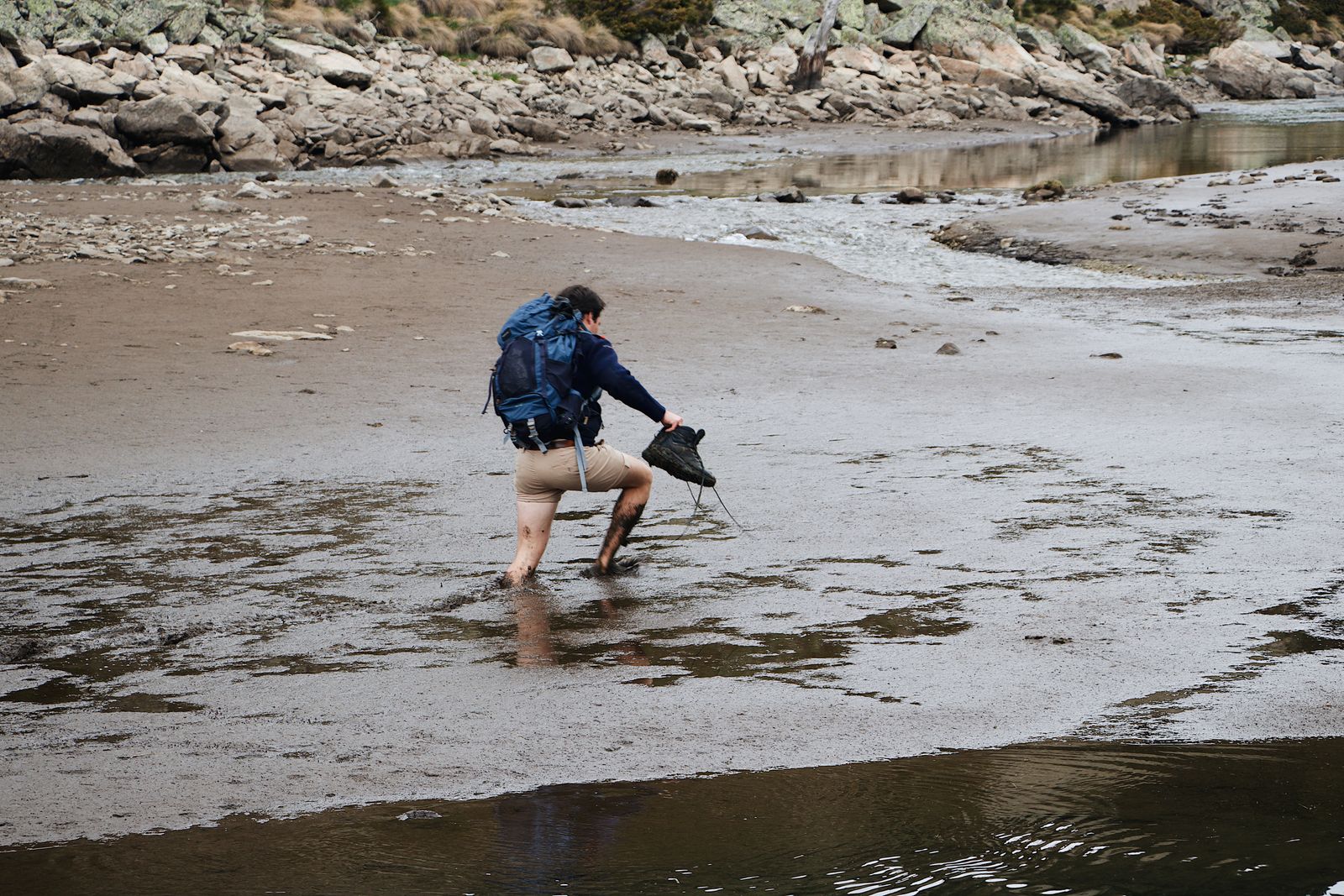
Decide the toe before you decide the brand, because it decides what can hurt you. Open toes drain fastest, breathe best and adjust easiest, and they expose your toes to every rock, root and stubbed step on the route. Closed toes guard the front of the foot behind a rubber bumper and pay for it in heat, weight and slower drainage. The safety literature leans the same way: NPS stream-crossing safety guidance warns that open-toed sandals do not protect toes from submerged hazards such as boulders and logs, and create drag in current — a fair summary of the open toe’s limits in moving water.
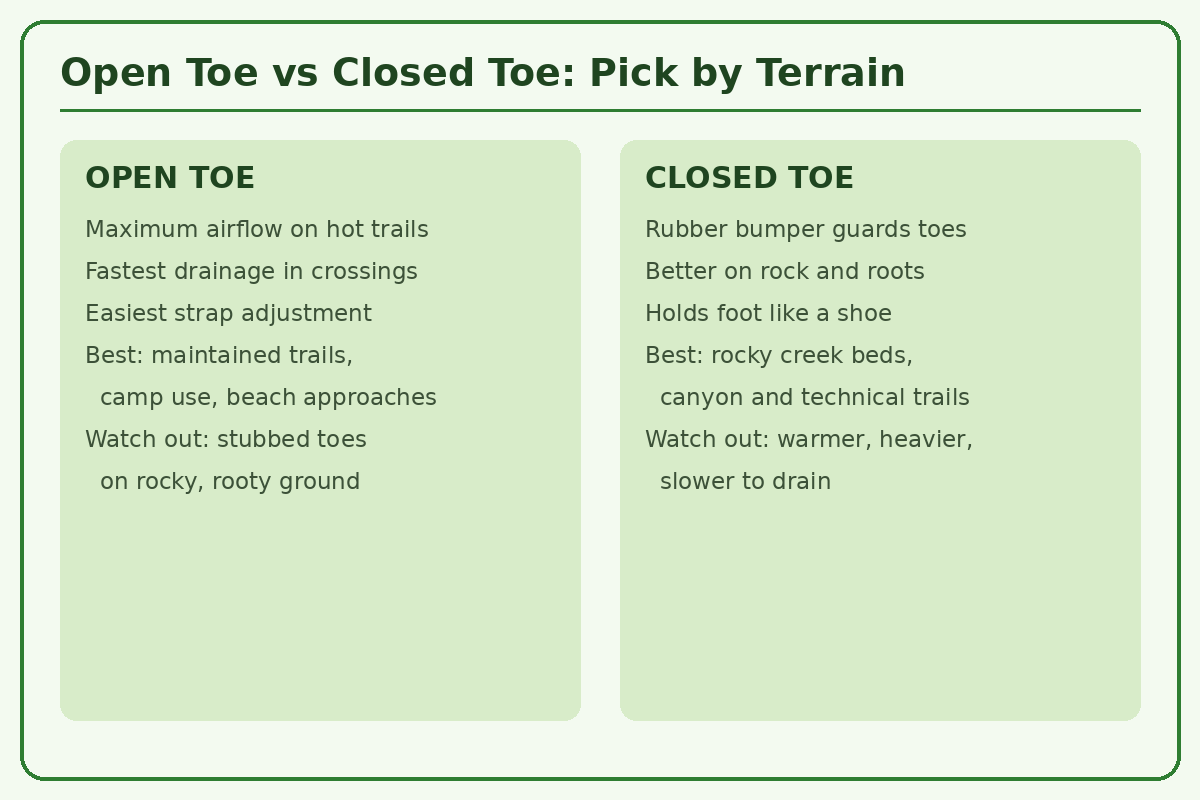
The practical rule most men land on is route-based, not loyalty-based. Maintained trail, beach approaches, camp and gentle crossings: open toe, and enjoy the airflow. Rocky creek beds, canyon bottoms, talus edges and any trail where you kick things in boots too: closed toe. Many hikers end up owning one of each across a few seasons — still cheaper than one boot bought for the wrong job, as our best hiking boots for men roundup makes clear.
The Hybrid Middle Ground
A bumper is not the only form of protection. Deep footbed sidewalls and straps that hold the foot back from the front edge also reduce stub damage. When trying sandals on, check where your toes sit at full stride: if the longest toe rides past the footbed’s front lip, that size will find rocks for you. A size or model change fixes it; hope does not.
Men’s Fit: Last, Width and Sizing
Men’s sandals are not women’s sandals in bigger sizes. A men’s last is typically longer, wider through the heel and higher in volume, with strap geometry placed for that shape — which is why this roundup does not reuse the women’s picks; a woman reading for herself belongs in the closed-toe women’s roundup. Fit method, though, is universal: REI’s boot guide makes fit the difference between blisters and bliss, and sandals punish a sloppy fit faster because there is no upper to hide it.
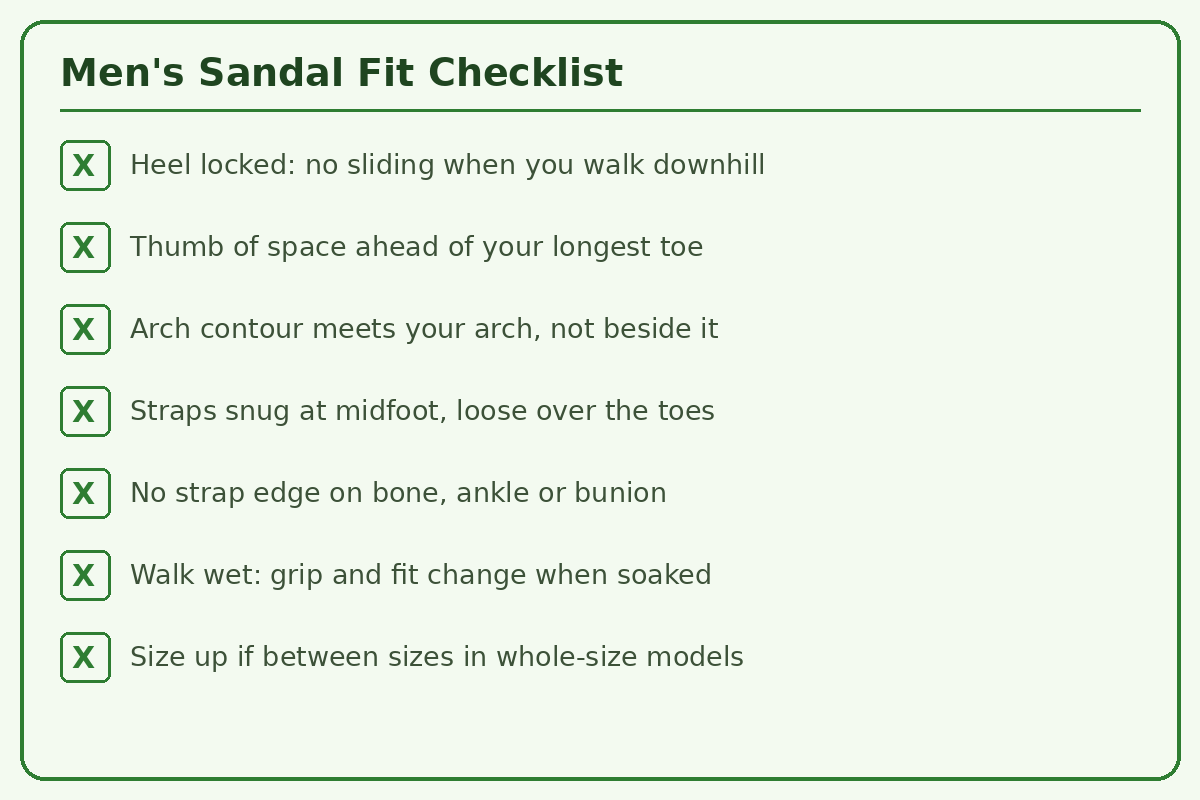
Run the fit test in the order your feet will fail. First, heel lock: walk briskly and stop hard — the heel must stay seated, because heel slide is the blister engine our blister prevention guide fights. Second, toe room: a thumb of space ahead of the longest toe. Third, strap placement: no edge on ankle bone or bunion joint. Fourth, the wet test: soak the sandal and walk again, since webbing stretches and footbeds get slick.
Whole Sizes, Wide Feet and Between-Sizes Rules
Most men’s hiking sandals come in whole sizes only, so the between-sizes rule matters: size up. A slightly long footbed adjusts with straps; a short one puts toes at the edge permanently. Wide feet should start with a published wide option or a generous last — the Newport and the wide Z/1. Narrow feet should choose multi-point hook-and-loop adjustment, which takes up slack a single strap cannot. Our best boot insoles for hiking guide applies to your boots only — sandal footbeds are the support system here.
Arch Support and Sore Feet
Cushion and support are different products wearing the same label. Cushion is soft material compressing under load; support is a shaped platform holding the arch up and the heel centred. Michigan Foot Doctors builds its sandal recommendations around genuine arch structure rather than flat foam, and GoodRx’s plantar fasciitis guide steers sore heels away from flat, unsupportive footwear — flip-flops named explicitly.
Match the footbed to the foot you have. Tired, flattening arches point to the Z/1’s firm contour; rigid high arches usually prefer the Hurricane’s softer EVA; healthy feet that want to work point to the Z-Trail. Persistent pain is a diagnosis question, not a shopping one — our best insoles for flat feet hiking guide covers the insole route in closed shoes.
The Break-In Honesty Section
Firm sandals break in by teaching your feet, not by softening. Give a contoured footbed short walks first and build distance over a week or two; fading soreness is normal, sharp pain or numbness is a stop signal. Cushioned sandals hide a different clock: when the EVA packs down, support quietly leaves.
Grip on Wet Rock, Mud and Dry Trail
A hiking sandal earns its name at the outsole. Look for a rubber compound — not foam — with lugs you can feel with a thumbnail, spaced widely enough to shed mud rather than pack it. Change Gear’s comparison scores the picks here partly on exactly that: lug depth and rubber at the contact patch, where the ChacoGrip’s published 3.5 millimetre lugs stand out among sandals. Smooth-bottomed fashion sandals fail this test instantly, whatever their straps claim.
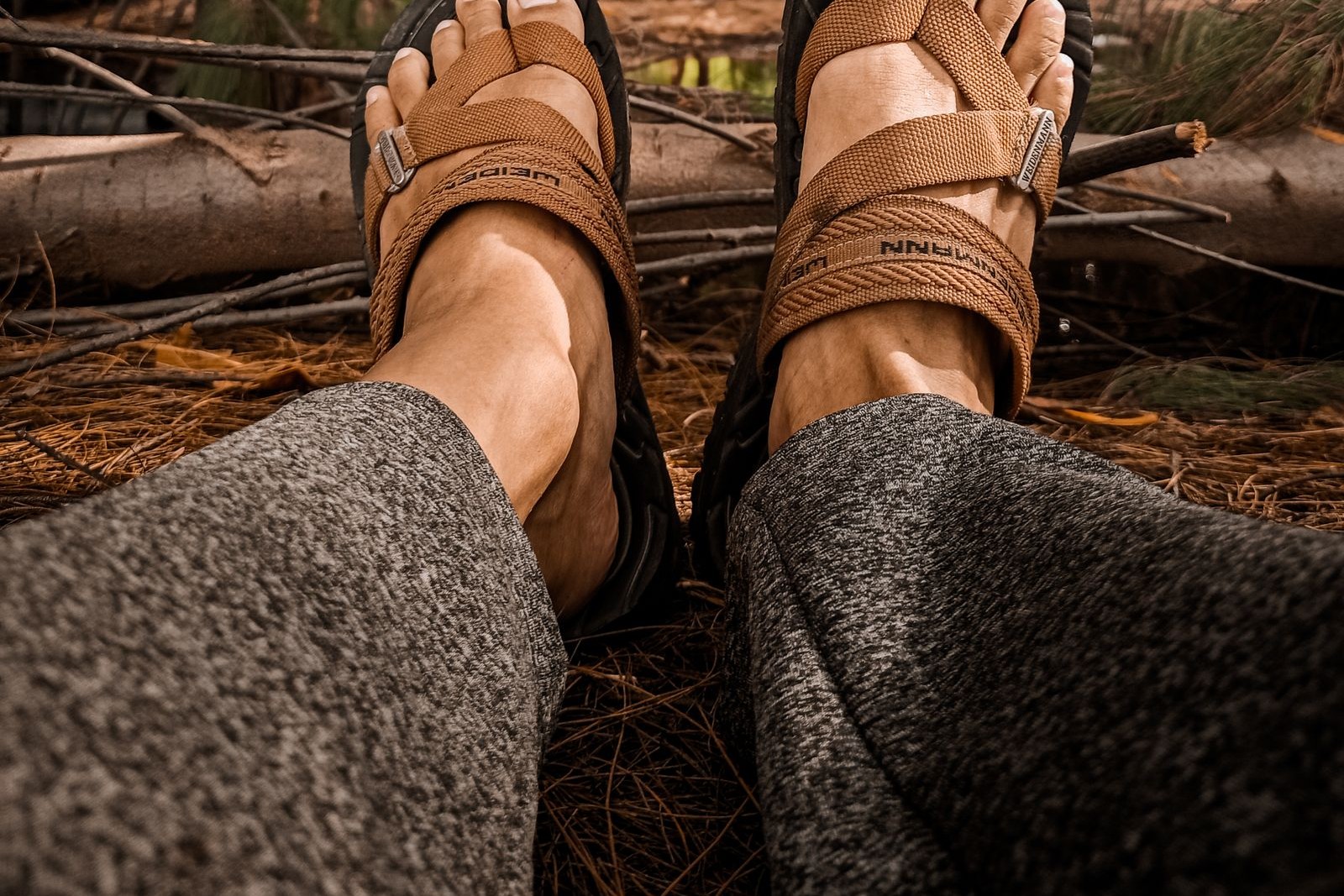
Wet grip is a system, not just a sole. The footbed texture matters when the top side is soaked, the strap hold matters because a foot sliding inside the sandal wastes the outsole’s grip, and your own technique matters most of all. NPS river safety guidance reminds hikers that water-polished rock is slippery wet or dry and that even shallow current can knock a person off their feet — sandal grip buys margin, not immunity. On dry, loose trail, deeper lugs and a locked heel beat any compound claim; compare how your shortlist handles descents before trusting it, the same test our best trail running shoes roundup applies to lugged shoes.
Socks With Sandals, Said Plainly
Yes, when the day turns cool or the trail turns dusty. A thin hiking sock stops grit grinding under straps, adds camp warmth and prevents mile-eight strap rub. Wool and synthetic only — cotton stays wet and blisters — per REI’s clothing guide; our best hiking socks roundup covers the weights that work inside straps.
Water Crossings and Hot-Weather Trails
Crossings are where sandals stop being a preference and become the plan. Crossing in boots soaks insulation that takes days to dry; crossing barefoot is the one option every authority rejects — traction drops and submerged hazards wait for unprotected feet. A strapped sandal with the hip belt unbuckled and a pole for a third point of contact is the textbook setup, and the river-safety guidance adds the judgement rule: never cross above rapids or falls.
Hot trails are the second home ground. Airflow ends the sweat-soak cycle that makes boots miserable in heat, and quick-dry webbing means a morning crossing is forgotten by lunch. The limits are sun and grit: exposed feet burn, so sunscreen belongs on them, and desert sand under straps needs regular rinsing. Our guide to what to wear hiking in summer builds the full hot-weather system around footwear like this, and the 10 Essentials still apply in full — sandals change your feet, not your safety list.
When Sandals Are the Wrong Tool
Say it in a sandal guide, because credibility is the product. Steep, loose descents under a heavy pack, cold water with cold air, sharp broken rock, and any route where ankle support is why you finish — those belong to boots or shoes. The boots vs trail runners comparison draws the load lines; sandals sit on the light-and-warm side of them.
Camp Sandals and the Second-Shoe Job
Half the pairs sold as hiking sandals actually work the evening shift. A camp sandal airs out feet that have been in boots all day, handles the walk to the water source, and stands ready as the crossing shoe the next morning — three jobs for the weight of the lightest pick here. That is why the Z-Trail’s packability matters: a sandal that rolls into a side pocket actually comes along, unlike a bulky second pair left home on exactly the trip with the big crossing. Judge a camp candidate by weight and pack size first, strap simplicity second — you will be fitting it by headlamp, tired — and enough outsole for wet rock third. Backpackers should read our multi-day backpacking checklist for where a second shoe earns its place in the load.
Care, Straps and Knowing When to Replace
Sandals die by straps and footbeds, not by outsoles alone. Rinse grit out of webbing after crossings — sand inside a strap is sandpaper with a schedule — and dry sandals in shade, since heat warps foam footbeds. A wash with mild soap when the smell sets in keeps any pick here socially acceptable at camp.
Replacement signs, in the order they appear. Hook-and-loop that no longer holds under load, a footbed contour that has visibly flattened, lugs worn smooth at the ball and heel, and strap fray at the footbed slots. Michigan Foot Doctors makes the clinical version of the same point — worn support stops being support — and GoodRx advises replacing footwear when it shows excessive wear. A resoleable design is the exception worth knowing: Chaco’s construction is famously long-lasting, which is part of why its higher price amortises better than it first looks.
Storage Between Trips
Store sandals clean, dry and unstrapped-loose. Cinched straps crease webbing at the fold, and a damp sandal in a closed bin grows a smell no wash fully removes. The same discipline as our guide to storing a backpack between trips: clean it, dry it, store it relaxed.
Our view
Men’s hiking sandals reward the hiker who buys for his actual trails: the Newport if your routes kick rocks, the Z/1 if your arches clock out early, the Hurricane if you want one honest pair for summer, and the Z-Trail riding in the pack for crossings and camp. Get the decision order right — toe, then footbed, then fit — the way our boots vs trail runners comparison orders the closed-footwear choice, keep expectations honest with the flat-feet boots guide if support is your story, and let the sore-feet guide be the reminder that no sandal fixes a fit you ignored. Buy the pair your terrain described, not the pair the advertisement did.
— Brian Ka
FAQ
Are hiking sandals good for long distances?
For trained feet on suitable terrain, yes — with the support pick, not the minimal one. A firm, contoured footbed and locked straps carry long miles; a thin barefoot sandal asks your feet to do that work and should be built up to gradually. Distance multiplies small fit errors, so the fit test matters more as mileage grows.
Should men’s hiking sandals be open or closed toe?
Closed toe for rocky, rooty or debris-filled trails and creek beds; open toe for maintained trails, camp and gentle water. The closed toe costs airflow and drainage speed, the open toe costs protection. Most men who hike varied summer terrain eventually run one of each, starting with the shape their home trails demand.
How should hiking sandals fit a man’s foot?
Heel locked with no slide, a thumb of space ahead of the longest toe, straps snug at the midfoot and no strap edge pressing on bone. Test the fit walking, then test it wet. In whole-size models, size up when between sizes — straps can take up length, but nothing adds footbed in front of your toes.
Can you hike in sandals with flat feet?
Yes, in a firm contoured model — that is the Z/1’s home ground. Flat feet generally do better with structure that holds the arch than with soft cushion that lets it collapse, and worse in completely flat barefoot sandals. Persistent pain deserves a professional assessment alongside any footwear change.
Do hiking sandals work for water crossings?
They are the recommended tool for it, worn strapped and paired with an unbuckled hip belt and a pole. Never cross barefoot, avoid crossing above rapids or falls, and pick the widest, shallowest, calmest line available. In cold or fast water, the crossing itself — not the footwear — is the decision to remake.
How long do men’s hiking sandals last?
It depends on the footbed material more than the brand. Firm polyurethane contours hold their shape for years; EVA packs down sooner under heavy mileage. Replace any sandal when straps stop holding, the contour flattens, or lugs wear smooth — worn support is no support.
Questions About Men’s Hiking Sandals?
Tell us your usual trails, how much water they involve and how your arches behave on long days, and we will help you pick between protection, support and cushion.
Contact UsSources
- KEEN — Men’s Newport H2 Sandal
- Teva — Men’s Hurricane XLT2
- Chaco — Z/1 Classic Sandal
- Xero Shoes — Z-Trail EV, Men
- REI Expert Advice — How to Choose Hiking Boots and Hiking Shoes
- REI Expert Advice — What to Wear Hiking
- OutdoorGearLab — KEEN Newport H2 Review
- Michigan Foot Doctors — Best Hiking Sandals
- GoodRx — What to Look for in Plantar Fasciitis Shoes
- National Park Service — Stream Crossing Safety
- National Park Service — River and Stream Safety
- Gear Patrol — Chaco vs Teva
- The Inertia — Best Hiking Sandals, Tested
- American Hiking Society — The 10 Essentials
- Change Gear — Best Hiking Sandals