
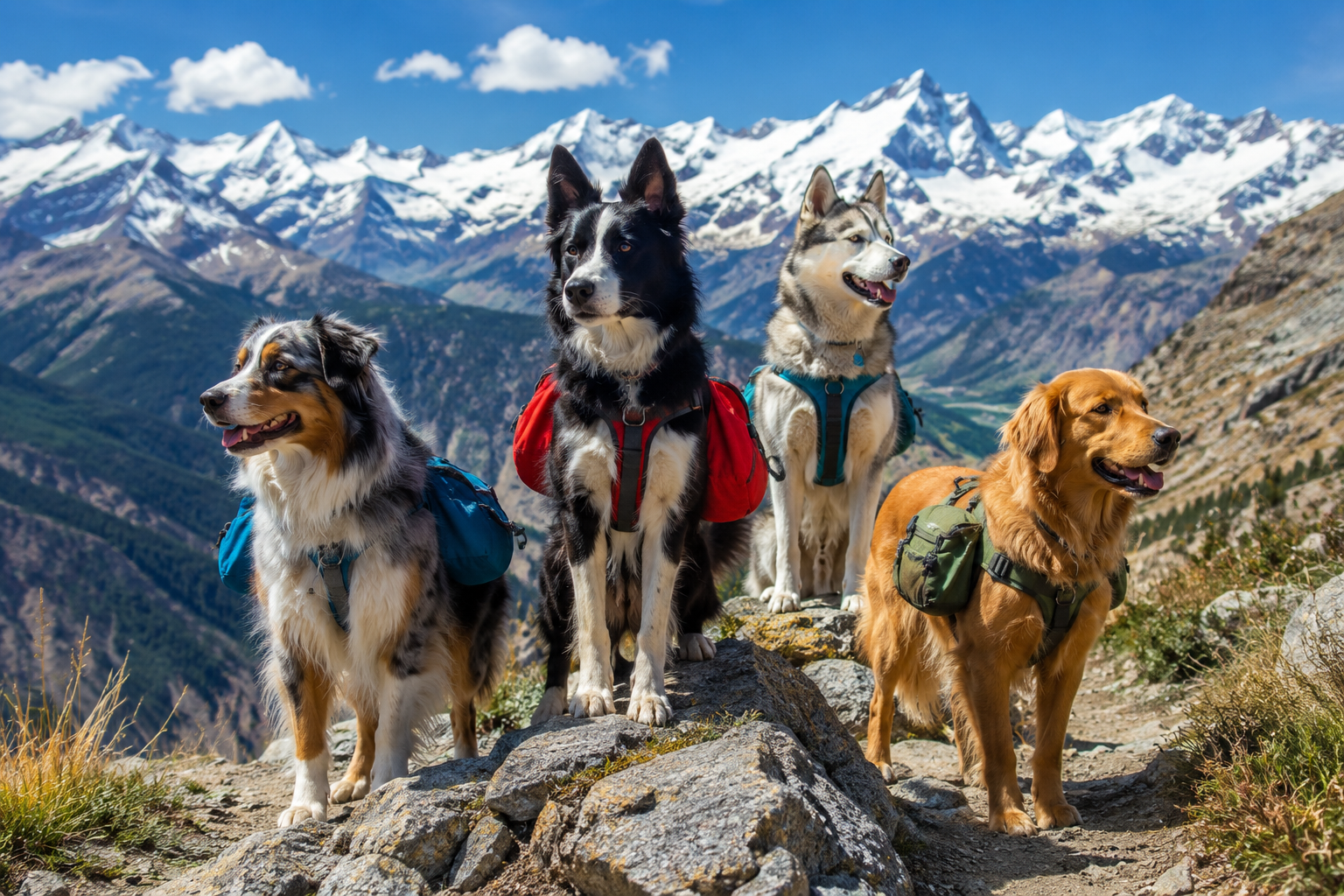
A dog that hikes comfortably at sea level or moderate elevation doesn’t necessarily hike comfortably at 9,000 or 12,000 feet. Thin air genuinely changes the physical demands of a hike — reduced oxygen means your dog’s heart and lungs work harder for the same physical output, and some breeds are meaningfully better equipped to handle that strain than others. Lung capacity, chest structure, and cardiovascular efficiency all matter here in ways that don’t come up on a flat trail near home, and understanding which breeds genuinely handle altitude well — and which face real, documented risk — is worth knowing before you commit to a fourteener or a high alpine backpacking trip with your dog in tow.
This guide covers the breed traits that genuinely matter for high-altitude hiking, which breeds tend to handle elevation well, which breeds carry real documented risk, and how to actually prepare and monitor any dog — regardless of breed — for a genuinely safe high-altitude hiking trip.
For the broader picture of choosing a hiking dog breed, our best hiking dog breeds guide covers general trail suitability, and our what to do if your dog gets injured or overheated on the trail guide covers broader trail emergency response that applies at altitude as much as anywhere else.
Why Altitude Genuinely Affects Dogs Differently
Altitude sickness in dogs works through essentially the same physiological mechanism as in humans — as elevation increases, atmospheric pressure drops and the air contains genuinely less available oxygen per breath. A dog’s body has to work harder to deliver adequate oxygen to vital organs and tissues, placing real strain on the cardiovascular and respiratory systems that becomes considerably more pronounced during active exertion like hiking than during rest.
Symptoms of altitude sickness in dogs mirror the human experience closely: increased heart rate, rapid or labored breathing, excessive panting, drooling, coughing, lethargy, loss of coordination, decreased appetite, and in more serious cases, vomiting, pale or discolored gums, and nosebleeds. In genuinely severe cases, fluid can accumulate in the lungs (high-altitude pulmonary edema) or the brain (high-altitude cerebral edema) — both serious, potentially life-threatening conditions that require immediate descent and veterinary attention.
Significant altitude sickness is genuinely rare below roughly 8,000 feet, with mild symptoms sometimes appearing in susceptible dogs between 8,000 and 10,000 feet, and real risk increasing meaningfully above that. Dogs should never attempt high-altitude hikes above 8,000 feet without proper acclimation, and veterinary and outdoor guidance consistently recommends that only healthy, well-conditioned dogs attempt elevations above roughly 11,000 feet at all.
Breed Traits That Genuinely Matter at Altitude
Lung capacity and chest structure are the single most consequential physical traits for altitude tolerance. Breeds developed for sustained work in mountainous or cold, high-elevation environments — historically bred for exactly this kind of physical demand — tend to have genuinely larger lung capacity and more efficient oxygen transport than breeds developed for other purposes entirely.
Red blood cell count and oxygen transport efficiency vary meaningfully between breeds and individuals. Some working and mountain breeds carry a genuinely higher number of red blood cells, which directly improves how efficiently oxygen moves from the lungs into the bloodstream and out to working muscles — a real physiological advantage during sustained high-altitude exertion.
Muzzle and airway structure is the most consequential risk factor of all, and it cuts strongly against brachycephalic (flat-faced) breeds specifically. Breeds like Bulldogs, Pugs, Boxers, Pekingese, and French Bulldogs already have compromised, restricted airways at sea level, and altitude compounds this dramatically. Veterinary sources specifically warn that increased breathing effort in these breeds can cause throat inflammation and swelling, creating a genuinely dangerous cascade effect that a dog’s body may not be able to recover from independently.
Overall physical conditioning and body weight matter as much as breed tendencies. A fit, appropriately conditioned dog of any breed adapts to altitude more effectively than an out-of-shape or overweight dog, and older dogs are generally less efficient at adapting regardless of breed background.
Existing heart, lung, or respiratory conditions are an absolute contraindication for high-altitude hiking regardless of breed. Veterinary guidance is consistent and direct on this point: dogs with known heart conditions or heart murmurs should not be taken on high-altitude mountain hikes at all, and any dog with a preexisting respiratory or cardiac issue should be evaluated by a veterinarian before any high-elevation trip is even considered.
Breeds Genuinely Well-Suited to High-Altitude Hiking
Mountain and livestock-guardian breeds — including Bernese Mountain Dogs and similar large, cold-climate working breeds — were historically developed for sustained physical work in genuinely mountainous terrain, and this heritage translates into real physiological advantages at altitude: larger lung capacity, efficient oxygen transport, and a body structure and coat built for cold, high-elevation conditions rather than working against them.
Herding breeds with mountain or high-elevation working heritage, including Border Collies and Tibetan Terriers, are frequently cited specifically for their combination of larger lung capacity and higher red blood cell counts — the same underlying traits that benefit mountain breeds, developed through generations of sustained work at real elevation rather than flatland herding alone.
Alpine and Nordic working breeds more broadly — dogs bred for sustained cold-weather endurance work, including sled and mountain rescue lineages — tend to share the cardiovascular efficiency and cold tolerance that high-altitude conditions genuinely demand, since cold and thin air frequently occur together at elevation.
It’s worth being direct about a limitation here: breed provides a genuine hint about likely altitude tolerance, not a guarantee. Individual dogs within any breed vary meaningfully in actual altitude tolerance, and knowing your specific dog’s demonstrated capabilities — built gradually through real experience at progressively higher elevations — matters more than breed alone for any single dog’s actual safety on a specific trip.
Breeds That Carry Genuine Elevated Risk
Brachycephalic (flat-faced) breeds are the clearest, most consistently flagged risk category across every veterinary and outdoor source on this topic. Bulldogs, Pugs, Boxers, Pekingese, and French Bulldogs all have structurally restricted airways that already compromise breathing efficiency at sea level, and altitude compounds this in a genuinely dangerous way rather than simply adding mild additional difficulty. Multiple veterinary sources specifically recommend leaving brachycephalic breeds at moderate elevation entirely for genuine high-altitude adventures, rather than attempting to manage the risk through careful monitoring alone.
Dogs with any diagnosed heart or lung condition should not attempt high-altitude hiking regardless of their breed’s general reputation for altitude tolerance — this is a categorical veterinary recommendation, not a case-by-case judgment call left to trail conditions or a dog’s apparent energy level on a given day.
Puppies and senior dogs face elevated risk independent of breed, since both a still-developing cardiovascular and respiratory system and an aging one are generally less efficient at adapting to reduced oxygen availability than a fully mature, healthy adult dog’s system. Puppies specifically should be limited to short, easy trails rather than genuine high-altitude exertion, since their bodies are still developing at a stage where added physiological stress carries more consequence.
Overweight or genuinely out-of-shape dogs of any breed are considerably more susceptible to altitude difficulty than a lean, well-conditioned dog, since excess weight adds real cardiovascular strain that compounds directly with the reduced-oxygen strain altitude already creates.
How to Actually Prepare Any Dog for High-Altitude Hiking
Acclimatize gradually rather than attempting a big climb immediately upon arrival at elevation. The single most consistently repeated piece of guidance across veterinary sources is to increase altitude exposure incrementally — starting with shorter hikes at progressively higher elevations over the course of several weeks, rather than driving or flying directly to a high-elevation trailhead and immediately attempting a demanding climb.
Flying to a high-elevation destination creates a genuinely more abrupt altitude change than driving does, and deserves specific extra caution. A dog flying from a low-elevation city directly to a mountain destination has had essentially no time to adjust before you’re already at altitude — build in real acclimatization time at the destination’s elevation before attempting any demanding hike, the same way a human traveler would plan around avoiding altitude sickness themselves.
Hydrate more aggressively than you would at lower elevation. Dehydration happens genuinely faster at altitude, and the practical rule most veterinary sources recommend is straightforward: every time you stop for your own water break, offer your dog water as well, and carry more water than you think either of you will need.
Pack more food than the trip’s duration strictly requires. Increased exertion at altitude burns more calories, and being over-prepared with extra food costs you nothing if unused, while being under-prepared genuinely compounds the physical stress your dog’s body is already managing.
Monitor activity level and behavior closely, especially above roughly 8,000 feet. This matters more than it might seem, because the most enthusiastic trail dogs are often the ones at greatest practical risk — a dog running circles around you with apparent boundless energy isn’t necessarily immune to altitude sickness, and an eager dog is genuinely less likely to self-regulate their pace the way a more cautious human hiker naturally does. You are your dog’s primary advocate for pacing at altitude, since they won’t consciously recognize or communicate early symptoms the way a person would.
Know the signs that warrant turning back immediately, and be genuinely willing to act on them. Excessive panting beyond what exertion alone explains, drooling, coughing, lethargy, loss of coordination, pale or discolored gums, vomiting, or nosebleeds are all signals to descend rather than push forward — altitude sickness resolves with descent, and every additional minute spent at altitude while a dog is symptomatic makes the underlying condition worse rather than better. Summits can wait; your dog’s health genuinely can’t.
Understand that sleeping at altitude is harder on a dog’s body than day-hiking at altitude. Overnight, the body continues managing the physiological stress of reduced oxygen without the option of an easy, immediate descent the way a day hike allows — worth factoring specifically into planning for any multi-day backpacking trip that involves an overnight camp at genuinely high elevation.
Carry a plan for carrying your dog out if needed. A dog carrying harness or an emergency carry method is worth having specifically for high-altitude trips, since a dog experiencing genuine altitude sickness may not be physically capable of hiking themselves back down to a safer elevation.
Discuss any known medical conditions with your veterinarian before a high-altitude trip specifically, rather than assuming a condition that’s manageable at sea level poses no additional risk at elevation. This is particularly important for any dog with a heart murmur, known cardiac condition, or respiratory issue, where the standard veterinary guidance is to avoid high-altitude hiking entirely rather than attempt it with extra caution.
After a Symptomatic Episode
If a dog does show genuine signs of altitude sickness, descending to lower elevation is the immediate priority — symptoms typically resolve with descent rather than requiring the dog to simply push through or rest in place at the same elevation. Once at a lower elevation, provide water and offer food once appetite genuinely returns, and monitor closely for any lingering symptoms over the following several hours. Most dogs recover fully within 24 to 48 hours of rest at normal elevation; if symptoms persist meaningfully beyond that window, seek veterinary evaluation rather than assuming continued rest alone will resolve things.
It’s also worth understanding for future trips that a dog who has experienced altitude sickness once may be more susceptible on subsequent high-altitude hikes — take additional precautions on future trips, and consider capping your dog’s maximum elevation more conservatively until you’ve built genuine confidence in their individual tolerance through repeated, careful exposure.
Final Thoughts
Breed genuinely matters for high-altitude hiking, but it’s a starting signal rather than a guarantee — mountain and working breeds with historically larger lung capacity and higher red blood cell counts tend to handle elevation well, while brachycephalic breeds carry documented, serious risk that veterinary sources consistently recommend managing by avoiding high-altitude hiking entirely rather than attempting it with extra caution. Regardless of breed, gradual acclimatization, aggressive hydration, close behavioral monitoring, and a genuine willingness to turn back at the first real signs of trouble matter more for any individual dog’s safety than breed alone ever will.
Know your specific dog’s demonstrated tolerance, built through real, careful exposure at progressively higher elevations rather than assumed from breed reputation alone, and you’ll have a far more reliable picture of what your dog can genuinely handle than any general breed guide — including this one — can promise on its own.
For more on choosing and preparing a hiking dog, check our best hiking dog breeds guide and our how to train your dog to hike long distances guide for building the conditioning foundation any high-altitude trip depends on.