
As an Amazon Associate I earn from qualifying purchases.
Every dog owner who hikes eventually asks the same question at a trailhead, usually while looking at a route that looks perfect for human legs: how far can a dog hike in a day before a good day turns into a harmful one? This explainer answers it the way veterinarians frame it — by size, age, breed type and conditioning, then by terrain, elevation, temperature and surface — and finishes with a build-up plan that turns a sensible starting distance into a safe, repeatable range for your own dog.
Find the Breeds Built for Trail Days
Distance starts with the dog in front of you, so see which breeds and body types are made for hiking before you plan the miles.
Key Takeaways
- Start shorter than you think your dog can manage, because the honest limit shows up in recovery the next day, not at the summit.
- Judge distance by the individual dog — size, age, breed type and conditioning move the range further than any single number.
- Build mileage in small weekly steps, adding distance or climb or heat one at a time, never all three together.
- Let temperature, surface and elevation shrink the plan, because a cool flat five miles and a hot rocky five miles are different hikes.
- Stop at the first clear fatigue sign and shorten the day, because a dog that quits happily today hikes again next week.
Table of Contents
- The Short Answer: A Range, Not a Number
- Size and Body Shape Set the Starting Point
- Age: Puppies, Adults and Seniors
- Breed Type, Breathing and Coat
- Conditioning: Fitness Is Built, Not Assumed
- Terrain, Elevation and Surface
- Temperature and Humidity Rewrite the Plan
- Water, Food and Rest Stops
- Control, Harnesses and Trail Rules
- How to Build Distance Safely
- Warning Signs: When to Stop and Turn Back
- Planning the Day Around Your Dog
- Our view
- FAQ
- Sources
- Recommended
The Short Answer: A Range, Not a Number
There is no universal mileage figure, and any source that gives you one without asking about your dog is guessing. Veterinary guidance consistently frames exercise around the individual animal — its health, age, body condition and current fitness — rather than around a fixed distance, which is why the AVMA companion animal care guidelines put regular veterinary input at the centre of an animal’s care plan instead of publishing one-size exercise numbers. A fit adult dog of a working or sporting type, built up gradually, may handle a long trail day that would be unsafe for a puppy, a senior, a flat-faced breed or a dog carrying extra weight. The ranges in the table below are therefore starting points for a healthy adult dog on moderate terrain in mild weather — sensible first outings and the built-up ranges experienced hikers work toward — and every factor in the sections that follow can pull your dog’s real number down from them.
Read the table as a conversation starter with your veterinarian, not a permission slip. The pre-hike preparation in the AKC guide to training a dog to hike starts with exactly that step: check with your veterinarian that your plans match your dog’s physical limits, and research your breed’s exercise needs before choosing a route. If your dog has any diagnosed condition, is recovering from injury, or has not exercised regularly in months, the vet conversation comes before the table, not after it. Our dog breed guide shows how widely breed builds differ, and our roundup of small dogs that hike all day shows why small legs do not automatically mean small range.
| Dog profile | Sensible starting distance | Built-up range (conditioned, mild conditions) |
|---|---|---|
| Small adult dog, healthy and active | Around 2–3 miles on easy ground | Often 5–8 miles, sometimes more for proven trail dogs |
| Medium adult dog, average fitness | Around 3–4 miles on easy ground | Often 8–12 miles with gradual conditioning |
| Large, athletic working or sporting type | Around 4–5 miles on easy ground | Often 10–15 miles; exceptional conditioned dogs go further |
| Puppy or adolescent dog | Short, gentle outings only — minutes matter more than miles | Full distance waits until growth is complete and your vet agrees |
| Senior dog or dog with joint issues | Short, flat, unhurried walks, judged by comfort | Modest increases only, with veterinary guidance throughout |
| Flat-faced (brachycephalic) dog | Short and easy, in cool conditions only | Range stays limited by breathing and heat, whatever the fitness |
Why Guidance Varies So Much Between Sources
Different authorities measure different things. Some quote daily exercise totals for general health, some describe endurance in conditioned working dogs, and some are warning about heat or growth plates rather than distance at all. That spread is real, and this explainer will keep saying so rather than silently picking the number that sounds best. Where veterinary sources agree is on the method: start below the suspected limit, increase gradually, watch recovery, and let the individual dog’s response — not a chart — set the ceiling. The VCA Hospitals exercise guidance for dogs takes the same position, tying the right amount of exercise to the dog’s age, breed and health and building it up progressively.
Size and Body Shape Set the Starting Point
Size changes the arithmetic of a mile. A small dog takes far more strides to cover the same ground, works harder over obstacles that a large dog steps across, and tires in brush and rock that barely slow a longer-legged animal. That does not cap small dogs at short hikes — plenty of small, fit dogs outlast their owners — but it does mean their starting distance should be set conservatively and their built-up range earned on trail evidence. The dogs in our small trail dogs roundup succeed because their owners built them up gradually and chose terrain their legs could handle, and the carriers in our dog carrier backpacks guide exist for the honest moment when a small dog’s day is done before yours is.
Body condition matters as much as body size. An overweight dog of any size is carrying a load on every step, and its joints, heart and cooling system all pay for it. The weight-management guidance from Cornell is blunt about the method: lengthen the daily walk gradually — around ten percent per week in their example — watch the dog’s reaction, and slow down if breathing becomes hard or the dog is clearly trying to reduce the pace. That gradualism is the correct template for distance building in every section of this explainer. If your dog is carrying extra weight, the first hiking goal is not a mileage target at all; it is regular, comfortable daily movement, with trail distance added only as condition improves. The breed profiles in our best hiking dogs roundup note typical builds and weights so you can judge where your dog sits against its own breed’s healthy shape.
Age: Puppies, Adults and Seniors
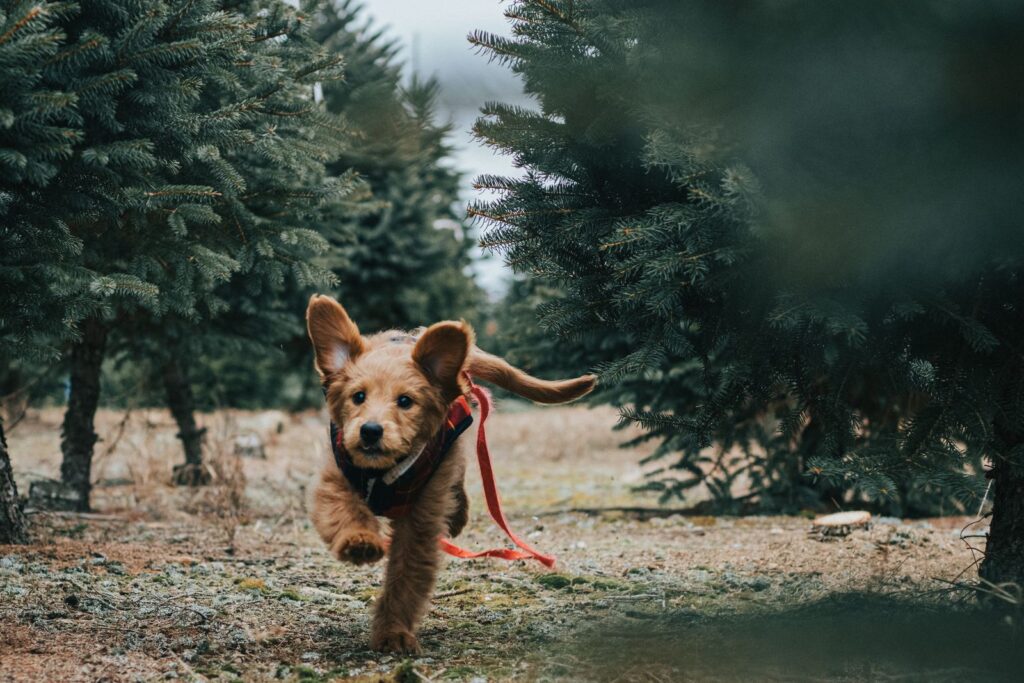
Puppies are the strictest limit in this whole explainer. Growing bones and joints are still forming, and repetitive endurance exercise on immature structures is the risk veterinary sources return to again and again. Young dogs need movement, play and exploration, but in short, self-paced bursts with rest whenever they choose it — not in marched trail miles at an adult’s pace. Keep puppy outings brief and gentle, carry the puppy for stretches on any longer walk, and treat full hiking distance as an adult privilege that arrives after growth is complete and your veterinarian is satisfied. The skills side can start early, though: loose-leash walking, recall and trail manners from our long-distance training guide are built in short sessions long before the miles are.
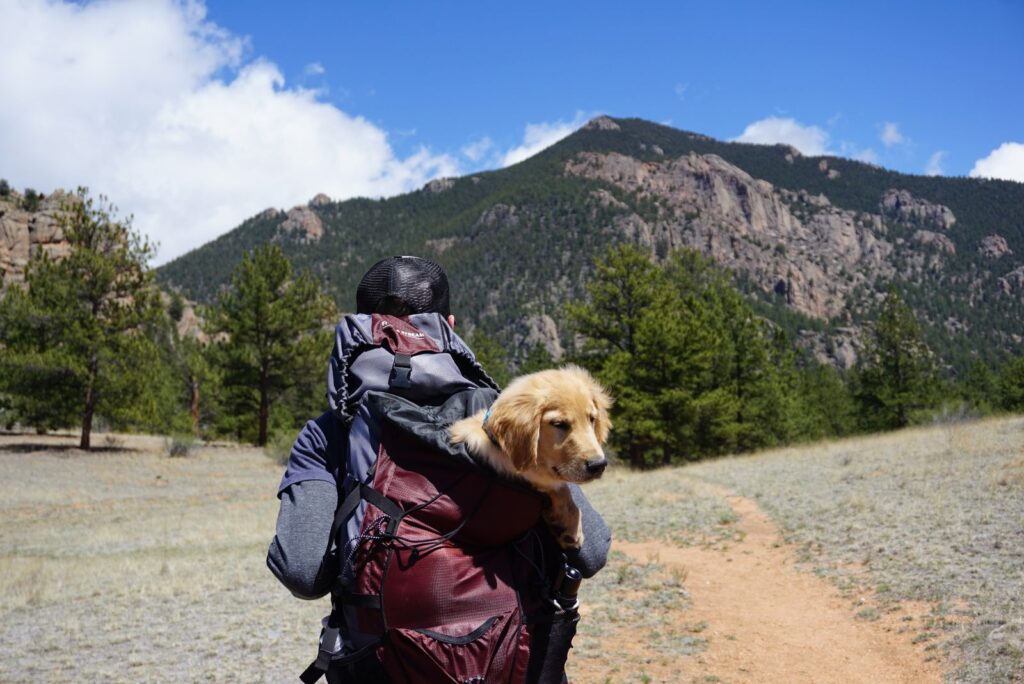
Healthy adults in their prime are the dogs the table’s ranges describe. Even here, prime age does not mean instant endurance. An adult dog that has spent its life on short neighbourhood walks is a beginner athlete whatever its birthdate says, and it enters the build-up plan at the starting distances like any other beginner. The conditioning work described by Cornell for treadmill training makes the same point from the rehabilitation side: exercise capacity is assessed individually, introduced in a controlled way, and progressed under observation — and a veterinarian or sports-medicine specialist is the right person to judge a dog’s candidacy for demanding exercise.
Breed Type, Breathing and Coat
Breathing sets a hard ceiling for flat-faced breeds. Bulldogs, pugs and other brachycephalic dogs move air through narrowed airways, and panting — a dog’s main cooling method — is inefficient work for them. The result is a dog that overheats sooner and recovers slower, on shorter distances, in conditions other dogs find easy. For these dogs the answer to the title question is genuinely small: short, cool, gentle outings, with distance increases treated as a veterinary conversation rather than a training goal. The heat guidance in the AKC heatstroke overview underlines why: dogs that cannot cool effectively can move from uncomfortable to emergency faster than owners expect.
Read your own breed before borrowing another breed’s range. The profiles in our hiking dog breeds guide and the stamina of the small dogs that hike all day show how far build and breeding move the answer in both directions.
Conditioning: Fitness Is Built, Not Assumed
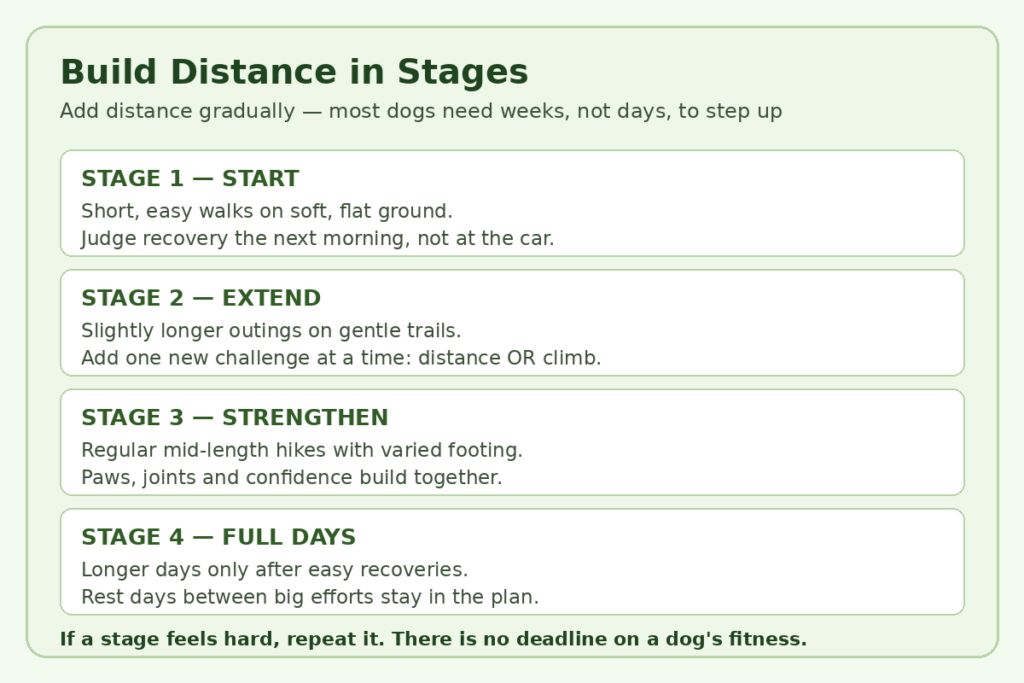
Endurance is a training outcome, not a breed trait. Muscles, cardiovascular fitness, paw pads and trail confidence all adapt to gradually increasing work, and all of them fail the same way when the increase is sudden: a dog that was joyful at mile three is sore, footsore or lame by mile eight. Veterinary guidance on heat and exertion makes the practical point that unconditioned dogs are at higher risk when activity jumps, which is why every veterinary source in this explainer converges on gradual progression. Think in weeks. A dog walking comfortably most days can add a little distance or a little climb each week, hold the new level until it looks easy, and only then add more.
The Recovery Test Decides the Next Step
Judge every increase the morning after. A dog that wakes up moving freely, eats normally and is keen for its usual walk has absorbed the last outing and earned the next small step. A dog that is stiff, quiet, off its food or reluctant has told you the last step was too big — repeat the previous level, or drop back, until recovery is clean. This single test, applied honestly, prevents more trail injuries than any mileage chart, and it costs nothing but attention. Keep a simple note of distance, terrain and next-day recovery for the first season and the pattern for your individual dog will be clearer than any general range, including the ones in this post. The structured approach in our training guide turns that habit into a programme.
Terrain, Elevation and Surface
Miles are not interchangeable. Five flat miles on soft forest tread ask far less of a dog than five miles with sustained climbing, loose rock or repeated stream crossings. Elevation gain multiplies effort for dogs just as it does for people, and altitude itself reduces the oxygen available to both of you — the preparation guidance in the Forest Service know-before-you-go advice, to research your area and its conditions before a trip, applies to your dog’s workload exactly as it applies to your route choice. When you add a new trail, change one variable at a time: a longer route on easy ground, or a shorter route with more climb, so you can see what each change costs your dog.
Translate ratings into dog effort before you commit. Our trail difficulty explainer helps convert a route’s grade into the work your dog will actually feel, and the routes behind our best hiking dogs coverage show the ground those ranges assume.
Temperature and Humidity Rewrite the Plan
Heat is the factor most likely to turn a reasonable distance into an emergency. Dogs cool themselves mainly by panting, and humid air blunts even that. The hot-weather guidance from the ASPCA warns that animals can develop heatstroke in warm, humid conditions and advises limiting exercise on hot days and providing ample shade and water — advice that translates directly into shorter routes, earlier starts and lower ambitions whenever the day warms up. In genuinely hot weather the correct answer to how far a dog can hike may be a short shaded walk at dawn, or no trail at all, and choosing that is good ownership rather than lost training.
Know the heatstroke picture before you need it. The VCA Hospitals heat stroke guidance describes a condition that escalates quickly and can be life-threatening, with heavy panting, thick drool, weakness and disorientation among the warning signs. A dog showing those signs needs the hike to stop immediately: move to shade, offer water without forcing it, cool the dog gradually, and seek veterinary care. Prevention is simpler than treatment — schedule around heat, carry more water than the distance seems to need, and let the thermometer, not the itinerary, set the day’s ceiling. The ASPCA cold-weather guidance makes the mirror-image point for winter: repeated exposure to cold can chill and harm pets, shorter outings suit many dogs in deep cold, and no dog should be pushed through weather its coat and condition cannot handle.
Gear can widen the margin, never repeal the weather. The options in our cooling vests guide help a dog shed heat on warm days, and the boots in our dog boots guide protect pads on hot or sharp ground — both adjust a plan; neither extends a dog past its signs.
Water, Food and Rest Stops
A hiking dog drinks more than a resting dog, and needs the chance to do it often. Offer water at regular stops rather than waiting for obvious thirst, and carry enough for the dog as well as yourself, with a margin for a delayed return. Established trail guidance includes hydration among its core habits — offering water regularly through the hike, with a collapsible bowl as the practical way to do it. Dogs should drink from water you carry or from clean running sources you trust, not from stagnant pools, which can carry parasites and bacteria that turn a good day into a veterinary visit.

Portable Dog Water Bottle
- Easy To Use: Exclusive patented design, U2mug design dog water bottle and water bowl two in one. The fold cap acts as a water bowl, and you don’t need any external bowl to give your hairy buddy water to drink anymore.The built-in travel water bowl for dogs and water key ensure no water is wasted, making it an ideal dog travel accessories
- Large Capacity: lesotc dog water bottle with a volume of 18oz/520ml. Dog travel water bottle can provide safe, fresh, and healthy water for puppy during long walking, travel, hiking, camping and other outdoor activities. It’s addition to your dog accessories, perfect for dog beach essentials and dog camping essentials
- Leak-Proof Design: dog water bottle dispenser designed with upgraded push-button lock keeps water clean and prevents spills. This dog water dispenser is designed with silica gel seal ring which can prevent water leakage efficiently. This makes it a reliable dog portable water bottle and a safe choice for your pet
List Price :
Offer: 15.19 $
Go to AmazonThe stop only happens if the kit makes it easy. A bowl carried accessibly rather than buried in your pack turns hydration into a habit — the designs in our portable water bowls roundup are built for that job — and the dog items belong on the same list as your own kit from our day hiking checklist.

Collapsible Dog Travel Bowl
- LEAKPROOF & TRAIL‑TOUGH. Built with a water-resistant outer shell and waterproof liner, the Quencher Dog Travel Bowl stands up to rugged use without leaking or soaking through your gear.
- FOLDS FLAT, GOES ANYWHERE. Lightweight and flexible, this portable dog bowl collapses down small so it fits in pockets or packs, making it convenient to take with you anywhere.
- STAYS PUT, NO TIPPING. With its low-profile, wide-bottom design, Ruffwear’s Quencher collapsible dog bowls resists sloshing and tipping, even when excited pet dive in fast after a long hike.
New starting from: 24.99 $
Go to AmazonControl, Harnesses and Trail Rules
A dog under control hikes further, because it wastes no energy and causes no incidents. Lunging, zig-zagging and pulling burn the reserves that distance needs, and they are unwelcome on shared trails regardless of fitness. The trail-skills approach in the American Hiking Society hiking-with-dogs guidance centres on preparation and control — a dog that walks calmly on leash, yields to other users and responds to its handler is a dog welcome on more trails, for more miles. Where rules require a leash, the leash is not negotiable, and the park guidance from the National Park Service on visiting with pets is explicit that pets must be restrained and kept to areas where they are allowed, which in many parks excludes trails entirely — always check before you plan a long day around a route your dog cannot legally walk.

Dog Hiking Harness
- DUAL LEASH ATTACHMENT POINTS. Features an aluminum V-ring on the back and reinforced webbing at the chest. Gives you options for everyday walks or redirecting dogs that tend to pull, so you can enjoy more controlled and pleasant outings.
- FIND THE RIGHT FIT WITH EASE. Not sure which size to choose? Check out our sizing chart image and how-to-fit video to help you measure your dog correctly. A proper fit means more comfort, control, and confidence on every adventure.
- FOAM-PADDED CONSTRUCTION. Built with closed-cell foam padding in the chest and belly panels. This provides cushioned support that helps prevent chafing during extended wear, making it ideal for long walks, hikes, or all-day adventures.
New starting from: 59.99 $
Go to AmazonThe B.A.R.K. framework is the etiquette of distance hiking with a dog. The National Park Service B.A.R.K. Ranger programme sums it up: bag your pet’s waste, always use a leash, respect wildlife, and know where you can go. A well-fitted harness gives you steering without throat pressure on climbs and descents — the fits in our dog hiking harnesses guide and the waist-belt options in our hands-free leashes roundup are the two control systems most distance hikers settle on. Dogs expected to hike off leash where it is legal need the reliability covered in our off-leash hiking breeds guide — and even then, a leash in the pack is part of the kit, for wildlife, livestock and the unexpected.
Waste, Wildlife and Other Walkers
Distance multiplies every small impact. A long day means more waste to pack out, more wildlife encounters to manage and more walkers, horses and dogs to pass politely. The National Park Service Leave No Trace principles apply to your dog as much as to you: dispose of waste properly, stay on durable surfaces, respect wildlife and be considerate of other visitors. Step off the trail with your dog held close when others pass, keep distance from wildlife even when your dog is calm, and never let a tired dog’s manners become someone else’s problem at mile nine.
How to Build Distance Safely
Treat the first season as a training block, not a test. Start with the starting distance from the table for your dog’s profile, on the easiest ground you have, in mild weather. Repeat it until it looks effortless and next-day recovery is clean. Then change one thing: a little more distance, or a little more climb, or a slightly rougher surface. Hold each new level for at least a couple of outings. If recovery falters, drop back a level without treating it as failure — the dog’s body is setting the pace of the programme, and arguing with it produces injuries, not fitness.
Structure turns patience into progress. The programme in our long-distance training guide lays the build-up out week by week, and the packs in our dog backpacks guide add load only once the distance underneath it is solid.
Warning Signs: When to Stop and Turn Back
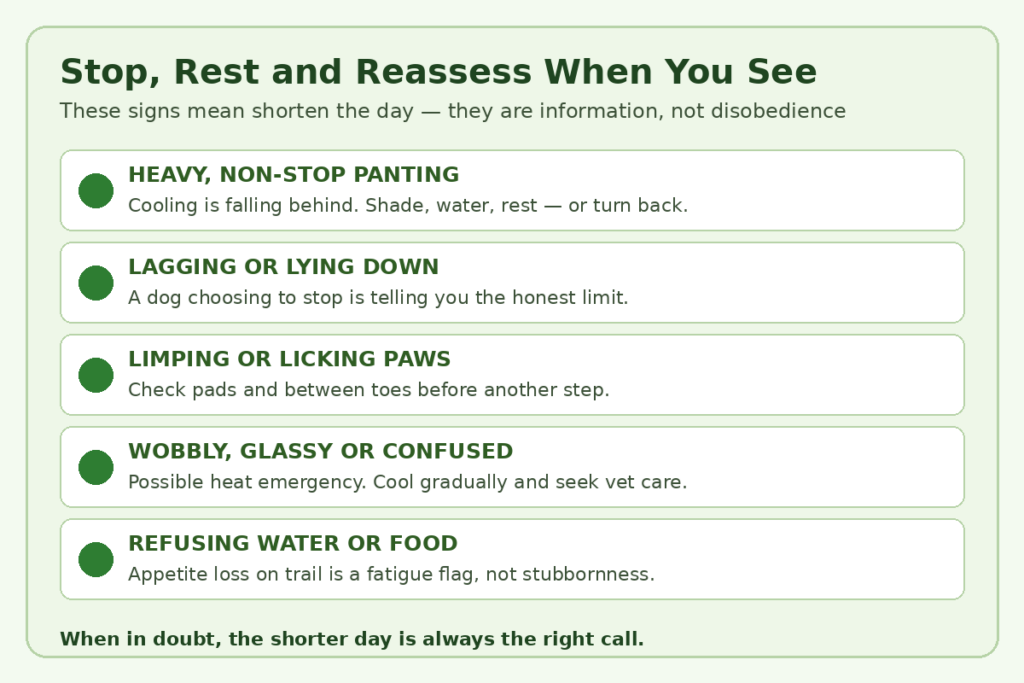
Your dog will show you its limit before it reaches it — if you are watching. The earliest signs are behavioural: a dog that stops to sniff everything, drifts behind instead of ranging ahead, or seeks shade at every stop is managing fatigue, not being stubborn. Physical signs follow: heavier panting that does not settle during a rest, thick ropey drool, a tongue hanging unusually wide and long, bright red gums, or a gait that loses its spring. Any of these means the day’s plan shrinks — rest properly, offer water, and be ready to turn back while turning back is still easy. The response steps in our injured dog guide cover what to do when a dog cannot comfortably continue, and carrying the kit from our dog first aid kits guide is what turns that knowledge into action.
Planning the Day Around Your Dog
Match the day to the dog you have this season, not the dog you hope to have. A young dog building fitness, an older dog defending its mobility and a prime-age athlete in mid-training all deserve routes chosen for their current reality. That honesty is what makes the title question answerable in practice: your dog can hike as far as it can cover while moving freely, recovering fully overnight, and arriving keen to go again — and that distance, built gradually and read honestly, grows further than most owners expect. Start with the breed context in our best hiking dogs roundup, set your starting point from the table above, and let the recovery test write the rest of the plan.
Our view
I stopped asking how far a dog can hike the day I started asking how a dog recovers, because recovery is where the truth lives. Set your starting point against the dogs in our best hiking dogs roundup, respect the genuine stamina of the small dogs that hike all day without borrowing their range before your dog has earned it, and follow the patient build-up in our long-distance training guide, and the miles take care of themselves — one clean recovery at a time.
— Brian Ka
FAQ
How far can a healthy adult dog hike in a day?
As far as its conditioning, the terrain and the weather allow — which for a fit, gradually built-up adult dog of an active type often means somewhere in the high single digits to low double digits of miles on moderate ground. An unconditioned adult should start at a few easy miles whatever its breed, and seniors, puppies and flat-faced breeds sit far below the general ranges. The table in this explainer gives starting points; your dog’s recovery sets the real figure.
Can a small dog hike long distances?
Yes — small size alone does not cap distance. Fit small dogs with sound joints regularly complete full trail days, and some outlast larger companions. Their limits arrive through stride length, obstacles and brush rather than stamina, so choose terrain their legs can handle, build up gradually, and carry a carrier option for the day their limit arrives before yours does.
How do I know if I have hiked my dog too far?
Read the recovery. Heavy panting that will not settle, lagging, lying down, limping or licking at paws on the trail are same-day warnings. Stiffness, reluctance to move, skipped meals or sore paws the next morning confirm the distance was too much. Shorten the next outing to the last level that produced a clean recovery and rebuild from there.
How quickly can I build my dog’s hiking distance?
In small steps across weeks, not in leaps across days. Add a little distance or a little climb at a time, hold each level until it looks easy and recovery is clean, and keep rest days in the week. Guidance on gradual exercise progression varies in its exact figures, but every veterinary source agrees on the direction: progressive, observed and reversible.
Should puppies hike at all?
Puppies should explore, not endure. Short, gentle, self-paced outings with rest and carrying breaks suit growing bodies; marched trail miles and repetitive endurance exercise wait until growth is complete and your veterinarian agrees. Trail skills — loose-leash walking, recall, calm passing — can be trained in those short sessions long before distance enters the picture.
Questions About Hiking Distance for Dogs?
Tell us your dog’s breed, age and current walks, plus the trails you have in mind, and we will help you set a starting distance and a build-up plan.
Sources
- AVMA — Companion Animal Care Guidelines
- AKC — How to Train Your Dog to Hike With You
- AKC — Heatstroke in Dogs
- VCA Hospitals — Exercise for Dogs
- VCA Hospitals — Heat Stroke in Dogs
- Cornell Riney Canine Health Center — Treadmill Training for Dogs
- Cornell Riney Canine Health Center — Obesity and Weight Management Tips
- ASPCA — Hot Weather Safety Tips
- ASPCA — Cold Weather Safety Tips
- National Park Service — Pets
- National Park Service — B.A.R.K. Ranger, Shenandoah National Park
- National Park Service — Leave No Trace Seven Principles
- American Hiking Society — Hiking With Dogs
- USDA Forest Service — Know Before You Go