
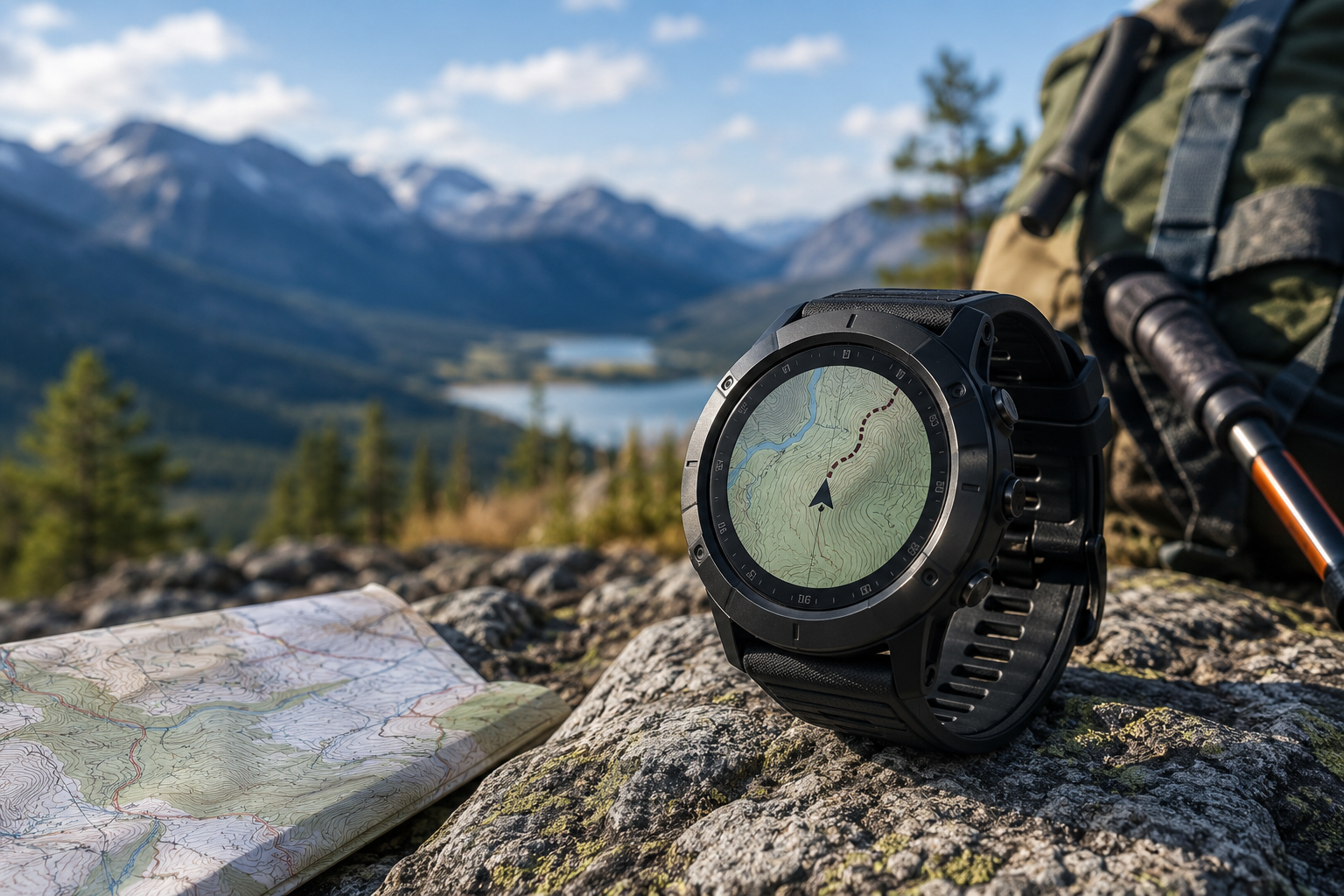
The spec sheet number that matters most on a hiking watch is genuinely the one most buyers overlook — not the “days” of battery life a brand advertises, but continuous GPS-on battery life specifically. A watch rated for 14 days of smartwatch battery can drop to a fraction of that the moment you turn on GPS tracking for a full day of navigation, and that gap is exactly where hikers get burned mid-trip when a watch dies well before they expected it to. Choosing the right watch means understanding that distinction and a handful of other genuine tradeoffs, rather than picking based on the biggest headline battery number alone.
This guide covers what actually matters when choosing a hiking watch — GPS accuracy and battery behavior, the navigation features that separate a real trail tool from a fitness tracker with a compass icon, and how to match watch capability to your actual hiking style. For specific product recommendations, hikingbackpackpro.com’s watch roundups cover current models across these categories once you know which specs to look for.
Why “Battery Life” Is a Misleading Number Without Context
Every watch in this category advertises two genuinely different battery numbers, and confusing them is the single most common mistake buyers make. Smartwatch mode battery life — often quoted in days or weeks — reflects the watch doing minimal background tracking with the screen mostly off. GPS mode battery life reflects the watch actively tracking your location continuously, which drains the battery dramatically faster since GPS requires a steady satellite lock and trail navigation adds meaningful additional screen time for maps and turn prompts.
The number that actually matters for hiking is continuous GPS-mode battery life, not the headline smartwatch figure most marketing leads with. A watch that claims 24 days of battery life might deliver only 20 to 30 hours once you’re actually navigating with GPS running continuously — a genuinely different number, and the one that determines whether a watch survives your actual multi-day trip.
For day hikes, a published continuous GPS rating above roughly 20 hours comfortably covers most single-day trips with real margin. For multi-day backpacking, prioritize watches rated for 40-plus hours of continuous GPS mode, since a shorter rating risks the watch dying partway through a trip where you genuinely need it working. For extended expeditions or thru-hikes, look specifically at watches offering 60 hours or more in a standard GPS tracking mode, with some premium models extending further through a reduced-frequency “expedition” or “ultra” tracking mode that trades some accuracy for genuinely extended runtime.
Solar charging, where available, can meaningfully extend real-world GPS battery life in good sun conditions — some watches report GPS battery life extending well beyond their base rating with solar assistance, though actual gains depend heavily on how much direct sun exposure your specific trip provides.
GPS Accuracy: Why Multi-Band Matters More in Certain Terrain
Standard single-band GPS works adequately in open terrain, but accuracy degrades meaningfully in dense forest canopy, deep canyons, and other terrain that partially blocks a clean satellite signal — exactly the conditions where accurate positioning matters most for genuine navigation confidence. Dual-frequency or multi-band GPS receivers pull signal from multiple satellite frequencies simultaneously, delivering meaningfully better accuracy specifically in these challenging conditions compared to single-band receivers.
This distinction matters most for hikers regularly navigating technical, forested, or canyon terrain where signal obstruction is a genuine, recurring issue. For hikers whose trails run mostly through open terrain with clear sky views, the accuracy difference between single-band and multi-band GPS matters considerably less in practice, and a single-band watch may deliver perfectly adequate accuracy for that specific use case.
Navigation Features That Separate a Real Trail Tool from a Fitness Tracker
Offline maps and route import are genuinely the feature that separates a serious hiking watch from a fitness tracker with GPS bolted on. A watch that can store topographic maps directly and import a GPX route file works fully without phone signal — a real requirement for backcountry use where cell coverage is unreliable or nonexistent. Some watches use full color topo maps; others use a simpler breadcrumb-trail approach that shows your traveled path without a full map underneath — both genuinely work for navigation, but color topo maps provide considerably more context about surrounding terrain.
A barometric altimeter measures elevation using air pressure rather than relying purely on GPS-derived elevation data, which is generally more accurate and more responsive to real elevation changes — genuinely useful for tracking climbs and descents accurately rather than approximating them.
A 3D or electronic compass provides genuine directional bearing independent of your movement, unlike GPS-derived heading alone, which only calculates direction based on your actual movement and can be unreliable when you’re standing still or moving slowly.
Route deviation alerts notify you directly if you’ve wandered off a planned route — a genuinely practical safety feature for anyone navigating an unfamiliar trail, catching a wrong turn before it compounds into a real navigation problem.
Track-back or back-to-start navigation lets you retrace your exact route to the trailhead using stored GPS data, a genuinely reassuring safety net if conditions deteriorate or you simply want a guaranteed way back rather than relying on memory.
Durability Standards Worth Checking
MIL-STD-810 certification indicates a watch has been tested against a genuine military durability standard covering shock, vibration, temperature extremes, and similar stress factors — a real, verifiable credential rather than a vague durability claim.
Water resistance rated in ATM (atmospheres) matters for creek crossings, rain, and general trail moisture exposure. 10 ATM rating provides real margin for genuinely wet conditions; watches with lower ratings may handle light rain fine but aren’t built for sustained submersion or serious water exposure.
Weight and Screen Size — A Genuine Tradeoff
Lighter watches, generally under roughly 60 grams, reduce fatigue during long days of wear, particularly relevant for trail runners or hikers who are genuinely sensitive to wrist weight over sustained hours. The tradeoff is real: larger screens make map reading meaningfully easier, especially for hikers who rely on visual map navigation rather than simpler breadcrumb tracking. A hiker who prioritizes map readability over minimal weight should lean toward a larger screen even if it adds some genuine bulk; a hiker who wants the lightest possible watch for long days on trail should accept a smaller screen as the tradeoff for that reduced weight.
Matching Watch Capability to Your Actual Hiking Style
Weekend day hikers on established, well-marked trails are often genuinely well served by a mid-tier watch with solid GPS accuracy and a 20-plus-hour GPS battery rating, without needing to pay for premium multi-band GPS or expedition-length battery life that goes unused on shorter, less technical trips.
Regular backpackers doing multi-day trips should prioritize genuine 40-plus-hour continuous GPS battery life and offline map storage above nearly every other spec, since these two factors most directly determine whether the watch functions reliably for the actual duration and navigation demands of a real multi-day trip.
Hikers in genuinely technical, forested, or canyon terrain should prioritize multi-band GPS specifically, since that’s precisely the terrain where single-band accuracy degrades most noticeably and reliable positioning matters most.
Thru-hikers and expedition-length trip planners need to look specifically at extended or “ultra” tracking modes offering 60-plus hours of GPS runtime, ideally paired with solar charging to extend real-world battery life further across genuinely sustained multi-week use.
Hikers who also want everyday smartwatch functionality — notifications, health tracking, non-hiking daily wear — should weigh that broader daily usability alongside pure trail performance, since some watches genuinely optimize hard for one use case at some cost to the other.
Conclusion
Choosing the right hiking watch comes down to reading past the headline battery number to the continuous GPS-mode rating that actually reflects real trail use, matching GPS accuracy technology to your actual terrain, and confirming the watch includes genuine offline navigation features rather than requiring a phone connection you may not reliably have on trail. Weigh weight against screen size honestly based on how you’ll actually use the watch, and match durability certifications to how hard you’re genuinely on gear.
Get those decisions right, and a hiking watch becomes exactly what it should be — a reliable navigation and safety tool that works when you need it, rather than a fitness tracker that happens to have a GPS icon on the home screen.