
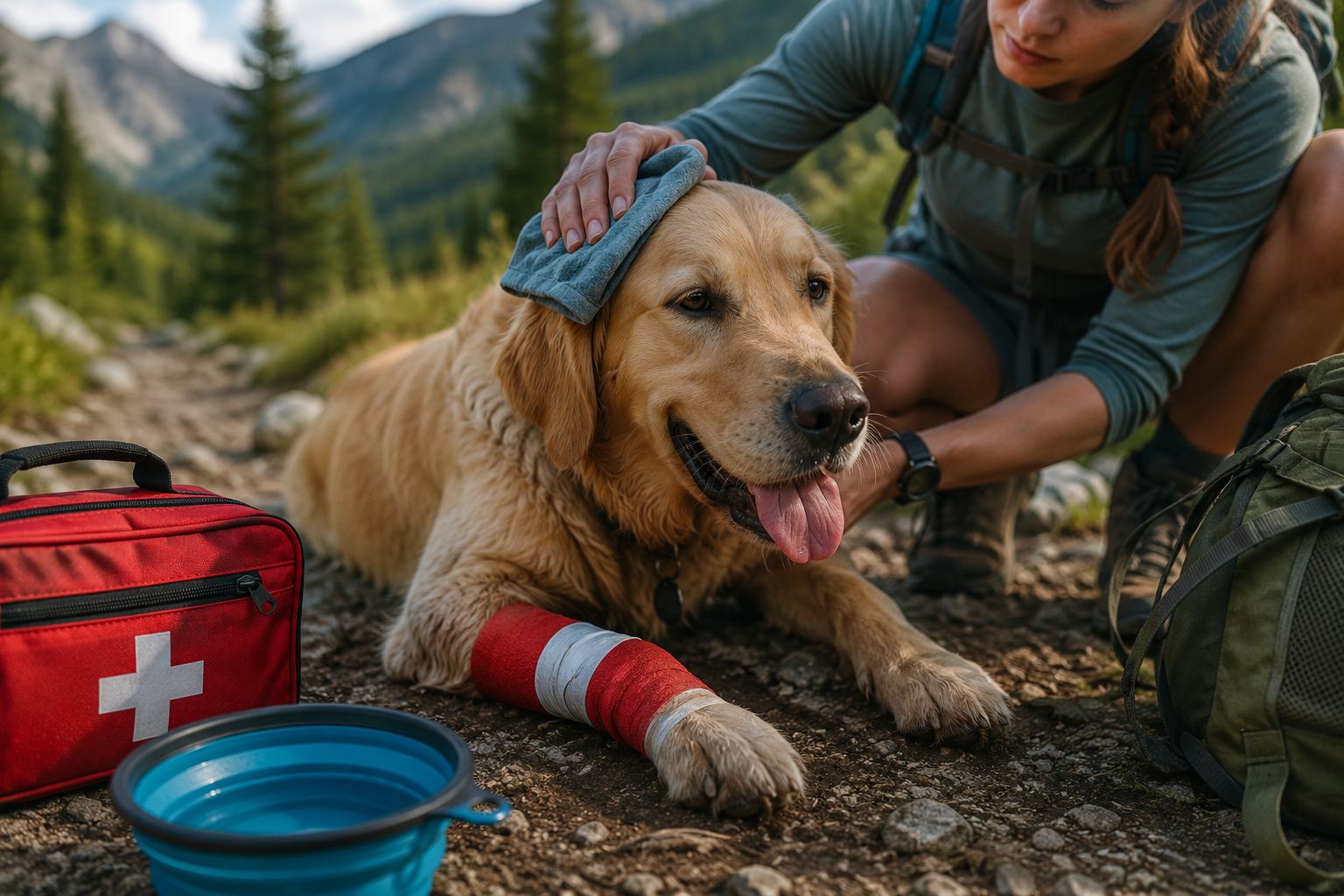
Most hiking dogs handle the trail better than their owners expect — until suddenly they don’t. A dog who’s been keeping pace all morning can go from fine to genuinely dangerous in a matter of minutes when heat, a paw injury, or a fall catches up with them. The difference between a scary moment that resolves and a real emergency almost always comes down to how quickly the owner recognizes what’s happening and responds correctly.
This guide covers the two most common trail emergencies for hiking dogs — overheating and injury — including how to recognize early warning signs, what to do immediately, and how to get your dog to help as fast as possible once you’re back at the trailhead.
For prevention gear, our best hiking snacks for dogs and best hiking dog breeds guides cover choosing and fueling a dog that’s genuinely built for trail conditions.
Recognizing Heat Stroke Before It Becomes Critical
Dogs don’t cool themselves the way humans do. They rely primarily on panting, with a small assist from sweat glands in their paw pads — a cooling system that becomes overwhelmed fast in high heat, direct sun, or high humidity, especially during sustained exertion like climbing a trail. Heat stroke in dogs can become fatal within 15 to 30 minutes of onset, and the dogs who don’t survive it are almost always the ones whose owners waited to see if they’d “sleep it off” rather than acting immediately.
Early warning signs — the stage where you can still turn things around easily:
- Heavy panting that doesn’t ease up with rest
- Seeking shade or trying to lie down on cool ground
- Slowing down, lagging behind, or refusing to continue
- Excessive drinking, or conversely, no interest in water
- General restlessness or an anxious, unsettled demeanor
Advancing signs — treat this as a genuine emergency:
- Bright red or dark red gums
- Thick, ropey drool
- Wobbliness, stumbling, or loss of coordination
- Vomiting or diarrhea
- Confusion or reduced responsiveness to you
Critical signs — life-threatening, act immediately:
- Collapse
- Seizure
- Gums that look pale, blue, or purple
- Unconsciousness
A rectal temperature above 104°F is the clinical threshold for heat stroke; above 106°F risk of organ damage rises sharply. You won’t have a thermometer on most day hikes, which is exactly why recognizing the behavioral and physical signs matters — don’t wait for a number you can’t measure to decide something is wrong.
What to Do Immediately If You Suspect Heat Stroke
Get your dog out of direct sun and into shade immediately. Even a few degrees of temperature difference and reduced solar load helps.
Cool your dog with cool — not ice-cold — water. Pour or wet down the belly, groin, paws, and neck, where blood vessels sit close to the skin and cooling has the most effect. Ice-cold water can cause blood vessels near the skin to constrict, which actually traps heat inside the body rather than releasing it, and can trigger shivering, which generates more heat. Room-temperature or cool tap-temperature water is the right call.
Use a wet bandana or shirt, evaporation, and airflow if you don’t have much water. Wetting your dog down and fanning them — even just walking so air moves across wet fur — accelerates evaporative cooling meaningfully.
Offer water but don’t force it. Let your dog drink if they want to; don’t pour water down their throat, which risks aspiration in a dog who’s already disoriented.
Cool first, transport second — but don’t delay transport once cooling has started. Begin cooling measures immediately at the point where you notice symptoms, but as soon as you’re able, start moving toward the trailhead and a vehicle. Continue cooling efforts during the hike or carry out if your dog can’t walk. The standard veterinary guidance is “cool first, transport second” — meaning don’t skip initial cooling to rush to the car, but also don’t stop cooling once you’re moving.
Get to a veterinarian even if your dog seems to recover. This is the step people skip most often, and it’s a genuine mistake. Some of the most serious effects of heat stroke — organ damage, clotting problems — don’t show up until hours after a dog appears to be back to normal. A dog who cooled down and perked up on the trail still needs a veterinary check as soon as possible.
Preventing Heat Stroke in the First Place
Know your dog’s risk factors. Brachycephalic (flat-faced) breeds — Bulldogs, Pugs, Boxers, and similar breeds — have a significantly reduced ability to cool themselves through panting and are at meaningfully higher risk. Senior dogs, overweight dogs, and dogs with existing heart or respiratory conditions are also higher risk and warrant more conservative planning around heat and exertion.
Hike early or late, not midday, in hot conditions. The temperature difference between a 7am start and a 1pm start on a summer trail is often the difference between a comfortable hike and a genuine hazard.
Bring more water than you think your dog needs, plus a collapsible bowl. Offer water on the same rhythm you’d use for yourself — roughly every 30 to 60 minutes of active hiking, more in heat.
Watch the trail surface, not just the air temperature. Exposed rock and sand can reach temperatures well above ambient air temperature in direct sun, radiating heat upward at your dog from below in a way that isn’t obvious to you standing several feet taller.
Know that a car is not a safe place to leave a dog, ever, even briefly. Car interior temperatures can climb past 120°F within minutes even on a mild 75°F day with windows cracked — this applies before and after your hike, not just during it.
Trail Injuries — Recognizing and Responding
Paw injuries, sprains, cuts, and impact injuries from falls or wildlife encounters are the most common non-heat trail emergencies for hiking dogs. How you respond depends heavily on the severity of what you’re looking at.
Paw Injuries
Cuts, punctures, and torn nails are common on rocky or sharp terrain. Check paws regularly during a hike — a dog favoring one foot, licking at a paw repeatedly, or suddenly slowing down is often telling you about a paw problem before it’s visually obvious.
For a minor cut or abrasion: rinse with clean water if available, remove any visible debris, and wrap loosely with gauze or a clean cloth if you’re carrying first aid supplies, snug enough to stay on but not tight enough to cut off circulation. Booties, if your dog will tolerate them, protect an injured paw for the walk back.
For a deep puncture, a wound that won’t stop bleeding, or a fully torn nail bleeding heavily: apply direct, steady pressure with clean cloth or gauze, and get to a vet. Deep punctures in particular carry meaningful infection risk and often need veterinary cleaning and antibiotics regardless of how minor they look on the surface.
Limping, Sprains, and Suspected Fractures
A dog who suddenly starts limping after a fall, a misstep, or an awkward landing needs to stop hiking immediately — continuing to walk on an injury, even a mild one, risks making it significantly worse.
Mild limping with no obvious deformity: Rest your dog, check the affected leg and paw carefully for swelling, cuts, or an obviously wrong angle, and if nothing looks severely wrong, a slow, supported walk back to the trailhead may be reasonable. Watch closely — if the limp worsens or your dog starts refusing to bear weight at all, stop and reassess.
Visible deformity, inability to bear any weight, or a limb at a clearly wrong angle: This may be a fracture. Do not attempt to splint it yourself unless you have specific training — an improperly applied splint can cause more damage than no splint at all. Keep your dog as still and calm as possible, and your priority becomes getting them off the trail with minimal additional movement.
Falls, Impacts, and Internal Injury Concerns
A dog who takes a hard fall — down a slope, off a rock ledge, into a ravine — needs careful assessment even if they seem okay immediately afterward. Watch for: labored or rapid breathing, pale gums, abdominal tenderness or a visibly distended belly, reluctance to move, or any change in alertness or behavior over the following hour. Internal injuries don’t always show obvious external signs right away, and a dog that seems shaken but fine immediately after a fall can decline over the following hours.
If you have any doubt after a significant fall, treat it as a reason to end the hike and get veterinary evaluation rather than continuing on the assumption that no obvious injury means no injury.
Carrying an Injured Dog Off the Trail
For small to medium dogs, carrying them directly — supporting the chest and hindquarters — works for a short distance. For anything beyond a short carry, or for larger dogs, a proper carrying method matters:
An emergency sling or carry harness, even improvised from a jacket or a length of webbing, distributes weight better than carrying a dog in your arms and reduces the risk of you dropping or further injuring them over uneven terrain.
A rigid support for a suspected spinal or fracture injury. A hiking pad, a flattened pack, or any available rigid surface can serve as an improvised stretcher if you’re carrying a dog with a suspected serious injury and have a second person to help.
Know your dog’s approximate weight before you need this information. Carrying a 15-pound dog a mile is a manageable task. Carrying a 70-pound dog a mile over rough terrain is a two-person job in most cases, and knowing that in advance shapes how far off-trail you’re comfortable venturing with a large dog in areas where a rescue carry-out would be genuinely difficult.
Getting to a Vet Fast — The Part Most Hikers Don’t Plan For
The gap in most dog trail emergency planning isn’t the first aid — it’s what happens after you’ve stabilized your dog and reached the trailhead. You’re often far from home, possibly without a vehicle large enough or clean enough to safely transport an injured or overheated dog, and searching for an emergency vet you’ve never used while your dog is in distress is a genuinely bad position to be in.
Know your nearest emergency vet before you need it, not while you’re standing at the trailhead in a panic. If you regularly hike in a specific area, look up the nearest 24-hour emergency veterinary clinic to that trailhead in advance and save the number and address in your phone.
Have a transport plan that doesn’t depend entirely on your own vehicle. If you hiked with friends who drove separately, if your car isn’t equipped to safely transport a large or injured dog, or if you’re genuinely too shaken to drive safely yourself after a scary trail emergency, a dedicated pet transport service solves a problem that a standard rideshare typically won’t touch. For hikers in the Los Angeles area, Pets Go Taxi provides pet-specific transportation that can get your dog directly to an emergency vet when you need a safe, dog-equipped ride rather than trying to manage an anxious or injured animal in the back seat of a car that isn’t set up for it.
Call ahead if you can. Whether you’re driving yourself or arranging transport, calling the emergency vet while you’re en route lets them prepare for your arrival — genuinely valuable time savings in a true emergency.
Building a Trail First Aid Kit for Your Dog
Beyond your own first aid kit, a few dog-specific additions are worth carrying on any hike with your dog:
Gauze and vet wrap sized appropriately for your dog, for wrapping paw injuries or applying pressure to a wound.
A muzzle, even for the friendliest dog. Pain and fear change behavior unpredictably, and a dog in genuine distress may bite reflexively even at an owner they trust completely — having a muzzle on hand protects both you and your ability to help them.
Tweezers, for removing splinters, thorns, or minor debris from paws.
A collapsible bowl, for both hydration and for offering water during a cooling response.
Your vet’s number and the nearest emergency vet’s number, saved in your phone before you need them, not searched for during a crisis.
Our best ultralight hiking first aid kits guide covers human-focused kits that can be supplemented with these dog-specific additions for a combined kit that covers your whole hiking party.
Final Thoughts
Most hiking dogs never experience a genuine trail emergency — but the owners who handle one well are almost always the ones who recognized the early signs, acted immediately rather than waiting to see if things improved on their own, and had a plan for getting their dog help fast once they were off the trail. Heat stroke and serious injury both share the same underlying lesson: speed matters more than almost anything else you do.
Know the early warning signs before you’re on trail watching for them in a panic. Carry basic first aid supplies. And know how you’ll actually get your dog to a vet — whether that’s your own car, a plan with a hiking partner, or a dedicated pet transport service — before the day you actually need it.
For more on keeping your dog safe and prepared for the trail, check our how to train your dog to hike long distances and best protective dog breeds for hiking guides.