
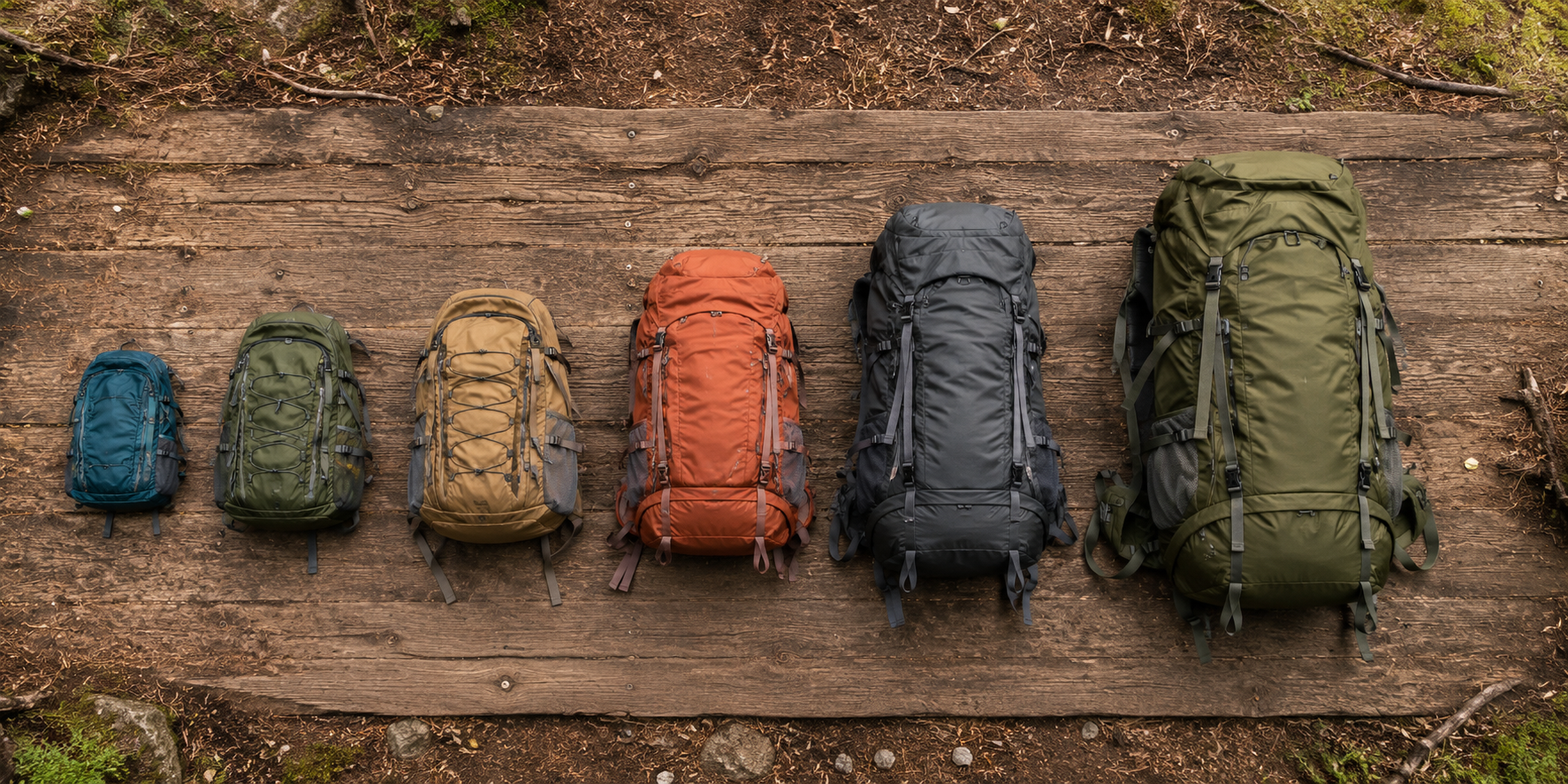
Backpack sizing is one of the most common sources of confusion for hikers at every experience level — and it’s also one of the most consequential decisions you’ll make before hitting the trail. Buy too small and you’re lashing gear to the outside of your pack, watching it catch on every branch. Buy too large and you’ll fill the extra space with things you don’t need, arriving at camp with a heavier pack and more tired legs than necessary.
The good news is that the decision isn’t complicated once you understand what the numbers actually mean and how different volumes perform in real-world packing scenarios. This guide cuts through the confusion — breaking down every size category from 10 liters to 70+ liters, explaining what fits in each, and giving you a clear framework for matching the right volume to your specific trip type, gear weight, and hiking style.
What Does Liter Volume Actually Mean?
When a backpack is labeled 45L or 60L, that number represents its total interior volume in liters — the combined space of the main compartment plus exterior pockets, lid compartments, and any other closed storage. One liter is roughly equivalent to 61 cubic inches, which gives you a sense of the actual physical space you’re working with.
A few important caveats before you take the number at face value:
Not all liters are equal. A 40L pack with a single large compartment packs out more efficiently than a 40L pack divided into four smaller sections. Internal organization — how the volume is divided — determines how usable that space actually is. A more compartmentalized design can be harder to use than a pack with 5 liters less total volume but a single open main compartment.
External pockets count. Most manufacturers include side pockets, hip belt pockets, and mesh pockets in the total liter count. Some of that volume is genuinely useful — side pockets for water bottles, hip belt pockets for snacks — but it counts the same as main compartment space in the spec sheet.
Your gear volume matters as much as your gear weight. A 3-pound sleeping bag stuffed into a compressible down bag takes up far less space than a 3-pound synthetic bag. A four-season tent takes more volume than a three-season tent at the same weight. Volume and weight are separate considerations — match your pack size to both.
The Quick Reference: Backpack Size by Trip Type
Before the detailed breakdown, here’s the framework that guides every size decision:
Under 10L: Trail running, minimalist hydration runs, very short hikes in good conditions.
10–25L: Half-day to full-day hikes with standard day gear. The daypack category.
25–35L: Full-day hikes with extra layers, shoulder-season day hiking, very light overnight use for minimalist packers.
35–50L: One to three-night backpacking trips with standard gear. The sweet spot for most weekend hikers.
50–65L: Three to five-night trips with standard to comfort-oriented gear. The most versatile multi-day range.
65–80L+: Five-plus nights, winter camping, group gear carrying, or any trip where gear bulk exceeds what smaller packs accommodate.
Now let’s go deeper on each category.
Under 10L — Minimalist Hydration and Trail Running Packs
Packs in this range are built for one purpose: getting water and minimal essentials on your back without slowing you down. Think hydration vests, lumbar packs, and trail running-specific designs where every ounce of pack weight is a liability.
What fits: a hydration reservoir or two water bottles, energy gels and snacks, a phone, a key, and a thin emergency layer if you push the volume.
What doesn’t fit: any meaningful amount of food, a real rain layer, navigation gear, or first aid supplies beyond the absolute minimum.
For trail runners and fast-hikers who’ve stripped their kit to the essentials and want to move at speed, this is the right category. For everyone else, it’s too limiting to be practical beyond a few hours on an established trail in good conditions.
Relevant guide: Our best trail running shoes guide covers the footwear that pairs naturally with this pack category for fast-moving trail use.
10–25L — The Daypack Range
This is the most-used pack category for recreational hikers — the range that covers everything from a casual two-hour nature walk to a full eight-to-ten-hour day hike on a demanding trail.
10–15L covers the essentials for half-day hikes: water, snacks, a light layer, sunscreen, and a small first aid kit. Most packs in this range lack a functional hip belt — which is appropriate since loads under 15–20 lbs don’t require hip transfer to be comfortable.
15–25L handles full-day hiking comfortably with standard day gear — 2–3 liters of water, a full day’s food, a rain layer, an insulating layer, a first aid kit, navigation gear, and sun protection. This is where most recreational day hikers live, and it’s the right volume for the majority of established trail day hikes across three seasons.
The upper end of this range — 22–25L — also works for very light overnight trips for experienced minimalist packers who use ultralight gear: a compressible quilt, a bivy or tarp shelter, and a down puffy layer can theoretically fit in 25 liters if your kit is intentional. For hikers with standard gear, this is still a day range.
For more on the best options in this category, check out our best hiking daypacks guide and our best front packs guide for chest-carry supplemental options.
25–35L — The Versatile Middle Ground
This is the most misunderstood size range in backpacking — too large for simple day hiking, too small for comfortable overnight use with standard gear, but genuinely useful for specific situations that fall between those categories.
For day hiking, a pack in this range gives you more organizational flexibility, more volume for bulky winter layers, and more room for camera gear, trekking poles, and extra water. Winter day hikers especially benefit from stepping up to 30–35L — snowshoes, microspikes, insulated layers, extra food for higher caloric demands, and more water all add up quickly.
For overnight use, this range becomes workable with careful packing and compressible ultralight gear. A lightweight quilt, a bivy or tarp, and a well-dialed kit can fit in 30L for summer conditions with warm overnight temperatures. With standard gear — a regular sleeping bag, a freestanding tent, and a self-inflating sleeping pad — this range gets tight to the point of frustration.
The honest assessment: a 30L pack often feels like more than enough when you’re looking at it in a store and not enough when you’re trying to fit everything the night before a trip. Know your gear’s packed volume before committing to this range for overnight use.
35–50L — The Weekend Backpacking Sweet Spot
This is where overnight and weekend backpacking truly begins for most hikers with standard gear. Real-world packing tests across this range tell a consistent story: 36 liters is the minimum that handles a one-night kit with standard equipment comfortably, and 47 liters gives you genuine breathing room for the same trip.
At 36–40L, everything fits — a sleeping bag, a tent, a sleeping pad, food for the night and the next morning, a change of clothes, cooking gear, and a water filter. But everything fits with intention. There isn’t room for comfort items, oversized food containers, or gear that hasn’t been thought through. Packing and unpacking requires care. For hikers who’ve dialed in their gear list and want a smaller, lighter pack, this range rewards the discipline.
At 45–50L, the experience changes noticeably. The seams aren’t stressed. The organizational pockets actually hold things. There’s room for a puffy jacket inside rather than strapped awkwardly to the exterior. For one to two-night trips with standard gear, 47–50L is the most comfortable, least stressful option — you have volume to work with rather than fighting every item into place.
The 45–50L range also handles two to three-night trips efficiently for hikers with reasonably modern gear. Three days of food adds meaningful volume — plan for approximately 1.5–2 liters per day of additional food space beyond your base kit, depending on how you package your food.
Relevant guides: For the best options in this range, our best hiking backpacks and best packable hiking backpacks guides cover the top picks across different use cases.
50–65L — The Multi-Day Workhorse
This is the most versatile multi-day backpacking range — capable of handling three to five-night trips with standard gear, accommodating the extra food volume that longer resupply stretches require, and providing enough breathing room to pack with comfort rather than precision.
At 50–55L, you’re in the sweet spot for three to four-night trips with modern three-season gear. This is where experienced backpackers with dialed-in gear lists often land — enough volume for everything they need, small enough that there isn’t excess space inviting unnecessary additions to the pack weight.
At 60–65L, the experience becomes notably more forgiving. Food for five or more days fits without creative packing. A group member can carry shared cooking gear alongside their personal kit. Camera gear, a camp chair, or other comfort items add meaningful quality of life without forcing compromises on core equipment. For hikers using heavier or bulkier conventional gear — a synthetic sleeping bag, a dome tent, a self-inflating pad — the jump from 50 to 60 liters makes a practical difference in how stressful the packing process is.
The 60L range is also where many hikers who carry camera systems, extra comfort items, or simply prefer a relaxed packing approach find their permanent home. The extra volume costs some pack weight, but for most multi-day hikers the trade-off is worth it.
For the best options in this range, our best 60L hiking backpacks guide covers the top picks with detailed comparisons. Our best lightweight hiking backpacks guide covers options at this volume for hikers who want to minimize pack weight alongside gear volume.
65–80L+ — Extended Trips, Winter Camping, and Heavy Loads
Once you cross 65 liters, you’re in territory that most casual backpackers never need — and that’s the correct position for most three-season hikers doing trips of five days or fewer with modern gear. But for specific scenarios, extra-large volume is the right answer rather than an overindulgence.
Winter backpacking is the most common legitimate use case for 70L+ packs. A 0°F sleeping bag takes roughly twice the packed volume of a 35°F summer bag. A four-season tent with extra poles and heavier fabric adds bulk that a summer shelter doesn’t. Insulated layers, extra fuel for a stove running in cold temperatures, and additional food for higher caloric demands in cold conditions all compound. Hikers who routinely do winter overnights often find that the 60L pack that handles their summer kit comfortably needs a step up to 70–75L for the same duration in winter.
Extended trips with long resupply gaps are the other primary use case. A week of food for a moderately hungry hiker adds 10–15 liters of volume to a base kit — which pushes many hikers from a comfortable 55L into 65–70L territory when resupply points are seven or more days apart.
Group gear carrying — parents carrying children’s supplies, guide leaders carrying shared cooking equipment and emergency shelter, or friends splitting group gear — adds volume that individual hiking doesn’t require. A parent carrying food for two children alongside their personal kit needs every liter a 70L pack provides.
One practical caution with large packs: available space invites filling it. A hiker who transitions from a 55L to a 75L pack without intentional discipline tends to arrive at camp with more weight, not just more volume. The pack size should match your actual gear volume — not create permission to bring more things.
For the best options in this category, our best extra-large hiking backpacks guide covers the top picks across budget and premium options. For hikers carrying genuinely heavy loads alongside large volume, our best hiking backpacks for heavy loads guide covers packs built specifically for that combination.
Compartmentalization: The Factor Most Size Guides Ignore
Volume alone doesn’t determine how usable a pack is — and real-world packing tests consistently reveal that internal organization matters as much as total liters for practical trail use.
A pack with 40 liters of total volume divided across eight separate pockets and compartments can be harder to use than a 35-liter pack with one large main compartment and two side pockets. The larger items — a tent body, a sleeping pad, a bear canister — need to fit into a single open space. When that space is broken into smaller segments, bigger items can’t fit anywhere regardless of how much total volume exists in the pack.
Before buying based on liter count alone, look at how the volume is organized:
Top-loading single compartment: The most efficient design for backpacking. Large items drop in from the top and fill the space without fighting compartment walls.
Panel-loading or U-zip access: Opens like a suitcase for easier access but often creates internal structure that limits how large items pack.
Sleeping bag compartment: A divider at the base separates your sleep system from daytime gear — practical for camp organization but reduces the continuous volume available for large items.
Side access pockets: Useful for water bottles and frequently accessed items. Count toward total liter volume but serve a different organizational function than main compartment space.
The practical test before buying: mentally pack your specific gear list into the specific compartments of the pack you’re considering. If your tent can’t fit in any single compartment because they’re all divided below its packed dimension, the total liter count is irrelevant.
Volume vs. Torso Fit: Which Matters More?
The honest answer: torso fit matters more than volume. A perfectly sized pack on the wrong back delivers worse carrying performance than a slightly oversized pack that fits correctly.
Torso length — the distance from your C7 vertebra at the base of your neck to the top of your hip bones — determines which pack size fits your body. Most quality packs are available in multiple torso lengths: Small, Medium, and Large for most brands. Buying the right volume in the wrong torso length means the hip belt sits in the wrong position, the load lifter straps pull at the wrong angle, and weight transfers to your shoulders instead of your hips.
Measure your torso before ordering any pack. Have a friend help — it’s nearly impossible to measure accurately on your own. Match the measurement to the torso range listed in the pack specs, not to your height. Two people of identical height can have torso lengths that differ by three or four inches.
For tall hikers who need longer torso sizing across all volume ranges, our best hiking backpacks for tall men guide covers the specific packs that accommodate longer backs most successfully. For women, our best hiking backpacks for women guide covers women-specific torso sizing and hip belt geometry.
How to Choose the Right Size: A Simple Decision Framework
Step 1: Determine your longest planned trip. Size for the trip you do most often — not the most ambitious trip you might someday do. If you primarily do overnight trips and occasionally do four-night trips, size for overnights and plan to carry a bit tighter on longer trips.
Step 2: Inventory your gear’s packed volume. Lay out everything you plan to carry and pack it into a box or bag. That physical volume tells you more than any spec sheet about the liter capacity you actually need.
Step 3: Add food volume. Calculate one to two liters per day of additional food volume beyond your base kit depending on how you package your food. A bear canister, if required for your destination, adds additional fixed volume — most standard bear canisters occupy roughly 10–12 liters.
Step 4: Add a 10–15% margin. Pack your gear into the smallest volume that fits, then step up one size to give yourself working room. A pack filled to 85% capacity is more comfortable to use and less stressful to manage than one stuffed to the seams.
Step 5: Verify torso fit in your chosen volume. Once you’ve identified the right volume, confirm the pack is available in your torso length. If not, find an equivalent volume from a brand that offers your size.
Final Thoughts
The right backpack size is the one that holds your actual gear for your actual trips without excess volume that invites overpacking. For most recreational hikers doing day trips, 20–25L handles everything comfortably. For weekend backpackers with standard gear, 45–50L is the sweet spot. For multi-day hikers doing three to five-night trips, 55–65L provides the most comfortable experience with the least packing stress. And for extended trips, winter camping, and heavy load scenarios, 70L+ earns its place.
Once you’ve identified the right volume, focus on fit and then features — in that order. The best-sized pack on the wrong torso is still uncomfortable. The best-featured pack in the wrong volume is still frustrating to use.
For specific recommendations at every volume, browse our full collection of backpack guides:
- Best Hiking Daypacks — 15–25L
- Best Packable Hiking Backpacks — 20–35L
- Best Lightweight Hiking Backpacks — 35–55L
- Best 60L Hiking Backpacks — 55–65L
- Best Extra-Large Hiking Backpacks — 70L+
- Best Hiking Backpacks for Heavy Loads — Heavy carries at any volume
- Best Hiking Backpacks for Women — Women’s specific fit
- Best Hiking Backpacks for Tall Men — Long torso fit