As an Amazon Associate I earn from qualifying purchases.
Forty litres is the pack size most likely to be bought for the wrong reason: it looks like a compromise, so it gets chosen by people who actually need more room, and ignored by the fast overnight hikers it suits perfectly. This guide fixes that decision. It shows what genuinely fits inside 40 litres, which trips that load serves, how the three pack classes at this size differ, and the honest point at which 40L fails and a bigger pack is the right buy.
Not Sure 40 Litres Is Your Size?
Work through the full capacity decision, from daypack to expedition sizes, before you spend money on any single size.
Read the Pack Size GuideKey Takeaways
- Buy 40L for fast overnights and light weekends, not as a smaller version of an everything pack.
- Pack a real load list first; if shelter, sleep kit and food do not fit on paper, they will not fit on trail.
- Pick your class before your brand: traditional, lightweight and ventilated 40L packs carry very differently.
- Respect the load limit on light packs; an overloaded light frame punishes shoulders within miles.
- Size up without guilt when a bear canister, bulky sleep kit or long food carry enters the trip.
Table of Contents
- Why 40L Is the Fast-Overnight Size
- What Actually Fits in 40 Litres
- Traditional Internal-Frame 40L Packs
- Lightweight 40L Packs
- Ventilated 40L Packs
- Shelter and Sleep: The Two Volume Decisions
- Food, Water and the Bear Canister Test
- When 40L Honestly Fails
- Fit in Brief: Buy Your Torso
- How to Test a 40L Pack Before a Trip
- Our view
- FAQ
- Sources
- Recommended
Why 40L Is the Fast-Overnight Size
Forty litres sits at the top of the weekend band, and that position is its whole identity. The capacity guide from REI places weekend packs for one to three nights in the 30 to 50 litre range, and notes that efficient packers with newer, less bulky gear can keep trips light inside it. A 40L pack is that band used deliberately: big enough for a complete overnight kit, small enough that the pack itself stays out of the way on the move. If you are still weighing sizes against each other, our what size hiking backpack do I need guide works the full range; this post assumes the question is narrower, whether 40L specifically earns its place.
Manufacturers build real overnight packs at this size, in real torso sizes. The sizing chart published by Osprey lists its 44-litre-class Talon 44 and Tempest 44 in two torso sizes each, which tells you two things: packs in the low forties are a designed category, not a shrunken afterthought, and even at this size you are expected to choose by torso length rather than taking the one on the shelf. The step down is covered in our best 35L hiking backpacks roundup; the difference between the two sizes is smaller than the difference in how honestly each one gets packed.
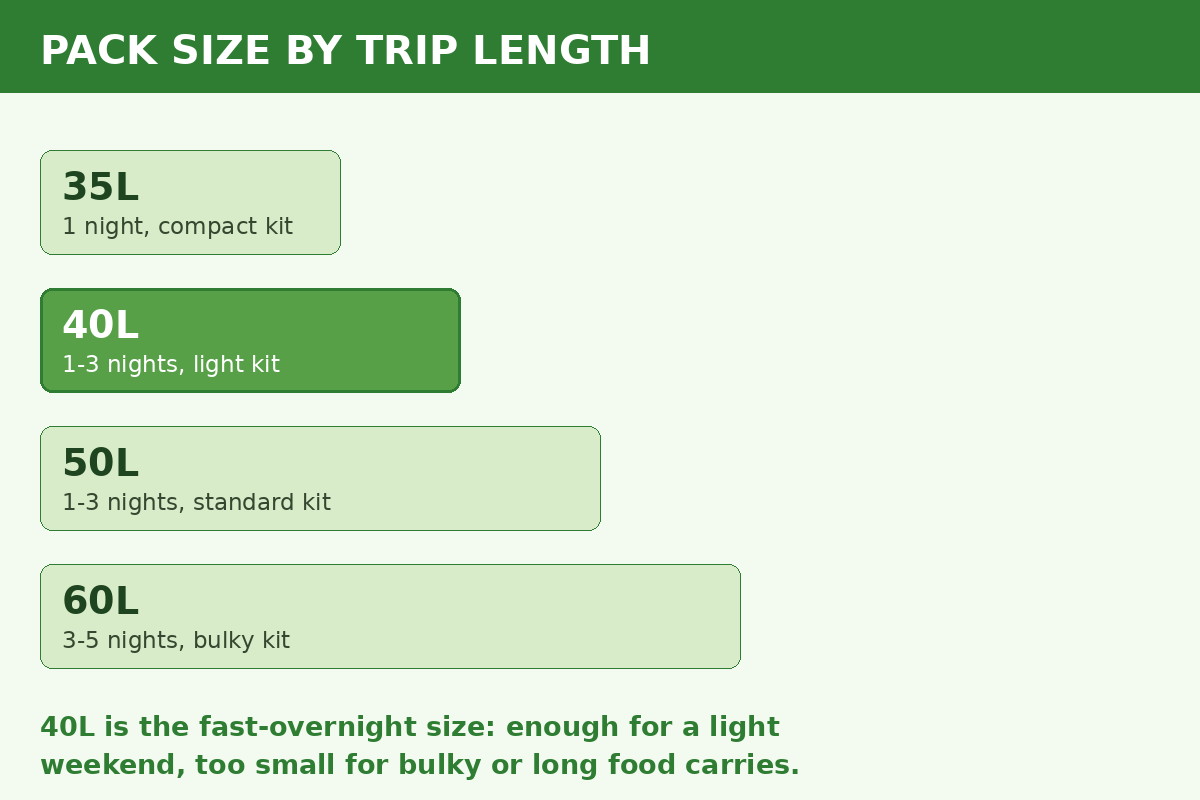
| Pack size | Trip it serves | Kit it assumes | Where it strains |
|---|---|---|---|
| 35L | One night, hut-to-hut, warm weekends | Compact shelter and sleep kit, minimal extras | Second nights of food and any bulky layer |
| 40L | Fast overnights, light one to three night weekends | Standard light kit, cooked meals, full safety gear | Bear canisters, bulky sleep systems, long food carries |
| 50L | One to three nights with standard gear | Roomier shelter, warmer bag, less disciplined packing | Tempts filler gear on short trips |
| 60L | Three to five nights, cold or bulky trips | Long food carries, extra layers, canister plus kit | Half-empty and sloppy on a simple overnight |
The Trips 40L Serves Best
The natural 40L trip is short, light and planned. One night out with a compact tent, a second night where the food is simple, a hut-to-hut route where the roof and the evening meal are provided and the pack carries layers, lunch and safety gear only: these are the trips where 40L feels generous rather than tight. Permit country suits it too, because a permitted itinerary fixes your nights in advance; the backcountry permit guidance from Grand Canyon National Park limits stays per campsite and per use area, so the trip length, and therefore the food carry, is known before you pack rather than guessed. Build the trip itself from our multi-day backpacking checklist, then test the result against the volume in the next section.
What Actually Fits in 40 Litres
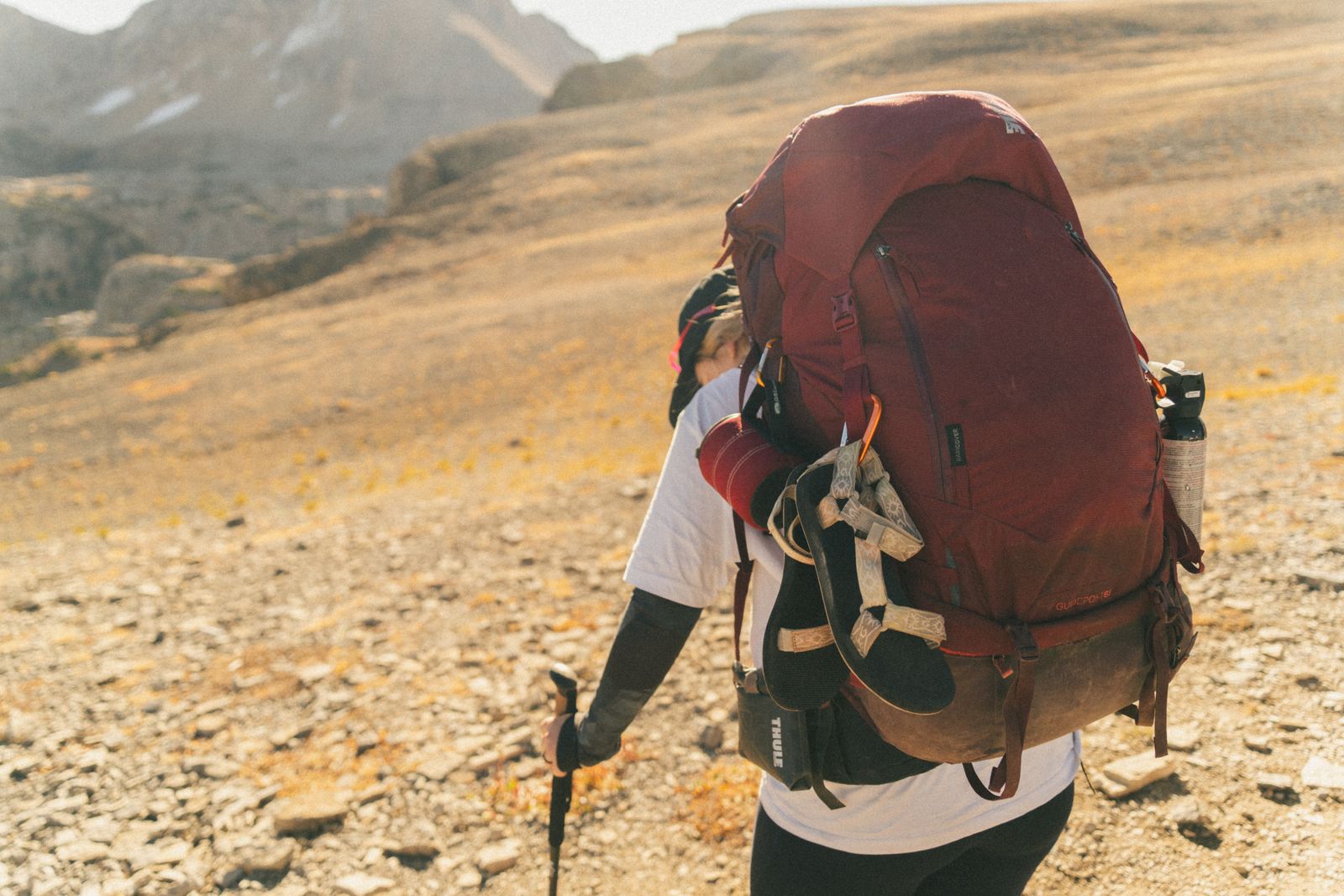
A 40L load is a complete overnight kit with nothing decorative in it. Shelter, sleep system, food and stove, water treatment, rain layers and the safety essentials all fit, provided each item is a backpacking version rather than a campground version. The gear list published by REI is the right audit tool: it treats the checklist as a menu to tailor to the trek, with the Ten Essentials as the non-negotiable core, and a 40L pack is simply that menu with the optional column left at home. Run your own kit against our best hiking backpacks for a 3-day hike guide if your weekends stretch to a third night, because that is where this size gets honest.
The essentials are not where the space goes. The Ten Essentials list from the American Hiking Society covers navigation, headlamp, sun protection, first aid, knife, fire starter, shelter, extra food, extra water and extra clothes, and nearly all of it is small. The litres are consumed by four bulky systems: the tent, the sleeping bag, the pad and the food bag. Control those four and 40L works; let any one of them be a bulky budget version and the pack fills before the essentials go in.
The Load Layout That Makes 40L Work
In a small pack, layout is capacity. The packing guide from REI divides a pack into zones: bulky gear you will not need until camp at the bottom, dense heavy items in the core against your back, bulky trail essentials at the top, and urgent small items in the accessory pockets. Followed in a 40L pack, that layout does double duty. It keeps the centre of gravity stable, and it stops the daily-access items from forcing you to unpack the sleep system at every stop. Our best way to pack a backpack for hiking guide walks the same zones with photographs of a loaded pack.
Traditional Internal-Frame 40L Packs
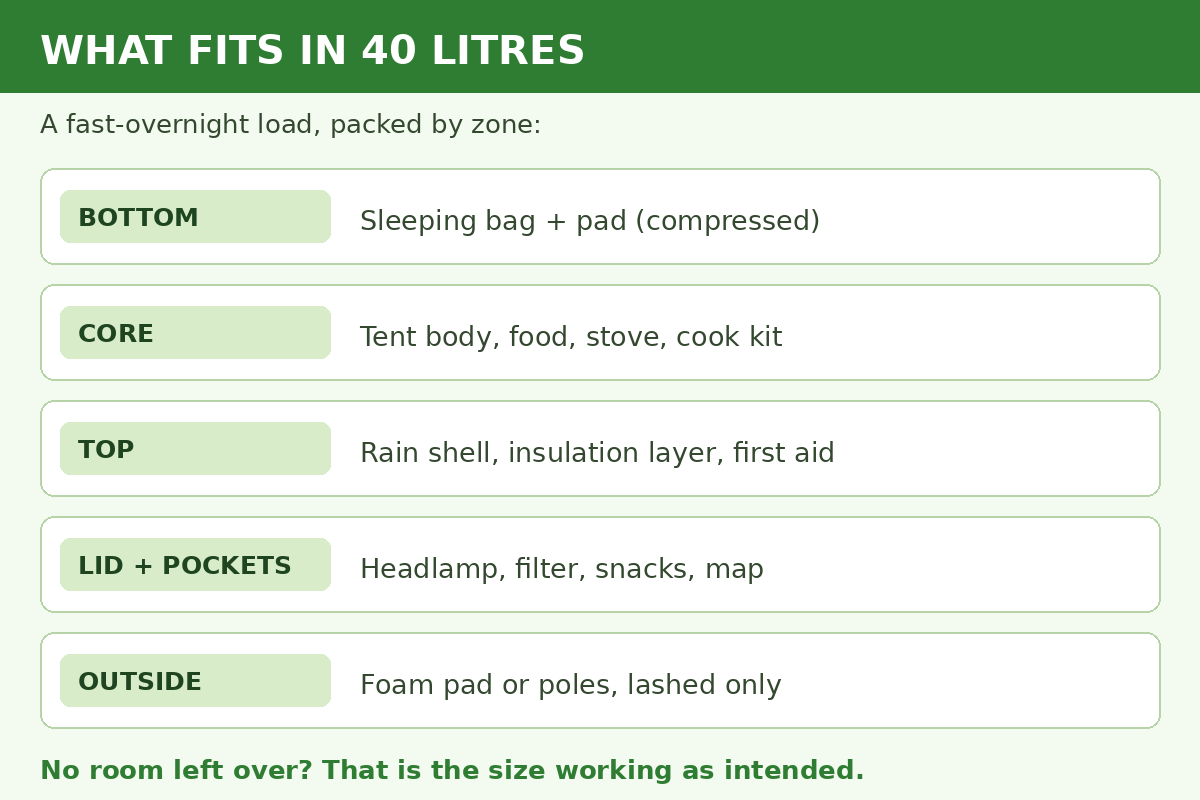
The traditional internal-frame pack is the default 40L buy, and for most overnight hikers it is the right one. A full internal frame with a padded hip belt carries a weekend load on the hips, tolerates a heavier food bag or a shared tent without complaint, and keeps working when the trip stretches a night longer than planned. The frame tradeoffs behind that choice are compared in our internal vs external frame backpacks explainer; at 40L the internal frame wins on stability over uneven ground, which is where overnight trails spend most of their miles.
Judge this class by its belt and its back panel, not its pocket count. A traditional 40L pack earns its keep when the hip belt is stiff enough to hold the load without folding, the frame transfers weight instead of merely stiffening the bag, and the main compartment opens wide enough to load by zones. Extra pockets add ounces and rarely add function at this size. One honest test: load the pack with your real kit before the return window closes, because a traditional frame that fits will feel boring on a stair climb, and boring is the compliment.
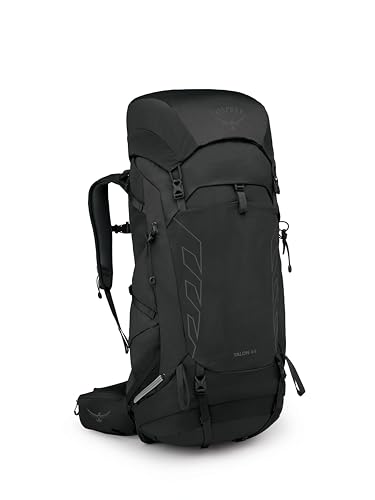
Osprey Talon 44L Men's Hiking Backpack
- LIGHTWEIGHT & VERSATILE DESIGN: The Talon 44L men’s hiking backpack is a streamlined top-loader with ample space for multi-day trips, camping essentials, and backpacking. A versatile technical pack designed to accommodate dynamic body movement.
- PRECISE & BREATHABLE FIT: Stay cool and supported with an AirScape backpanel that delivers a close-to-body, stable carry and improves airflow to reduce sweat while hiking, backpacking, traveling and more. The adjustable sliding yoke and BioStretch hipbelt create a personalized men’s fit, keeping the bag stable and comfortable on adventures where comfort and stability are key.
- MULTI-DAY HIKING VERSATILITY: Top-loading design with floating lid, zippered sleeping bag area, side-zip main compartment access and dual tuck-away ice axe loops make this backpack ideal for long hikes, climbs, or lightweight, multi-day trips.
List Price :
Offer: 220.00 $
Go to AmazonWho Should Buy Traditional First
First overnight pack, mixed trip lengths, shared gear: buy traditional. If you carry a partner’s share of a tent, cook for two, or alternate between one-night and three-night trips, the traditional frame absorbs that variation without a second purchase. It is also the class that forgives a heavier sleep system while you save for a lighter one. The wider field is compared in our best hiking backpacks roundup, where the traditional 40L models sit alongside the larger sizes they compete with.
Lightweight 40L Packs
The lightweight class trades frame strength for pack weight, and the trade only pays when your kit is already light. The ultralight basics guide from REI describes the pattern at exactly this size: minimalist 40 to 50 litre packs can weigh around a pound and a half to two pounds, with load limits commonly in the 30 to 35 pound range, and it warns against selecting an ultralight pack and then cramming an old, heavy kit into it. That warning is the whole buying rule for this class. The models are compared in our best lightweight hiking backpacks roundup.

Osprey Talon Pro 40L Men's Hiking Backpack
- Pro-Worthy Durability – Constructed with our technical NanoFly fabric, which is reinforced with a triple-grid UHMWPE ripstop for outstanding strength, and extra-tough stretch pockets, this pack elevates our understanding of durability
- Quiver-Killing Versatility – Talon Pro is designed to be lightweight, fast moving and thoroughly featured to effectively adapt to the multi-sport demands of on-the-go adventurers and athletes
- Category-Leading Framesheet & Torso Adjustment – Our innovative new torso adjustment and premium injection-molded framesheet provides just-right structure to the pack and allows for a more comprehensive fit across the full spectrum of torso range
New starting from: 280.00 $
Go to Amazon
The Load Limit Is the Real Spec
Shop this class by load limit first and weight second. A light pack whose comfortable ceiling sits below your real trail weight will carry worse than a heavier traditional pack, because the frame flexes, the hip belt creeps, and the load migrates to your shoulders. Weigh your full kit, food and water included, and keep an honest margin under the stated limit. Frameless designs sit at the far end of this class, and our best frameless hiking backpacks roundup covers when giving up the frame entirely makes sense.
Ventilated 40L Packs
A suspended-mesh back panel is the one feature that changes how a 40L pack feels all day. The packbag hangs off a tensioned mesh panel, air moves between the pack and your back, and the sweaty-back problem of a close-fitting internal frame largely disappears. For warm routes, humid forests and hikers who run hot, that airflow is worth real money. The current models are gathered in our best hiking backpacks with ventilated suspended mesh backs roundup.

Deuter Aircontact Lite 40 + 10 L Hiking Backpack
- USE CASE: The Aircontact Lite 40 + 10-liter-by-volume backpack designed for ambitious long-distance hikers who value light weight and big comfort. It features the deuter Aircontact back system for reduced perspiration rates, exceptional load transfer, and a secure, perfectly balanced fit. Ideal for hiking, world travelers, long-distance backpacking, and extended travel. Specs – Weight: 3.5 lbs., Dimensions: 28 / 12 / 10 (h x w x d) in.
- AIRCONTACT BACK SYSTEM: The essence of our Aircontact system ensures an efficient method of carrying heavy loads whereby the weight is brought close to the body, aligning with the center of gravity. This configuration enables complete pack control and facilitates effective load transfer. Additionally, our Aircontact cushions, crafted from unique hollow chamber foam, ensure exceptional ventilation by capitalizing on the pump effect generated with every movement.
- COMFORTABLE FIT: Vari Quick adjustable back length, continuously adjustable chest strap, load adjustment straps and ergonomically padded hip fins for added stability and comfort. A pull-forward system for hip fin adjustments, and side compression straps which can be attached below the side pocket for a secure carry.
New starting from: 220.00 $
Go to AmazonWhat Ventilation Costs You
The trade is load position and a little volume. Holding the packbag away from your back moves the weight slightly outward, which a traditional close-fitting frame avoids, and the curved frame shape can make boxy items, a bear canister above all, sit awkwardly. Neither cost matters on a warm weekend with a soft, light load; both matter on a heavy or canister trip. If your trips split between hot day routes and overnights, the wider comparison in our best hiking backpacks roundup shows where ventilated models sit against the field.
Shelter and Sleep: The Two Volume Decisions
Your tent and your sleeping bag decide whether 40L works before the pack is even chosen. The tent guide from REI makes the mechanism plain: packed size is a listed tent spec, and splitting components between partners, one carrying poles and fly while the other carries the tent body, shrinks what any single pack must swallow. A two-person tent split that way is a 40L-friendly shelter; the same tent carried solo in a bulky stuff sack may not be. Choose the shelter itself from our how to choose a backpacking tent guide and the current models in our best 2-person backpacking tents roundup.
The sleeping bag follows the same logic: compression is capacity. The sleeping bag guide from REI notes that down bags are lighter and pack down smaller than synthetic options of similar warmth, which is why down dominates light overnight kits, while synthetic fill insulates when damp and costs less. Either fill works at 40L if the packed size is honest; what fails is the bulky campground bag that fills half the pack alone. The pad underneath it matters to warmth as much as volume, and our sleeping pad R-value explained guide covers that number properly.
Food, Water and the Bear Canister Test
Food is the load that grows, so plan the pack around the longest food carry, not the average one. Two nights of dehydrated meals, snacks and coffee fit a 40L pack without drama. Four nights of food, or fresh food with real bulk, pushes the size past its honest limit. Where bears are managed, the test is stricter: the food storage guidance from Yosemite National Park requires food, trash and scented items to be stored in an allowed bear-resistant container or a provided locker, and a rigid canister has to fit inside the pack alongside everything else, not instead of something essential. If a canister is part of your normal kit, shop from our best bear canisters for backpacking roundup and test-fit the canister in any 40L pack before buying.
Hut-to-Hut Changes the Math
A hut, hostel or lodge at the end of the day removes the two bulkiest systems from the pack. No tent and no full sleep kit means 40L becomes generous: layers, lunch, water treatment and safety gear ride with room to spare, and the size doubles as a travel bag on the same trip. Two disciplines survive the lighter load. Waste still packs out, as the Leave No Trace principles published by the National Park Service set out, and the pack still has to meet airline rules on the way home, which our will a hiking backpack fit as airline carry-on guide checks size by size.
When 40L Honestly Fails
Name the failure cases plainly, because they are common. A bulky synthetic sleep system plus a solo tent plus three nights of food will not fit, and no packing technique fixes arithmetic. Cold trips fail it too: the warmer bag, the extra layers and the bigger shelter all grow at once. Carrying gear for a child or a new partner fails it fastest of all, because one pack silently becomes two people’s kit. In each case the answer is the size above, and our best 60L hiking backpacks roundup covers the packs built for exactly those loads.
Size Up Without Guilt
A half-empty bigger pack beats a bursting 40L on every trail measure. An overloaded small pack carries high and unstable, its compression straps maxed, its lid floating, its owner stopping to repack. The symptoms of a load problem are diagnosed in our backpack too heavy guide, and half of them trace back to a pack one size too small for the trip it was asked to do. Buy the size your bulkiest regular trip needs, and let the fast weekends run a little underfilled.
Fit in Brief: Buy Your Torso
Fit is covered in full elsewhere on this site; here is the short version that protects a 40L purchase. The fit guide from REI states the governing fact directly: your torso length, not your height, is the key measurement, taken from the C7 vertebra at the base of the neck to the line between the tops of your hip bones. Measure it, match it to the maker’s size chart for the exact model, and remember that most of the load should ride on your hips. The complete procedure lives in our how to fit a hiking backpack to your torso length guide, and the full size decision in our what size hiking backpack do I need explainer. Do not re-derive fit from this page; use those two and buy once.
How to Test a 40L Pack Before a Trip
Test with your real kit, loaded the way you will actually carry it. Fill the pack by zones, water included, then walk stairs and a slope, not just the shop floor. A 40L pack at its honest limit should still close without force, sit stable when you turn, and leave the daily-access items reachable. Rain protection is part of the test, because a pack this size often carries its weather gear outside; our best backpack rain covers for hiking roundup covers the cover itself, and our best hydration bladders for hiking backpacks roundup covers the reservoir most of these packs are built around.
The Loaded Walk Test
Twenty minutes loaded tells you more than any spec sheet. Hot spots on the hip bones, shoulder straps taking weight they should not, a load that sways on descent: each one is a reason to adjust the torso setting once, then reject the pack if it persists. Finish the test by unpacking and repacking once. A 40L pack you cannot repack neatly at a trailhead will be repacked badly at a wet campsite, and the second pack of the day is always worse than the first.
Our view
Forty litres is the size I recommend when a hiker’s trips are honest: out after work, one or two nights, home before the weekend ends. Buy it for those trips and it disappears on your back. Start from the full size decision in our what size hiking backpack do I need guide, set the fit with our torso fit walkthrough, and load it using our best way to pack a backpack for hiking guide, and a 40L pack stops being a compromise and becomes the fastest overnight tool you own.
— Brian Ka
FAQ
Is 40L big enough for a 3-day hike?
Yes, with a light kit and simple food; no, with bulky gear. Three days means two to three nights of food, and that food bag is the deciding item. If your tent is compact, your bag compresses small and your meals are dehydrated, 40L closes. Add a bear canister or a bulky synthetic bag and the same trip belongs in a larger pack.
Can a 40L backpack work for hut-to-hut hiking?
It is the ideal hut-to-hut size. With shelter and dinner provided, the pack carries layers, lunch, water and safety gear, and 40L leaves comfortable margin instead of forcing choices. It also stays small enough to manage easily in shared bunk rooms and on trains between trailheads.
What is the difference between a 40L and a 50L backpack?
Ten litres of forgiveness. A 50L pack swallows a bulkier sleep system, a longer food carry and less disciplined packing. A 40L pack demands a lighter, more deliberate kit and rewards it with a smaller, more stable carry. The trips overlap; the packing discipline does not.
How much should a loaded 40L backpack weigh?
Let the pack class set the ceiling. Traditional internal-frame models carry weekend loads comfortably, while lightweight models commonly state load limits in the low thirties of pounds, and carrying past a stated limit is where comfort collapses. Weigh the loaded pack at home; the number, not the effort of lifting it, is the test.
Is a 40L backpack big enough for winter camping?
For most winter trips, no. A warmer bag, a sturdier shelter and real insulation layers all grow at the same time, and frozen-ground sleep systems add bulk of their own. A mild, hut-supported winter overnight can work; a self-supported winter camp belongs in a larger pack.
Questions About 40L Backpacks?
Tell us the trip, the nights and the bulkiest item in your kit, and we will tell you plainly whether 40 litres covers it or you should size up.
Contact UsSources
- REI — How to Choose a Backpack: Sizing and Fit Guide
- REI — Backpacks: Fit and Torso Size Guide
- REI — How to Pack a Backpack for Backpacking and Hiking
- REI — Ultralight Backpacking Basics
- REI — Backpacking Gear List: What to Bring on a Backpacking Trip
- REI — Backpacking Tents: How to Choose
- REI — Sleeping Bags for Camping: How to Choose
- Osprey — Backpack Size Chart and Sizing Guide
- American Hiking Society — The 10 Essentials
- Yosemite National Park — Food Storage and Bear Canisters
- National Park Service — Leave No Trace Seven Principles
- Grand Canyon National Park — Backcountry Permit