As an Amazon Associate, HikingBackpackPro.com earns from qualifying purchases at no extra cost to you.
The insole that came with your hiking boots was designed to fill space — not to support your foot. Most stock insoles are flat pieces of foam with minimal arch structure, minimal heel cushioning, and a lifespan measured in weeks of serious hiking rather than seasons. By the time your boots feel broken in, the stock insole has already compressed and lost whatever minimal structure it started with.
The right aftermarket insole changes the entire feel of a boot. A deep heel cup stabilizes rear foot motion. Structured arch support distributes load across the full foot rather than concentrating it at the heel and ball. Proper cushioning absorbs the repetitive impact of trail surfaces before it reaches your joints. The cumulative effect over a 10-mile day is the difference between arriving at camp tired and arriving in pain.
This guide covers the 10 best boot insoles for hiking — organized by use case, foot type, and budget — all available on Amazon. Whether you’re dealing with arch pain, heel pain, flat feet, high arches, or just want more cushion than your stock insole provides, there’s an option here that addresses your specific situation.
For more on hiking footwear, check out our guides to the best hiking boots for men, best hiking boots for women, and best hiking shoes for men.
What to Look for in a Hiking Boot Insole
Arch support type: Low arch support works for flat feet and flexible arches. Medium arch suits most hikers. High arch support addresses high, rigid arches that don’t flatten under load. Using the wrong arch height creates new problems while failing to solve existing ones — know your arch type before buying.
Heel cup depth: A deep heel cup wraps the rear foot in a cradle that prevents the inward rolling and lateral movement that causes ankle fatigue and knee strain on uneven terrain. Shallow heel cups provide cushioning without meaningful stabilization — appropriate for soft terrain, inadequate for rocky trails.
Firmness: Firm insoles provide correction and structural support. Soft insoles provide cushioning and comfort. The right choice depends on what your feet need — hikers with biomechanical issues need firm correction; hikers with healthy mechanics who simply want more cushion can choose softer options.
Volume: Hiking boots typically have more interior volume than trail runners, which means they accommodate thicker, more structured insoles without creating a cramped fit. Always remove the stock insole before inserting an aftermarket one — adding insole on top of insole creates too much volume and throws off the boot’s fit.
Trim-to-fit: Most quality insoles are trimable — sized slightly large so you can cut them to match your boot’s exact dimensions. Cut along the outline of the stock insole for a precise fit.
1. Superfeet HIKE Support — Best Overall Boot Insole for Hiking
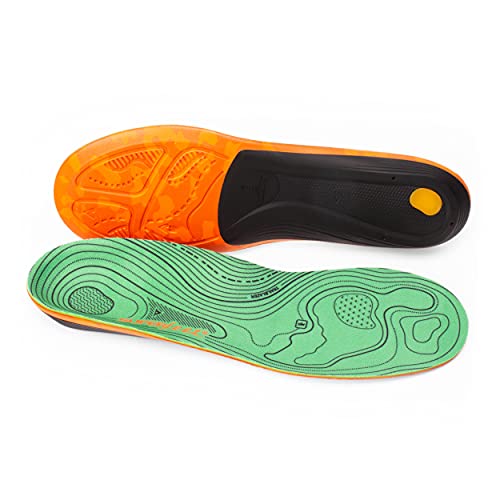
Superfeet Hike Support Insoles for Hikers with High Arch Support & Carbon Fiber Stabilizer – 9.5-11 Men, 10.5-12 Women
- Do these insoles need to be cut to size? Yes, these are trim-to-fit. Superfeet insoles are made to be trimmed to fit your shoes and boots; follow cutting instructions before use, and if you’re between sizes, size up and trim down to fit
- Are these suitable for rough terrain? Medium to high arch support made in an orthotic shape to stabilize the foot on rough terrain, reducing stress on feet, ankles, knees, and back
- What makes the support structure lightweight yet strong? Proprietary EVOLyte carbon fiber and polymer blend provides responsive, weight-defying support and stability for the trail
New starting from: 59.95 $
Go to AmazonThe Superfeet HIKE Support is the most consistently top-ranked hiking boot insole across multiple independent testing publications — and after real-world testing across hundreds of miles of trail, it earns that consensus. It’s the insole that comes up most frequently when experienced hikers are asked what’s in their boots, and for good reason.
The firm arch and deep heel cup deliver a locked-in feel that stabilizes the foot and reduces fatigue on longer hikes or when carrying a heavier pack. The dual-layer cushioning provides noticeable impact protection on rocky trails and steep descents — absorbing the repetitive shock that accumulates into joint soreness over long days. The Moisturewick top cover manages sweat on multi-day trips without retaining odor, and the trim-to-fit design integrates cleanly into most hiking boots without modification.
The firmness takes a break-in period — expect 2–3 shorter hikes before the insole settles into its most comfortable configuration. For hikers coming from flat stock insoles, the initial sensation of structured arch support feels aggressive before it becomes natural. Give it time. Once broken in it essentially disappears underfoot while continuing to deliver correction mile after mile.
At 2.5 oz it adds minimal weight and fits the wide volume of most hiking boots without creating pressure. For the majority of hikers with medium to high arches who want the most proven, well-documented boot insole available, the HIKE Support is the starting point.
Best for: Most hikers with medium to high arches who want the most proven all-around hiking boot insole for long trail days and heavy pack carrying.
2. Currex HIKEPRO — Best Dynamic Arch Insole for Hiking Boots

CURREX HikePro Insoles for Hiking Boots & Shoes – Shock Absorbing Inserts to Help Reduce Fatigue and Increase Performance – Anti-Slip Heel Surface for Stability – for Men & Women – High Arch, Large
- FEEL BETTER, PERFORM BETTER: Our hiking insoles offer flexible support and shock absorbing cushioning to provide superior comfort, reducing fatigue and increasing performance on any trail, from short hikes to all day outings; plus, a non-slip, deep heel cup increases stability and confidence on all terrain so you can make the most of the great outdoors
- 3D Dynamic Arch Technology & SuperGrip Anti-slip: Our dynamic arch support insoles come in low, medium and high arch support profiles; they feature a deep decoupled heel cup that fits, wraps and locks the heel in place with a perfect fit for sure-footedness and stability on uneven terrain and downhill descents
- Engineered to Keep You Outdoors: Shock absorbing cushioning with flexible arch support provide superior comfort in a perfect fit, supporting your feet for less fatigue through endless adventure; insoles can be trimmed for an exact fit, providing the most comfortable hiking experience no matter where your trail takes you
New starting from: 59.95 $
Go to AmazonThe Currex HIKEPRO is the Editor’s Pick from CleverHiker — one of the most trusted independent hiking gear publications — and it takes a fundamentally different approach to arch support than rigid orthotic-style insoles. Rather than a fixed plastic or carbon fiber arch, the HIKEPRO uses Dynamic Arch Technology that flexes with your foot’s natural movement rather than holding it in a predetermined position.
The anti-slip Super Grip heel surface and deep heel cup work together to lock the heel in place on uneven terrain and steep descents — the specific condition where most hikers lose rear foot control and fatigue accumulates fastest. In real-world testing across alpine trails, the silicone heel grabbers prevented the insole from sliding inside the boot even on sustained downhill sections where foot pressure shifts forward.
The bamboo mid layer and ventilated sole manage moisture and heat better than most competitors — keeping feet noticeably drier after 10-mile hikes in humid conditions. Available in high, medium, and low arch profiles matched to your specific foot structure — which is the feature that sets it apart from insoles that offer one arch height and hope for the best.
For hikers who’ve found rigid orthotics uncomfortable or who prefer a more natural trail feel without giving up meaningful support, the HIKEPRO delivers both. Zero drop design preserves the heel-to-toe geometry your boots were designed around.
Best for: Hikers who want dynamic, motion-adaptive arch support rather than rigid correction — especially on technical terrain where the foot moves constantly and support needs to move with it.
3. Superfeet GREEN — Best Firm Arch Support for Hiking Boots

Superfeet All-Purpose Support High Arch Insoles (Green) for Active Lifestyle with High Arch Support – Men 9.5-11 / Women 10.5-12
- Do these insoles need to be cut to size? Yes, these are trim-to-fit. Superfeet insoles are made to be trimmed to fit your shoes and boots; follow cutting instructions before use, and if you’re between sizes, size up and trim down to fit
- How do these stabilize the heel? Deep heel cup works with your body’s natural cushioning for maximum support
- Do these insoles cradle the heel securely? Sculpted heel cup cradles the heel to maximize natural shock absorption; designed for roomy footwear
New starting from: 59.95 $
Go to AmazonThe Superfeet GREEN is the benchmark rigid arch insole — the one that podiatrists recommend, the one that’s been in serious hikers’ boots for decades, and the one that most other insoles are measured against. It delivers maximum structural correction in a full-length format that fits the generous volume of most hiking boots.
The high-profile stabilizer cap wraps around the rear foot and creates a deep heel cup that locks your foot from the first step — preventing the inward roll that causes arch fatigue, ankle strain, and knee compensation over long distances. The high-density closed-cell foam base is firm enough to maintain structure under heavy pack loads without compressing, which is why the GREEN holds up through multiple seasons of hard hiking where softer insoles need annual replacement.
It’s the right insole specifically for hikers with overpronation, high arches that need maximum support, or those carrying loads over 35 lbs regularly. For neutral-gait hikers on lighter day hikes, the GREEN’s aggressive correction may feel like more than necessary — in which case the HIKE Support or HIKEPRO is the more appropriate fit.
The break-in period is real and longer than most insoles — up to a week of hiking before the GREEN reaches its most comfortable configuration. Persist through it. The long-term performance payoff justifies the adjustment period.
Best for: Hikers with overpronation, high arches, or heavy pack loads who need maximum rigid correction and long-lasting structural support that holds up through multiple seasons.
4. Tread Labs Pace — Best Long-Lasting Insole for Hiking Boots

Tread Labs Pace 2 Insoles – Extra Firm Clinical-Grade Arch Support for Foot Pain Relief, Plantar Fasciitis & Overpronation – Replaceable Top Cover – Men & Women
- Firm, Clinical-Grade Support: Provides structured, orthotic-level arch support designed to address foot pain at the source, not just cushion it. Designed for plantar fasciitis, overpronation, and long days on your feet that demand real stability.
- Refined Top Cover Geometry + Enhanced Cushioning: Updated top cover geometry and a precision heel cushion help reduce pressure and improve cushioning at impact for better stability with every step.
- Precision Heel Cushion for Impact Control: Targeted heel cushioning helps soften heel strike and reduce harsh impact where your foot takes the most load, without compromising support.
New starting from: 79.95 $
Go to AmazonThe Tread Labs Pace stands out for its modular design and multiple arch height options — low, medium, high, and extra-high. Most insoles offer one arch profile. Tread Labs lets you select the precise arch height calibrated for your specific foot structure, which eliminates the trial-and-error that generic insoles require.
The firm support shell delivers serious rear foot stability across rough, uneven terrain. After 30+ miles in varied conditions, the Pace maintained its shape and support without the compression fatigue that foam-only alternatives develop over time. Once broken in — which requires a few shorter hikes — it settles into a supportive, natural feel that holds its integrity over significantly more miles than most alternatives.
The replaceable top cover is the design detail that justifies the higher upfront cost. When the cushioned layer wears out, you replace just the cover for around $15–20 rather than the whole insole — which means the firm support shell, the most expensive component to manufacture, lasts for years of heavy use. For regular hikers who burn through insoles annually, the long-term economics are compelling.
Best for: Regular hikers who want precisely matched arch height and a modular design that eliminates annual full replacement cost — investing more upfront to save significantly over multiple seasons.
5. Powerstep Pinnacle — Best Cushioned Support Insole for Hiking

PowerStep Pinnacle Insoles, Orthotics for Plantar Fasciitis Relief, Made in USA Orthotic Insoles, Arch Support Inserts with Moderate Pronation, #1 Podiatrist Recommended (M 9-9.5, W 11-11.5)
- The Pinnacle Full length insoles for men & women provide maximum cushioning, from high activity to moderate support. The PowerStep arch support shape provides stability to the foot and ankle, helping to relieve foot pain.
- When you spend all day on your feet, every step counts. PowerStep insoles are a podiatrist-recommended orthotic to help relieve & prevent foot pain related to athletes, runners, Plantar Fasciitis, heel spurs & other common foot, ankle & knee injuries
- The Pinnacle plantar fasciitis insoles offer superior heel cushioning and arch support. The dual-layer cushioning is designed to reduce stress and fatigue, while PowerStep premium arch support is designed for plantar fasciitis relief.
New starting from: 49.75 $
Go to AmazonThe Powerstep Pinnacle is the most comfortable structured insole for hikers who want meaningful arch support without the firm, aggressive feel of orthotic-style insoles. The dual-layer construction uses a semi-rigid base for support and a softer top layer for comfort — delivering both correction and cushioning in a single insole rather than forcing a choice between them.
The angled exterior heel platform counteracts the inward roll of overpronation at the rear foot — the point where most hikers lose control of their foot position on downhill sections and uneven ground. Combined with the full-length arch support, it creates a stable, controlled ride from heel strike to toe-off without the stiffness that turns many hikers off rigid alternatives.
For hikers new to aftermarket insoles, the Pinnacle is the best starting point — the more immediate comfort makes the transition from flat stock insoles easier, and the support is meaningful enough to make a real difference on longer trail days. FSA and HSA eligible when used for documented foot conditions.
Best for: Hikers who want structured support with more cushioning comfort than rigid orthotic-style insoles — especially those new to aftermarket insoles who want immediate comfort alongside meaningful arch correction.
6. VALSOLE Heavy Duty Support Orthotics — Best for Heavy Hikers and Plantar Fasciitis
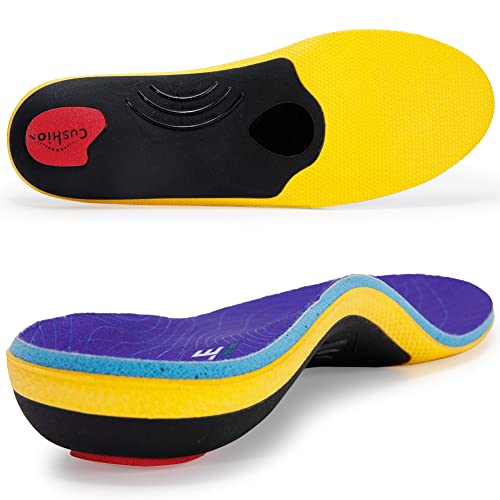
VALSOLE Heavy Duty 220+ lbs Orthotic Inserts for Plantar Fasciitis – Absorb Shock, Support High Arches and Flat Feet
- 【HEAVY DUTY SUPPORT INSOLES】Orthotic Shoe Inserts for Men Women designed for over 220lbs, provide extra stong high arch support plus shock guard technology to relieves foot & leg fatigue and reduces lower bak pain and distribute weight and reduce the impact of each step.
- 【FOOT PAIN RELIEF&PREVETION】:Orthotic inserts offers rigid arch support reduce the overstretch of Plantar Fasciitis.Helps ease stress and pain caused by flat feet,fallen arch,bunions, low back pain and diabetes.Achilles Tendonitis and also Ball of Foot pain.Provides moderate control and support in working and standing, comfort and cushioning for everyday use.
- 【COMFORT MATERIAL FOR STANDING ALL DAY】:Poron heel pad excellent for shock absorption and pain relief. The black hard TPU material supports the arch of your foot and wraps your heel when you running or jogging.And good fabric reduces odor and keeps the feet fresh.
List Price :
Offer: 22.17 $
Go to AmazonThe VALSOLE Heavy Duty Support Orthotics is the #1 bestseller in Foot Arch Supports on Amazon with over 22,000 ratings — and for heavy hikers dealing with plantar fasciitis, heel pain, or flat feet, it’s the most directly targeted option on this list. Specifically designed for people over 220 lbs, it addresses the biomechanical reality that extra body weight creates extra strain on the arch and heel that standard insoles aren’t engineered to handle.
The rigid TPU arch support is the core of what makes the VALSOLE work for heavy hikers. Unlike foam arches that compress under sustained load and lose their correction within hours, the hard TPU maintains its structural integrity throughout a full hiking day regardless of body weight or pack weight. The deep heel cup cradles the heel bone in a vertical position that distributes load evenly, reduces rear foot instability, and provides the side-to-side stability control that prevents ankle rolling on uneven terrain.
The PU heel pad uses Shock Guard technology to absorb impact at the heel strike — the most vulnerable point for plantar fasciitis sufferers on trail surfaces. No-smell breathable velvet top cover manages moisture over long hiking days, and the trim-to-fit design accommodates most hiking boot sizes across men’s and women’s sizing.
At around $25 it’s one of the most affordable structured correction insoles on this list — podiatrist-recommended, Amazon’s top-rated arch support, and engineered for the specific demands that most insole manufacturers don’t address: significant body weight combined with sustained trail activity.
Best for: Heavy hikers over 200 lbs, hikers dealing with plantar fasciitis or heel pain, and anyone who needs rigid structural correction that holds up under sustained heavy load without compressing.
7. Remind Insoles Destin — Best for High-Impact Hiking and Heavy Hikers

Remind Insoles Destin | Shoe Inserts for Low Arch Support | Ski Boot, Snowboarding & Skateboarding | Walking & Running | Lightweight Comfort | Clouds | Mens Size 9-9.5
- Soft Support for All Arches: Designed for low to all arch types, The Destin offers our softest ride yet with a 5.5mm forefoot and 9mm heel cushion. No stabilizer material means total flexibility and comfort that molds to your movement.
- Custom Comfort Fit: Self-forming technology adapts to your foot’s unique shape, distributing pressure evenly and promoting healthy alignment for long-lasting comfort and performance.
- Feather-Light & Durable: Lightweight, high-performance foam materials deliver excellent energy return, resist breakdown over time, and maintain structure even with heavy daily use.
New starting from: 45.00 $
Go to AmazonThe Remind Insoles Destin was originally designed for skateboarding and snowboarding — high-impact sports that demand serious shock absorption — and that engineering background translates directly to the repetitive impact demands of trail hiking. For heavier hikers, heavy pack carriers, and anyone dealing with significant heel or forefoot pain on rocky trails, the Destin’s impact-focused construction stands out.
The flat arch profile in the Destin specifically addresses true flat feet — not feet that merely flatten under load, but feet with minimal arch structure in both sitting and standing positions. Multiple thickness options — 3mm and 5mm — let you fine-tune volume impact on your footwear. The 3mm version fits in tighter boots without creating pressure; the 5mm provides more cushioning for heavier loads and longer days.
Multiple independent testers have used the Destin Classic for over two years in regular hiking boots without structural failure — durability that most insoles at this price point don’t achieve. The unisex, trimmable design fits most hiking boot sizes and shapes without modification.
Best for: Heavy hikers, heavy pack carriers, and anyone dealing with significant impact pain on rocky terrain who wants insoles built from the ground up for high-impact absorption.
8. Sof Sole Active Insoles — Best Budget Hiking Boot Insole

Sof Sole mens Athlete Performance Full-length Insole, Orange, 7-8.5 US
- ENHANCE YOUR PERFORMANCE: Gel in the heel and forefoot absorbs each foot strike for superior shock absorption and impact protection with every step
- ALL-DAY COMFORT: Foam provides heel-to-toe cushioning that protects joints and muscles in the lower body, keeping your feet comfortable during physical activities
- LIGHTWEIGHT SUPPORT: Enjoy enhanced cushioning without added weight, preventing your shoes from feeling heavy during running, walking, or while playing sports
New starting from: 29.99 $
Go to AmazonThe Sof Sole Active is the most capable budget hiking boot insole available — delivering meaningful arch support, gel cushioning at the heel and forefoot, and a moisture-wicking top cover at a price that makes it accessible even for casual hikers who can’t justify spending $60 on an insole.
The contoured design with a deep heel cup provides genuine arch support and promotes foot alignment throughout the hike — not just flat foam padding masquerading as support. The Sof Gel technology inserts in the heel and forefoot cushion impact at the key strike zones where fatigue accumulates fastest on trail surfaces. The moisture-wicking fabric cover manages sweat and odor over full hiking days.
It won’t match the biomechanical precision or long-term durability of Superfeet or Tread Labs alternatives. The foam compresses faster under regular heavy hiking use, and the arch support is less aggressive for hikers with significant correction needs. For casual hikers, beginners, and anyone who wants to experience the difference aftermarket insoles make before investing in premium options, the Sof Sole Active is the most financially painless starting point available.
Best for: Budget-conscious casual hikers who want a meaningful upgrade from stock insoles without spending $50+ on a premium option.
9. Dr. Scholl’s Hiking Insoles — Best Over-the-Counter Option for Everyday Trail Use

Dr. Scholl’s Sport Insoles – Superior Shock Absorption and Arch Support to Reduce Muscle Fatigue and Stress on Lower Body Joints for Men Size 8-14
- Protects and reduces stress on lower body joints
- Keeps you on your feet longer
- Provides flexible side-to-side support so you can move more, in any direction
New starting from: 14.97 $
Go to AmazonDr. Scholl’s hiking-specific insoles deliver the brand’s proven cushioning technology in a trail-focused format — gel waves that absorb shock and return energy, arch support that targets the midfoot pressure points that stock insoles ignore, and a construction designed for the sustained impact of hiking rather than casual walking.
For hikers with relatively neutral arches who primarily need more cushioning than their stock insole provides — rather than biomechanical correction — the Dr. Scholl’s hiking insoles address the need at a price that requires no deliberation. The trim-to-fit design accommodates most hiking boot sizes, and the available men’s and women’s versions account for the different arch geometry between genders.
The limitation is the same as most budget options: the foam compresses faster under heavy hiking use than premium alternatives, and the arch support is appropriate for mild needs rather than significant overpronation or high arch correction. For the target user — a casual to moderate hiker who wants more cushioning on established trails — they deliver reliable, comfortable performance at the lowest price on this list.
Best for: Casual hikers with neutral arches who primarily need more cushioning than their stock insoles provide, without needing significant biomechanical correction.
10. Oboz Trail Insole — Best Replacement Insole for Oboz Footwear
Dr. Scholl’s Sport Insoles – Superior Shock Absorption and Arch Support to Reduce Muscle Fatigue and Stress on Lower Body Joints for Men Size 8-14
- Protects and reduces stress on lower body joints
- Keeps you on your feet longer
- Provides flexible side-to-side support so you can move more, in any direction
New starting from: 14.97 $
Go to AmazonThe Oboz Trail Insole is the OEM replacement insole for Oboz hiking boots and shoes — which means if you own Oboz footwear, this is the exact insole design your boots were built around, just new. When the stock Oboz insole has compressed and lost its cushioning structure, replacing it with this keeps the original fit geometry rather than adapting to a third-party design.
The high-density EVA foam provides a neutral platform with mild support — appropriate for hikers with healthy mechanics who don’t need aggressive correction, but want meaningful cushioning improvement over a compressed stock insole. Poron pods at the heel and forefoot add targeted impact absorption at the key strike zones. The odor-resistant construction keeps the insole fresher over extended trail use.
For hikers who own non-Oboz boots, it functions as a capable neutral-to-mild support insole at a reasonable price — the Poron heel and forefoot padding is a feature that most insoles at this price point omit. For Oboz owners specifically, it’s the most straightforward replacement that preserves the fit their boots were designed to deliver. Check our best hiking boots for men and best trail running shoes guides for more on the footwear these insoles pair best with.
Best for: Oboz boot owners whose stock insoles have worn out, and non-Oboz hikers with neutral mechanics who want targeted heel and forefoot cushioning at a mid-range price.
How to Choose the Right Boot Insole for Hiking
Know your arch type before buying. Wet your foot and step on a piece of paper — the wet imprint tells you your arch type. A full imprint with no curve means flat feet or low arches. A moderate curve on the inner edge means a normal arch. A very narrow connection between heel and forefoot means a high arch. Match the insole’s arch height to your foot’s actual structure.
Match firmness to your needs. Firm insoles correct biomechanical issues — overpronation, high arches that need structure, rear foot instability. Soft insoles add cushioning and comfort for hikers with healthy mechanics. Don’t buy a firm corrective insole if your feet are biomechanically neutral — you’ll create new pressure points without solving any problems.
Remove the stock insole first. Always remove the factory insole before inserting an aftermarket one. Stacking insoles creates too much volume, throws off the boot’s fit, and reduces the effectiveness of both insoles. The stock insole comes out — the new one goes in its place.
Expect a break-in period. Structured insoles — particularly the Superfeet GREEN and TRAILBLAZER — feel stiff and sometimes uncomfortable for the first few hikes. Your foot is adapting to a new supported position. Give any structured insole at least 3–4 shorter hikes before making a final judgment. Returning an insole after one uncomfortable hike is premature.
Replace before they bottom out. Even quality insoles have a lifespan. Most premium hiking insoles last 6–12 months of regular use depending on frequency, terrain, and load. When the cushioning feels flat and the arch support loses its firmness, replace them — a worn-out insole provides false confidence without meaningful support. For hikers who go through insoles quickly, the Tread Labs Pace’s replaceable cover system significantly reduces the annual cost of maintaining proper insole support.
Final Thoughts
The right boot insole is one of the highest-impact, lowest-cost upgrades available to any hiker. A $60 insole that properly supports your arch and stabilizes your heel contributes more to trail comfort and injury prevention than most gear purchases at three times the price.
For most hikers, the Superfeet HIKE Support is the most proven starting point. For those who prefer dynamic support over rigid correction, the Currex HIKEPRO is the alternative. For maximum correction under heavy loads, the Superfeet GREEN has been the answer for decades. And for budget hikers who want to experience the difference before committing to premium options, the Sof Sole Active delivers meaningful improvement at the lowest price on this list.
Check current pricing and availability on Amazon using the links above. For more on building a complete trail footwear setup, our best hiking socks guide covers the essential layer between your insole and your foot.