
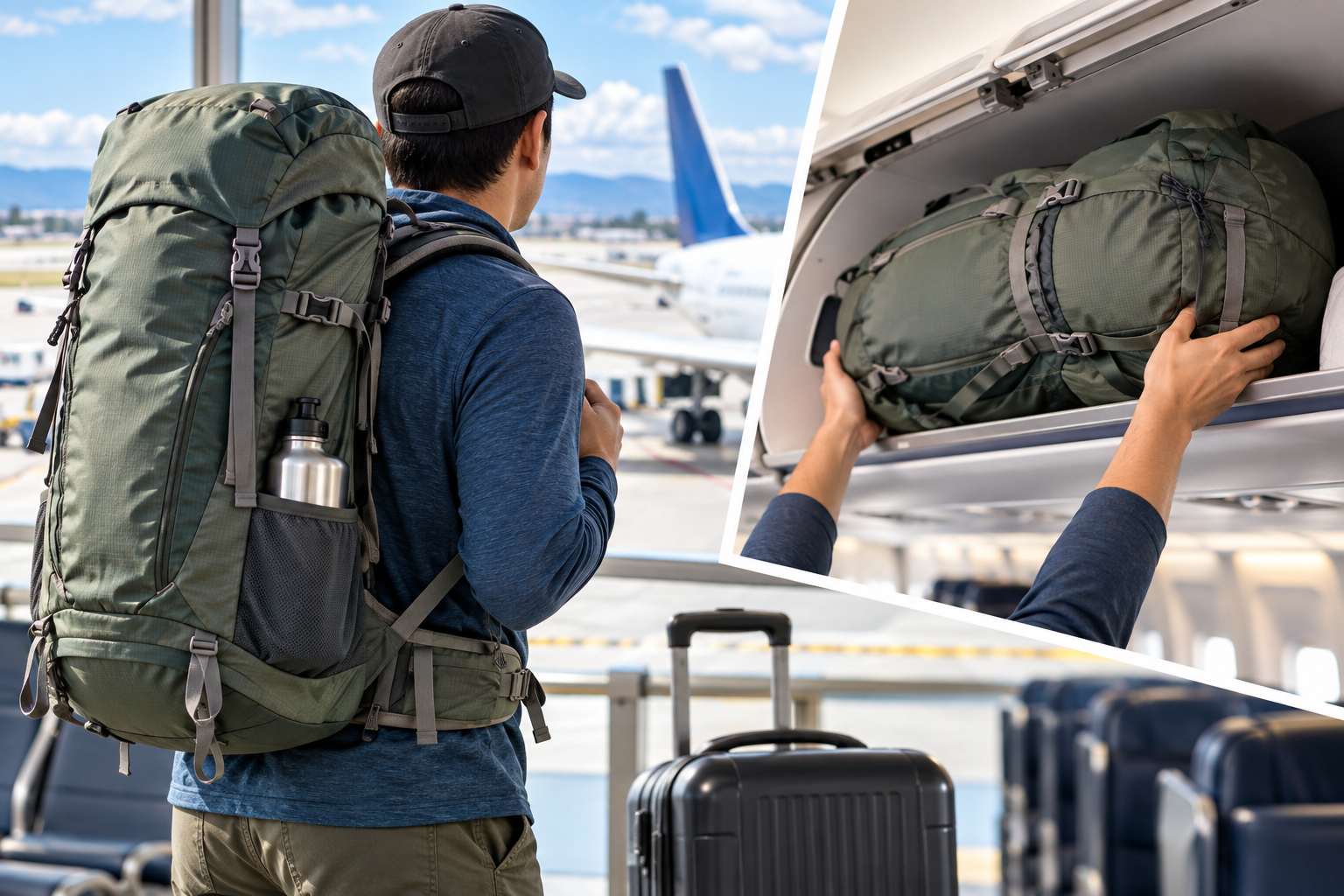
Flying to a trailhead with your regular backpacking pack sounds simple right up until you’re standing at the gate watching an agent eye your 65-liter pack with genuine suspicion. Airlines don’t size carry-on luggage by liters the way backpacking gear is marketed — they size by linear dimensions, and a pack’s advertised capacity tells you almost nothing about whether it’ll actually clear the sizer box at the gate. Understanding the real relationship between backpack volume and airline carry-on rules can save you a genuinely stressful, expensive surprise the moment you’re trying to board.
This guide covers exactly how airline carry-on sizing actually works, which backpack capacities genuinely tend to fit, and the practical steps that meaningfully reduce your risk of a forced gate-check. For the packs themselves, hikingbackpackpro.com’s guides on backpacks for tall women and backpacks for petite frames cover specific models across size ranges, some of which are explicitly marketed as carry-on compliant.
Why Liters and Carry-On Rules Don’t Translate Directly
A backpack’s liter capacity measures internal volume — how much gear fits inside it. Airline carry-on limits measure external linear dimensions — length plus width plus height, or each dimension checked individually against a sizer template at the gate. These are genuinely different measurements, and a pack can be well under its stated liter capacity in actual use while still exceeding carry-on dimensions, or conversely, a pack can be dimensionally compliant while carrying more gear than you’d expect from a smaller-sounding liter number.
This mismatch is exactly why “will my 40L pack fit as carry-on” doesn’t have a single universal answer — it depends entirely on that specific pack’s actual length, width, and depth when packed, not on the liter figure printed on the tag.
Standard Carry-On Dimension Limits
Most US airlines allow a maximum carry-on size of roughly 22 x 14 x 9 inches (56 x 36 x 23 cm), though this varies meaningfully by carrier and by whether you’re flying domestic or international. Some airlines, particularly budget carriers and many international operators, enforce noticeably smaller limits, sometimes closer to 21.5 x 15.75 x 8 inches or other combinations that differ from the more commonly cited US standard.
These limits typically include the bag’s wheels, handles, and any external pockets or straps that add to its overall profile, not just the main body of the pack. A backpack with bulging side pockets or an external sleeping pad strapped on can exceed the sizer even if the pack’s core dimensions would otherwise comply.
Weight limits exist separately from size limits and vary just as much between carriers. A pack that fits the dimensional sizer perfectly can still be rejected or charged extra if it exceeds a specific airline’s weight allowance, so checking both specs for your specific airline matters, not just one or the other.
Which Backpack Capacities Tend to Fit
Daypacks and packs in the 20 to 30-liter range are the most reliably carry-on compliant category, and this is genuinely consistent across most airlines and pack brands. A pack this size simply doesn’t have enough internal volume to physically exceed most standard carry-on dimension limits even when packed reasonably full.
35 to 45-liter packs occupy genuine gray territory, and whether a specific pack in this range fits depends heavily on its actual shape rather than its liter rating alone. A tall, narrow 40-liter pack with a compact footprint can fit within carry-on dimensions more easily than a shorter, wider 35-liter pack with a bulkier overall profile, even though the wider pack has less total capacity.
Packs above roughly 45 to 50 liters are genuinely unlikely to meet carry-on size restrictions for most airlines, regardless of how you pack them. At this volume, the pack’s actual external dimensions when reasonably loaded almost always exceed standard sizer limits, and treating a pack this size as reliably carry-on compliant is a real gamble rather than a reasonable expectation.
Real Product Examples Worth Understanding
Some manufacturers explicitly design and market specific packs as carry-on compliant, building the pack’s actual external dimensions around known airline limits rather than leaving compliance to chance. When a product listing or manufacturer spec sheet explicitly states carry-on compliance, that’s a genuinely more reliable signal than assuming compliance based on liter capacity alone, since the manufacturer has already done the dimensional verification work.
Conversely, a pack marketed purely by its liter capacity, with no explicit carry-on claim, requires you to do that verification yourself — measuring the actual pack’s length, width, and depth when packed the way you’d genuinely travel with it, then comparing those measurements against your specific airline’s stated limits.
How to Actually Check Before You Fly
Measure your specific pack in its genuinely loaded, travel-ready state, not empty. A backpack’s dimensions change meaningfully once you’ve packed it — side pockets expand, the main compartment fills out, and external straps compress or bulge depending on what’s attached. Measuring an empty pack and assuming those numbers hold once loaded is a common and genuinely risky mistake.
Check your specific airline’s current carry-on policy directly rather than relying on a general industry standard. Airline size and weight limits change, vary by carrier, and sometimes differ between domestic and international routes operated by the same airline — the “roughly 22 x 14 x 9 inches” figure is a reasonable starting reference, but it’s not a guarantee for any specific flight.
Account for external attachments separately from the pack’s core body. A sleeping pad strapped to the outside, trekking poles clipped to a side, or a bulging front pocket can all push an otherwise-compliant pack over the sizer limit, and these additions are easy to forget about when mentally estimating whether your pack will fit.
Compress your pack as much as possible before attempting to board with it as carry-on. Compression straps genuinely reduce a pack’s external profile by cinching down excess internal volume, and using them fully — rather than leaving them loose — can be the difference between a pack that clears the sizer and one that doesn’t.
What Happens If Your Pack Doesn’t Fit
Gate agents can require you to check a bag that doesn’t meet carry-on size requirements, often at the gate rather than at check-in, which is a genuinely worse outcome than checking it proactively. A gate check at the last minute means less control over how the bag is handled, less time to remove any items you’d rather keep with you, and potentially a real delay to boarding while the situation gets sorted out.
Checking your pack in advance at the counter, rather than risking a gate check, generally gives you more control over the process. You can remove specific items you want to carry on separately, confirm the bag is packed appropriately for the rougher handling checked luggage typically receives, and avoid the genuine stress of an unexpected gate-side size dispute.
Fees for a checked bag versus an oversized carry-on caught at the gate can differ, and airline policies on this vary — some charge the same either way, others penalize a gate-caught oversized bag more than a bag checked proactively at the counter. Checking your specific airline’s fee structure in advance removes the guesswork.
Packing Strategies That Genuinely Help
Pack your bulkiest, least compressible items — a sleeping bag, a puffy jacket — toward the pack’s center rather than pushing everything toward the outer edges. This keeps the pack’s external silhouette more consistent and predictable, rather than creating uneven bulges that push specific dimensions past the sizer limit even if the pack’s overall volume is genuinely within range.
Remove and separately carry anything you don’t strictly need inside the main pack during the flight itself. Trekking poles, a bear canister, or bulky cookware can sometimes travel more easily as a separate checked item or in a different bag entirely, reducing your main pack’s profile specifically for the carry-on attempt.
If you’re genuinely uncertain whether your pack will fit, plan for a checked-bag contingency rather than assuming carry-on will work out. Packing any genuinely essential items — medication, a change of clothes, valuables — into a smaller secondary bag that will definitely qualify as carry-on protects you against the scenario where your main pack does get checked, whether by choice at the counter or by requirement at the gate.
When a Smaller Pack Genuinely Makes More Sense
If your trip specifically involves flying to a trailhead, choosing a pack in the 30 to 40-liter range from the outset — rather than defaulting to a larger multi-day pack — genuinely simplifies the entire travel logistics question. A pack sized deliberately with carry-on compliance in mind removes the uncertainty this whole guide addresses, at the cost of potentially needing to pack more efficiently for the trip itself.
For hikers who fly regularly to different trailheads, a dedicated carry-on-compliant pack, used specifically for travel days, paired with a larger pack reserved for genuinely long trips accessed by car, is a reasonable two-pack strategy rather than trying to make one pack serve both purposes and running into carry-on uncertainty every time you fly.
Final Thoughts
Whether a hiking backpack fits as airline carry-on comes down to real external dimensions when packed, not the liter capacity printed on the tag — a distinction that trips up a genuine number of hikers who assume their “40L pack should be fine” without ever measuring it against their specific airline’s actual sizer limits. Daypacks and packs in the 20 to 30-liter range are reliably compliant across most carriers; packs above 45 to 50 liters are genuinely unlikely to fit regardless of how carefully you pack them; and everything in between depends on the specific pack’s shape and how you load it, not its capacity rating alone.
Measure your pack loaded the way you’d actually travel with it, check your specific airline’s current policy rather than a general industry rule of thumb, and build in a checked-bag contingency if you’re genuinely uncertain — the small amount of advance planning is considerably less stressful than discovering the answer at the gate with a boarding line building up behind you.