
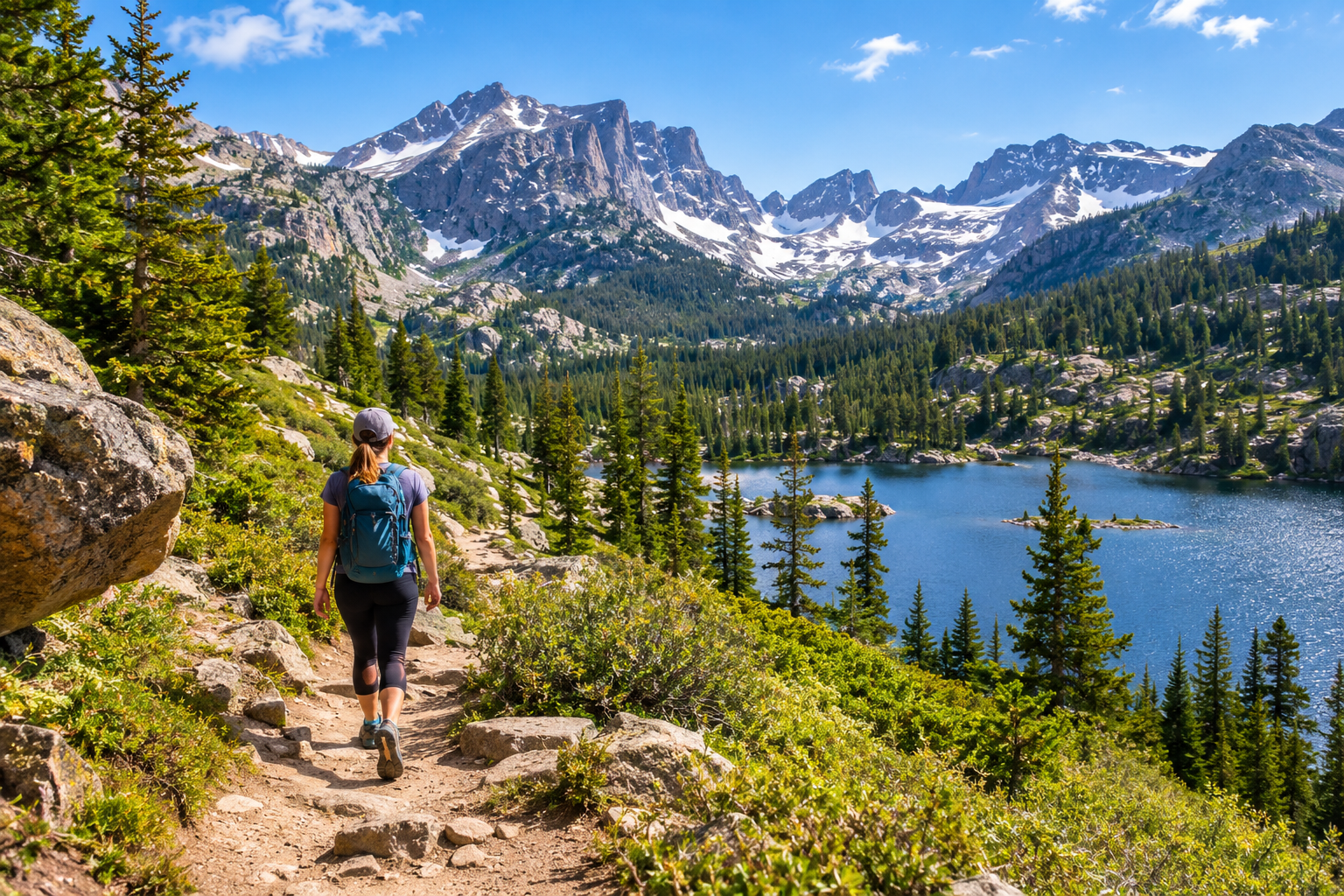
Rocky Mountain National Park has a genuine reputation for demanding, high-alpine terrain, but that reputation misses something important — a real cluster of short, flat, and often paved trails delivering the same alpine lakes, waterfalls, and tundra views that draw hikers here in the first place, without requiring serious fitness or technical experience. Several of these trails are wheelchair accessible or close to it, and the park sees genuinely broad visitation from families with young kids through hikers well into retirement, precisely because these easy options exist alongside the park’s more demanding routes.
This guide covers the best easy hikes in Rocky Mountain National Park for beginners, families, and anyone who wants genuine payoff without a strenuous climb — with current 2026 timed entry information, since this park’s access system genuinely changed the way you need to plan a visit.
For gear appropriate to Rocky Mountain’s genuine elevation and fast-changing alpine weather, our what to wear hiking in summer guide covers layering for conditions that shift quickly at altitude.
Before You Go — Essential 2026 Planning Information
A timed entry reservation is required from May 22 through mid-October 2026, and this is genuinely the single most important planning detail for any summer visit. There are two distinct reservation types: a Timed Entry + Bear Lake Road permit, required from 5am to 6pm and covering the park’s busiest corridor (Bear Lake, Sprague Lake, Nymph Lake, Dream Lake all fall within this zone), and a standard Timed Entry permit covering the rest of the park, required from 9am to 2pm. Choose based on which specific hikes are on your list — most of the easy hikes covered in this guide sit within the Bear Lake corridor specifically.
Reservations cost just $2 and must be booked through Recreation.gov, not at the entrance station — they genuinely cannot be purchased in person. Reservations release on a rolling monthly schedule (May 1 for May 22 through June 30, June 1 for July, and so on), with additional reservations released first-come, first-served each night at 7pm Mountain Time for the following day. A separate standard park entrance fee or pass is required regardless of your timed entry reservation.
If you arrive before or after your reservation’s required hours, you don’t need the reservation at all, though you’ll always need a standard park pass. Hiker Shuttle riders, campers with a valid camping permit, and guided tour participants are also exempt from timed entry.
Several of the easiest hikes on this list are genuinely wheelchair accessible or close to it, including Coyote Valley Trail, Bear Lake’s paved sections, the Alluvial Fan, and Lily Lake — worth knowing if accessibility is a genuine priority for your group.
Easy Hikes on the East Side (Bear Lake Corridor)
Bear Lake — Best Overall Easy Hike, Wheelchair Accessible
Distance: Roughly 0.8 miles (loop) | Elevation gain: Minimal | Difficulty: Easy
Bear Lake is genuinely one of the most popular destinations in the entire park, and the trail matches that popularity with real accessibility — mostly graded and paved, with much of the loop wheelchair accessible (though not the complete circuit). The lake itself is genuinely beautiful, framed by mountain views, and benches positioned at nearly every viewpoint make this a strong choice for a relaxed picnic rather than a rushed walk-through. This is consistently described as a genuine must-do despite the real crowds it draws.
Nymph Lake — Best Short Introduction
Distance: 0.5 miles one-way (1 mile round trip) | Elevation gain: Moderate, steady incline | Difficulty: Easy
Nymph Lake earns its easy rating specifically because the incline, while real and steady, isn’t genuinely difficult, and the return trip is entirely downhill. Lily pads dot the lake’s surface, surrounded by pine trees, making this a genuinely beautiful and efficient first stop for a day exploring the Bear Lake corridor.
Dream Lake — Best for Wildlife and Mountain Views
Distance: 0.6 miles beyond Nymph Lake (roughly 2.2 miles round trip from the Bear Lake trailhead) | Elevation gain: Moderate, with some stone steps | Difficulty: Easy
Continuing past Nymph Lake, Dream Lake adds genuine variety — a couple of stream crossings, a cascading waterfall, and stone “mountain stairs” along the way, before delivering a genuinely striking glacier-backed mountain view at the lake itself. The water is crystal clear enough that trout are visible swimming beneath the surface, and the trail surface remains flat dirt and rock throughout.
Sprague Lake — Best for Reliable Parking and Accessibility
Distance: 0.8 miles (loop) | Elevation gain: Minimal | Difficulty: Easy
Sprague Lake delivers a genuinely relaxed, roughly 15-minute walk around a scenic lake with real mountain views, and it has a genuine practical advantage over other popular corridor trails — the parking lot here tends to stay open even at midday when Bear Lake’s lot fills up. A dedicated pet area near the parking lot lets dogs stretch their legs before or after the hike, since dogs aren’t permitted on the trail itself.
Easy Hikes on Trail Ridge Road
Forest Canyon Overlook — Best Paved Overlook Walk
Distance: A few hundred feet from the parking lot | Elevation gain: Minimal | Difficulty: Easy
This is technically more of a viewpoint than a hike, but the short, paved walk genuinely delivers alpine tundra wildflowers alongside a dramatic canyon overlook — a strong, low-effort stop for anyone driving Trail Ridge Road who wants a genuine payoff without leaving the car for long.
Tundra Communities Trail — Best for Experiencing Alpine Tundra
Distance: 0.5 miles one-way | Elevation gain: Moderate, genuinely felt at altitude | Difficulty: Easy to Moderate
Starting at 12,110 feet above sea level at the Rock Cut pullout, this paved trail is genuinely the easiest of the “easy” hikes in name only — the elevation itself makes even a gentle walk feel more demanding than the trail’s grade alone would suggest, so make sure you’ve had a couple of days to acclimate before attempting it. The reward is a genuine walk through Rocky Mountain’s alpine tundra ecosystem, found nowhere else at lower elevation in the park, with wildflowers in late June and early July and real odds of spotting elk or bighorn sheep.
The trail ends at a boulder pile; nimble hikers can scramble up to find a memorial to former park superintendent Roger Toll, which doubles as a mountain identification map. Hike this specifically in the morning or evening — summer afternoon lightning storms at this elevation are a genuine, real safety concern, not a remote hypothetical. Stay strictly on the trail, since the tundra vegetation here is genuinely fragile and can’t survive repeated foot traffic.
Easy Hikes on the West Side (Grand Lake Area)
Coyote Valley Trail — Best for Wildflowers and Solitude
Distance: 0.5 miles one-way (1 mile round trip) | Elevation gain: None, entirely flat | Difficulty: Easy, wheelchair accessible
Located on the park’s west side, Coyote Valley Trail has a genuinely different character from the busier east-side corridor — less crowded, and set within one of the park’s namesake “parks,” a French-derived term for a mountain-ringed valley. The trail is completely flat, wheelchair accessible, and genuinely filled with wildflowers, following a stream through open valley scenery. Since the views here overlap somewhat with the nearby Holzwarth Historic Site, consider choosing one or the other rather than doing both back to back.
Holzwarth Historic Site — Best for History Alongside Scenery
Distance: 1 mile round trip | Elevation gain: Minimal | Difficulty: Easy
This flat, easy trail (not officially wheelchair accessible, but close) leads to a genuine historic dude ranch, where you’ll learn the story of the couple who homesteaded here out of necessity. The valley setting is genuinely gorgeous on its own — wildflowers, a meadow, mountains, and a running stream — with the historical cabins serving as a real bonus rather than the sole draw.
Adams Falls and East Meadow — Best Short Waterfall with Wildlife Viewing
Distance: 1/3 mile to the falls; add another 1/3 mile for East Meadow | Elevation gain: Minimal | Difficulty: Easy
Located just 1.5 miles east of Grand Lake, this short hike winds through aspen and pine stands to a genuinely striking waterfall, with an overlook positioned above the falls looking down as the stream splits around an island before crashing down with real spray, particularly in spring and early summer. Continuing another third of a mile brings you to East Meadow, a genuinely peaceful open meadow with views of Mount Craig (known locally as Mount Baldy) — moose sightings here are a real possibility, so bring binoculars.
Easy Hikes Near Estes Park
Alluvial Fan — Best Hike With Real Geological History
Distance: Under 0.5 miles, mostly wheelchair accessible | Elevation gain: Minimal | Difficulty: Easy
This short, paved trail sits at the site of a genuine natural disaster — a dam failure in the 1980s sent water and debris crashing down the canyon into Estes Park, and a subsequent 2013 storm further reshaped the landscape, washing out the original trail entirely before a new one was rebuilt in 2020. The result is a genuinely unique landscape of boulders and a cascading waterfall, with a small bridge overlooking the river. This is a favorite spot for kids specifically, who enjoy climbing the boulders and playing in shallow pools later in summer once the powerful spring meltwater has calmed down — avoid the main stream during spring and early summer specifically, when it runs genuinely dangerous.
Lily Lake — Best for Sunrise or Evening Solitude
Distance: 1 mile (loop) | Elevation gain: Minimal | Difficulty: Easy, wheelchair accessible
Located 6 miles south of Estes Park on Highway 7, Lily Lake delivers a genuinely gentle, fully wheelchair-accessible loop with views in every direction — Longs Peak, the park’s tallest mountain, to the south; Twin Sisters Peaks to the east; and a jagged rock hill to the north. Muskrats are a genuine common sighting swimming or resting along the shore, and the boardwalk on the south side is a strong spot for birdwatching. This hike is genuinely spectacular at sunrise, when Longs Peak catches the first light, and equally peaceful in the evening once crowds thin out. An upper trail on the north end adds real elevation and stairs for hikers who want more of a challenge.
An Easier Alternative: Guided Horseback Rides
For visitors who want genuine mountain scenery without walking at all, several outfitters offer guided horseback rides in and around the park, typically running $100 to $150 per person for a one-to-two-hour ride. These are genuinely beginner-friendly — the horses know these trails well — and deliver the same meadows, streams, and mountain views the hiking trails offer, from the saddle instead.
Building Your Easy-Hiking Itinerary
One day: Bear Lake and Sprague Lake in the Bear Lake corridor (secure a Timed Entry + Bear Lake Road permit), followed by a Trail Ridge Road drive with stops at Forest Canyon Overlook and, if acclimated, the Tundra Communities Trail.
Two to three days: Day one covers the Bear Lake corridor — Nymph Lake, Dream Lake, Bear Lake, and Sprague Lake. Day two covers Trail Ridge Road and the west side — Forest Canyon Overlook, Tundra Communities Trail, Coyote Valley, Holzwarth, and Adams Falls near Grand Lake. Day three covers the Estes Park-adjacent hikes — Alluvial Fan and Lily Lake, ideally Lily Lake at sunrise or a quiet evening.
Four or more days: Add a guided horseback ride for a genuinely different pace, and build in real buffer time around timed entry reservations, particularly for the Bear Lake corridor, which sells out fastest given how many of the park’s easiest and most popular hikes sit within it.
Conclusion
Rocky Mountain National Park’s easy hikes prove that genuine alpine payoff doesn’t require strenuous effort — Bear Lake, Nymph Lake, and Dream Lake deliver real mountain and glacier views within a mile or two of flat-to-moderate walking, while Coyote Valley and Lily Lake offer fully accessible loops through wildflower-filled valleys. Start with the Bear Lake corridor to understand why it’s the park’s most popular area, add a Trail Ridge Road stop at Forest Canyon Overlook or the Tundra Communities Trail if you’ve acclimated to the elevation, and don’t overlook the west side’s quieter Coyote Valley and Adams Falls trails for a genuinely different, less crowded pace.
Secure your timed entry reservation well in advance given how quickly the Bear Lake corridor sells out, respect the fragile tundra vegetation on any high-elevation trail, and plan tundra hikes for morning or evening specifically to avoid the genuine lightning risk that builds most summer afternoons.
For more national park hiking guides, check our best hikes in Glacier National Park and best hikes in Grand Teton National Park guides.