
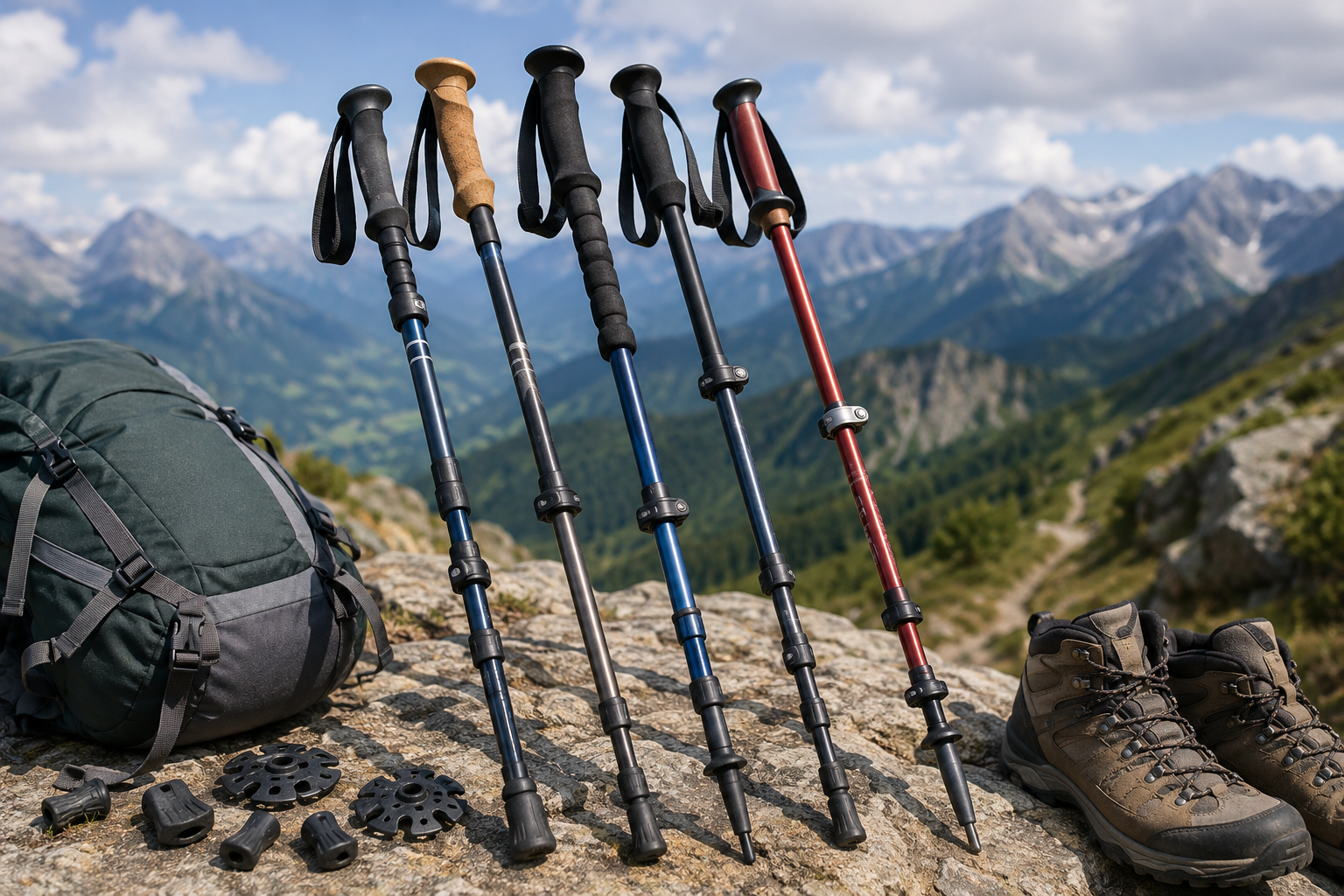
Trekking poles look like the simplest piece of gear in a hiker’s kit — two sticks with straps — and that simplicity is exactly why so many people end up with buyer’s remorse. Choosing between aluminum and carbon fiber, flip locks and twist locks, foam and cork, genuinely matters for how a pole performs on your specific trails, and mismatching those choices to your actual hiking style is how people end up with poles that slip, snap, or fatigue their arms well before a hike is over. The real question isn’t which pole scores highest in a review roundup — it’s how and where you’re actually going to use them.
This guide covers the trade-offs that matter most: pole material, locking mechanism, grip type, sizing, and construction style, so you can match a pole to your real trail conditions rather than defaulting to whatever’s trending. Once you’ve settled on the right specs, our best hiking poles roundup on hikingbackpackpro.com covers specific product picks across these categories.
Aluminum vs. Carbon Fiber
This is the single biggest material decision, and both options are genuinely good — they’re just built for different priorities.
Aluminum poles are heavier but considerably more durable and less sensitive to sudden impact. If you regularly put your full body weight onto your poles, hike in talus fields, or scramble on rocky, technical terrain, aluminum is the safer material choice. Aluminum flexes and bends under stress rather than snapping outright, which means a hard sideways impact is far more likely to leave you with a bent pole you can still limp home with than a broken one you’re now carrying instead of using.
Carbon fiber poles are lighter and dampen trail vibration better, but they’re more brittle under side-load stress. Carbon can break suddenly when wedged between rocks or subjected to a sharp lateral impact — a failure mode aluminum simply doesn’t share in the same way. The weight savings are real, though: carbon poles typically save 2 to 3 ounces per pair compared to aluminum equivalents, a meaningful difference for high-mileage hikers, thru-hikers, and trail runners counting every ounce. For hikers logging serious distance where the weight savings compound over thousands of steps, carbon pays for itself quickly in reduced arm fatigue.
The practical rule: choose aluminum if durability and reliability under hard use matter more to you than shaving ounces, and choose carbon if you’re optimizing for weight and mostly staying on established trail rather than scrambling or leaning heavily on your poles.
Flip Locks vs. Twist Locks
The locking mechanism determines how you adjust pole length on the trail, and this is worth understanding before you buy rather than discovering the hard way mid-hike.
Flip locks (also called lever locks) use an external lever that clamps the pole segments in place. They’re genuinely easier to operate one-handed, even with gloves on, and they tend to hold more securely under load than twist locks. Because the entire mechanism sits on the outside of the pole, if something does go wrong, you can see and manipulate it directly rather than troubleshooting blind. The tradeoff is mechanical complexity — more moving parts means more potential points of failure, and flip locks can loosen over time, occasionally requiring you to tighten a small screw to maintain a secure clamp.
Twist locks rely on an internal expanding collar that you twist to tighten or release. They’re more compact and have fewer visible moving parts, but that same internal design becomes a real liability in cold or wet conditions — the internal collar can slip when it’s damp or when temperatures drop, exactly the conditions where a secure pole matters most. Twist locks are also somewhat more of a hassle to adjust on the go, but they’re genuinely easier to repair in the field if something does go wrong, since the mechanism is simpler overall.
For most hikers, flip locks are the more broadly recommended choice specifically because of their reliability under load and ease of one-handed, glove-on adjustment. Twist locks remain a reasonable choice for hikers prioritizing a more minimal, lower-profile design and who aren’t regularly hiking in cold or wet conditions where the internal collar’s vulnerability becomes a real issue.
Grip Material: Cork, Foam, and Rubber
Cork grips mold to your hand shape over time, wick sweat effectively, and stay comfortable across both hot and cold conditions. This is the clear winner for all-day comfort and long hiking days specifically, since a grip that’s actively shaping itself to your hand reduces the friction and pressure points that cause hand fatigue over many hours. Cork does cost more and typically outlasts foam, which is part of why it’s the standard choice on premium poles.
Foam grips are lighter and softer, with genuinely good shock absorption, but they can become slippery once they get wet — a real consideration if you’re hiking somewhere with frequent rain or heavy sweat. Foam performs particularly well in cold conditions specifically, where it stays comfortable to hold without the stiffness some other grip materials develop in low temperatures.
Rubber grips are the most durable option but cause more hand fatigue on long days, since rubber doesn’t breathe the way cork or foam does — your hand stays warmer and sweatier inside a rubber grip over sustained use, which becomes uncomfortable well before cork or foam would.
Some poles combine materials in a single bi-material grip — foam or rubber on the lower portion for a secondary lower hand-hold on steep terrain, cork on the primary upper grip — giving you the benefit of each material exactly where it matters most.
Fixed-Length vs. Adjustable Poles
Adjustable (telescoping) poles let you change length on the trail, and this is the right choice for most hikers specifically because pole length needs genuinely change with terrain — you want poles shorter for steep uphill climbs and longer for descents, and an adjustable pole lets you make that change in real time rather than committing to one length for the entire hike.
Fixed-length poles are simpler and often lighter, popular specifically among ultralight backpackers and trail runners who’ve already dialed in their ideal length and don’t need trail-side adjustment. Fixed-length poles typically come in a range of preset sizes so you can still choose the length that suits your height, you just can’t fine-tune it once you’re on trail.
For hikers who do a mix of steep, varied terrain, adjustable poles are genuinely the more versatile and broadly recommended choice. For dedicated ultralight hikers or trail runners prioritizing minimum weight and simplicity above trail-side flexibility, fixed-length is a legitimate and often lighter alternative.
Telescoping vs. Folding Construction
This is a separate decision from fixed versus adjustable, and it’s easy to conflate the two.
Telescoping poles slide and lock into place along their length, and most telescoping poles are also adjustable, letting you fine-tune length to match changing terrain throughout a hike.
Folding poles collapse into segments connected by an internal cord, similar in concept to a tent pole, packing down to a considerably smaller stowed size than telescoping poles typically achieve. Folding poles deploy and stow away faster, which is exactly why they’re the standard choice for trail running, where you need to quickly put poles away and pull them back out repeatedly during a single run. The tradeoff is that folding poles are generally fixed-length once deployed, sacrificing the trail-side adjustability that telescoping poles offer.
If packed size for travel, running-vest storage, or airline carry-on compliance matters to you, folding construction is worth prioritizing. If you want the ability to fine-tune length as terrain changes throughout a hike, telescoping construction remains the more versatile choice.
Sizing Your Poles Correctly
Getting pole length right matters as much as any material or mechanism choice, since a pole that’s the wrong length undermines the ergonomic benefit poles are supposed to provide in the first place. As a general starting point, your elbow should form roughly a 90-degree angle when you’re holding the pole with the tip resting on the ground next to your foot while standing upright — this baseline length works well on flat terrain and serves as your reference point for adjustments.
For adjustable poles, shorten them for uphill sections, where a shorter pole keeps your arm angle comfortable as your uphill hand naturally sits higher relative to the ground. Lengthen them for descents, where a longer pole reaches the ground further out in front of you and provides better stability and impact absorption on the way down. This is precisely the scenario where adjustable, telescoping poles earn their keep over fixed-length alternatives — the ability to make this adjustment mid-hike, rather than living with one compromise length for an entire route with mixed terrain.
Putting It Together
For most day hikers and backpackers on varied, moderate terrain: adjustable aluminum poles with flip locks and cork grips deliver the most reliable, broadly versatile combination — durable enough to handle real trail abuse, adjustable enough to match changing terrain, and comfortable enough for genuinely long days.
For high-mileage hikers, thru-hikers, and anyone counting ounces: carbon fiber poles, whether telescoping or folding depending on your packing priorities, deliver meaningful weight savings that compound over serious distance — just be mindful of carbon’s vulnerability to hard side-impact if your route includes technical scrambling.
For trail runners: folding carbon poles with flip locks are the standard choice, prioritizing fast deployment and minimal packed size over the trail-side length adjustment that telescoping poles offer.
For technical, rocky, or off-trail terrain where you’re leaning hard on your poles: aluminum remains the safer material choice regardless of your other preferences, since its tendency to bend rather than snap under hard impact genuinely matters more in that specific terrain than the weight savings carbon offers.
Conclusion
The right trekking poles come down to matching a handful of real trade-offs to your actual hiking rather than chasing whatever ranks highest on a gear review site. Choose aluminum for durability on technical terrain or carbon for weight savings on high-mileage trails, prioritize flip locks for reliable one-handed adjustment or twist locks for a simpler, more minimal design, and pick cork grips if all-day comfort matters most to you. Get the length dialed in correctly and adjust it as terrain changes, and the poles you choose will genuinely support your hiking rather than becoming one more piece of gear you have to compensate for on trail.