
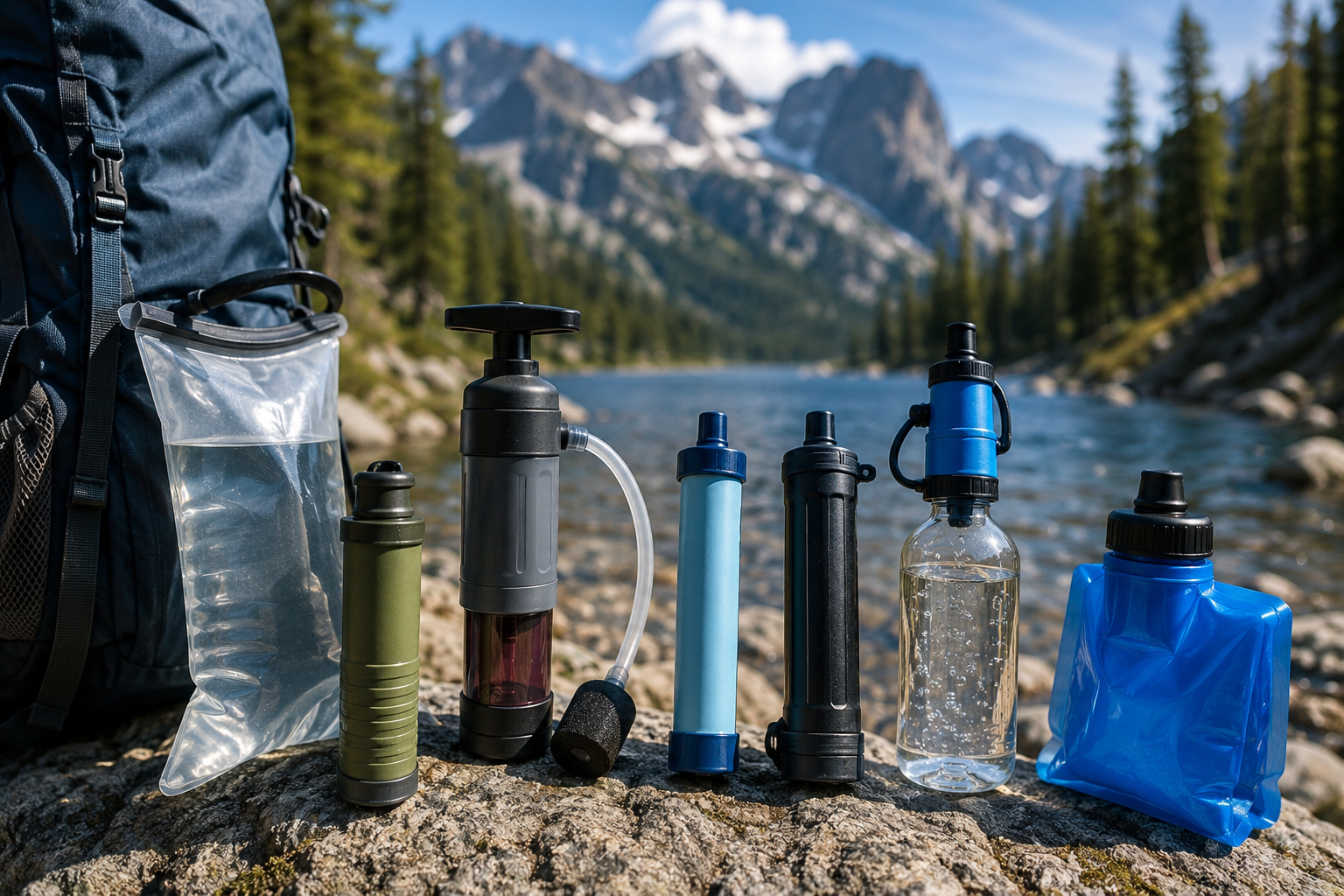
Water is the one supply on a backpacking trip you genuinely can’t carry enough of to last the whole way — which means treating water from streams, lakes, and springs along your route isn’t optional gear, it’s the thing that determines whether your trip actually works. The water filter market has genuinely consolidated around a handful of core technologies over the past decade, and hollow-fiber filters in particular have come to dominate the category for good reason: reliable performance, the ability to backflush and clean them in the field, and genuinely light weight compared to older filtration approaches. But “hollow-fiber” is just the starting point — the real decision tree involves filter format, pore size, what pathogens you actually need protection from, and how your specific trip’s water sources and group size shape which format makes sense.
This guide walks through exactly how to make that decision — the real technology differences between filter types, what pore size actually protects against, and how to match a filter to your specific trip rather than defaulting to whatever’s most popular on the trail this season. For the actual product recommendations once you’ve settled on a type, our best personal water filters for hiking guide and our best water purification options for backpacking roundup cover specific models across these categories.
What You’re Actually Filtering Out
Before comparing filter types, it helps to understand what threats water treatment is actually designed to address, since different technologies handle different threats.
Protozoa (like Giardia and Cryptosporidium) are the largest of the three major threats, and virtually every filter on the market — mechanical or chemical — handles them effectively.
Bacteria (E. coli, Salmonella, and similar) are smaller than protozoa but still large enough that a standard 0.2-micron mechanical filter catches them reliably. This is the threat level most backpackers in North America genuinely need to plan around.
Viruses are dramatically smaller than bacteria or protozoa — small enough that most mechanical filters, including nearly every squeeze and gravity filter on the market, simply can’t catch them by pore size alone. Viruses are a much bigger concern in international travel and areas with human sewage contamination than in typical North American backcountry water sources, which is why most domestic backpackers don’t prioritize virus protection the way international travelers should.
This distinction matters directly for the type decision below: if you’re hiking domestically in water sources without heavy human contamination, a standard hollow-fiber mechanical filter covers your real risk. If you’re traveling internationally or hiking somewhere with a genuine sewage contamination risk, you need either a purifier with a smaller pore size, a UV device, or a chemical treatment — mechanical filtration alone won’t protect you.
The Core Filter Types
Squeeze Filters
Squeeze filters are genuinely the dominant choice among thru-hikers today, and it’s not close — on trails like the PCT, you’ll see an overwhelming majority of hikers using an ultralight squeeze filter rather than any other format. The appeal is straightforward: they’re the fastest, simplest, and most reliable system for both solo hikers and groups, provided everyone in a group carries their own.
A squeeze filter screws directly onto a soft flask or a standard water bottle (some interface with any threaded bottle, others require a proprietary reservoir), and you fill the reservoir from your water source, then squeeze water through the filter into a clean container or directly into your mouth. These filters use hollow-fiber membrane technology almost universally now, with pore sizes typically in the 0.1 to 0.2 micron range — effective against bacteria and protozoa, not viruses.
The tradeoffs are real but manageable: squeeze filters can clog with sediment-heavy water faster than gravity systems, and flow rate depends entirely on your own arm strength and squeeze effort rather than being hands-free. Weight is genuinely minimal, often under 3 ounces for the filter alone.
Gravity Filters
Gravity filters solve the hands-free problem directly — you fill a “dirty” reservoir, hang it above a “clean” reservoir, and let gravity pull water through the filter membrane over several minutes while you set up camp or handle other tasks. This is genuinely the fastest format by raw flow rate: a well-known gravity system filters roughly 1.75 liters per minute, meaning a 4-liter bladder fills in just a few minutes without you touching anything during the process.
This makes gravity filters the clear choice for groups and base camps specifically — splitting the weight of one gravity system across several hikers, and filtering multiple people’s water simultaneously without each person squeezing their own bottle, is a genuine efficiency win that scales with group size. The tradeoff is bulk and weight relative to a minimalist squeeze filter — you’re carrying two reservoirs plus the filter element itself, which adds up for a solo ultralight hiker in a way it doesn’t for a group splitting the load.
Pump Filters
Pump filters use a hand-operated pump to force water through a filter cartridge, and they’re generally heavier than every other format on this list — best suited specifically to expedition-style trips into genuinely demanding backcountry, or situations where you’re processing consistently silty, gunky water that would clog a squeeze or gravity filter quickly.
The category has genuinely narrowed over the past decade as squeeze and gravity filters have improved, but pump filters retain one real advantage: some premium pump purifiers use pore sizes small enough (as small as 0.02 microns in top models) to filter viruses as well as bacteria and protozoa, making them a legitimate purifier rather than just a filter. This comes at real cost — both in price and in the physical effort of pumping — but for hikers who specifically need virus protection without carrying chemicals, a premium pump purifier is one of the few mechanical options that delivers it.
Straw Filters
Straw filters let you drink directly from a water source through a built-in filter membrane, without needing a separate reservoir at all. Despite being designed primarily as a straw-format filter, the strongest models in this category also function surprisingly well as gravity and squeeze filters when paired with a compatible reservoir — genuine multi-format flexibility from a single piece of gear.
Straw filters use the same hollow-fiber technology as squeeze filters, typically at 0.2 microns, filtering out the overwhelming majority of bacteria and protozoa along with microplastics, sand, and silt. The tradeoff specific to this format: straw filters tend to clog somewhat faster than dedicated squeeze or gravity designs, and you’re limited to drinking directly from the source rather than filling containers for later — a real limitation on trips where you need to carry filtered water between water sources rather than drinking on the spot.
UV Purifiers
UV purifiers use ultraviolet light to neutralize the DNA of bacteria, protozoa, and viruses without physically filtering anything out of the water — this is a genuinely different mechanism from every format above, and it’s the reason UV devices are classified as purifiers rather than filters. A UV purifier’s real strength is virus protection without chemicals, making it a strong choice specifically for international travelers and hikers in clear-water areas who want that protection without the taste tradeoffs chemical treatment introduces.
The real limitation: UV light requires reasonably clear water to work effectively, since sediment and organic matter can shield pathogens from full UV exposure. UV devices also don’t remove sediment, taste, or odor at all — the water might be pathogen-free but still gritty or earthy-tasting if the source itself is silty. Pairing a UV purifier with a simple pre-filter for clarity is the standard workaround.
Chemical Treatment
Chemical treatments — iodine tablets, chlorine dioxide tablets, or liquid drops like a popular chlorine dioxide formula — are widely regarded as the most durable and reliable water treatment option available specifically because they have no moving parts, require no maintenance, and don’t expire the way a filter membrane can clog or a UV device’s battery can die. If you want maximum reliability with zero mechanical failure points, chemical treatment delivers that more completely than any filter or purifier on this list.
The tradeoffs are genuine: chemical treatments don’t address particulates at all, so silty or organic-tasting water stays silty and organic-tasting even after treatment — you’re killing what’s dangerous, not improving what’s unappealing about the water. Chlorine-based treatments also leave a residual taste that many hikers find genuinely unpleasant, even though it’s the same taste that confirms the treatment worked. Most experienced backpackers carry chemical treatment specifically as backup rather than a primary system — filters and pumps can clog, parts can be lost or break, and a small vial of treatment drops or tablets can mean the difference between a manageable situation and a genuinely serious one when your primary system fails mid-trip.
Matching Filter Type to Your Trip
Solo or duo hikers on established North American trails are almost always best served by a squeeze filter. It’s the lightest, simplest, fastest-to-use format for the threat level (bacteria and protozoa) that dominates most domestic backcountry water sources.
Groups and base camp setups benefit genuinely from a gravity filter, where the hands-free operation and faster overall flow rate scale well when you’re filtering water for multiple people simultaneously rather than each person squeezing their own bottle one at a time.
Genuinely silty, sediment-heavy water sources encountered repeatedly — desert washes, glacial melt, agricultural runoff areas — favor either a pump filter’s ability to handle heavy sediment loads without clogging as quickly, or at minimum, a squeeze or gravity filter you’re prepared to backflush frequently in the field.
International travel or areas with known sewage contamination require virus protection that standard mechanical filters don’t provide — a premium pump purifier with a small enough pore size, a UV purifier, or chemical treatment are your real options here, not a standard squeeze or gravity filter.
Every trip, regardless of primary system benefits from carrying a chemical treatment backup. This is the single most consistently repeated piece of advice across experienced backpackers and gear reviewers alike: primary filtration systems fail in the field more often than beginners expect, and a lightweight backup that requires no moving parts is cheap insurance against a genuinely serious problem.
Checking Filter Integrity
A hollow-fiber filter that’s been dropped, frozen, or simply used for a long time is worth testing before you trust it on a trip where failure would be a real problem. The standard field test: backflush at least half a liter of water through the filter, empty the dirty reservoir, and reattach it. Introduce air into the filter — either by squeezing the empty bag or, for gravity systems, blowing air through the clean side. If air bubbles pass through to the clean side, the filter membrane is compromised and needs to be replaced. This takes a few minutes and is worth doing before any trip where you’re relying on a filter that’s seen hard use or an uncertain storage history.
A Note on Freezing
Standard hollow-fiber filters are genuinely vulnerable to freezing — ice crystals forming inside the microscopic hollow fibers can rupture them, creating channels large enough for pathogens to pass through undetected, with no visible sign of damage. If you’re hiking in genuinely cold conditions where your filter might freeze overnight, either sleep with it inside your sleeping bag or plan around chemical treatment or a UV purifier instead, since neither of those technologies shares this specific vulnerability.
Final Thoughts
The right water filter for backpacking isn’t about finding the single best product on the market — it’s about matching the technology to your actual trip’s water sources, group size, and real pathogen risk. Squeeze filters dominate for good reason among solo and duo hikers on domestic trails; gravity systems earn their place for groups and base camps; pump purifiers and UV devices matter specifically when virus protection is a real concern; and chemical treatment remains the most failure-resistant backup regardless of which primary system you choose.
Whatever you settle on, carry a backup, know how to field-test your filter’s integrity, and understand the specific pathogen threats your actual route presents before assuming any single technology has you fully covered.