
As an Amazon Associate I earn from qualifying purchases.
Boots or trail runners is not a loyalty test, and it is not settled by which pair looks more serious at the trailhead. The two designs solve different problems: one protects and stabilises a loaded foot on rough ground, the other keeps a light foot quick and cool on gentler ground. This explainer walks through how each design actually works — support, weight, water, traction, durability and load — and ends with a simple framework for matching the footwear to your pack, your terrain and your feet.
Start With How to Choose the Right Hiking Boots
Once you know which side of this decision you land on, the full boot-choosing guide walks through types, materials and fit in order.
Read How to Choose the Right Hiking BootsKey Takeaways
- Match footwear to the load first: heavy packs push toward boots, light packs free you.
- A high collar steadies a tired ankle, but strength and balance do most of the protecting.
- Weight on your feet costs far more energy than weight on your back.
- Waterproof boots keep water out and in; mesh shoes get wet, then dry fast.
- Decide by your hardest regular trail, not the hardest one you can imagine.
Table of Contents
- The Short Answer: Two Tools, Not Two Tribes
- How a Hiking Boot Actually Works
- How a Trail Runner Actually Works
- Ankle Support: What the Evidence Actually Says
- Weight on Your Feet and the Energy Bill
- Water: Keep It Out or Let It Drain
- Traction, Protection and Rough Ground
- Pack Load: Where Each Design Runs Out
- Break-In, Blisters and Happy Feet
- Durability and Cost Per Mile
- The Middle Ground: Light Hiking Shoes
- Decide by Load, Terrain and Feet
- Our view
- FAQ
- Sources
- Recommended
The Short Answer: Two Tools, Not Two Tribes
A hiking boot is a protective, load-carrying tool; a trail runner is a light, agile tool — and most hikers are best served by owning the decision, not a side. Boots wrap the ankle in a structured collar, stand the foot on a firm platform, and use durable materials that shrug off rock and root. Trail runners cut the collar away, soften and lighten the platform, and trade some protection and lifespan for speed, comfort and ventilation. Neither is the grown-up version of the other.
| Trait | Hiking boots | Trail runners |
|---|---|---|
| Ankle support | Mid or high collar steadies the ankle and resists a roll | Low collar; the ankle works freely and must steady itself |
| Weight and energy | Heavier per pair; more energy spent lifting each step | Much lighter; legs stay fresher over long, fast days |
| Water strategy | Waterproof versions keep shallow water and mud out | Mesh versions let water in, then drain and dry quickly |
| Traction and protection | Deep lugs, stiff sole, toe and ankle protection from rock | Grippy lugs and toe caps; less shielding on very rough ground |
| Durability | Built to last; uppers and soles wear slowly | Foam and mesh wear sooner; expect to replace more often |
| Load it suits | Day packs through heavy multi-day loads | Light day packs; modest loads for conditioned feet |
Why Hikers End Up Owning Both
Different trails ask different questions, so a two-pair answer is often the honest one. The same hiker can wear runners on a dry, well-made valley trail and boots on a rocky, pack-heavy route the following weekend. The sections below explain each trait on its own evidence, so the final choice is a framework you can reuse whenever the trail, the load or your feet change.
How a Hiking Boot Actually Works
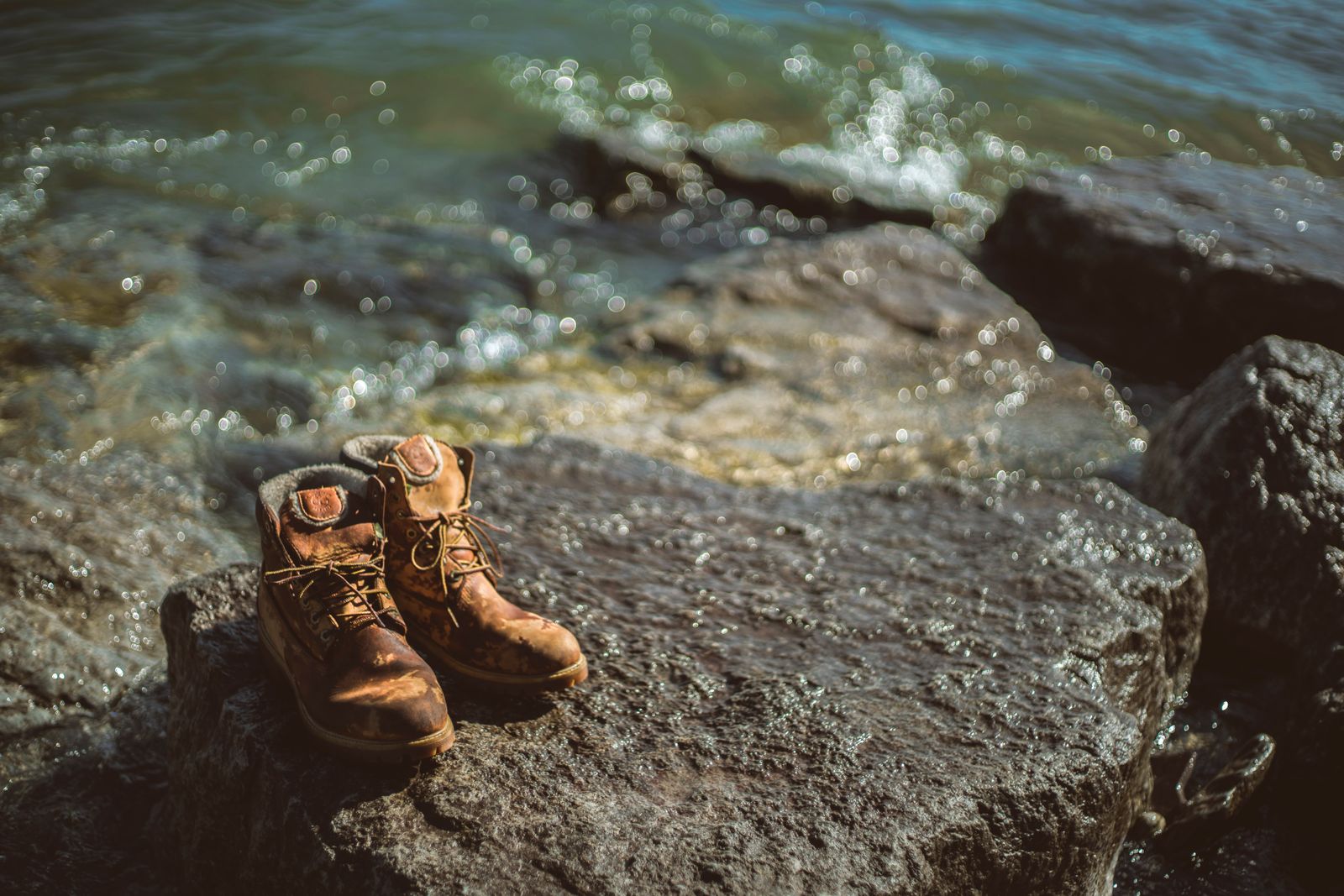
A boot works by controlling how the foot moves and by standing between the foot and the ground. The collar rises over the ankle and, laced firmly, limits how far the ankle can roll before the boot pushes back. Underneath, a firm midsole and often a shank spread the pressure of sharp edges across the whole foot instead of letting one rock dig into one spot — protection a soft shoe cannot offer. The components guide from REI breaks a boot down the same way — uppers, midsoles, shanks and outsoles each doing a distinct job — and sorts boots into hiking shoes, day hiking boots and backpacking boots by how much of that structure they carry.
That structure is why boots feel reassuring under a pack and clumsy without one. A stiff platform that protects a loaded foot on a descent can feel like walking in casts on a flat, easy path. Fit decides which experience you get, which is why our how to choose the right hiking boots guide treats type and fit as one decision, and why our best hiking boots for men and best hiking boots for women roundups are organised by load and terrain.

Merrell Moab 3 Mid Waterproof Hiking Boots
- Women’s Waterproof Hiking Boots: Waterproof and breathable membrane helps keep feet dry and comfortable on wet trails and rough terrain.
- Durable Leather & Mesh Upper: Pigskin leather combined with breathable mesh delivers long-lasting durability, ventilation, and abrasion resistance.
- All-Day Comfort & Arch Support: Removable contoured footbed, reinforced heel cushioning, and molded nylon arch shank provide stability and support for extended hikes.
New starting from: 149.8 $
Go to AmazonWhere Boots Earn Their Weight
Boots earn their keep in four situations: heavy loads, rough and uneven ground, cold and wet conditions, and long descents. A heavy pack multiplies the force through every step, and the firm platform and collar share that work with your ankles and knees; on broken ground the stiff sole bridges gaps and edges instead of wrapping around them; in cold, wet weather the taller upper keeps feet drier and warmer. None of it matters much on a short, dry, well-made trail — where the other design takes over.
How a Trail Runner Actually Works
A trail runner works by getting out of the foot’s way. The low collar lets the ankle move through its full range, the softer midsole foam cushions each landing and then rebounds, and the light mesh upper vents heat and sheds water instead of sealing it in. The buying guide from REI sorts trail runners by the ground they are built for — light trail shoes for uniform surfaces such as fire roads and gravel paths, rugged trail shoes for technical, rocky routes — and notes the features that make them trail tools rather than road shoes: grippy lugs, rubber toe caps and, on rugged models, rock plates that shield the sole from sharp edges.
The trade is deliberate: less structure, more feel. A flexible shoe lets your foot sense the ground and react quickly, and lets the small muscles of the foot and ankle do the stabilising work a boot would do for them — a genuine benefit for conditioned feet, and a genuine demand on feet that are not. The models in our best trail running shoes roundup show the range, from near-road-shoe lightness to rugged mountain shoes.

Saucony Women's Peregrine 12 Running Shoe, Black/Charcoal, 8
- Lighter. Faster. Infinitely more fun. Fun trail outing.Never skip a beat.
- Ditch debris with a redesigned lug pattern, while PWRTRAC rubber ensures maximum traction and grip.
- A new and improved rock plate sheds moisture and gives you more flexibility for each and every step.
New starting from: 89.9 $
Go to AmazonThe Thru-Hiker Lesson Hikers Borrow
Long-distance hikers popularised trail runners for walking, for practical reasons. Light shoes need almost no break-in, dry overnight instead of staying soaked, and leave legs fresher at high daily mileages. The same guide from REI adds the counterpoint: expect to replace them more often, and choose the toughest rugged-trail models, because comfort in a light shoe depends on pack weight, trail ruggedness and foot toughness. Borrow the reasoning, not just the shoe.
Ankle Support: What the Evidence Actually Says
This is the most argued trait, so it deserves the plainest answer: a boot collar helps, and it is not the whole story. Most ankle sprains happen the same way in any footwear — the foot rolls inward on an uneven landing and the ligaments on the outside of the ankle are stretched or torn, as the AAOS OrthoInfo overview of sprained ankles describes. A firm, laced collar resists that roll and gives the ankle something to lean against when you are tired, loaded or descending — the moments sprains actually happen.
What a collar cannot do is make an ankle strong, balanced or attentive. The prevention guidance collected by FootCareMD puts the emphasis on strengthening the muscles around the ankle, improving balance and proprioception, and using bracing or taping during higher-risk activity — footwear is one part of the list, not the list. That is why plenty of runner-shod hikers with strong ankles cross rough country unhurt, and why a booted hiker with a previously injured, unstable ankle can still roll it inside the boot.
If Your Ankles Have a History
A previous sprain changes the decision more than any trail feature does. The Mayo Clinic overview lists a previous injury, weak ankles and uneven surfaces among the main risk factors for another sprain, and its prevention guidance includes an ankle support brace for a weak or previously injured ankle. The NHS guidance makes the same point from the treatment side: protection, including shoes that support the foot or ankle, is the first step while a sprain settles. So a roll-prone ankle means the boot, or the runner plus a brace and balance work — and repeated giving-way is a reason to see a clinician, not just to shop.
Weight on Your Feet and the Energy Bill
Weight carried on the feet is the most expensive weight on the whole hike. Every step lifts the shoe thousands of times, so a heavy pair taxes your legs in a way the same weight in your pack never does. That is the trail runner’s strongest argument: over a long, fast, lightly loaded day, lighter feet mean fresher legs, a quicker cadence and less of the sloppy foot placement tired legs produce late in the day — and fatigue is itself a safety issue, because most stumbles happen when placement gets careless.
The boot’s reply is that energy is not the only bill being paid. A firm platform spends some of your energy to save your feet and ankles work they would otherwise do unsupported — flexing around every rock, stabilising every landing under load. On a short or heavily loaded hike, that trade favours the boot; on a long, light, smooth hike, it favours the runner. So ask which resource runs out first on your typical route: days that end with tired legs and happy feet call for lighter footwear, while days that end with beaten, bruised or rolled feet call for more structure.
Water: Keep It Out or Let It Drain
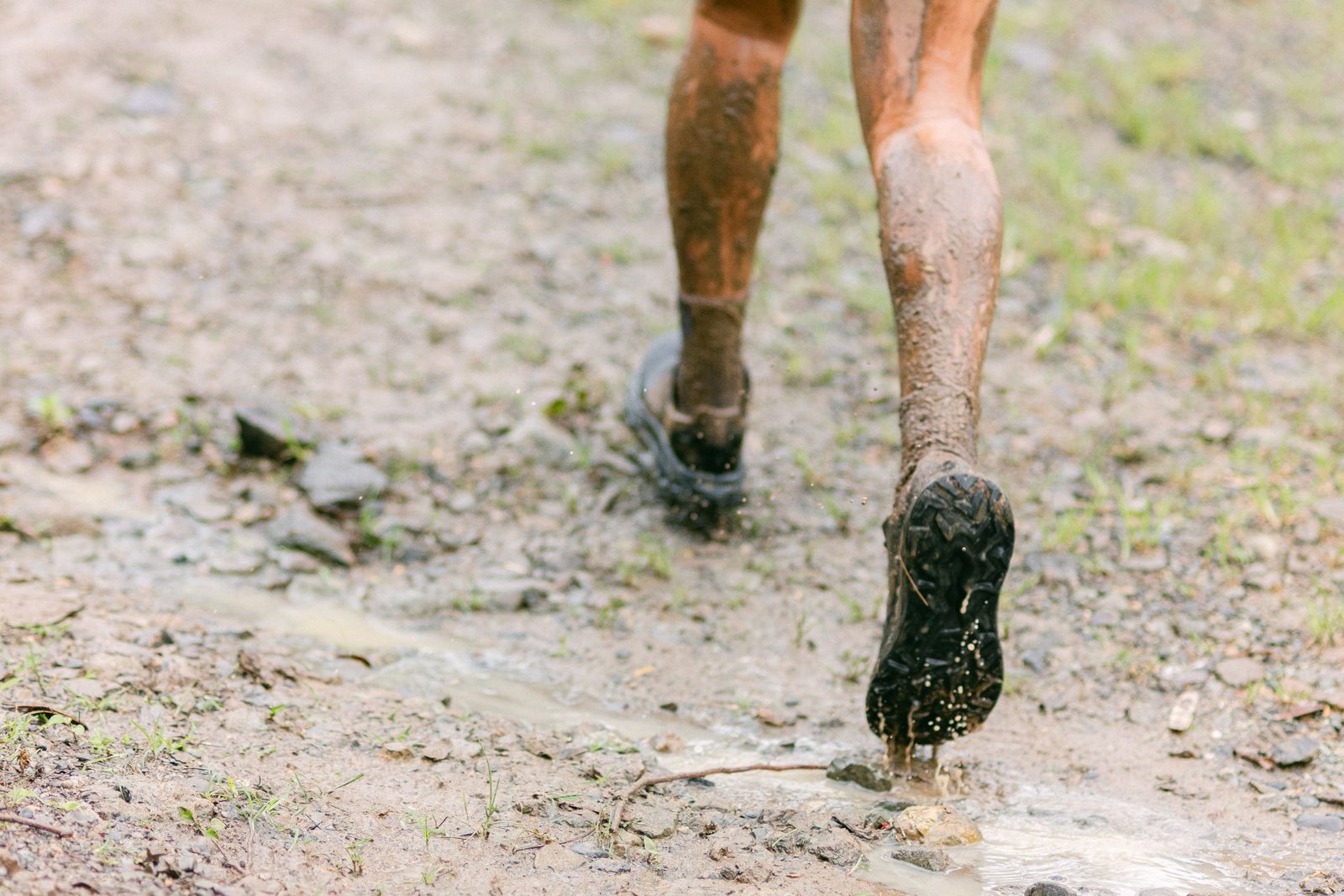
There are two water strategies, and they fail in opposite ways. A waterproof boot keeps rain, mud and shallow puddles out — until water comes over the collar in a deep crossing or a downpour works through, after which the same membrane that kept water out keeps it in, and the boot can stay wet for days. A non-waterproof trail runner makes no promise at all: water walks straight in through the mesh, and then straight back out, and the shoe drains and dries quickly as you walk and overnight at camp.
Match the Strategy to the Weather, Not the Hope
Cold changes the answer; warm rain mostly does not. In cold conditions, wet feet lose heat fast and a waterproof boot is the safer tool. In warm conditions, feet get wet in either design on a truly wet trail, and the shoe that dries is usually the more comfortable one. Waterproof trail runners exist too, and inherit the boot’s trade: fine for cold, splashy days, slower to dry once soaked.
Traction, Protection and Rough Ground
Grip is closer than the marketing suggests; protection is not. Both designs use lugged rubber outsoles, and a rugged trail runner on sticky rubber can out-grip a general-purpose boot on rock. The boot pulls ahead on everything around the grip: an upper that shrugs off kicked rocks, a sole stiff enough to edge and bridge sharp ground, and a collar that keeps grit out. The trail-safety guidance from the National Park Service treats footwear as core safety equipment for exactly this reason — shoes with good traction and support matched to the terrain you will actually cross.
Roughness, not distance, is the trigger. A long trail can be smooth, and a short one can be a boulder field. For genuinely technical, rocky routes, look at how the shoes in our trail running shoes for technical and rocky terrain roundup add rock plates and protection — and notice how, feature by feature, they start converging on a light boot. That convergence is the market admitting the two designs are ends of one spectrum.
Scree, Mud and Wet Rock
Each surface has a preference. Deep, widely spaced lugs clear mud and bite into soft ground; sticky rubber and a stiffer platform help on wet rock; loose scree rewards the boot’s collar and debris protection most of all. If your trails are mostly one surface, let that surface cast a vote.
Pack Load: Where Each Design Runs Out
Load is the closest thing this decision has to a hard line. A light day pack asks little of footwear, and either design serves. As the pack grows — more water, more food, overnight gear — each step lands harder, descents punish the forefoot, and the foot tires and spreads inside the shoe. A trail runner’s soft foam packs down under sustained load and its flexible platform lets the foot work harder for stability; a boot’s firm midsole, shank and collar are built precisely for that job. Sizing the load honestly matters as much as sizing the shoe, and our what size hiking backpack do I need guide and our best way to pack a backpack for hiking walkthrough both help keep the number on your back realistic.
Preparedness guidance frames load the same way. The National Park Service Ten Essentials list is built around carrying enough to handle a day going wrong, and that carried weight is part of the footwear equation whether we count it or not. A hiker carrying a full, responsible kit on rough trails is, by footwear logic, a boot hiker more often than a minimalist with a tiny pack on a smooth one.
The Honest Middle Loads
Between a light day pack and a full overnight load sits the grey zone where most hikers actually live. Here your feet decide: conditioned, problem-free feet handle mid loads in rugged runners well, while feet that ache, roll or bruise easily will be happier in boots or in the middle-ground shoes covered below. Sore soles and tired ankles after loaded days are data — let them vote.
Break-In, Blisters and Happy Feet
Boots ask for time up front; runners ask for almost none. A structured boot needs a gradual break-in — short walks building to full days — the staged process in our how to break in hiking boots guide. A trail runner usually feels right within a walk or two, though its soft fit can hide a bad match until mile eight, while a boot announces its problems early, when they are still cheap to fix.
Blisters follow friction and moisture, not brand loyalty. Either design can blister a foot that slides inside it, and either can stay blister-free when the fit is locked at the heel, the socks are right — our how to choose hiking socks guide covers that half of the system — and hot spots are treated early, as our blister prevention guide sets out. Feet with their own support needs change the fit maths again: the support logic in our best hiking boots for flat feet roundup applies to runners too, because a collapsing arch works hard in a flexible shoe. And when feet still hurt, our feet hurt after hiking explainer works through what each kind of soreness is telling you. The ankle guidance from MedlinePlus adds the injury-side reminder that a sprain is a ligament injury to be rested and assessed, not a discomfort to walk off in either shoe.
Durability and Cost Per Mile
Boots usually cost more up front and less per mile; runners reverse the maths. A boot’s leather or heavy synthetic upper and thick, firm sole wear slowly, and the shoe often stays supportive long after it stops looking new. A trail runner’s engineered mesh and soft foam are consumables: the cushioning tires and the upper frays, and the shoe is done while its tread still looks respectable. The boot-care guidance from Merrell treats choosing and caring for boots as a long-service decision — clean them, dry them properly and store them well, and a good pair repays it over many seasons.
Trail care is part of durability too. Staying on durable surfaces and on the trail itself, as the National Park Service Leave No Trace principles set out, spares both the ground and your soles the off-trail rock and brush that chew footwear fastest. Counted honestly — price divided by miles served — each design is the economical choice on its own ground, and the expensive one on the other’s.
When to Retire Each Design
Retire a runner when the foam feels dead or the upper can no longer hold the foot, even if the tread survives. Retire a boot when its midsole no longer resists a twist, its sole is worn smooth, or its collar has gone soft. Support you cannot feel working is support you no longer have.
The Middle Ground: Light Hiking Shoes
Between the two sits the design many hikers actually need: the light hiking shoe. It keeps the runner’s low, light, no-break-in feel and adds the boot’s firmer platform, protective toe and more durable upper. For day hikers carrying light-to-moderate packs on mixed trails, it is often the single-pair answer — and the natural first step for a boot hiker curious about lighter footwear, or a runner hiker who keeps bruising soles on rock.

KEEN Women's Targhee 2 Low Height Waterproof Hiking Shoes, Magnet/Coral, 7.5 US
- WATERPROOF: KEEN.DRY waterproof breathable membrane keeps your feet dry and comfortable all day long by allowing vapor out without letting water in
- TRACTION: KEEN ALL-TERRAIN rubber outsole provides high traction grip in muddy environments and on rocky surfaces; Non marking rubber outsoles leaves no trace or imprints when walking indoors
- SUPPORT: External Support Shank delivers balance on uneven surfaces; Contoured heel provides next level stability
New starting from: 170.00 $
Go to Amazon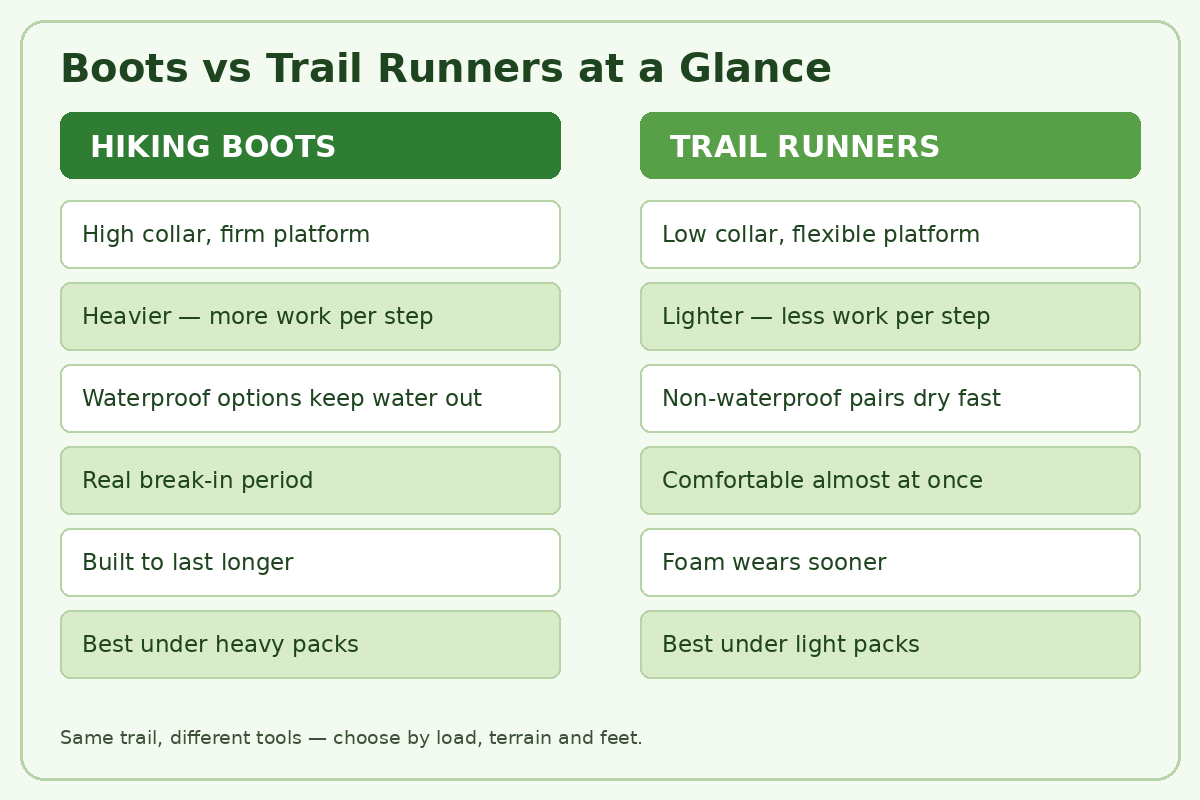
Who the Middle Ground Suits Best
Choose it when your hikes are varied but rarely extreme. If one pair must cover smooth paths, rocky viewpoints and the occasional loaded day, the light hiking shoe gives up the least at both ends — it matches neither a runner’s speed nor a boot’s support, and for most day-hiking lives it never has to.
Decide by Load, Terrain and Feet
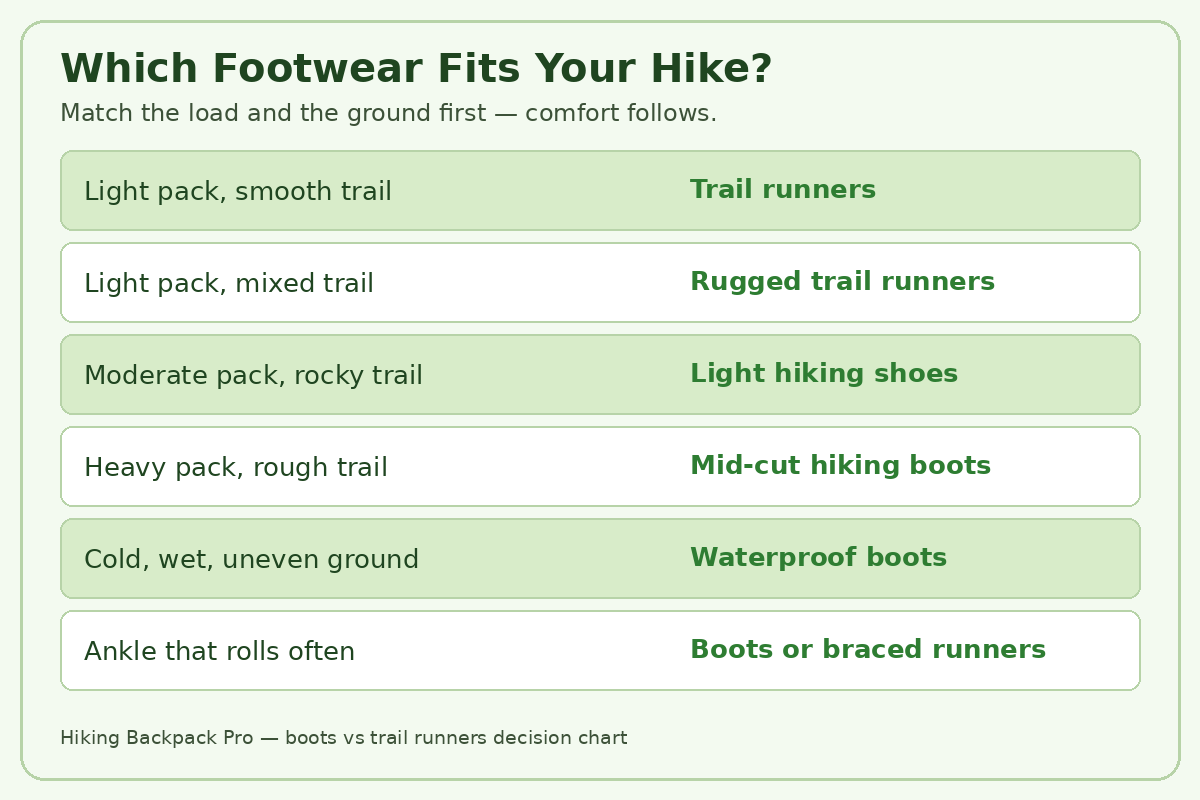
Run the decision in this order: load, terrain, feet, weather. Heavy loads end the debate in favour of boots. Rough, rocky ground adds structure; smooth, well-made trails subtract it. A history of ankle sprains or sore soles pushes toward boots or braced runners; strong, conditioned feet widen the runner’s territory. Weather casts the last vote, cold and wet favouring the waterproof boot. The trip-planning guidance from the US Forest Service makes the same sequence a habit: know the conditions before you go, and let that knowledge, not habit, pick the gear.
Three Worked Examples
A light pack on a dry, maintained trail, with healthy feet: trail runners, and it is not close. An overnight pack on rocky, uneven ground: boots — the load and the surface both demand structure, and the end-of-day descent is where the collar and platform earn their weight. A moderate pack on mixed trails, with one ankle that has rolled before: boots, or rugged runners plus a brace and balance work. The feet, in that third case, outvote the terrain — the framework working as intended.
Our view
Neither design wins, and that is the useful truth: boots protect a loaded foot on rough ground, runners free a light foot on kind ground, and the honest choice follows your pack, your trails and your ankles. Work the boot side properly with our how to choose the right hiking boots guide, see the runner side in our best trail running shoes roundup, and give whichever you pick a fair start with our how to break in hiking boots method — then let your own miles, not anyone’s tribe, settle it.
— Brian Ka
FAQ
Can you hike in trail runners with a backpack?
Yes, within limits. With a light pack on reasonable trails, rugged trail runners carry many hikers comfortably, including over long distances. As the load grows heavier and the ground rougher, the soft platform tires the foot and offers less stability — that is where boots, or at least light hiking shoes, take over.
Do hiking boots really prevent ankle sprains?
They reduce the risk; they do not remove it. A firm, laced collar resists a roll and steadies a tired ankle, but strength, balance and attention do most of the protecting, and a previously injured ankle may need a brace in any footwear. Treat boots as one layer of prevention, not a guarantee.
Are trail runners bad for your feet on rocky trails?
Not inherently — but they protect less. On sharp, rocky ground a soft sole lets edges press into the foot and a light upper shields less from kicked rocks. Rugged models with rock plates close much of that gap; smooth-trail models on rough ground are the mismatch.
Should beginners start with boots or trail runners?
Start with the trails you will actually walk. Easy trails and light packs suit runners or light hiking shoes, which need no break-in. Rougher trails, heavier packs or uncertain ankles point to boots — fitted properly and broken in gradually.
Can one pair do everything?
One pair can do most things, rarely everything. A light hiking shoe or rugged trail runner covers the widest middle. Hikers whose routes swing between smooth paths and loaded, rocky mountain days will eventually be better served by owning both ends of the spectrum.
Questions About Boots or Trail Runners?
Tell us the loads you carry, the trails you walk and how your ankles behave, and we will help you decide which side of this line your next pair belongs on.
Contact UsSources
- REI — How to Choose Hiking Boots and Hiking Shoes
- REI — Trail-Running Shoes Buying Guide
- AAOS OrthoInfo — Sprained Ankle
- FootCareMD — Sprained Ankle
- Mayo Clinic — Sprained Ankle: Symptoms and Causes
- NHS — Sprains and Strains
- MedlinePlus — Ankle Sprain
- National Park Service — Hiking Safety
- National Park Service — Ten Essentials
- US Forest Service — Know Before You Go
- Merrell — How to Choose Hiking Boots
- National Park Service — Leave No Trace Seven Principles