
As an Amazon Associate I earn from qualifying purchases.
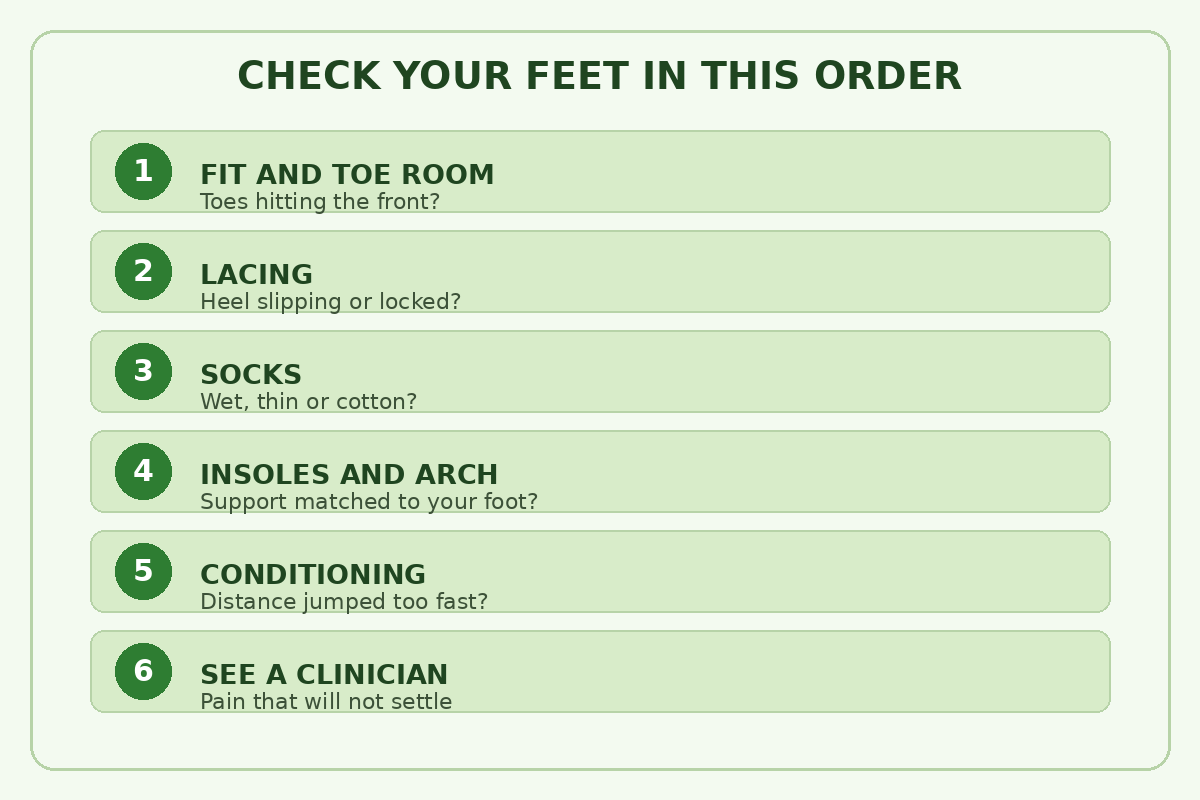
Sore feet after a hike feel like one problem, but they are usually several small problems stacked in a predictable order, and fixing them out of order is why the pain keeps coming back. This guide works the causes the way you should check them — fit and toe room first, then lacing, socks, insoles and conditioning — because each check either solves the pain or rules out a layer, and only what survives all five checks belongs in front of a clinician.
Start With Boots That Fit Your Feet
Most post-hike foot pain starts with fit, so work through the boot-choosing guide before you spend money on anything else.
Read the Boots Choosing GuideKey Takeaways
- Check fit first, because toes hitting the front of the boot cause more post-hike pain than any other single fault.
- Re-lace before you replace, because a heel that slips forward turns a good boot into a toe-banging boot.
- Fix socks before insoles, because wet, thin or cotton socks undo whatever support sits underneath them.
- Add distance gradually, because feet complain loudest about jumps in mileage, not about mileage itself.
- See a clinician for pain that persists, localises to one spot, or comes with numbness, swelling or colour change.
Table of Contents
- Read the Pain First: Where It Hurts Points to Why
- Check One: Fit and Toe Bang
- Check Two: Lacing That Lets the Foot Slide
- Check Three: Socks and Wet Feet
- Check Four: Insoles and Arch Support
- Check Five: Conditioning and Doing Too Much
- Heel, Arch and Forefoot Pain That Is Not Fit
- Check Six: When to See a Clinician
- A Simple Recovery Routine After a Sore Hike
- Our view
- FAQ
- Sources
- Recommended
Read the Pain First: Where It Hurts Points to Why
Before you change any gear, read the pain itself, because location is the fastest diagnostic you own. Sore toes after a descent, a burning ball of the foot, an aching arch and a stabbing heel are four different conversations, each pointing at a different first check. The NHS foot pain guidance organises the problem the same way, by where the pain sits, and the Hospital for Special Surgery plantar fasciitis overview shows how one location — the bottom of the heel — maps to one structure. Use the table to aim your first check, then still work the checks in order, because causes stack.
| Where it hurts | Most likely cause to check first | First fix to try |
|---|---|---|
| Toes sore, bruised or numb after descents | Toe bang — boot too short, or foot sliding forward | Check toe room standing, then heel-lock lacing |
| Hot spots or blisters on heels, toes or sides | Friction from movement, moisture or thin socks | Fit check, then padded moisture-wicking socks |
| Arch aches or feels unsupported by mid-hike | Stock insole flattened, or arch type unsupported | Replace the insole with a matched support |
| Ball of the foot burns on long or hard trails | Forefoot overload, thin forefoot cushioning | Cushioned insole; check forefoot room |
| Whole foot tired and sore after a big jump in distance | Conditioning — load rose faster than feet adapted | Rebuild distance gradually, rest between big days |
| Sharp heel pain worst on first morning steps | Plantar fascia irritation — a medical pattern, not fit | Support and stretching; clinician if it persists |
One Foot or Both Feet?
Symmetry is information. Both feet hurting the same way usually means a system problem — fit, lacing, socks, insoles or distance. One foot hurting, or one precise spot on one foot, deserves more suspicion, and a localised spot that keeps hurting is a pattern the clinician section treats seriously. Note which pattern you have before changing things.
Check One: Fit and Toe Bang
Fit is check one because no lace pattern, sock or insole can rescue a boot that is the wrong size or shape for your foot. The classic failure is toe bang: on descents your foot is pushed forward, your toes strike the front of the boot thousands of times, and you finish with sore, bruised or numb toes, sometimes a blackened nail days later. Stand in your boots with hiking socks on, push your foot forward until your toes lightly touch the front; you should fit a finger snugly behind your heel. Then step down firmly on a slope: your toes should not strike the front at all. The Harvard Health plantar fasciitis overview makes the footwear connection plainly — worn or poorly constructed shoes that lack arch support, heel cushioning or sole flexibility contribute to foot pain — and a boot that does not hold the foot properly transfers the damage to the foot itself.
Length is only one of three fit dimensions. Width matters just as much: a narrow boot squeezes the forefoot until the ball of the foot burns, while a wide boot lets the foot swim and friction does the damage instead. Volume matters too — a low-volume foot in a high-volume boot will slide however the laces are tied. If your forefoot is regularly crushed, the wider fits in our wide toe box boots roundup are the honest fix, and our boots choosing guide walks the whole measurement process in order.
New Boots Need Breaking In, Not Enduring
A stiff new boot is a fit question you answer gradually, not a pain sentence you serve on a long hike. Wear new boots around the house, then on short walks, then a short hike, and only then a full day, so any genuine pressure point announces itself while the walk home is still short. Our break-in guide sets out that progression. A pressure point present in the living room, in the same place at the same intensity, is not a break-in problem — it is a fit problem, and no mileage will fix it.
Check Two: Lacing That Lets the Foot Slide
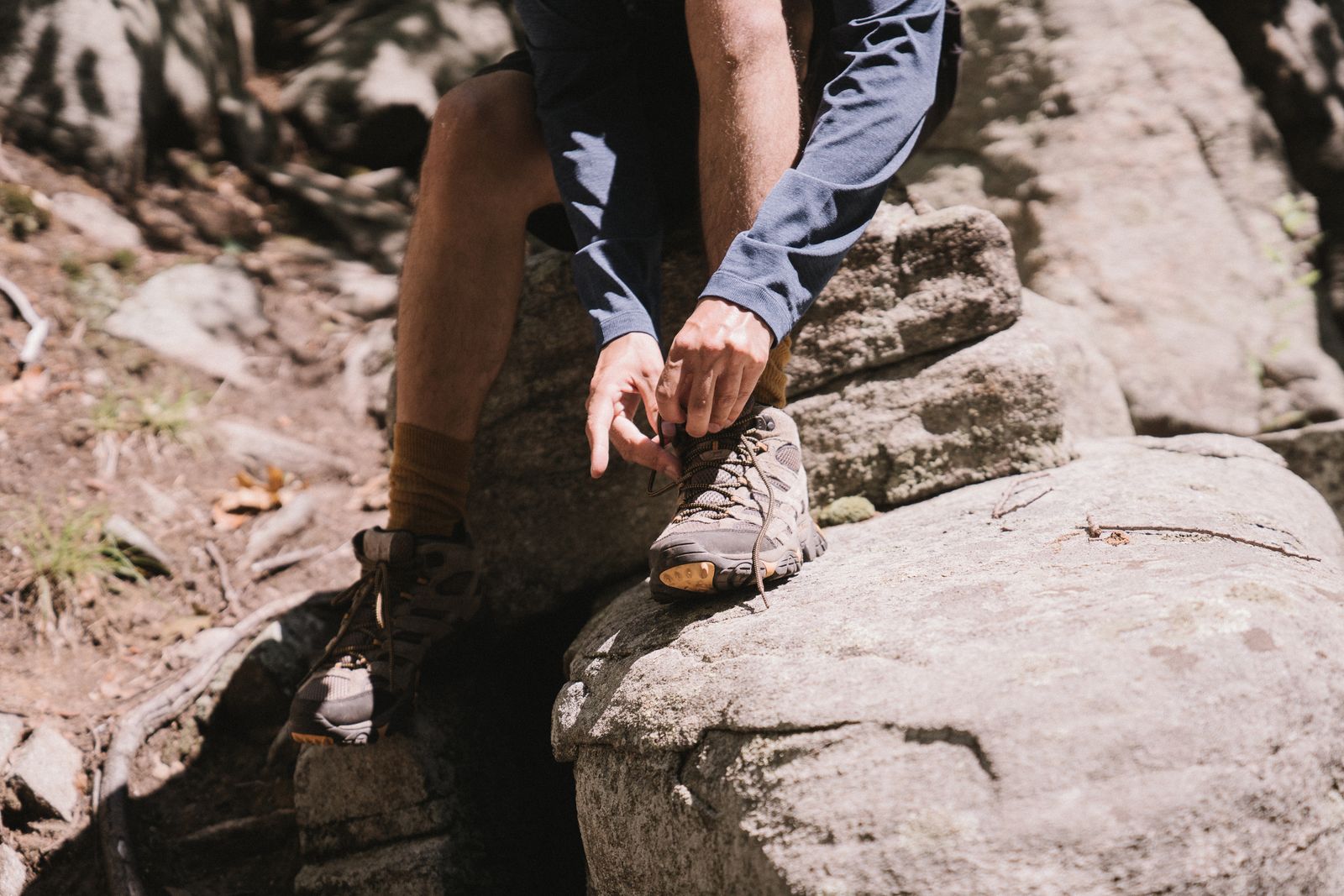
Lacing is check two because it decides whether a correctly sized boot actually holds your foot in place for six hours. Most hikers lace once, loosely and evenly, at the trailhead — and an evenly loose boot lets the heel lift on climbs and the whole foot ram forward on descents, manufacturing toe bang inside a boot that measured perfectly in the shop. Work the laces in zones instead: snug through the midfoot, firm at the ankle, and only as tight over the top of the foot as comfort allows, because a crushed instep creates its own pain. Re-check tension at the first stop; laces settle and feet swell.
The Heel Lock, the Window and the Knot
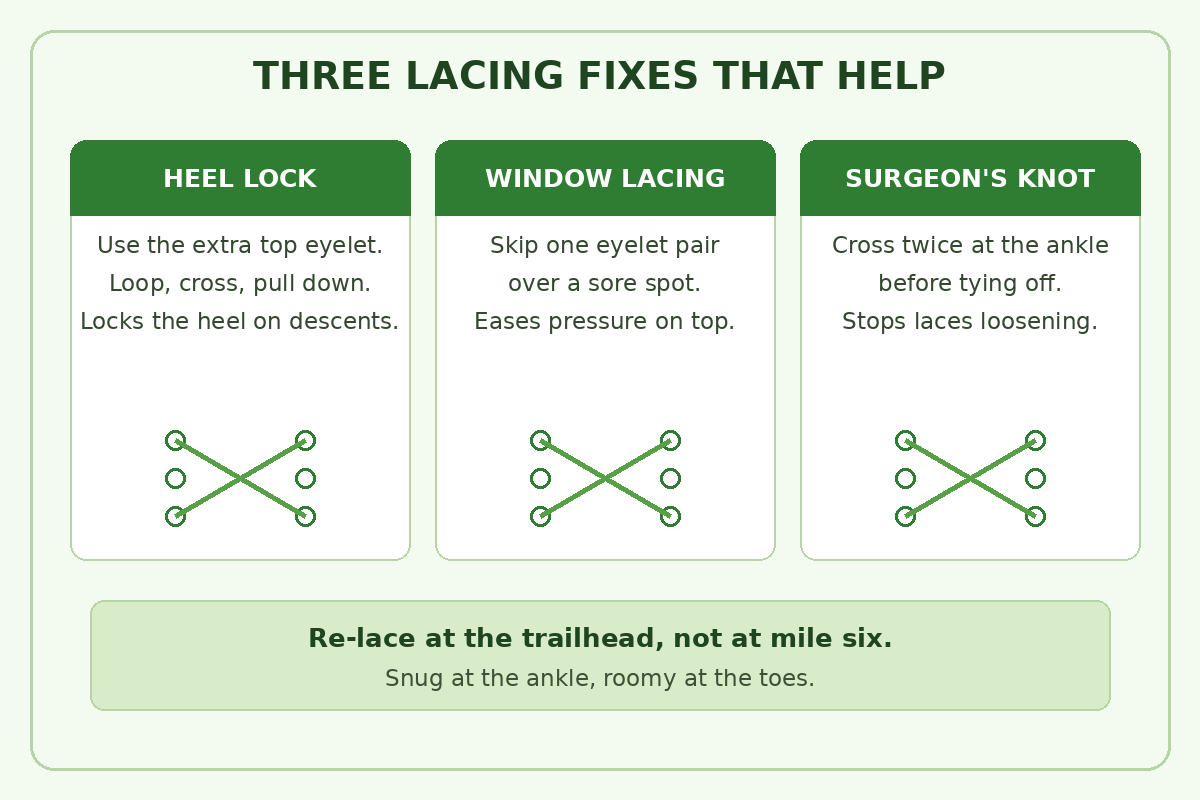
Three lacing changes solve most slide-related pain, and all three are free. The heel lock uses the extra top eyelet most boots provide: run the lace straight up into it to form a loop on each side, cross the laces through the loops, and pull down and out to seat the heel back before tying — the single most effective fix for heel lift and toe bang. Window lacing skips one pair of eyelets over a sore spot on top of the foot. A surgeon’s knot — crossing the laces twice at the ankle — adds friction that stops the ankle section loosening as you walk. The lacing diagram in this article shows all three.
Hold on to the order, though: lacing compensates for small fit gaps, it does not manufacture fit. If a heel lock and snug midfoot still leave your toes striking the front on a descent, the boot is too short or too low in volume, and the answer is a different boot. And if pain sits under the heel or arch, lacing was never the layer at fault — keep moving down the checks. Blisters get one word here: friction from a sliding foot is a main engine of them, and our blister prevention guide covers blister causes, taping and treatment in full, so this article does not repeat it.
Check Three: Socks and Wet Feet
Socks are check three because they are the layer your skin actually feels, and a good boot with the wrong sock still delivers friction, moisture and heat directly to your foot. The rule is short: no cotton on the trail. Cotton soaks up sweat, stays wet, and loses all cushioning when wet. What works instead is a merino wool or synthetic hiking sock, thickness matched to the boot and weather, cushioned at heel and toe, with a fit that does not bunch or sag. Carry a spare pair on anything longer than a half-day: swapping into dry socks at lunch is the cheapest mid-hike fix that exists.
Moisture amplifies every other fault. Wet skin blisters at far lower friction than dry skin, so a stream crossing or a hot day’s sweat can turn a boot that was fine at mile three into a blister factory by mile six. Treat crossings as sock events: dry the feet, change soaked socks, and dry the wet pair on the pack. Fit your boots wearing the socks you will actually hike in. Our hiking socks guide compares sock types, our choosing socks guide explains thickness and cushioning, and our waterproof socks guide covers wet days.
The Two-Sock Question
A thin liner sock under the main sock is an experiment, not a default. The liner moves friction between the two sock layers instead of between sock and skin, which helps easily blistered skin — at the cost of extra heat and volume inside the boot, so try it on short walks first. If taping and patching already handle your blisters — see our blister patches guide — the liner is a second experiment, not a first one.
Check Four: Insoles and Arch Support
Insoles are check four because the thin, flat factory insole in most boots is designed to cost little, not to support a foot for a full day under load. It flattens within weeks, leaving your arch unsupported and your heel taking every impact, felt as a diffuse ache across the sole by mid-afternoon. The fix is a replacement insole matched to your arch type: flat feet need support that holds the arch up, high arches need support that fills the gap underneath, and a neutral foot needs firm cushioning more than correction. Test your arch at home with a wet footprint — a full print suggests a low arch, a thin connecting band a high arch, a half-width band a neutral arch — and the NHS flat feet guidance describes the low-arch pattern and its tendency to roll the foot inward.
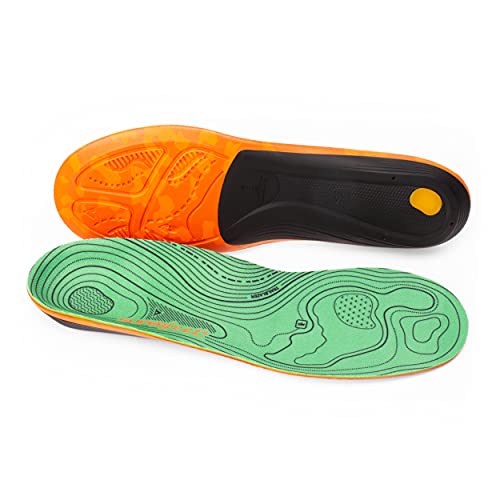
Superfeet Hike Support Insoles for Hikers with High Arch Support & Carbon Fiber Stabilizer – 9.5-11 Men, 10.5-12 Women
- Do these insoles need to be cut to size? Yes, these are trim-to-fit. Superfeet insoles are made to be trimmed to fit your shoes and boots; follow cutting instructions before use, and if you’re between sizes, size up and trim down to fit
- Are these suitable for rough terrain? Medium to high arch support made in an orthotic shape to stabilize the foot on rough terrain, reducing stress on feet, ankles, knees, and back
- What makes the support structure lightweight yet strong? Proprietary EVOLyte carbon fiber and polymer blend provides responsive, weight-defying support and stability for the trail
New starting from: 59.95 $
Go to AmazonInsoles are also the bridge between footwear and medicine. The Cleveland Clinic plantar fasciitis guidance lists over-the-counter or custom shoe inserts and arch supports among the standard non-surgical treatments for heel pain, because an insert that supports the arch and cushions the heel reduces strain on the tissue underneath it. That is not a claim that an insole cures anything; it is why a good insole is worth trying before more expensive answers. The boot insole comparisons and the hiking boot insole roundup compare the main options, and the flat feet insole guide is the starting point if your arch is low.
How to Test an Insole Without Wasting Money
Swap the stock insole out entirely rather than stacking the new one on top of it, because a stacked insole crowds the toe box and manufactures toe bang. Walk uphill and downhill for a few miles before judging. If the pain moves — arch to heel, or heel to forefoot — a podiatrist or specialist fitting is the next step, not another blind purchase.
Check Five: Conditioning and Doing Too Much
Conditioning is check five because the same gear that served you perfectly for five miles can punish you at twelve, and the variable that changed was the load, not the gear. Feet adapt to distance slowly, and only when the increase is gradual enough for adaptation to keep up. The common pattern is a mostly seated weekday and a weekend hike that jumps from an easy five miles to a steep ten — the boots did not fail, the training load doubled. Build distance and elevation gradually, and give your feet a lighter day after a hard one.
Tissue also fatigues inside a single hike, which is why the pain arrives late. Early in the day the foot’s muscles are fresh and the arch holds its shape; hours in, they tire, the arch drops further with every step, and the plantar fascia and forefoot take more load than at mile one. That is why feet can feel fine at the summit and miserable at the car park — and why a stress fracture can announce itself as a sore spot that worsens step by step. The AAOS stress fracture guidance describes how repetitive stress can build to a fracture without a single twist or fall.
Rest Is a Fix, Not a Failure
A day off is the cheapest treatment in this article. Soreness gone by morning is normal fatigue. Soreness still there two days later, or returning at the same mileage on the next hike, means the load exceeded what your feet were ready for — and repeating the same hike to test it is the same experiment with the same result. Shorten the next hike, flatten it, and rebuild. If pain keeps returning at the same low mileage despite the gradual rebuild, it is no longer a conditioning problem — it is one of the patterns in the next section.
Heel, Arch and Forefoot Pain That Is Not Fit
Some foot pain is not a gear problem at all, and recognising the patterns changes the fix entirely. The most common is plantar fasciitis, an irritation of the thick band of tissue along the bottom of the foot that supports the arch. The Mayo Clinic plantar fasciitis guidance describes its signature: a sharp, stabbing pain near the heel, worst with the first steps in the morning, easing as you move, and returning after long standing or sitting. That first-step pattern is the giveaway — fit pain hurts during the hike; plantar fascia pain greets you getting out of bed the morning after. The AAOS plantar fasciitis and bone spurs guidance covers the same condition, including the bone spur often blamed for pain it did not cause.
The Other Patterns Worth Knowing
The ball of the foot has its own pattern. Metatarsalgia is pain and inflammation in the ball of the foot, and the NHS metatarsalgia guidance describes pain that worsens with standing, walking or running and eases with rest, often with a feeling of having a stone in the shoe. A burning or tingling pain between the toes, with a pebble-in-the-shoe feeling and numbness in the neighbouring toes, points a different way. The AAOS Morton’s neuroma guidance describes a thickening of tissue around a nerve between the toes, aggravated by tight shoes — which is why a roomy toe box helps, but also why this pattern belongs in front of a clinician. None of these patterns is a self-diagnosis; they are descriptions to carry into the clinician’s office.

Alvada Merino Wool Hiking Socks Thermal Warm Crew Winter Boot Sock For Men Women 3 Pairs ML
- MAKE HIKING A COMFORTABLE EXPERIENCE These Merino wool hiking socks are built to provide you with total support and comfort during your hiking trips, no matter the weather. Each pair of these hiking boot socks is ideal for the rugged terrain, allowing these to be great mens or women’s hiking socks
- ITCH FREE MATERIAL These wool hiking socks come blended with nylon to promote a comfortable, itch free experience. Ultra comfortable, these women and mens hiking socks won’t cause you to pause in your step to scratch at your foot or readjust the calf height sock
- KEEP YOUR FEET WARM DURING COLD WINTER HIKES With these hiking socks, women and men alike can enjoy the comfortable warmth that these cozy socks provide. Especially good for the colder months, each winter sock in the pair of men and womens wool socks will keep out the cold and moisture that wintertime often affords
List Price :
Offer: 14.99 $
Go to AmazonOne practical note connects this section back to gear. Where the pattern involves a squeezed forefoot, a cushioned, properly sized sock matters as much as the boot. Compare the choices in our hiking socks guide, and see the women’s hiking socks guide for narrower fits.
Check Six: When to See a Clinician
The final check is the threshold: if your pain matches any of these patterns, the gear checks are finished and a clinician is the next step. See a doctor, podiatrist or physiotherapist if the pain is severe or stopping normal activities, if it is getting worse, if it keeps coming back hike after hike, or if it has not improved after about two weeks of sensible self-care. The NHS plantar fasciitis guidance sets its threshold in almost those terms, adding two flags: any tingling or loss of feeling in the foot, and any foot pain at all if you have diabetes, because foot problems can become more serious in that case. The Cleveland Clinic heel pain guidance likewise treats persistent pain as a reason to be examined rather than endured, because several conditions share the same first symptom.
Get Seen Sooner, Not Later
Some signs skip the two-week queue entirely. Seek care the same day if you cannot bear weight, if the foot is swollen, red, hot or visibly deformed, if pain followed a twist or fall and has not settled, if numbness does not pass, or if you have diabetes and develop a wound or sore that is not healing. Pain that wakes you at night, pain at rest, and a single point on a bone that hurts sharply when pressed should also be examined promptly. These are the presentations under which a stress fracture, infection or nerve problem is most likely to be hiding, and all three get worse with waiting.
A Simple Recovery Routine After a Sore Hike
What you do in the hours after a sore hike decides how much soreness is still with you in the morning. Get out of the boots, wash and dry the feet, and look at them — hot spots are far easier to deal with the evening you find them. Rest the feet up, use a cold pack through a thin barrier if that eases a sore area, roll the sole slowly over a ball or bottle, and stretch the calves against a wall. The AAOS heel pain guidance treats rest, ice and stretching as the standard first-line response after a big day.
The Morning-After Test
Judge the hike by the morning after, not by the evening of it. Back to normal within a day or two means the distance was within your capacity; limping into the second morning means it was not — shorten the next hike and rebuild. Keep a note of distance, boots, socks and insoles alongside next-day soreness, because four hikes of notes show a pattern memory will not.
Our view
I treat post-hike foot pain as a checklist, not a mystery, because in my experience the cause is almost always one of the first three checks and almost never the exotic one. Start with the fit method in our boots choosing guide, hold the foot still with the lacing in this article, and only then spend money on the support compared in our hiking boot insole roundup — and if the pain survives all of that, believe it, and take it to a clinician with the notes you kept, because feet that keep hurting are telling you something the gear cannot fix.
— Brian Ka
FAQ
Why do my feet hurt after hiking but not after walking?
Because hiking loads your feet in ways flat walking does not. Descents drive your toes into the front of the boot, climbs lift your heel thousands of times, uneven ground works the foot’s small muscles continuously, and a pack adds load to every step.
Should hiking boots hurt until they are broken in?
No — new boots should feel stiff, not painful. Stiffness eases as the materials flex where your foot bends. A sharp pressure point, numb toes or heel blisters in the same place on every walk are fit faults, not break-in stages, and they will be worse at the end of a long hike.
Can insoles really fix sore feet after hiking?
Insoles fix the share of pain that comes from unsupported arches and flattened factory footbeds, which is a large share — but only that share. They will not fix a boot that is too short, a foot sliding forward for want of lacing, or a medical pattern on its own. Work the checks in order, fit the insole to your arch type, and judge it over a few miles of the terrain that hurt you.
Why do the balls of my feet burn on long hikes?
Forefoot burning usually means the ball of the foot is taking more load than it can spread — thin forefoot cushioning, a tight toe box, or simple fatigue late in a long day. A cushioned insole and room around the toes are the gear fixes. If the burning comes with tingling, numbness or a pebble-in-the-shoe feeling, treat it as a possible nerve pattern and have it examined.
When is foot pain after hiking serious?
Foot pain is serious when it is severe, worsening, localised to one spot on a bone, present at rest or at night, or accompanied by swelling, redness, heat, numbness or loss of feeling — and any foot pain deserves prompt attention if you have diabetes. Pain not improved after about two weeks of rest, support and reduced load also belongs in front of a clinician.
Questions About Foot Pain After Hiking?
Tell us where the pain sits, when it starts on the hike, and what boots, socks and insoles you are wearing, and we will help you work the checks in order.
Contact UsSources
- Mayo Clinic — Plantar Fasciitis: Symptoms and Causes
- NHS — Plantar Fasciitis
- Cleveland Clinic — Plantar Fasciitis
- Cleveland Clinic — Heel Pain
- AAOS OrthoInfo — Plantar Fasciitis and Bone Spurs
- AAOS OrthoInfo — Heel Pain
- AAOS OrthoInfo — Stress Fractures of the Foot and Ankle
- AAOS OrthoInfo — Morton’s Neuroma
- NHS — Foot Pain
- NHS — Metatarsalgia
- NHS — Flat Feet
- Harvard Health — Plantar Fasciitis
- Hospital for Special Surgery — Plantar Fasciitis