
As an Amazon Associate I earn from qualifying purchases.
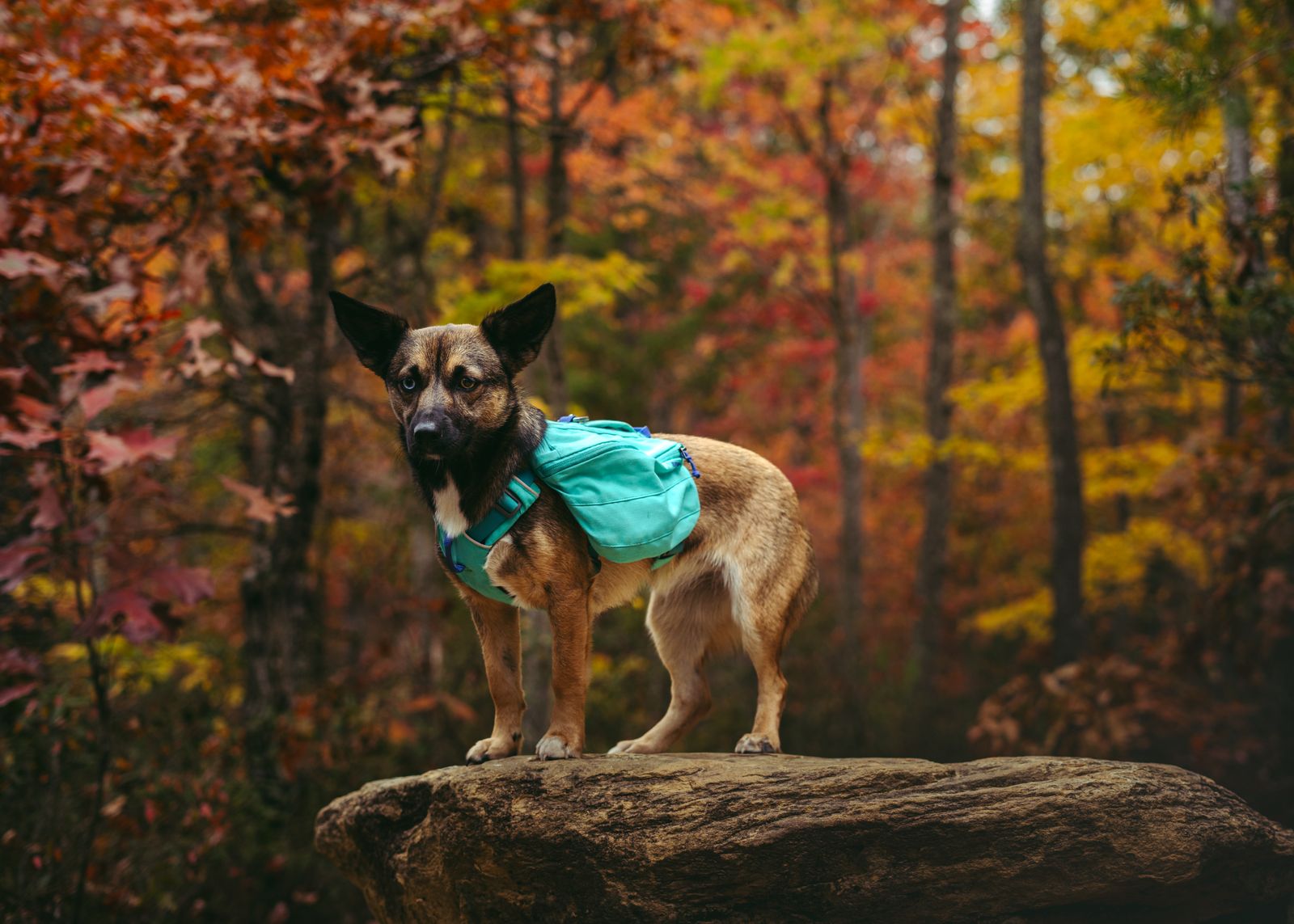
A dog backpack that fits badly is worse than no backpack at all: it slides, rubs, and turns a willing trail partner into a dog that stops and refuses to move. A pack that fits well disappears on the dog — level, quiet, and no change to how it walks. This guide works through the whole procedure in order: whether your dog is ready to carry, the three measurements that decide the size, the fitting steps, how much weight is safe, and how to build up to a working load.
Find the Pack Worth Fitting First
A good fit starts with a good pack, so see the packs that hold up on real trails before you measure your dog.
See the Best Dog BackpacksKey Takeaways
- Measure chest girth first, because that single number picks the size.
- Fit the empty pack before any weight goes in it.
- Keep the loaded pack at or under one tenth of your dog’s body weight.
- Balance both panniers to the same weight, every single time.
- Build the load in stages, and let the vet clear your dog first.
Table of Contents
- Before You Buy: Is Your Dog Ready for a Pack?
- The Three Measurements That Decide the Size
- The Fitting Procedure, Step by Step
- How Much Weight Your Dog Can Carry
- How to Load a Dog Backpack So It Rides Level
- What a Good Fit Looks Like on Trail
- Common Fit Problems and How to Fix Them
- Conditioning: Building Up to a Working Load
- When a Pack Does Not Fit — and When a Dog Should Not Carry One
- Care and Maintenance After the Hike
- Our view
- FAQ
- Sources
- Recommended
Before You Buy: Is Your Dog Ready for a Pack?
Not every dog should carry a pack, and the decision comes before the measuring tape does. A healthy, fully grown adult in good condition is the candidate; a growing puppy, a stiff senior, and a dog with a heart or breathing condition are not, or not without a vet’s say-so. The preparation-first approach in the American Hiking Society hiking-with-dogs guidance sets the same priority: plan the dog’s needs before the trailhead.
Age and build decide the question before brand or size does. Puppies should not carry added weight while their growth plates are still closing, and AKC guidance says growing puppies and seniors with health issues such as arthritis should wear an empty pack or none at all. Long-backed breeds, overweight dogs, and dogs that have never hiked need the same caution — a pack rewards a dog that already walks well; it does not make an unfit dog fitter. The exercise guidance from VCA Hospitals frames activity around age, breed and health, built progressively.
| Dog | Ready to carry? | What to do first | Pack limit |
|---|---|---|---|
| Healthy adult, fit, experienced hiker | Yes | Measure, fit empty, condition | Up to 10% of body weight, pack included |
| Healthy adult, new to hiking | Not yet | Build trail fitness first, then fit the pack | Empty pack only until conditioned |
| Puppy still growing | No weight | Empty-pack introductions only; ask the vet when growth is done | Empty pack or none |
| Senior or arthritic dog | Usually no | Vet clearance first; a carrier may suit better | Empty pack or none |
| Overweight or unconditioned dog | Not yet | Build fitness on unloaded walks first | Empty pack only until fit |
The Vet Conversation Is Part of the Fitting
Ask the vet before the first loaded walk, not after the first sore one. Three questions: is this dog structurally ready to carry weight, does any joint, heart or breathing issue change the answer, and what limit fits this dog? A dog with a history of lameness, a long back, or a flat face needs a real answer — “probably fine” from a gear review is not one. Our long-distance training guide builds fitness before load, vet check first.
The Three Measurements That Decide the Size
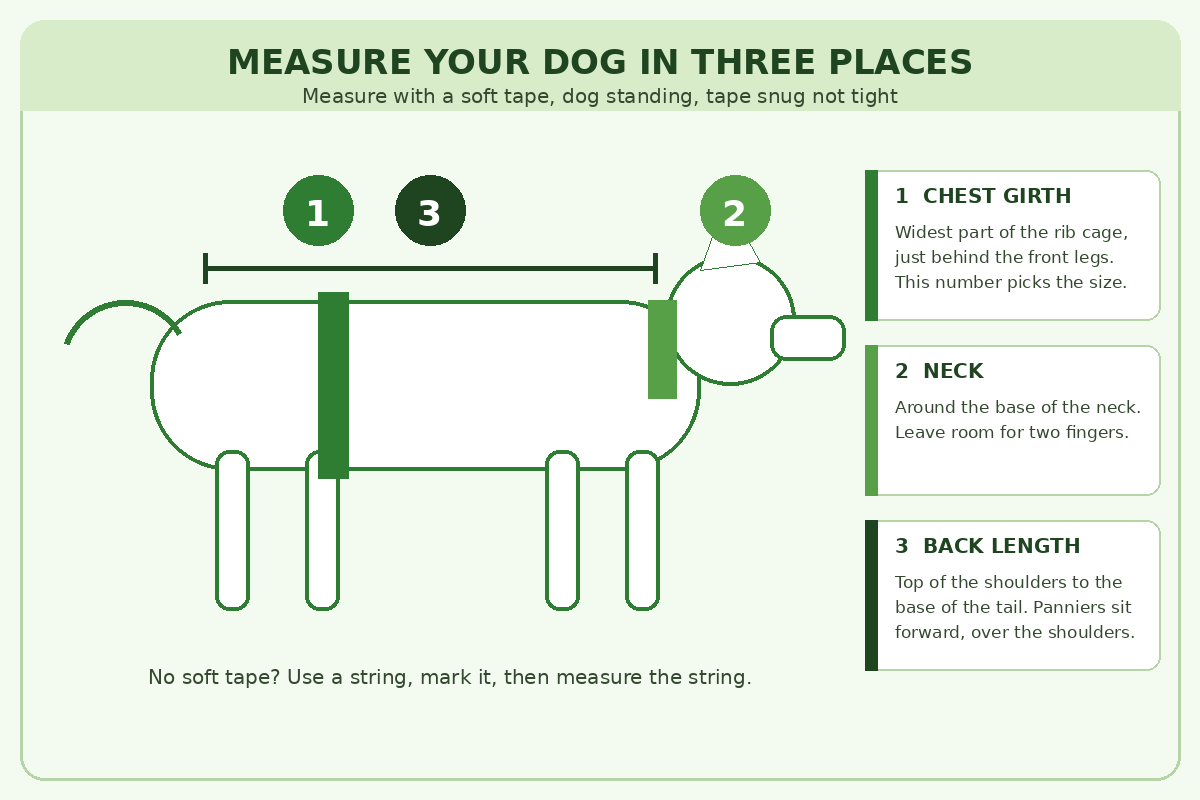
Dog packs are sized by chest girth, not by breed and not by weight alone. Two dogs of identical weight can have very different chest depths, and it is the chest the pack has to wrap. The measuring method in the Ruffwear sizing guide is the standard one: a tailor’s tape — or string marked and measured afterwards — around the widest part of the rib cage, just behind the front legs, snug but not tight, dog standing square.
1. Chest Girth: The Number That Picks the Size
Measure around the widest part of the rib cage, just behind the front legs. Slide the tape behind one front leg, across the chest, and up behind the other, meeting where you started. On a fluffy-coated dog, measure over the coat — the straps ride on its surface. Between sizes, a growing dog takes the larger size; a finished adult just over a boundary is often better in the smaller one. Use the chart for the pack you are actually buying.
2. Neck and 3. Back Length: The Numbers That Confirm It
The neck measurement is a comfort check, and the back length is a placement check. Measure the neck around its base, leaving room for two fingers — a neck strap that fails that test rubs on every stride. Then measure the back from the shoulders to the base of the tail. Packs sit forward, panniers over the shoulders rather than the hips, because shoulders carry weight better than the spine behind them. A pack whose body runs well past the mid-back is the wrong shape, whatever the chart says. Our dog hiking harnesses roundup uses the same three measurements, so one session serves both.

Singer Fabric Measuring Tape
- 5-foot soft vinyl tape measure perfect tailor’s tool for measuring flat or rounded surfaces
- Black print on pink tape
- Shows inches and centimeters
New starting from: 7.4 $
Go to AmazonThe Fitting Procedure, Step by Step
Fit the pack empty, at home, on a calm dog — never for the first time at a trailhead. Work in order, letting the dog walk around between adjustments, so you fit the pack to a moving dog, not a statue. The pre-hike preparation in the AKC guide to training a dog to hike makes the same point: introduce new gear at home before the real outing depends on it.
Step 1: Position the Pack Forward
Set the empty pack on the dog’s back with the panniers over the shoulders. The front edge should sit just behind the shoulder blades, not halfway down the back. The harness-style base should lie flat with no folds or twists. If the pack sits crooked before any strap is tightened, it is the wrong size or shape.
Step 2: Set the Chest Strap
Fasten the chest strap first, snug enough to hold the pack without pressing on the windpipe. It runs across the chest, in front of the front legs, and stops the pack sliding backwards on climbs. Two fingers should slide flat between strap and chest. Too loose, and the pack creeps rearward; too tight, and it restricts the stride and rubs the armpits.
Step 3: Set the Belly Straps
Fasten the belly straps next, front to back. Most packs have one or two, behind the rib cage. Snug them the same way — two fingers of room — because a loose belly strap lets a pannier swing, and a swinging pannier pulls a pack sideways on descents. Check that no strap pinches skin or traps coat.
Step 4: The Two-Finger and Shake Checks
Run the full check before any weight goes in. Two fingers under every strap, pack centred on the spine, panniers at equal height. Then let the dog walk, trot, turn, sit and shake. A well-fitted empty pack survives all of that without rotating, bouncing or sliding. Watch the dog’s face and gait too: freezing, scratching at straps, or a shortened stride all report a problem. The packs in our dog backpacks guide differ in adjustment points; more points make this step easier on deep-chested or narrow dogs.
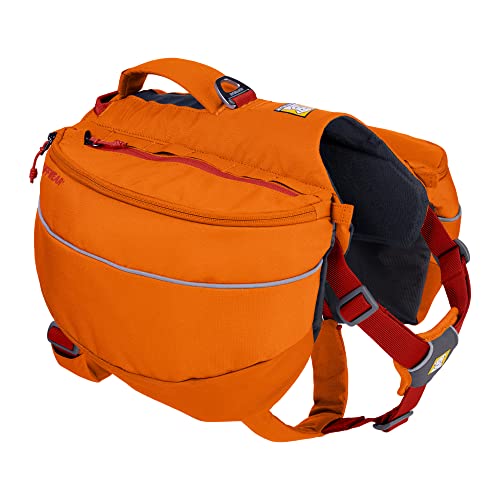
Ruffwear, Approach Pack Dog Backpack, Weight‑Forward Saddlebags with Flopper Stoppers, 5‑Point Adjustable Fit, Padded Handle, Dual Leash Points, Reflective Trim, Campfire Orange, Medium
- TRAIL-READY & BALANCED. The Approach Pack’s radial-cut hiking saddlebags and weight-forward design keep gear stable and bounce-free, even on rugged, uneven trails or twisty turns through underbrush.
- FIND THE RIGHT FIT WITH EASE. Not sure which size to choose? Check out our sizing chart image and how-to-fit video to help you measure your dog correctly. A proper fit means more comfort, control, and confidence on every adventure.
- CARRY WITH PURPOSE. Dogs thrive with a job. Dual saddlebags let them haul their own trail kit while aluminum V-ring and reinforced webbing loop offer secure leash connection and control.
New starting from: 59.99 $
Go to AmazonStep 5: Short Test Walk, Then Check the Skin
Take a short walk on familiar ground, then take the pack off and look. Run your hands over the chest, armpits, belly and back where the straps sat. Redness, rubbed patches or hair pressed flat in a strap-shaped line mean the fit needs work. This is the most valuable habit in this guide: straps that rub on a twenty-minute walk will wound on a four-hour one. Add weight only when a short walk leaves skin and coat undisturbed.
How Much Weight Your Dog Can Carry
The most widely used limit is one tenth of the dog’s body weight — pack and contents together. The AKC guidance on teaching a dog to wear a backpack puts it plainly: pack plus contents should be no more than 10% of body weight for a healthy, well-conditioned dog, so a 20-pound dog carries up to 2 pounds in total and a 60-pound dog up to 6. Published limits vary by source, so treat 10% as a ceiling, not a target, and let your vet set a lower one where joints, age or build argue for it.
Work the number out from ideal weight, not from today’s weight. An overweight dog earns a lighter pack — its extra body weight is already load on the same joints. Weigh the loaded pack on a kitchen scale before the first loaded hike. The dog’s water most often rides in the human’s pack, because the dog needs it whether or not its own pack is still on. Our dog water bottles roundup covers the bottles, and our dog hiking distance explainer settles the miles first.
Weight Is Only Half of the Heat Equation
A loaded dog works harder, and harder work means more heat. The dehydration overview from the AKC lists dry, sticky gums, thick saliva, loss of skin elasticity, sunken-looking eyes and reduced energy among the warning signs in a working dog. Under load on a warm day those signs arrive sooner — a pack fine on a cool morning loop is too much on a hot afternoon climb. When in doubt, move weight from the dog’s pack to yours.
How to Load a Dog Backpack So It Rides Level
Balance is the whole skill: equal weight in each pannier, packed tight, with nothing loose to swing. Weigh the two sides against each other in your hands before the pack goes on; if one side is heavier, move items until they match. An unbalanced pack rotates toward the heavy side and the light side’s straps saw at the coat. Pack soft items low and close to the body, pad anything hard, and fill empty space so nothing shifts at a trot.
Load the dog’s own trail kit, and keep it genuinely the dog’s. Waste bags, a collapsible bowl, a portion of its food and a spare lead are the natural contents; your tent poles and stove are not. Packing out waste is part of the deal — the National Park Service Leave No Trace principles cover waste disposal and consideration for other visitors, and a dog carrying its own waste bags makes following them effortless. Keep urgent items reachable, and keep food sealed: a dog that can smell dinner through the pannier will work on it all afternoon.

Dog Hiking Harness
- DUAL LEASH ATTACHMENT POINTS. Features an aluminum V-ring on the back and reinforced webbing at the chest. Gives you options for everyday walks or redirecting dogs that tend to pull, so you can enjoy more controlled and pleasant outings.
- FIND THE RIGHT FIT WITH EASE. Not sure which size to choose? Check out our sizing chart image and how-to-fit video to help you measure your dog correctly. A proper fit means more comfort, control, and confidence on every adventure.
- FOAM-PADDED CONSTRUCTION. Built with closed-cell foam padding in the chest and belly panels. This provides cushioned support that helps prevent chafing during extended wear, making it ideal for long walks, hikes, or all-day adventures.
New starting from: 59.99 $
Go to AmazonThe Harness Underneath Matters
Many packs are built on a harness base, and that base does the real fitting work. Where a pack sits over a separate harness, the harness fit decides the pack fit: a harness that rotates takes the pack with it. Fit the harness first, then add the pack and repeat the shake check.
What a Good Fit Looks Like on Trail
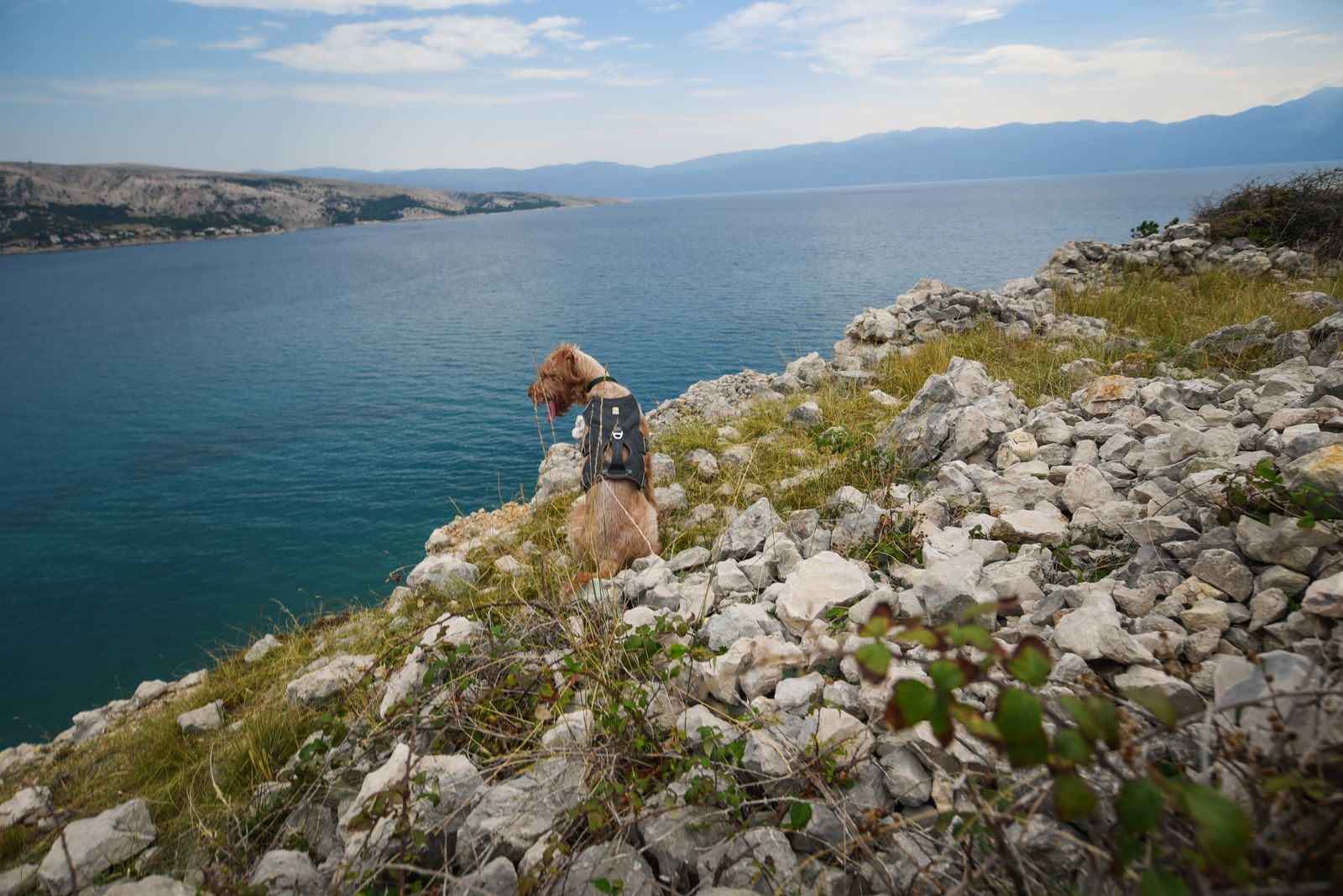
A well-fitted pack is boring to watch — and that is the point. It sits level, centred on the spine, panniers at the same height, and it does not bounce at a trot or creep forward on descents. The gait looks normal: full stride, no crabbing, no reluctance on climbs. Check at every stop, because a level pack can shift as the miles add up.
Water stops are fit checks too. The summer safety guidance from Cornell advises frequent water breaks as a core strategy for keeping dogs safe in warm weather, alongside cooler hours and shade. Use each break for the whole routine: water offered, pack re-centred, straps checked, skin felt underneath. The hot-weather guidance from the ASPCA advises ample fresh water, shade and limited exercise on hot days — a loaded dog earns those breaks more often, not less. On warm routes, our dog boots guide covers pads on hot ground, and our cooling vests guide covers the rest.
The Signs That Say Stop and Adjust
Learn the short list, and act on the first sign rather than the third. The heat stroke guidance from VCA Hospitals describes a condition that escalates quickly, with heavy panting, thick drool, weakness and disorientation among its signs — a dog showing any of them needs the pack off, shade, water and rest, in that order. Pack warnings are quieter: a dog that keeps sitting or lagging is reporting a fit problem. Stop and check the skin.
Common Fit Problems and How to Fix Them
Almost every fit problem is one of four: sliding back, rotating, swinging, or rubbing — each with a specific cause. Sliding backwards means the chest strap is loose or the pack sits too far back; reposition and snug. Rotating means the load is unbalanced or one belly strap is looser; repack to equal weights and re-set both. Swinging panniers mean the pack is too big or packed too loosely; fill the space, cinch any compression straps, and if it persists, the size is wrong.
Rubbing is the problem that ends trips, so treat it as a stop signal, not an adjustment. Armpit rubbing usually means the chest strap sits too close behind the front legs or the pack body is too long; belly rubbing usually means a strap crosses bare skin instead of coat, or grit has worked underneath. A too-small pack will not be fixed by padding, nor an oversized one by tightening. Change the size, not the dog. Small dogs hit the size boundary most often, which is why our small dog backpacks roundup separates them.
When Adjustment Is Not the Answer
Some dogs and some packs simply do not match. A very deep-chested, very narrow, or unusually long- or short-backed dog may fall outside what a standard pack shape can fit. The honest options are a different design with more adjustment points, a harness-based system, or no pack at all — the gear serves the dog. Our dog carrier backpacks guide covers the alternative for a dog that cannot walk the distance.
Conditioning: Building Up to a Working Load
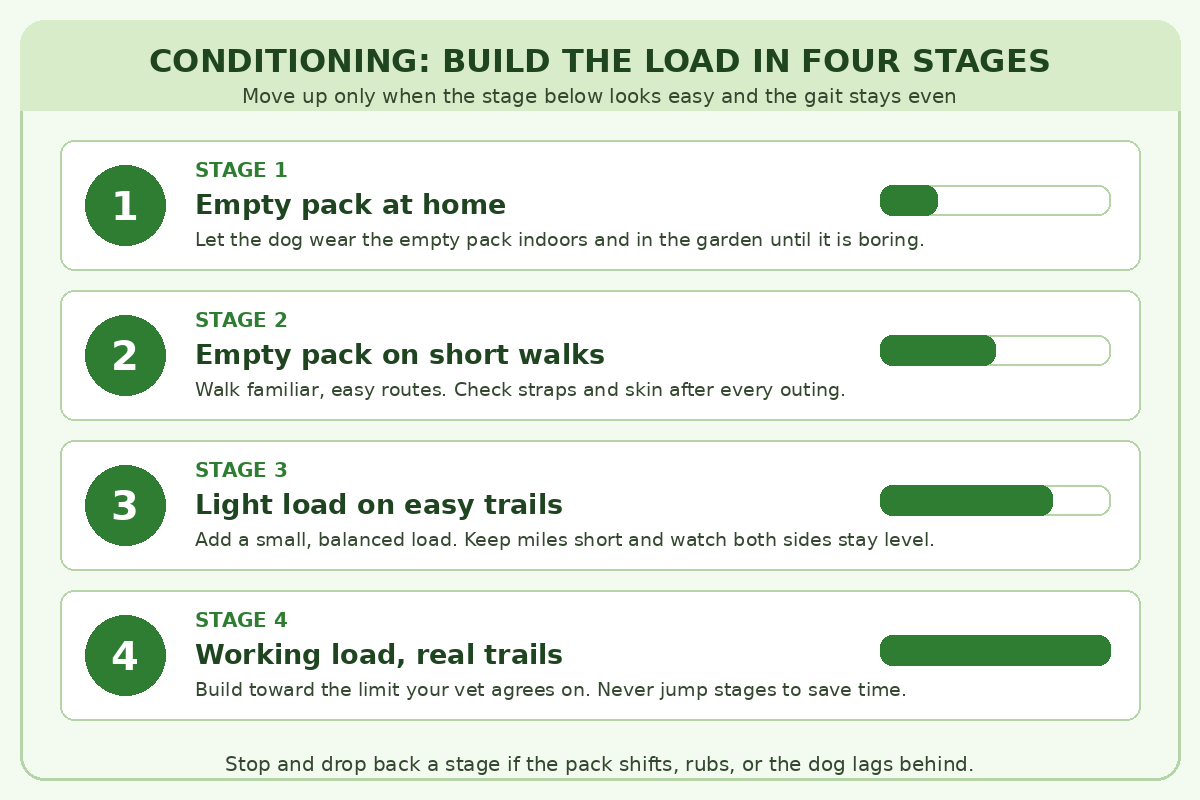
No dog should meet a loaded pack and a long trail on the same day. Conditioning is the slow part of this guide, and the part that decides whether a dog loves its pack or tolerates it. Build progressively: empty pack at home until the dog ignores it, then empty-pack walks on familiar ground, then a small balanced load on short, easy trails, and only then a working load. A stage is finished when gait, skin and enthusiasm all say the step is easy.
How to Know a Stage Is Working
Judge by three things: gait, skin and attitude. The gait stays even and willing; the skin and coat under the straps stay undisturbed; and the dog still greets the pack the way it greets the lead. A dog that avoids the pack, lags, or shows rubbed patches is saying the programme moved too fast — drop back a stage. Our long-distance training guide builds pack work in alongside leash skills and distance, and our hiking with a puppy guide keeps young dogs on the empty-pack stage until growth is finished.
Conditioning Includes the Human Half
Your habits condition alongside the dog’s muscles. Weighing the pack, balancing the sides, and checking straps and skin become automatic only if you practise them on the short stages, when nothing is at stake. Conditioning is where the routine gets learned while the days are still easy.
When a Pack Does Not Fit — and When a Dog Should Not Carry One
Heat is the most common reason to unload a dog, and the decision belongs to the forecast, not to the plan. On hot days a loaded dog needs the pack off more often, the route shortened, and water carried for it rather than by it. The summer guidance from the RSPCA underlines the basics: constant access to clean water, shade and rest, exercise cut back as temperatures climb, and hiking in cooler hours.
Some no-carry decisions are permanent, and making them early is a kindness. A dog with diagnosed joint disease, a heart or breathing condition, or a build no pack fits should hike unloaded for life. Know the emergency end of the scale: the heatstroke overview from the AKC describes how quickly a dog that cannot cool itself can move from uncomfortable to emergency, and the emergency treatment in the Cornell heatstroke guidance makes clear that fast cooling and veterinary care are the whole response. If a dog collapses, the pack comes off and the hike is over.
Rules on Trail: The Pack Does Not Change Them
A dog in a backpack follows the same rules as a dog without one. The pet guidance from the National Park Service requires pets to be leashed and kept to areas where they are allowed, and many parks restrict dogs to campgrounds, roads and specific trails — check before the route depends on it. Leave No Trace applies in full: pack out waste and stay on durable surfaces.
Care and Maintenance After the Hike
The after-hike routine starts with the dog, not the pack. Offer water freely, let the dog rest in shade, and run the quick checks while it drinks: gums moist rather than tacky, and skin over the shoulders springing back when gently lifted and released — the two standard field checks for dehydration. Keep watching after you stop: an overheated dog may not show its worst signs until the effort ends.
Then care for the pack the way you care for your own. Shake out grit, sponge off mud, and check every strap, buckle and seam under good light. Grit left under a strap is next hike’s rub, and a frayed strap found at home is a nuisance while the same strap found on trail is a problem. Wash as the maker directs, dry fully before storing, and re-check the fit next outing — dogs change shape with fitness and season.
Our view
A dog backpack earns its place only when the dog forgets it is wearing one — level, quiet and balanced from the first mile to the last. Pick the pack from our dog backpacks guide, size small frames with our small dog backpacks roundup, set distances with our dog hiking distance explainer, then do the unglamorous part properly: measure honestly, fit the empty pack first, weigh the load, and build up in stages. The dogs that carry happily for years are the ones whose people never skipped a step.
— Brian Ka
FAQ
How do I know what size dog backpack to buy?
Measure the chest girth — the widest part of the rib cage, just behind the front legs — and match it to the maker’s chart. Girth picks the size; neck and back length confirm it. Between two sizes, a growing dog takes the larger one; a finished adult near a boundary often fits the smaller one cinched correctly.
How much weight can my dog carry in a backpack?
For a healthy, well-conditioned adult, keep pack plus contents at or under 10% of body weight. A 40-pound dog carries up to 4 pounds in total, including the empty pack. Treat 10% as a ceiling, start far below it, and ask your vet to set your dog’s own limit — young, senior, long-backed or joint-compromised dogs carry less or nothing.
How long does it take to condition a dog to a backpack?
As long as the stages take — there is no honest fixed timetable. Most dogs need several short outings per stage: empty pack at home, empty pack on walks, light load on easy trails, then a working load. Move up only when the gait stays even, the skin stays undisturbed, and the dog greets the pack happily.
Why does my dog’s backpack keep sliding to one side?
Almost always because the two sides weigh different amounts, or a belly strap is looser on one side. Weigh the panniers against each other in your hands, move items until they match, and re-set every strap evenly. If it still rotates, it is probably the wrong size — re-check the girth against the chart.
Can a puppy wear a dog backpack?
A puppy can wear an empty pack, but should carry no added weight until fully grown. Growing joints and open growth plates are not built for a sustained load, and large breeds finish growing later than small ones. Confirm with your vet that growth is complete before the first weighted outing.
Questions About Fitting a Dog Backpack?
Tell us your dog’s breed, weight and chest girth, plus your trails, and we will help you work out the size, the limit and the conditioning plan.
Contact UsSources
- American Hiking Society — Hiking With Dogs
- AKC — Teach Your Dog to Wear a Backpack
- AKC — How to Train Your Dog to Hike With You
- AKC — Dehydration in Dogs
- AKC — Heatstroke in Dogs
- VCA Hospitals — Exercise for Dogs
- VCA Hospitals — Heat Stroke in Dogs
- Cornell Riney Canine Health Center — Summer Heat Safety Tips for Dogs
- Cornell Riney Canine Health Center — Heatstroke: A Medical Emergency
- ASPCA — Hot Weather Safety Tips
- RSPCA — Keeping Your Dog Safe in Summer
- Ruffwear — The Size Is Right: How to Measure for Your Dog’s Gear
- National Park Service — Pets
- National Park Service — Leave No Trace Seven Principles