
As an Amazon Associate I earn from qualifying purchases.
A dog rarely goes from fine to heatstroke in one step, and that is the good news hidden inside a frightening problem: overheating announces itself in stages, in an order you can learn before you ever need it. This problem-solving guide works the problem the way you will meet it on the trail — the early signs first, then the checks in the order to make them, then the first response in the order to give it, and finally the prevention habits and gear that keep a warm hike from becoming an emergency at all.
Start With the Dogs Built for the Trail
Heat tolerance starts with the dog itself, so see which breeds and body types handle trail days best before you plan around the weather.
See the Best Hiking DogsKey Takeaways
- Stop at the first stage of signs, because early overheating is reversible and late heatstroke often is not.
- Check in order — panting, drool, gums, behaviour, balance — because the sequence tells you how urgent this is.
- Cool gradually with cool water and moving air, never with ice, and never by draping a wet towel over the dog.
- Call the veterinarian while you cool, not after, because organ damage can follow even a dog that seems to recover.
- Prevent the emergency with timing, water and shade, because no vest or boot makes a hot midday hike safe.
Table of Contents
- Early Signs vs Emergency Signs
- Why Dogs Overheat So Fast on the Trail
- Check in Order: Working Through the Signs
- First Response in Order: Stop, Shade, Cool, Vet
- What Not to Do With an Overheating Dog
- Hydration on the Trail
- Dogs at Higher Risk of Overheating
- Hot Ground, Sun and Humidity
- Prevention Before You Leave the Trailhead
- Prevention Gear That Genuinely Helps
- After the Hike: Watching for Delayed Problems
- Our view
- FAQ
- Sources
- Recommended
Early Signs vs Emergency Signs
The single most useful skill in this article is telling an early, reversible problem from a late, life-threatening one. Veterinary guidance draws that line by the progression of signs: a dog that is hot and working hard to cool down looks different from a dog whose body is beginning to fail at cooling altogether. The AKC heatstroke overview describes that escalation from heavy panting and drooling through to weakness, disorientation and collapse, and the VCA Hospitals heat stroke guidance treats the later signs as the emergency they are. Read the table below as a decision tool, not a trivia list: the left column means stop, shade and cool now; the right column means cool now and get veterinary help immediately, at the same time.
| Early overheating signs — stop, shade, cool | Emergency heatstroke signs — cool and get a vet now |
|---|---|
| Panting harder and faster than the effort explains | Panting that will not settle, or noisy, laboured breathing |
| Seeking shade, slowing down, lagging behind | Wobbling, stumbling or inability to stand steadily |
| Drooling more than usual, tongue hanging wide | Thick, ropey drool, vomiting or diarrhoea |
| Gums redder than normal, ears and belly hot | Gums very dark red, muddy or pale; glazed, confused expression |
| Restless, whining, reluctant to continue | Collapse, seizures or unconsciousness |
Why the Order of Signs Matters
Signs arrive in a sequence because the body fails in a sequence. Panting speeds up first because panting is the cooling system working harder; behaviour changes next because a sensible dog tries to reduce its own workload; balance, gut signs and collapse come last because those are systems being damaged, not systems compensating. A dog showing only left-column signs, cooled promptly, usually recovers on the trail. A dog showing any right-column sign is a veterinary patient who happens to be outdoors, and everything you do from that moment is first aid on the way to care, not a substitute for it.
Why Dogs Overheat So Fast on the Trail
Dogs run a cooling system with one main outlet, and hiking loads it from three directions at once. A dog sheds heat mainly by panting, moving air over a wet tongue and airways so evaporation can carry heat away, with only a small contribution from the paw pads. Exercise generates heat inside the muscles, sunshine adds heat from outside, and warm humid air slows the evaporation the whole system depends on. The Cornell heatstroke guidance frames the condition exactly that way: body temperature rises when heat production and heat gain outrun the dog’s limited ability to lose it, and the consequences reach every organ if the rise is prolonged.
A trail makes the mismatch worse than a garden does. On a hike the dog is working continuously, often uphill, often excited, and often further from shade, water and a vehicle than an owner realises until something goes wrong. The breed and build differences behind that risk are laid out in our hiking dog breeds guide, and the dogs bred for warm conditions in our hot-climate hiking dogs roundup show what a heat-suited build actually looks like.
Panting Has a Ceiling
Panting works until the air itself defeats it. When the surrounding air is hot, each breath brings in less cooling; when it is humid, evaporation slows and the same frantic panting moves less heat. Past that ceiling the dog’s temperature does not plateau — it climbs, and it can climb quickly. That mechanism is why the Cornell heat safety tips for dogs, which put limiting activity in heat and humidity, and watching for the earliest signs, ahead of any treatment advice. Prevention is not a lesser topic than first aid in this article; physiologically, it is the main one.
Check in Order: Working Through the Signs
When you suspect overheating, do not scan randomly — check in a fixed order, fastest and most informative first. Start with breathing, move to drool and gums, then to behaviour, then to balance and responsiveness.
Step One: Breathing and Panting
Ask whether the panting matches the moment. Dogs with shortened airways reach this step’s warning signs sooner than other dogs, a risk the risk section below covers in full.
Step Two: Drool, Tongue and Gums
Look in the mouth next, because it reports both heat and circulation. Early on, drool increases and the tongue spreads wide and long to maximise evaporation. As overheating deepens, the saliva turns thick and ropey and the gums shift from their normal pink to bright red, and later potentially to a muddy or pale tone. The RSPCA sign list and the PDSA heatstroke guidance both list the same mouth signs — drooling, bright red gums, and later vomiting and diarrhoea — among the markers that should trigger first aid and an immediate call to a veterinarian.
Step Three: Behaviour, Balance and Responsiveness
Finish the check with the whole dog. Behaviour changes are information, not disobedience: a dog that lags, seeks every patch of shade, lies down or whines is managing a problem the only way it can. Treat those signs as the dog asking for the stop you should already be making. Balance and responsiveness are the dividing line of the whole check — a dog that wobbles, stumbles, seems confused or glazed, vomits, or cannot rise steadily has crossed into heatstroke territory, and the response stops being watchful cooling and becomes the emergency sequence in the next section.
First Response in Order: Stop, Shade, Cool, Vet
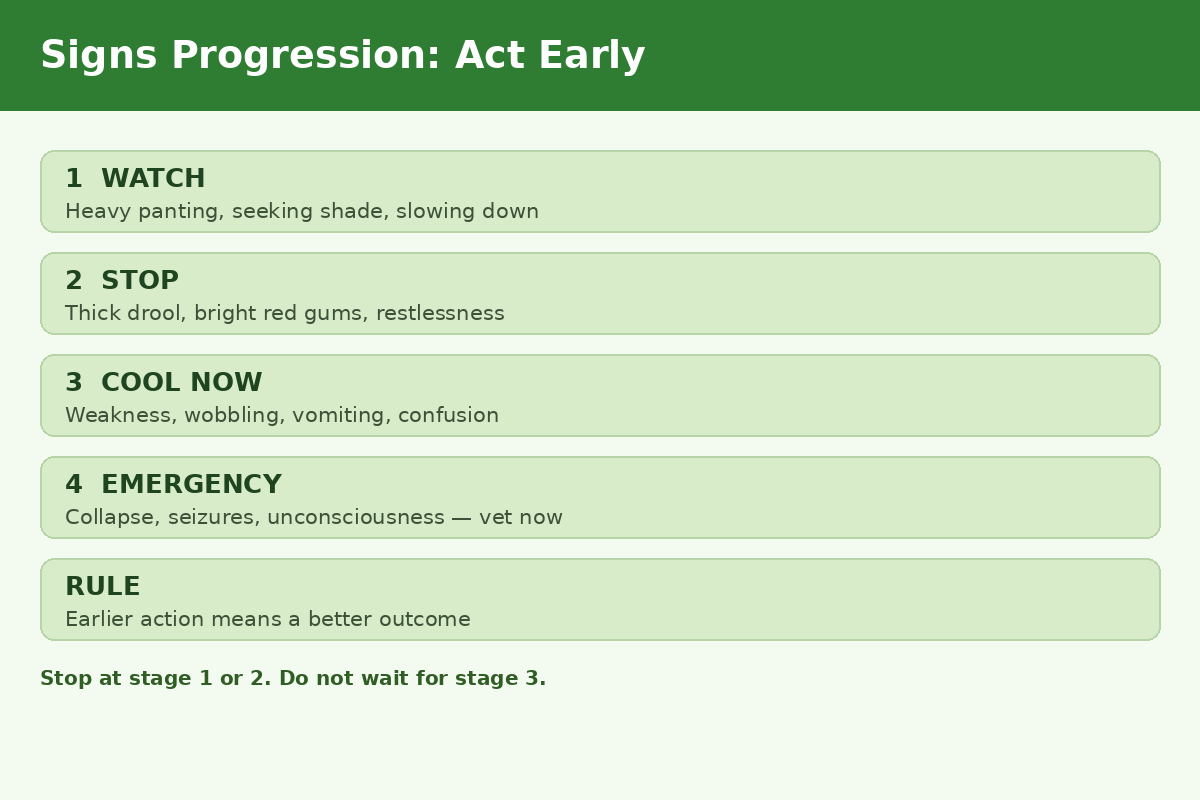
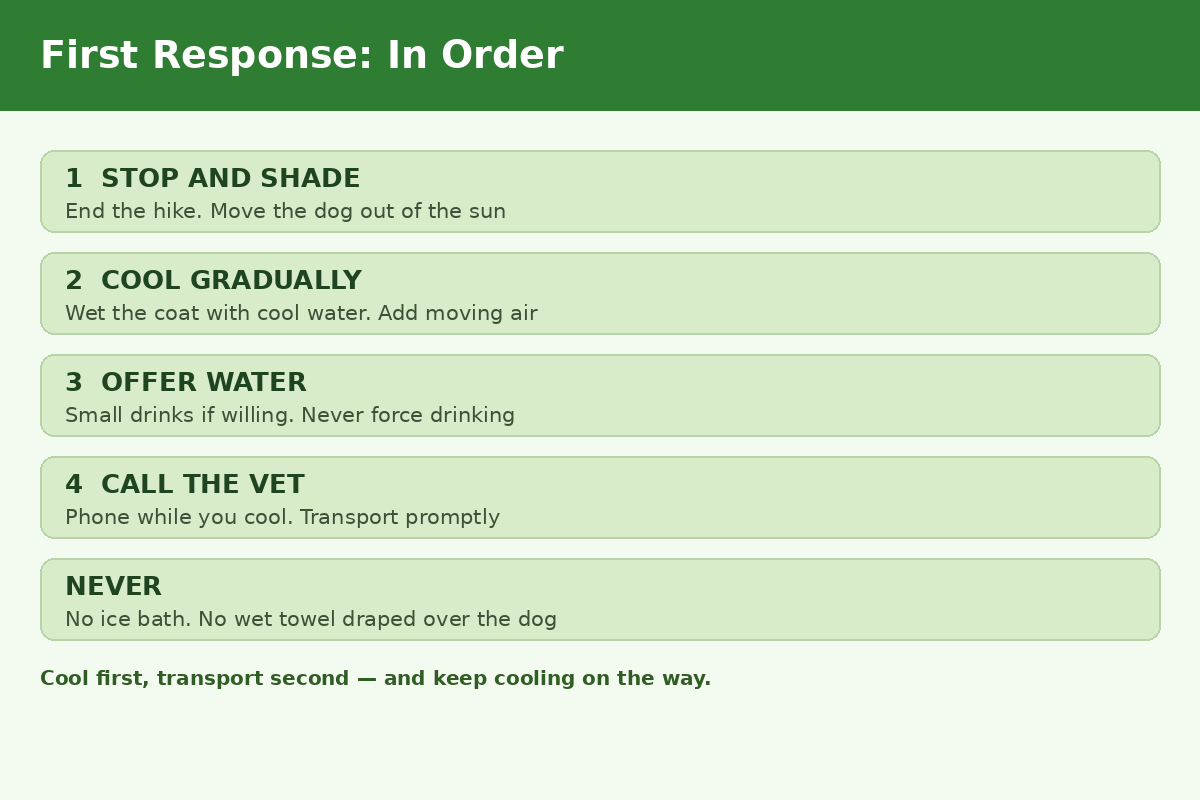
The response has an order for the same reason the diagnosis does: each step makes the next one work. The ASPCA hot-weather guidance gives the same shape to the response: get the animal out of the heat, begin cooling, and involve a veterinarian promptly rather than waiting to see whether home cooling was enough.
Cooling That Helps, Done Properly
Wet the dog through to the skin with cool water, and keep air moving over the wet coat. Pour or sponge water over the whole body, paying attention to the neck, belly, armpits and groin where blood runs close to the surface, and re-wet as the coat warms. Moving air — wind, fanning, a vehicle’s air conditioning — is what carries the heat away once the coat is wet, so a wet dog in still, hot air cools far slower than a wet dog in a breeze. Offer small drinks of cool water if the dog wants them, and never force water into the mouth of a dog that is weak, vomiting or disoriented. Then transport: cooling continues on the way to the clinic, and the dog goes even if it appears to recover, because the internal effects of heatstroke can declare themselves hours later.
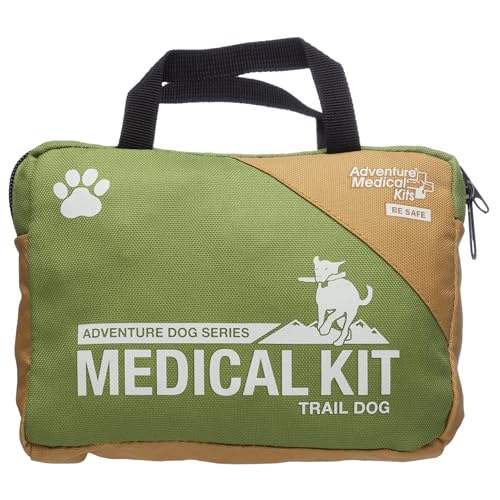
Adventure Medical Kits Trail Dog Medical Kit – Pet First Aid Kit with Dressings, Bandages, Instruction Manual & Tools – Lightweight, Compact Dog Safety Pack
- Splinter Picker/Tick Remover: Safely remove splinters and ticks from your dog’s paws and body
- Triangular Bandage: Safely administer first aid to your dog by first muzzling them with this triangular bandage
- Cohesive Elastic Bandage: Easily wrap injuries with this self-adhering bandage which doesn’t stick to fur
List Price :
Offer: 22.68 $
Go to AmazonA trail kit turns that sequence from improvisation into routine. The kit should let you wet and monitor the dog, deal with the paw and minor-injury problems that share hot hikes, and keep the dog calm and contained while you work — the selection in our dog first aid kits guide is built around exactly that trail use. If the dog cannot walk out comfortably once cooled, the carry and evacuation options in our injured dog guide become the next decision, and a dog that collapsed should be carried rather than walked whenever the terrain and help available allow it.
What Not to Do With an Overheating Dog
The common mistakes are all versions of cooling too aggressively or acting too slowly. Do not use ice or ice-cold water immersion: very cold water constricts the surface blood vessels that cooling depends on and can drive the situation toward shock, which is why veterinary first-aid guidance consistently specifies cool water instead. Do not drape a wet towel over the dog and leave it there — a towel laid over the coat traps a layer of warming water against the body; a dog lying on a wet towel, with water poured over and air moving, is a different and useful arrangement. Do not keep walking to the car and plan to cool the dog there; cooling starts where the dog is, in the first shade you find. And do not skip the veterinarian because the dog brightened up — the AVMA companion animal care guidelines place ongoing veterinary assessment at the centre of an animal’s care for exactly this class of problem, where what you can see is not the whole injury.
The Towel and Ice Myths, Settled Plainly
If you remember one sentence from this section, make it this: cool water poured over, air moving across, nothing insulating left on top.
Hydration on the Trail
Water is prevention, support and early treatment at once, which makes carrying it a system rather than a hope. A hiking dog loses water through the same panting that cools it, so the harder the dog works to stay cool, the faster it dehydrates — and a dehydrated dog cools less efficiently, in a spiral every hiker should respect. Offer water little and often rather than in rare, huge drinks: at every stop, at every shade break, and at any point the panting changes character. The pre-hike preparation in the AKC guide to training a dog to hike treats carrying water for the dog, and planning around it, as basic trail readiness rather than an optional extra.

Portable Dog Water Bottle
- Easy To Use: Exclusive patented design, U2mug design dog water bottle and water bowl two in one. The fold cap acts as a water bowl, and you don’t need any external bowl to give your hairy buddy water to drink anymore.The built-in travel water bowl for dogs and water key ensure no water is wasted, making it an ideal dog travel accessories
- Large Capacity: lesotc dog water bottle with a volume of 18oz/520ml. Dog travel water bottle can provide safe, fresh, and healthy water for puppy during long walking, travel, hiking, camping and other outdoor activities. It’s addition to your dog accessories, perfect for dog beach essentials and dog camping essentials
- Leak-Proof Design: dog water bottle dispenser designed with upgraded push-button lock keeps water clean and prevents spills. This dog water dispenser is designed with silica gel seal ring which can prevent water leakage efficiently. This makes it a reliable dog portable water bottle and a safe choice for your pet
List Price :
Offer: 15.19 $
Go to AmazonThe bottle only helps if it is reachable in seconds. A dog water bottle clipped outside the pack gets used at the first shade patch; water buried at the bottom of a main compartment gets used at planned stops only, and overheating does not respect the plan. Carry more than the distance seems to need; the margin is what an emergency drinks from. Keep the dog settled while you stop with one of the hands-free leashes from our roundup, so both hands stay free for water and checks.
Dogs at Higher Risk of Overheating
Any dog can overheat, but the risk is not shared equally, and knowing your dog’s category changes how early you act. Flat-faced breeds — bulldogs, pugs, French bulldogs and their relatives — cool through airways that are shortened and narrowed by their build, so their panting moves less air and their ceiling arrives sooner, sometimes in weather other dogs find unremarkable. The Royal Veterinary College VetCompass research programme, analysing the clinical records of hundreds of thousands of dogs, found that exercise was the trigger behind the large majority of heatstroke cases and that flat-faced breeds were heavily over-represented among them
Weight, Age, Coat and Fitness
The other risk factors stack quietly. An overweight dog insulates its own heat and works harder to move; an older dog’s circulation and stamina are reduced; a puppy has neither the fitness nor the judgement to pace itself; a thick or dark coat absorbs and holds heat; and an unfit dog of any description reaches its limits at workloads a conditioned dog handles easily. The conditioning approach in our distance explainer applies directly: fitness earned slowly is heat tolerance earned slowly, because a fit dog does the same work with less effort and therefore less heat. Dogs that will carry their own gear need the same gradual build before any load is added, as our dog backpacks guide sets out.
Hot Ground, Sun and Humidity
The trail surface is part of the weather. Sun-baked rock, sand and any paved approach path radiate heat upward at exactly dog height and can burn paw pads outright, injuring the one part of the cooling system that touches the ground. Test surfaces with the back of your hand held down for several seconds: if you cannot keep it there comfortably, your dog should not be walking there. The trail-planning guidance from the Forest Service — research your area, its exposure and its conditions before you go — is the planning version of the same habit: a route’s shade, water and surface are knowable in advance, and a hot-day route should be chosen for them, not discovered by them.
Humidity is the invisible multiplier. Two days at the same temperature are not the same day for a panting dog, because saturated air slows evaporation to a crawl. On humid days, shorten the plan even if the thermometer looks acceptable, favour shaded and breezy routes over still ones, and treat water and creek stops as cooling stations rather than drinks alone — a dog standing belly-deep in a stream is using the most effective cooling available on any trail.
Prevention Before You Leave the Trailhead
Most trail heat emergencies are decided before the hike starts, by the clock, the route and the forecast. Hike early or late on warm days and let the midday hours go; a dawn start is not a compromise but the standard practice of everyone who hikes with dogs in warm country. The preparation guidance from the American Hiking Society on hiking with dogs centres on exactly this planning layer: know the route, know the rules, prepare the dog and the kit, and let conditions set the ambition.
Know Where You Are Allowed to Cool Down
A prevention plan includes knowing where help and water actually are. Check before you go whether dogs are allowed on your route at all and where they must stay leashed, because the National Park Service guidance on visiting with pets is clear that many parks restrict pets to developed areas and exclude them from most trails — a fact that changes both your route choice and your emergency options. Note the nearest veterinary clinic to the trailhead in your phone before you lose signal, carry a charged phone, and tell someone your route and return time.
Prevention Gear That Genuinely Helps
Gear widens the safety margin; it never replaces the clock, the route or the check sequence. Used honestly, three categories earn their pack space on warm hikes. A cooling vest, wetted before and during the hike, extends the dog’s own evaporation system across the torso — the designs compared in our cooling vests guide work on that principle and suit dogs whose build and coat let a vest fit close. Boots protect pads from hot and sharp surfaces, as covered in the hot-ground section above — the fits in our dog boots guide are the trail-proven starting point. And shade you carry — a light tarp or the shelter in your own kit — guarantees a cooling stop on exposed routes where natural shade runs out.

Kurgo Core Cooling Vest, Large
- Stay Cool on Every Adventure: The Kurgo Dog Core Cooling Vest helps prevent overheating in warm weather using an evaporative cooling coat design and lightweight cooling gear construction
- Functional & Comfortable Fit: Features adjustable side straps and quick release buckles for secure, customizable wear that’s perfect for running, hiking, or everyday outings
- Smart Features for Hot Weather: This dog cooling vest includes a two way zippered top for easy harness access, plus heat reflective fabric and high-visibility trim for safety
New starting from: 39.95 $
Go to AmazonFit is what separates a cooling vest from a warm blanket. A vest that hangs loose moves little heat; a vest fitted close, kept wet, and paired with rest stops in real shade does measurable work. Re-wet it at every water stop, because a dried-out vest insulates instead of cooling. Judge every piece of heat gear by the same test: does it help the dog lose heat, protect the surfaces that lose heat, or shorten the time to shade and water? If it does none of those, it is decoration. For small dogs whose day ends before yours on hot routes, the carry options in our dog carrier backpacks guide are the honest final layer of the prevention system — a carried dog generates almost no exercise heat at all.
After the Hike: Watching for Delayed Problems
A dog that cools down and brightens up has earned monitoring, not a clean bill of health. Heatstroke’s internal effects — on kidneys, blood clotting and the gut — can develop over the hours after the event, which is why veterinary guidance sends even recovered-looking dogs for assessment after a significant episode.
Our view
I plan warm hikes backwards from the dog’s cooling system, not forwards from the route I want, because the dog is the only one on the trail who cannot tell me in words that the plan is wrong. Match the dog to the day using our best hiking dogs roundup, respect the honest ranges in our dog distance explainer, and fit the margin-widening gear from our cooling vests guide before you need it, and overheating stops being a surprise and becomes what it should be — a problem you saw early, in order, with time to spare.
— Brian Ka
FAQ
How hot is too hot to hike with a dog?
There is no single safe temperature, because humidity, sun, terrain and your dog’s build move the line as much as the thermometer does. A fit, lean, long-muzzled dog may hike comfortably in conditions that are dangerous for a flat-faced, overweight or elderly dog. Use the check sequence rather than a number: if panting is escalating at an easy pace early in the hike, conditions are already too hot for that dog on that day, whatever the forecast said.
Can I pour cold water on an overheating dog?
Use cool water, poured over the whole coat through to the skin, with air moving over the dog — and avoid ice and ice-cold immersion. Very cold water constricts the surface vessels cooling depends on and risks shock. Re-wet as the coat warms, offer small drinks without forcing them, and involve a veterinarian promptly, including for a dog that seems to recover.
Should a dog that recovered on the trail still see a vet?
Yes, after any episode beyond the earliest signs — and urgently after any emergency-column sign. Heatstroke can damage organs and clotting in ways that are not visible in the dog’s behaviour, and problems can develop over the following hours. A dog that was caught at the earliest stage, cooled quickly and stayed completely normal still deserves a call describing what happened.
Do cooling vests actually work?
A well-fitted, kept-wet cooling vest genuinely helps, because it extends evaporation across the torso — but it widens a margin rather than creating one. It does not make a midday hike in extreme heat safe, it stops working as it dries out, and it never replaces timing, shade, water and the sign checks. Treat it as one layer in the prevention system described in this article.
Why did my dog overheat on a day that was not very hot?
Because exercise, not air temperature alone, generates most of the heat in most cases. Exertion in cool-looking weather, high humidity, an unfit or excited dog, a thick coat, or a climb at pace can each be enough, and several together can overwhelm a dog in conditions that feel pleasant to a person in shorts. That is why the checks in this article are based on the dog in front of you, not on the forecast.
Questions About Dog Overheating on the Trail?
Tell us your dog’s breed, age and build, plus the trails and temperatures you hike in, and we will help you set warm-day limits and a prevention plan.
Contact UsSources
- AKC — Heatstroke in Dogs
- VCA Hospitals — Heat Stroke in Dogs
- Cornell Riney Canine Health Center — Heatstroke: A Medical Emergency
- Cornell Riney Canine Health Center — Summer Heat Safety Tips for Dogs
- RSPCA — Heatstroke in Dogs
- ASPCA — Hot Weather Safety Tips
- AVMA — Companion Animal Care Guidelines
- Royal Veterinary College — VetCompass: Exercise and Heatstroke in Dogs
- PDSA — Heatstroke in Dogs
- National Park Service — Pets
- American Hiking Society — Hiking With Dogs
- USDA Forest Service — Know Before You Go
- AKC — How to Train Your Dog to Hike With You